
What Is ML-Master 2.0
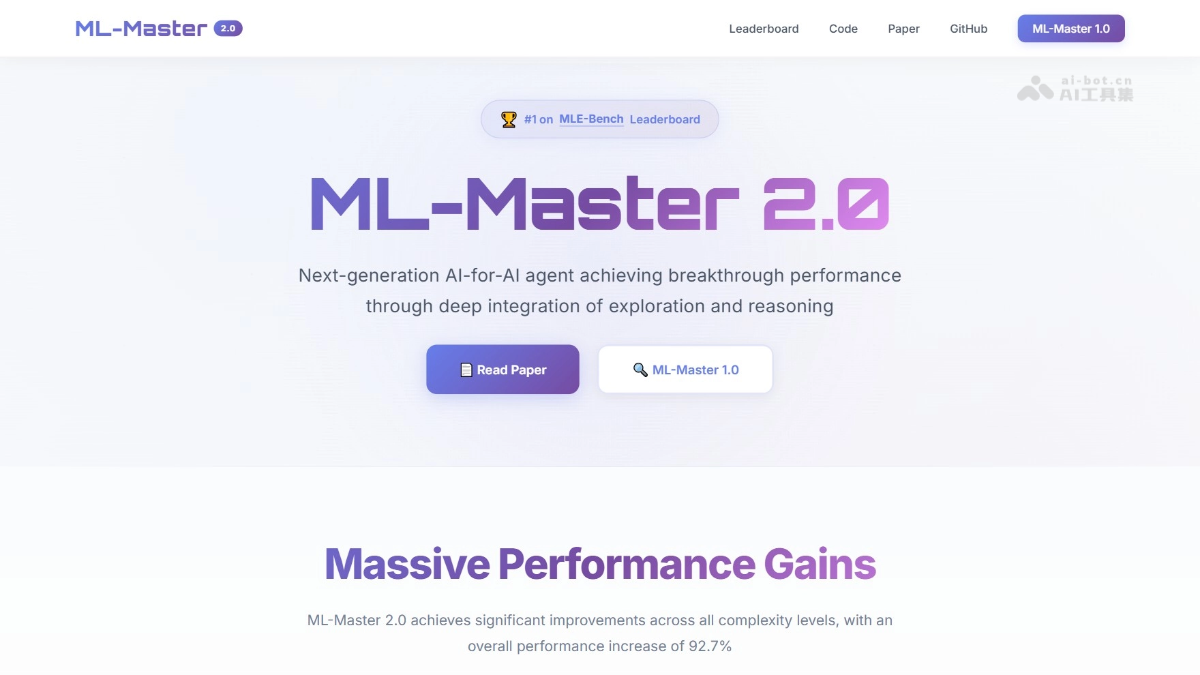
ML-Master 2.0 is an autonomous agent for real-world machine learning research tasks, launched by the SciMaster team composed of the School of Artificial Intelligence at Shanghai Jiao Tong University, Shanghai Institute for Advanced Algorithms Research, and DP Technology. ML-Master 2.0 is based on the domestic open-source large model DeepSeek, and possesses ultra-long-horizon autonomy, enabling continuous trial and error, experience accumulation, and self-evolution during long-duration research tasks. The hierarchical cognitive caching mechanism of ML-Master 2.0 can efficiently manage knowledge and wisdom, significantly improving research efficiency. In OpenAI's MLE-bench test, ML-Master 2.0 defeated top international teams such as Google and Meta, achieving first place globally, demonstrating China's strong capabilities in autonomous AI research. It has already been applied in frontier fields such as embodied intelligence and theoretical physics.
Main Features of ML-Master 2.0
-
Autonomous Exploration of Long-Term Research Tasks: Capable of continuously working on complex tasks lasting tens of hours, exploring around the same research objective.
-
Experience Accumulation and Knowledge Consolidation: Summarizes patterns from failures, transforms experience into reusable knowledge, and transfers it to new tasks.
-
Code Generation and Debugging: Automatically generates and debugs code, completing the full loop of experimental design, code implementation, and result analysis.
-
Multi-Task Adaptability: Through the hierarchical cognitive caching mechanism, reuses high-level strategies across tasks, improving task adaptability.
-
Efficient Resource Management: Maintains a stable research rhythm during long-term operation, avoiding context explosion or forgetting historical experience.
Technical Principles of ML-Master 2.0
- Ultra-Long-Horizon Autonomy: ML-Master 2.0 simulates the real research process and designs an ultra-long-horizon autonomy mechanism, maintaining goal consistency during long-duration tasks and actively avoiding ineffective paths.
- Hierarchical Cognitive Caching (HCC): Divides cognition into three levels: Experience, Knowledge, and Wisdom. Experience is used for immediate decision-making, Knowledge consists of verified stable conclusions, and Wisdom refers to high-level strategies reusable across tasks. Cognitions at different levels each perform their own roles in tasks, and through dynamic screening and elevation, ensure that valuable information is retained and noisy information is eliminated.
- Deep Exploration and Reasoning Integration: Combines exploration and reasoning capabilities, selectively capturing and summarizing key information through an adaptive memory mechanism, ensuring the two reinforce each other.
- Based on the Domestic Open-Source Large Model DeepSeek: Uses the domestic open-source large model DeepSeek-V3.2-Speciale, combined with high-performance AI infrastructure, to achieve efficient computing and reasoning capabilities.
Project Address of ML-Master 2.0
- Project Official Website:https://sjtu-sai-agents.github.io/ML-Master/
- GitHub Repository:https://github.com/sjtu-sai-agents/ML-Maste
Application Scenarios of ML-Master 2.0
- Embodied Intelligent Robot Training: ML-Master 2.0 can help robots autonomously learn and optimize behavioral strategies in complex environments, improving adaptability and decision-making capabilities.
- Theoretical Physics Simulation and Discovery: The system can design complex physics simulation experiments, helping scientists discover new physical laws and accelerating the progress of theoretical physics research.
- Machine Learning Engineering Tasks: ML-Master 2.0 can automate engineering tasks such as machine learning model development and optimization, improving development efficiency by efficiently managing knowledge and experience.
- Complex System Modeling and Optimization: Used for modeling and optimization of complex systems such as financial risk models and climate models, adapting to dynamic system changes to improve model accuracy.
- Automated Scientific Research: ML-Master 2.0 can assist scientists in designing experiments, analyzing data, and proposing hypotheses, driving research development in fields such as biomedicine and materials science.