
What is Mistral Code
Mistral Code is an AI coding assistantlaunched by Mistral AI for enterprise development teams. Mistral Code integrates four advanced AI models,Codestral(code completion and fill-in), Codestral Embed (code search and retrieval),Devstral(intelligent coding), and Mistral Medium (chat assistance). It supports more than 80 programming languages and can provide advanced features such as code completion, code search, and multi-step refactoring. Mistral Code supports model fine-tuning and customization within enterprises, ensuring code security and compliance. Mistral Code provides a rich management console that makes it convenient for IT administrators to monitor and manage usage, helping developers greatly improve productivity and meeting enterprises' requirements for security and controllability.
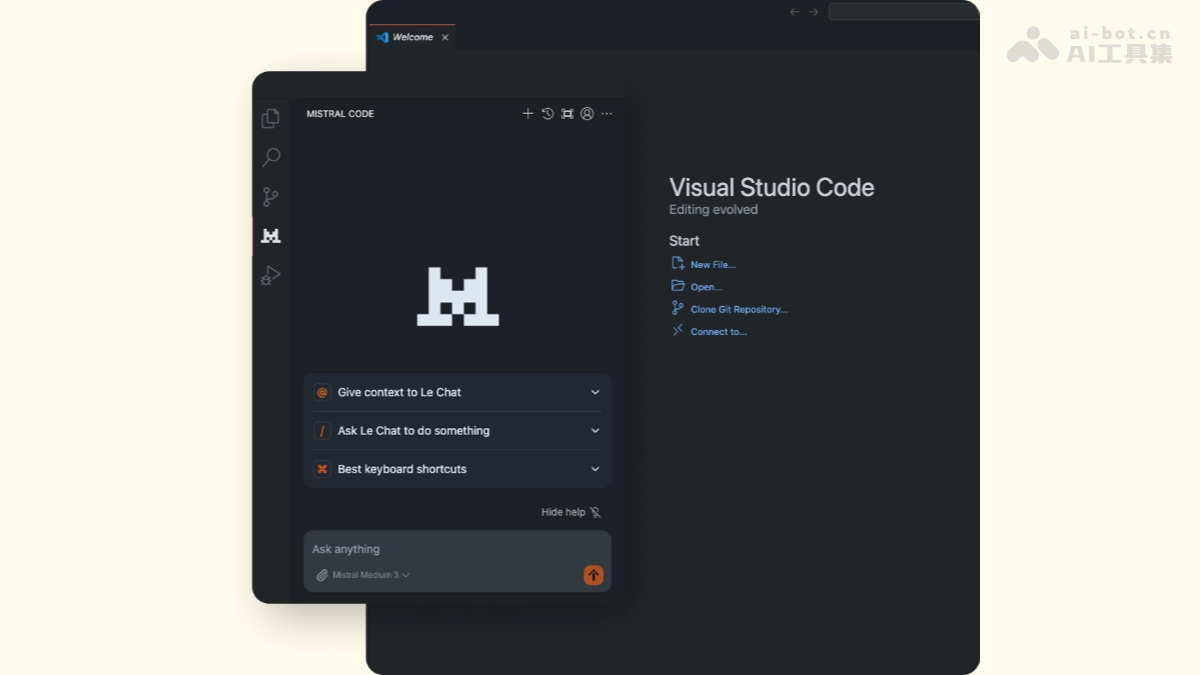
Main features of Mistral Code
- Code completion and intelligent suggestions: Based on the Codestral model, it provides real-time code completion and intelligent suggestions, helping developers quickly write code and reduce repetitive work.
- Code search and retrieval: Based on the Codestral Embed model, it quickly searches and retrieves relevant code snippets in the codebase, helping developers quickly locate and reuse existing code.
- Multi-step refactoring and task automation: With the Devstral model, it supports complex multi-step code refactoring tasks.
- Chat assistance and question answering: It provides chat assistance features to help developers answer programming questions, provide code optimization suggestions, and even assist with debugging.
- Enterprise-grade security and compliance: It supports local deployment (including cloud, reserved capacity, or isolated local GPUs), ensuring that code and data are fully processed within the enterprise and meeting security and compliance requirements.
- Model customization and fine-tuning: It supports users in fine-tuning or post-training the underlying models based on private codebases to generate lightweight variants that adapt to specific business needs.
- Integration and extension: It supports mainstream development environments such as JetBrains IDE and VSCode, seamlessly integrating into developers' workflows.
Technical principles of Mistral Code
- Deep learning-based model architecture: The core of Mistral Code is four advanced AI models (Codestral, Codestral Embed, Devstral, and Mistral Medium). The models are based on deep learning technologies such as the Transformer architecture and are trained on large amounts of code data to understand the semantics and context of programming languages.
- Natural language processing and code understanding: The models use natural language processing technology to parse code and comments, understand the logical structure and semantics of code, and generate high-quality code completion and refactoring suggestions.
- Context awareness and multi-step reasoning: The Devstral model supports multi-step reasoning and can generate complex code snippets or perform multi-step operations based on the context of the current code and task requirements, such as automatically completing the refactoring of an entire function.
- Local deployment and data isolation: To meet enterprises' requirements for data security and privacy, Mistral Code provides local deployment options, fully retaining models and data within the enterprise and avoiding the risk of data leakage.
Mistral Code official website address
- Official website address:https://mistral.ai/news/mistral-code
Application scenarios of Mistral Code
- Code writing and completion: Provides real-time code completion and intelligent suggestions, supports more than 80 programming languages, helps developers quickly generate code, and reduces repetitive work.
- Code refactoring and optimization: Supports multi-step code refactoring tasks, provides code optimization suggestions, and helps developers keep code clear and efficient.
- Code search and reuse: Quickly searches for relevant snippets in the codebase, promotes cross-project code reuse, and avoids duplicate development.
- Enterprise-grade security and compliance: Supports local deployment, ensures that code and data are processed within the enterprise, and meets data security and privacy requirements.
- Team collaboration and knowledge sharing: Promotes code sharing and experience exchange among team members, helps new developers get started quickly, and improves the team's overall development efficiency.