
What is MiniMax H3 Max
MiniMax H3 Max is a real-timevideo generationmodel launched by MiniMax, built on the open-source H3 for post-training and inference optimization. The model supports text-to-video/image-to-video and simultaneously generates audio. A 5-second 768p video can be generated in under 3 seconds, with throughput reaching 35 times that of native H3, ranking first on both the Artificial Analysis and Design Arena image-to-video leaderboards. It has now been integrated into the MiniMax open platform and MiniMax Design, supporting cutting-edge scenarios such as 24-hour AI livestreaming and real-time interactive content.
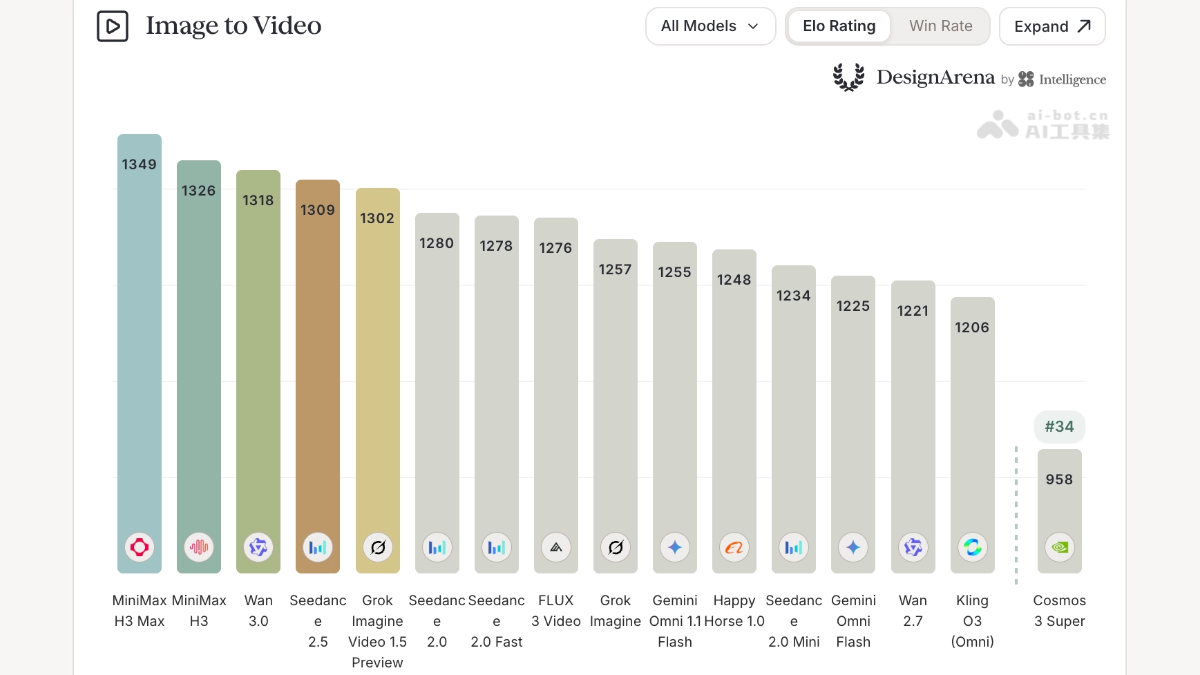
Main features of MiniMax H3 Max
-
Text-to-video/image-to-video: Supports text or image input to generate complete video clips at 480p/768p, 5–15 seconds, 24fps.
-
Synchronized audio generation: Automatically generates matching sound while outputting the visuals, achieving true audio-video integration.
-
Real-time-level speed: A 5-second 768p video takes less than 3 seconds to generate, and a 15-second video takes about 15 seconds, meeting the real-time streaming needs of livestreaming.
-
High-throughput inference: Throughput is about 35 times that of native H3, capable of supporting high-concurrency, uninterrupted content production.
Technical principles of MiniMax H3 Max
-
Open-source foundation + post-training optimization: Built on the open-source MiniMax H3 as the foundation, fal adds new data and verifiable reinforcement learning (RL) for post-training, continuously optimizing prompt adherence and visual performance, while also making targeted adaptations to its own inference infrastructure.
-
Inference engine collaborative optimization: Through joint tuning of the model architecture and inference engine, the generation latency of a single request is compressed to an extremely low level, and overall throughput is increased to about 35 times that of native H3, making real-time livestreaming scenarios possible.
-
Sparsification and hardware acceleration (FastH3): Teams such as FastVideo compressed native H3's 49 Transformer Forwards to 4, and combined with VSA technology at 90% sparsity, achieved generation of a 15-second 768p video in 13 seconds on 8 B200s, with up to 14x acceleration on a single Blackwell card.
How to use MiniMax H3 Max
-
API call: Visit the MiniMax open platformhttps://platform.minimaxi.com/接入 Video Generation V2 API, input text or images to generate videos.
-
MiniMax Design: Visit MiniMax Design official website, directly input prompts or upload images in the visual interface to generate video content.
Core advantages of MiniMax H3 Max
-
Ultra-fast generation: A 5-second 768p video can be completed in less than 3 seconds, and a 15-second video takes about 15 seconds to generate, crossing the speed threshold for real-time livestreaming.
-
Ultra-high throughput: Throughput is about 35 times that of native H3, capable of supporting high concurrency and uninterrupted content production.
-
Audio-visual synchronization: Automatically outputs matching audio while generating video visuals, achieving true audio-video integration.
-
Leaderboard leading: Ranks first on both the Artificial Analysis and Design Arena image-to-video leaderboards.
-
Open ecosystem: Built on open-source H3, with over 24 million downloads within three weeks and over 300 derivative models.
-
Real-time interaction: Supports 24-hour AI livestreaming and real-time command rewriting by viewers, evolving video generation from a tool into a content system.
-
Flexible resolution: provides both 480p and 768p resolutions, adapting to different scenarios and bandwidth requirements.
Comparison of MiniMax H3 Max with similar competitors
| Comparison dimension | MiniMax H3 Max | LTX-2.5 |
|---|---|---|
| Model nature | Post-training optimized based on open-source H3, open API + open-source ecosystem | Fully open source (Apache-2.0), open weights + API hosting |
| Core positioning | Real-time livestream-level video generation ("generating faster than playback") | Consumer-grade real-time video generation (runs locally, faster than playback) |
| Generation speed | 5-second 768p video < 3 secondsgeneration; 15-second video in about 15 seconds | 5-second 768×512 video in about 4 seconds(RTX 4090); 10-second 720p in about 6.8 seconds(2×GB200) |
| Maximum resolution | 480p / 768p | Up to native 4K(50 FPS), supports multiple tiers including 1216×704, 720p, 1080p |
| Audio capability | Video andmatching audio generated synchronously | Nativejoint audio-video generation, supports audio condition control and audio-video synchronization |
| Hardware threshold | Mainly cloud API calls, relies on fal/MiniMax inference infrastructure | Runs locally on consumer-grade GPUs (RTX 4080/4090; quantized version requires only 6–8GB VRAM) |
| Throughput | About 35 timesthat of native H3, supporting high-concurrency livestreaming | Kernel-level optimization, inference efficiency improved by up to 30 times |
| Leaderboard ranking | Artificial Analysis image-to-video (with audio)No. 1(Elo 1202) | LTX-2.5 Fast / Pro also rank among the top of the same leaderboard |
| API cost | About $2.40/minute(768p) | Fast tier about $0.09/second(720p with audio), i.e., about $5.40/minute; self-hosting marginal cost is only electricity |
Application scenarios of MiniMax H3 Max
-
24-hour AI livestreaming: with a generation speed of under 3 seconds, achieve 24-hour uninterrupted livestreaming on Twitch or a self-built website where viewer-input prompts can change the visuals and storyline in real time.
-
Rapid brand advertising generation: batch output high-resolution product showcase videos via API, greatly reducing commercial filming costs and production cycles.
-
Batch production of short dramas/short videos: with cost-effective API pricing and high throughput, support MCN agencies in daily updates of massive amounts of plot-driven short video content.
-
Game concept and motion design: accurately generate game character demos, UI motion effects, and scene integration content based on reference images, accelerating the game development pipeline.
-
Cross-border e-commerce localized content: combined with multilingual voice generation capabilities, batch produce product promotional and social media marketing videos adapted to different overseas markets.