
What is Mini DALL·E 3?
Mini DALL·E 3 is an interactivetext-to-image(iT2I) framework jointly launched by Beijing Institute of Technology, Shanghai AI Lab, Tsinghua University, and The Chinese University of Hong Kong. Based on natural language, it engages in multi-turn dialogue with users to achieve high-quality image generation, editing, and optimization. Users refine image requirements step by step with simple instructions. Based on large language models (LLMs) and pre-trained text-to-image models (such as Stable Diffusion), it generates images highly consistent with text descriptions without additional training. The system supports question-answering functionality, providing users with a more coherent interactive experience and enhancing the convenience of human-computer interaction and the quality of image generation.
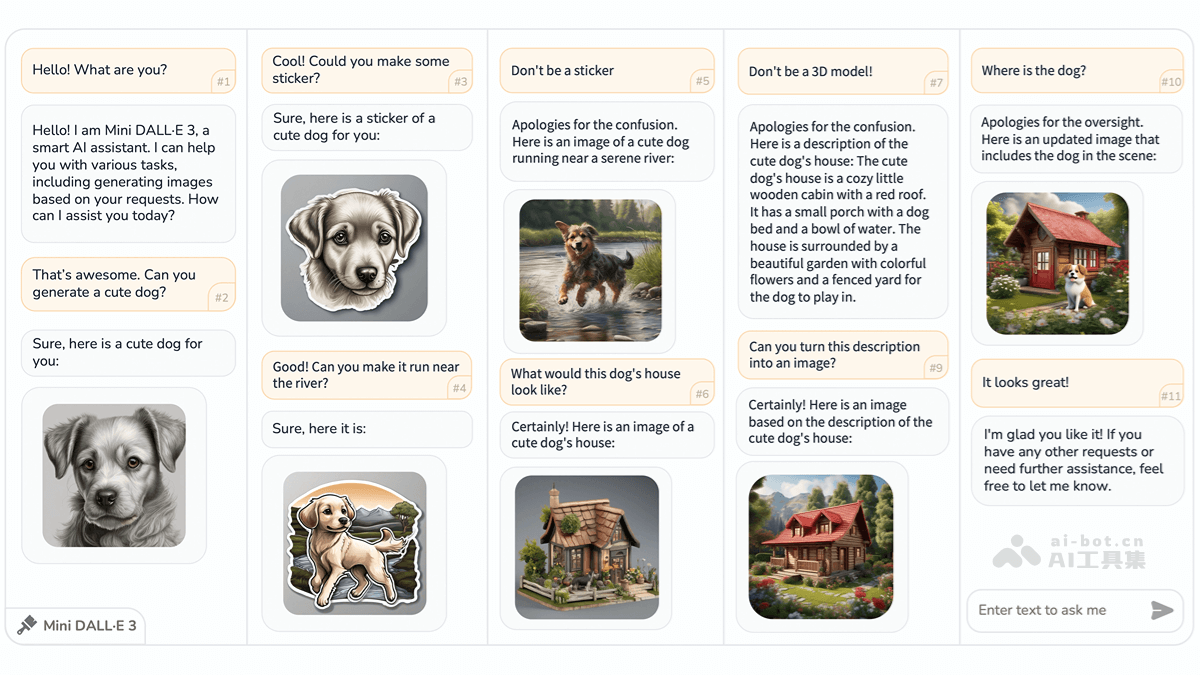
Main features of Mini DALL·E 3
- Interactive image generation: Users describe their needs based on natural language, and the system generates matching images.
- Image editing and optimization: Supports users' requests to modify images, and the system gradually adjusts based on feedback.
- Content consistency: Maintains coherence of image theme and style across multi-turn dialogues.
- Integration of question answering: Supports users in asking about image details, and the system answers based on content.
Technical principles of Mini DALL·E 3
- Large language models (LLMs): Based on existing large language models (such as ChatGPT、LLAMA etc.) as the core, it analyzes users' natural language instructions and generates image descriptions. Based on prompting techniques, it guides the LLM to generate image description text that meets the requirements.
- Prompting techniques and text transformation: Uses special prompt formats (such as <image> and <edit> tags) to transform image generation tasks into text generation tasks. Based on multi-turn dialogue, the system gradually optimizes image descriptions according to context and user feedback. It provides a prompt refinement module to further optimize the raw descriptions generated by the LLM and adapt them to subsequent text-to-image models.
- Text-to-image models (T2I): Combines existing text-to-image models to transform image descriptions generated by the LLM into actual images. Depending on the complexity of the description and the magnitude of content changes, different T2I models are selected to ensure generation quality and efficiency.
- Hierarchical content consistency control: Introduces T2I models at different levels to flexibly handle small content changes (such as style adjustments) and large content changes (such as scene reconstruction). Based on pre-trained T2I models, the previously generated image is used as contextual input to ensure consistency of image content across multiple rounds of generation.
- System architecture: Includes LLM, router, adapter, and T2I models. The router is responsible for parsing the LLM's output, identifying image generation requirements, and passing them to the adapter. The adapter converts image descriptions into a format suitable for the T2I model, and the T2I model generates the image.
Project address of Mini DALL·E 3
- Project official website:https://minidalle3.github.io/
- GitHub repository:https://github.com/Zeqiang-Lai/Mini-DALLE3
- arXiv technical paper:https://arxiv.org/pdf/2310.07653
Application scenarios of Mini DALL·E 3
- Creative design and content generation: Used to generate creative design content such as artworks, illustrations, posters, etc., helping designers quickly realize creative ideas.
- Story creation and illustration: Generates accompanying illustrations for novels, fairy tales, scripts, etc., assisting authors in visualizing story plots.
- Concept design and prototyping: In fields such as product design and architectural design, quickly generate concept diagrams and prototypes to help users better express and optimize their ideas.
- Education and Teaching: In educational scenarios, provide students with intuitive image-assisted learning to help them understand abstract concepts or historical scenes.
- Entertainment and Interactive Experience: In scenarios such as game development and social media interaction, generate personalized images based on user input to enhance user experience and engagement.