
What Is Mellum2.1
Mellum2.1 is an open-source AI JetBrains programming model released by programmingmodel, adopting a 12B mixture-of-experts architecture. In Mellum2.1, reinforcement learning has shifted from a final wrap-up stage to the main body of training. Combined with millions of sandbox runs, the model can explore codebases, edit files, and self-check modifications, greatly improving its agentic programming capabilities. Under high load, Mellum2.1's throughput is nearly twice that of Qwen3.5-9B. It supports private deployment and is now available on Hugging Face.
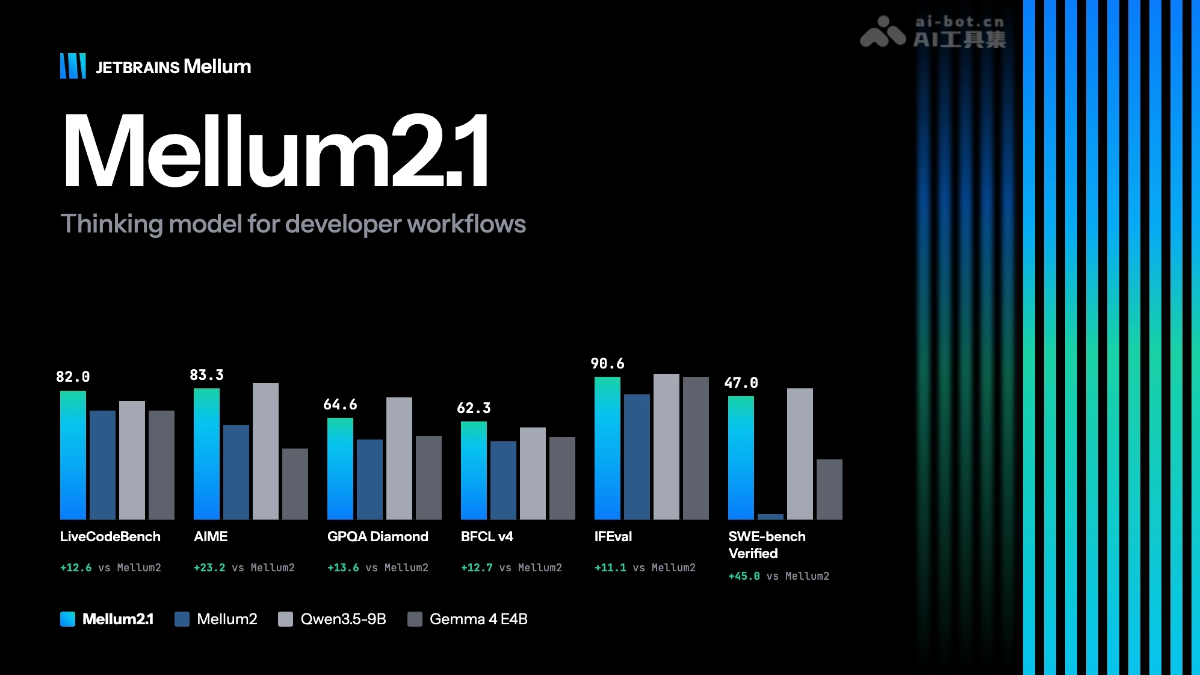
Mellum2.1's Main Features
-
Agentic Programming: Explores codebases, edits files, and self-checks modifications; can identify the root cause of failing tests and draft and verify fixes.
-
Code Completion and Generation: Continues Mellum2's positioning by providing fast code generation and Q&A capabilities for coding workflows.
-
Tool Calling: Can orchestrate external tools to complete tasks, suitable for building AI agent systems.
-
General Reasoning: Can handle everyday Q&A and progressively derive and solve math and logic problems.
-
Private Deployment: Supports running locally or on your own infrastructure, keeping code and data entirely within the enterprise.
Mellum2.1's Technical Principles
- Mixture-of-Experts (MoE) Architecture: Mellum2.1 adopts a 12B-parameter mixture-of-experts architecture, activating only 2.5B parameters per inference. The model consists of multiple "expert" subnetworks. Inputs are routed to only some experts for processing, greatly reducing computation while ensuring model capacity, achieving low-cost, high-throughput inference.
- Large-Scale Reinforcement Learning (RL): The core upgrade in this version lies in the training process: RL has expanded from a brief post-pretraining wrap-up stage into the main body of training. The team added tasks in mathematics, competitive programming, science, tool use, and software engineering. Its self-built infrastructure launches millions of sandboxes during training, covering thousands of real environments, allowing the model to acquire the exploration, editing, and verification capabilities required by agents through trial and error and reward signals while interacting with real coding scenarios.
- Strict Data Filtering: All open datasets used for training are filtered before ingestion, removing tasks with test defects, unverifiable answers, or inappropriate difficulty, ensuring reliable RL training signals and preventing the model from learning from incorrect feedback.
- Multi-Token Prediction (MTP): MTP allows the model to predict multiple subsequent tokens in a single forward pass. In single-request scenarios, speed increases by about 1.6x. Combined with MoE's low activated-parameter design, Mellum2.1's throughput under high load is nearly twice that of Qwen3.5-9B.

Follow WeChat and reply "open source" to join theAI Open-Source Project Community Group
How to Use Mellum2.1
-
Visit the Model Page: Open the official JetBrains organization page on Hugging Face and find the Mellum2.1 model repository.
-
Download the Model Weights: On the model card page, click download or pull the model files according to the license terms (if there is a gate, you must first agree to the usage agreement).
-
Choose a Deployment Framework: Use Transformers or vLLM for deployment. The former is suitable for simple validation, while the latter is suitable for production-grade high-concurrency services.
-
Configure the Inference Environment: Prepare the GPU environment (the official benchmark is based on a single H200), load the model, and set the 131K context parameters.
-
Enable acceleration options: Configure Multi-Token Prediction (MTP) according to official guidance to improve single-request speed by about 1.6x.
-
Initiate inference calls: Send prompts for code generation, repository-level editing, or agent tasks via the API to obtain model output.
Core advantages of Mellum2.1
-
Outstanding agentic coding capabilities: Trained with large-scale RL in real environments, it can autonomously explore codebases, edit files, and verify changes, and can locate the root cause of test failures and draft fix plans.
-
Industry-leading inference speed: Throughput under high load is nearly twice that of Qwen3.5-9B, making it the fastest among models of the same tier.
-
Fast single-request response: Multi-Token Prediction (MTP) technology improves single-request speed by about 1.6x.
-
Efficient architecture: The 12B MoE design activates only 2.5B parameters, achieving high performance at low compute cost.
-
High training data quality: All training data is rigorously screened, defective tasks are removed, and reliable learning signals are ensured.
-
Strong overall capabilities: Comprehensive improvements across dimensions such as coding, competitive programming, mathematics, tool calling, and general knowledge.
-
Private deployment friendly: Supports running locally or on self-owned infrastructure, with full autonomy and control over code and data, suitable for sensitive enterprise scenarios.
Project addresses for Mellum2.1
- Project official website:https://blog.jetbrains.com/ai/2026/10/mellum2-1-gets-to-work-a-fast-open-model-for-coding-agents/
- HuggingFace model repository:https://huggingface.co/JetBrains/Mellum2.1-12B-A2.5B-Thinking
Comparison of Mellum2.1 with similar competing products
| Comparison dimension | Mellum2.1(JetBrains) | Qwen3.5-9B(Alibaba) |
|---|---|---|
| Model architecture | 12B Mixture of Experts (MoE), 2.5B activated | 9B dense architecture |
| Core positioning | Coding agents / sub-agents, private deployment | General-purpose large model, with coding capabilities as well |
| Agentic coding | Strength: can explore codebases, edit files, self-check changes, and locate the root cause of test failures | Has tool-calling capabilities, but the official positioning does not emphasize repository-level agent operations |
| Training method | Reinforcement learning is the main training approach, with millions of runs in real sandbox environments | Conventional pre-training + post-training (no public RL sandbox training at the same scale) |
| Inference speed | High-load throughput is nearly twice that of Qwen3.5-9B, and single-request speed is improved by about 1.6x via MTP | Benchmark reference, with relatively lower throughput |
| Multi-Token Prediction | Built-in MTP, and the vLLM speculative decoding head is coming soon | No publicly disclosed equivalent MTP capability |
| Overall performance | Comprehensive improvements in coding, mathematics, competition, tool calling, and general knowledge | Strong general capabilities, with each item serving as the comparison benchmark for Mellum2.1 |
| Ecosystem background | JetBrains IDE ecosystem (IntelliJ/PyCharm), and can complement Codex and others | Alibaba Tongyi ecosystem, with a large Qwen series community |
Application scenarios for Mellum2.1
-
Agentic coding: Autonomously explore code repositories, edit files, and verify changes, completing the entire process from locating test failures to fixing them.
-
Enterprise Private Deployment Assistant: Locally deployed on enterprise servers, ensuring code and data do not leave the internal network.
-
Deep IDE Integration: Embedded in the JetBrains series of IDEs or third-party tools, providing code completion and intelligent Q&A.
-
Sub-agent Scheduling: Leveraging low-latency and high-throughput characteristics to execute subtasks or route requests in multi-agent systems.
-
Mathematical and Logical Reasoning: Handles mathematical problem-solving, algorithm competitions, and everyday Q&A, while also possessing general assistant capabilities.