
What is Mamoda2.5
Mamoda2.5 is a unified multimodal AR-Diffusion model launched by ByteDance, based on a 128-expert fine-grained DiT-MoE architecture, with a total parameter count of 25B and only about 3B activated per pass. The model integrates multimodal understanding, text-to-image, text-to-video, and image/video editing into one, ranks first on the OpenVE-Bench, FiVE-Bench, and Reco-Bench video editing leaderboards, and generates 720p video 12–18 times faster than comparable models.
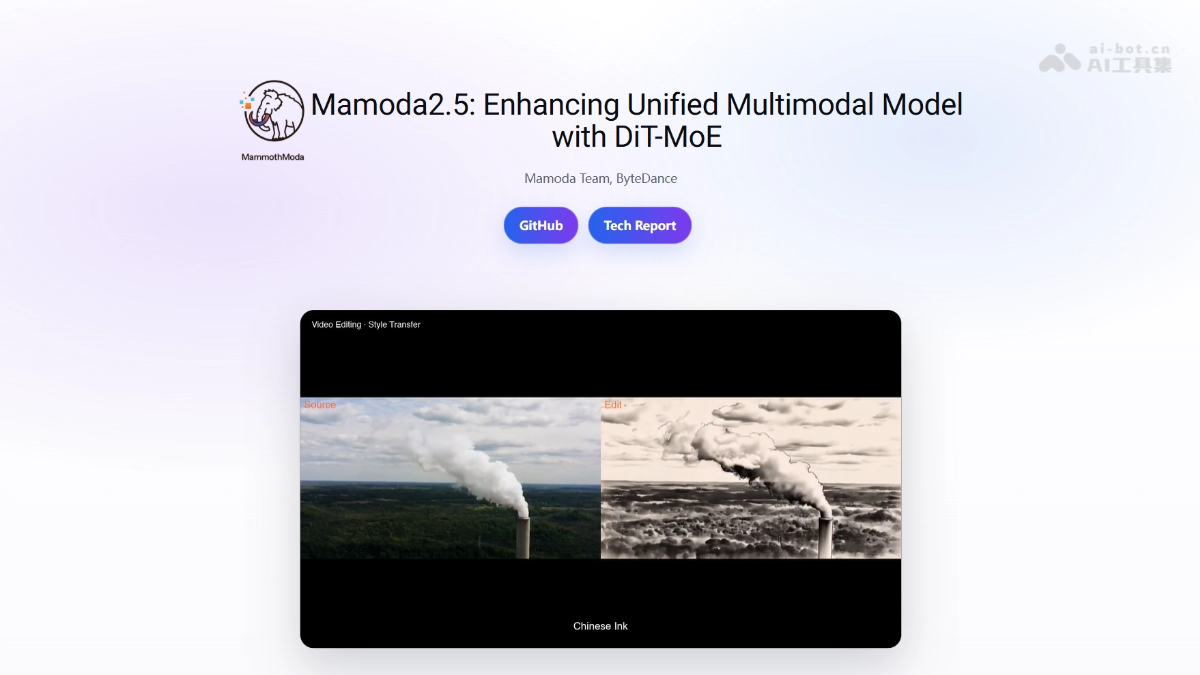
Main Features of Mamoda2.5
-
Text-to-Video: Generates 720p high-quality video from text descriptions, with inference speed 12–18 times faster than comparable models.
-
Video Editing: Supports five operations—addition, removal, replacement, style transfer, and subtitle editing—and ranks first on all three major video editing benchmarks.
-
Text-to-Image: Generates static images with high aesthetic quality based on multilingual prompts.
-
Image Editing: Performs local modifications, style transformations, facial and pose adjustments, and more on images through natural language instructions.
-
Multimodal Understanding: Implements understanding capabilities such as visual question answering, OCR, and chart parsing based on Qwen3-VL-8B, forming a unified closed loop with generation and editing.
Technical Principles of Mamoda2.5
- AR-Diffusion Unified Architecture: The model incorporates "understanding" and "generation" into a single end-to-end framework: the front end uses an autoregressive (AR) module for semantic understanding and instruction parsing, while the back end iteratively denoises and generates visual content through a Diffusion Transformer (DiT), avoiding the error accumulation and latency issues caused by the separation of understanding models and generation models in traditional approaches.
- Fine-Grained DiT-MoE Sparse Activation: A Mixture-of-Experts (MoE) design is introduced into the diffusion backbone, with 128 routed experts and 1 shared expert, using a Top-8 token-level routing strategy. The total parameter count is expanded to 25B, but only about 3B parameters are activated per forward pass (sparsity of about 12%), greatly increasing model capacity while keeping computational cost at the low level of dense models.
- MetaQueries Bridging Mechanism: The AR understanding module activates generation experts (Gen Experts) through a set of learnable MetaQueries, efficiently injecting semantic representations into the DiT-MoE. The design retains the strong instruction understanding capability of the AR model while avoiding the high latency and error accumulation defects of autoregressive visual generation.
- In-Context Multi-Task Conditional Generation: All tasks (text-to-image, text-to-video, image/video editing) are uniformly modeled as conditional generation problems. Multimodal condition features (instruction text, reference images/videos, byT5 character-level text encoding) are refined and concatenated with noise latent variables along the sequence dimension, and the DiT performs self-attention on the globally concatenated sequence to achieve deep feature fusion, without modifying the network structure for different tasks.
- Dense-to-MoE Upcycling Initialization: To reduce the cost of training a 25B MoE model from scratch, the team proposes a three-stage upcycling initialization: directly reusing the Attention and LayerNorm parameters of a dense model (Wan2.2 5B); for the FFN layers, adopting a random neuron sampling strategy to assign 14,336-dimensional intermediate neurons without duplication to 128 fine-grained experts; and initializing router weights randomly with Expert Bias load balancing. Ablation experiments show that this strategy improves convergence speed by about 2.2 times.
- Joint Few-Step Distillation and Reinforcement Learning Acceleration: To address the high inference cost of video editing, a joint distillation + RL framework is built: using a 30-step teacher model as the baseline, a 4-step student model is trained while removing the Classifier-Free Guidance (CFG) overhead. While maintaining editing quality, the distilled version compresses 480p video editing latency from 69 seconds to 9 seconds, achieving up to 95.9x speedup compared to open-source baselines.
- High-Compression 3D Causal VAE: It adopts Wan2.2's 4×16×16 spatiotemporal compression VAE. Compared with the commonly used 4×8×8 configuration in the industry, the number of spatial tokens is reduced by 4x, significantly lowering the quadratic attention computation overhead and memory usage of the DiT on long video sequences. This is the key engineering foundation for achieving 720p video generation in 111 seconds.
How to Use Mamoda2.5
-
Visit the Official Website: Go to the project's official website to view the technical report and demo cases.
-
Get the Model: Follow the GitHub / HuggingFace open-source repositories and download the 25B MoE checkpoint.
-
Environment Setup: Prepare a GPU environment that supports MoE inference and load the model weights.
-
Invoke Tasks: Input text/image/video instructions and select the corresponding task mode (generation or editing).
-
Turbo Mode: If you need extreme speed, switch to the 4-step distilled version for video editing.
Key Information and Usage Requirements for Mamoda2.5
-
Hardware: 720p generation can run on a single device, but the 25B MoE model still requires relatively high VRAM (about 3B sparse activation; 24GB+ VRAM is recommended, subject to the officially released configuration).
-
Inference Framework: Requires an inference backend that supports MoE sparse activation (such as vLLM, Megatron-LM, or the team's custom inference code).
-
Underlying Dependencies: The understanding module is based on Qwen3-VL-8B, and the VAE is based on Wan2.2; both need to be loaded together.
-
License Agreement: To be clarified officially (usually Apache 2.0 or ByteDance's custom open-source license); pay attention to license restrictions for commercial use.
-
Quick Experience: Currently, demos and papers can be viewed through the official website; local deployment requires waiting for the open-source repositories to release complete weights and launch scripts.
Core Advantages of Mamoda2.5
-
One Model, Multiple Tasks: A single architecture uniformly covers understanding, generation, and editing, with no need for task-specific models.
-
Extreme Inference Efficiency: Sparse activation + high-compression VAE, with video generation/editing speed leading by orders of magnitude.
-
SOTA Editing Capability: Ranked first on OpenVE-Bench, FiVE-Bench, and Reco-Bench, surpassing Kling O1.
-
Low-Cost Scaling: Upcycling initialization makes full use of existing dense model weights, avoiding the huge cost of training 25B parameters from scratch.
Project Addresses for Mamoda2.5
- Project Official Website:https://mamoda25.github.io/
- GitHub Repository:https://github.com/bytedance/mammothmoda
- arXiv Technical Paper:https://arxiv.org/pdf/2605.02641
Comparison of Mamoda2.5 with Similar Competitors
| Comparison Dimension | Mamoda2.5 | Wan2.2 | VInO |
|---|---|---|---|
| Publisher | ByteDance | Alibaba | Open-Source Community |
| Core Positioning | Unified understanding + generation + editing | Dedicated text-to-video | Dedicated video editing |
| Architecture | DiT-MoE (25B total parameters/3B activated) | Dense DiT(28B-A14B) | MMDiT + VLM(13B) |
| Text-to-video | Supported, top-tier on VBench 2.0 | Supported, open-source benchmark | Not supported |
| Video editing | SOTA, ranked first on three leaderboards | Not supported | Supported, among the top open-source |
| Image generation/editing | Supported | Not supported | Not supported |
| Multimodal understanding | Supported(Qwen3-VL-8B) | Not supported | Limited |
| Unified single model | Yes | No | Yes (editing only) |
| 720p generation speed | 111 seconds | 1366 seconds | — |
| 480p editing latency | 9 seconds(distilled version) | — | 882 seconds |
| Open-source status | Paper published, weights pending open-source release | Open-sourced | Open-sourced |
Application scenarios of Mamoda2.5
- Advertising creativity and content moderation: Mamoda2.5 has been deployed in ByteDance's internal advertising scenarios for creative video editing and content safety restoration, with a task success rate of 98%. It supports quickly replacing products, adding brand elements, and correcting subtitle typos.
- Batch short video production: Creators can complete style transfer (e.g., "convert to cyberpunk style"), element addition/removal (e.g., "remove background people"), seasonal changes, and other operations through natural language instructions. Editing a single 480p video takes only 9 seconds, suitable for daily-update-level production capacity needs.
- E-commerce visual marketing: Generate product display videos with one click, or perform background replacement, model outfit changes, and multilingual subtitle addition based on live-action footage, reducing filming and post-production costs.
- Film and animation previews: Directors and producers can use text-to-video to quickly generate storyboard previews, and adjust characters, scenes, and camera movement through video editing, accelerating pre-production decision-making.
- Education and training content: Convert static courseware into dynamic explanatory videos, or update existing teaching videos (e.g., replacing old UI interfaces, updating data charts) without re-recording.