
From "one person doing the work" to "a team providing the service," pet part-time work lets points automatically regenerate, and the organizational form of desktop agents is evolving
When most users use an AI Agent, there is often one problem that remains unsolved: complex tasks often require the coordination of multiple specialized capabilities. What do you do if one AI cannot handle it?
This timeLoomy's update provides the answer:"Partner Teams" and "Pet Part-time Work" , two major features launched simultaneously.
After using them for a few days, my feeling is:it has finally begun to seriously think about these two questions: "how do multiple people coordinate to get work done" and "how do we make users willing to keep using it"。
In this article, from the perspective of a real user, I will talk about what these two features are actually like, what complaints there are, and some new observations I have about the direction of desktop agents.
1. Partner Teams: Letting AI form teams to work, coordinating like a real human team
1.1 First, what is this
Simply put, a partner is an AI assistant with a specific specialty, and a Partner Team is grouping these specialized partners together to collaboratively complete complex tasks.

For example, these officially preset Partner Teams:
|
Partner Team
|
Member Composition
|
What It Is For
|
|
Content Growth Team
|
6 members including content strategist, research editor, lead content writer, etc.
|
Handles the full content chain from topic selection to distribution
|
|
Product Launch Team
|
User researcher, product manager, interaction designer, etc.
|
The full process from user research to product implementation
|
|
Business Proposal Team
|
Industry researcher, solution architect, financial modeling consultant, etc.
|
Creates industry solutions + financial modeling
|
|
Data Business Analysis Team
|
Data analyst, financial analyst, data visualization specialist
|
Turns business data into business recommendations
|
It sounds impressive, so I actually tested a scenario
My test: I have recently been considering the direction of a personal project and wanted to try making a simple product proposal. I invoked the "Product Launch Team" Partner Team and gave it a very vague requirement: "I want to make a small tool to help programmers record technical notes. Help me think about how to do it."
The feedback I got was:
- User Researcherfirst output a version of the "target user profile" (technical blog authors, high-frequency GitHub users, etc.)
- Product Managerproduced a draft PRD based on the profile, including core functional modules
- Interaction Designerprovided a set of preliminary page structure suggestions
- Market Communicationadded a "cold-start promotion approach"
The whole process took about three to five minutes. The quality of the output was not exactly "amazing," butthe structure and logic were complete. It really did turn "a vague idea" into "a preliminary discussable proposal framework."
My judgment: if you are starting a project from scratch or writing a proposal, using a Partner Team to help youBuilding frameworks, listing outlines, filling blind spots, the efficiency gains are real. But if you're already a domain expert, its output may only be "passing grade," and you'll need to spend more time polishing it.

1.2 From a technical perspective, this thing is kind of interesting
Although there are still some rough edges in the experience, from a technical architecture perspective, 搭子团 has several design aspects worth noting:
First, role division is constrained by System Prompt. Each 搭子 is preset with specific role instructions and skill boundaries, which is equivalent to role isolation at the Agent framework level. The difference from "using one general-purpose model to do everything" is thateach 搭子's output style and thinking framework are fixed and won't go off track。
Second, task routing is a key engineering point. When you give 搭子团 a task, it needs to automatically break it down and dispatch it to the corresponding 搭子. Behind this is atask planning and schedulinglogic—which 搭子 goes first, which 搭子 has to wait for others to finish before starting—all of this needs orchestration.
Third, productized packaging of multi-agent collaboration. Multi-Agent collaboration has been discussed a lot in academia and the open-source community, but Loomy has turned it intoan out-of-the-box product feature. For developers paying attention to this direction, 搭子团 is a great sample for observation. You can see what trade-offs exist between "ideal multi-Agent collaboration" and "productized multi-Agent collaboration."
1.3 Compared with the single-Agent mode, where's the difference?
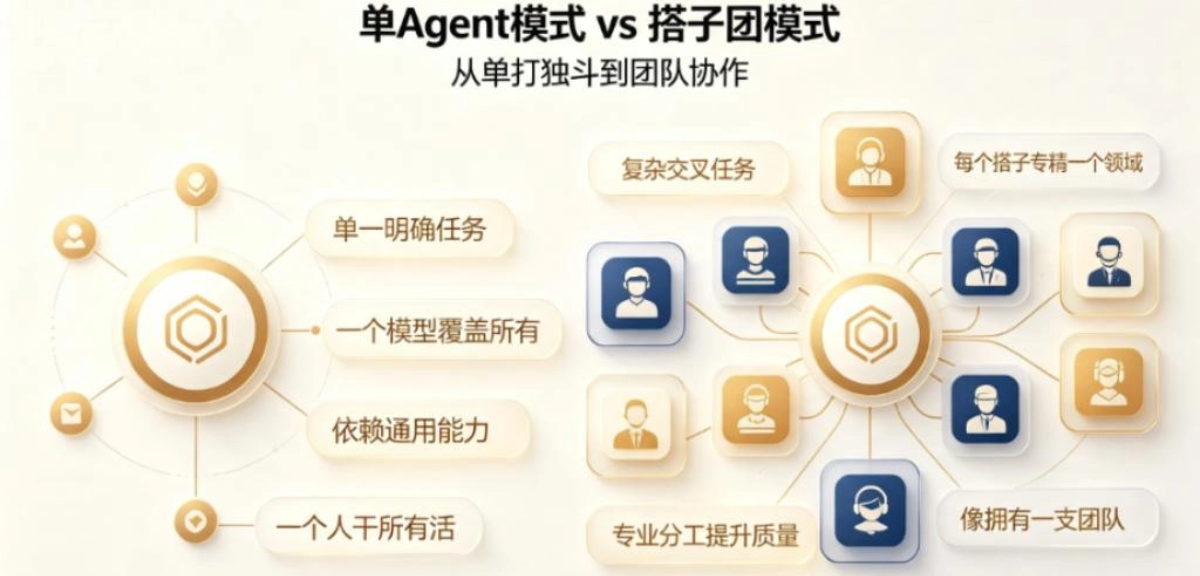
To sum it up in one sentence: a single Agent is you ask a question and get an answer; 搭子团 is you give a goal and it helps you organize an "online meeting" and outputs the meeting results.
Two, Pet Part-Time Work: an underrated "humanized" design
If 搭子团 is a "capability upgrade," then Pet Part-Time Work, I think, is an "experience upgrade."
2.1 How do you play it? You don't have to do anything; it earns money on its own
The logic of Pet Part-Time Work is especially simple:turn on the pet feature and use it normallyLoomy, and the desktop pet will occasionally pop up and say "I helped you earn XX points," and then the points arrive。
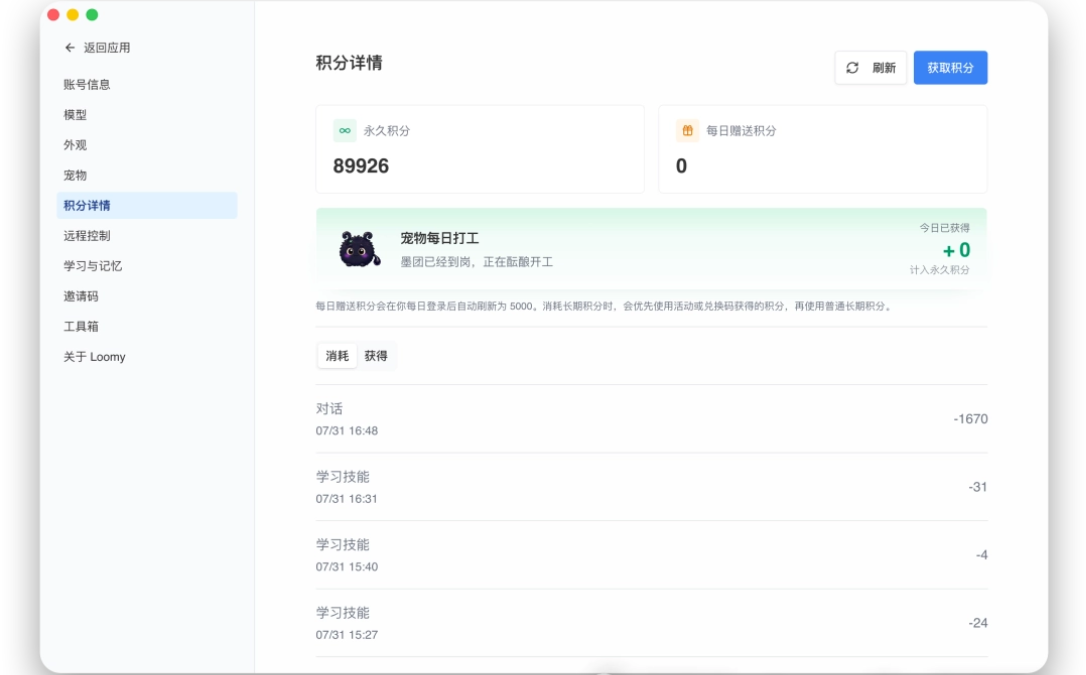
Throughout the whole process you don't need to do any extra operations:
- no check-in, no tasks, no need to keep it in mind
- it will "secretly work part-time" while you're working
- when it earns points, it will come running to report to you
- the points details page lets you check every single income entry
I used it for three days, using it normally every dayLoomyto handle some tasks, and I passively received about three or four points deposits in total. The amounts weren't large,but every time the pet popped up and said "Master, I earned points for you," it really did give a feeling of "hey, not bad"。
2.2 Why I think this design is pretty smart
PreviouslyLoomy's points system required users to actively consume points; executing complex tasks, calling AI image recognition, etc. would all deduct points. Under this model, users would have a kind of "using points is like spending money" psychological burden.
Pet Part-Time Work flips it around,during normal use, points automatically increase. The significance of this shift lies in:
- Lowering the psychological threshold: Users no longer feel that "using Loomy = burning credits"; instead, they think, "Anyway, when I use it, the pet is also helping me earn, so it's fine to use it more."
- Passive motivation: In psychology,variable ratio reinforcement(not knowing when a reward will come) is more effective at maintaining behavior frequency than fixed rewards. A pet that "unpredictably" pops up to give credits is more likely to create a sense of anticipation than "check in every day for a fixed X credits."
- Emotional value: The narrative packaging of "the pet is working for you" is much warmer than "the system rewards XX credits."
2.3 But to be honest, I also have a few complaints
The current problem with pet work is thatI can't see what my pet is "doing". It says it went to work, but I don't know where it went, what it did, or how it earned the credits. If a visualized interface like a "pet work log" could be added in the future (for example, "Today I went to the database to help organize files and earned 10 credits"), the experience would be much more complete.
Also, the credit-earning efficiency of pet work currently seems tied to usage frequency, but the specific rules are not transparent. As a technical user who prefers "predictable feedback," I hope to see a simple explanation of the rules, even if it is just something like "calculated comprehensively based on usage duration and task complexity."
III. Complaints and Expectations
Now that I've covered the good parts, let me talk about what I think isstill not good enough:
- The professional depth of the partners is limited. I tested several partners with strong industry attributes (such as the Supervision and Inspection Partner). For shallow needs ("help me break down the key milestones of this project"), it performed well, but for deeper needs ("help me analyze the possible risk points of this project and give avoidance suggestions"), the granularity of the output was still relatively coarse.
- The credit value and consumption speed of pet work need to be balanced. Currently, the speed of earning credits and spending credits still feels out of proportion - complex tasks consume credits quickly, but pet work accumulates them rather slowly. If this remains in a state of "spending more than earning" for a long time, the gamified incentive effect will be diminished.
- The preset templates for partner teams are sufficient, but can developers define partner teams themselves? Currently, the official offering provides four preset teams, but in theory the greatest imagination for this feature is -users forming their own partner teams. For example, I might want to form an "indie developer team" (product + design + development + operations), using my own defined Skills to fill each role. If SkillHub opens up partner team customization capabilities in the future, the value of this feature will multiply several times over.
IV. Conclusion: From "tool" to "organization," Loomy is taking a new path
I have an overall judgment aboutLoomythis update:it is evolving from "a tool that helps you get work done" into "a virtual team you can call on for yourself"。
Partner teams solve the problem of "breadth of capability." Complex tasks cannot be handled by one person and require coordination among multiple roles.
Pet work solves the problem of "willingness to use," allowing users to keep using it continuously without psychological burden, and even to form a habit through "being incentivized."
If you have also installedLoomy, I suggest you try the "Product Launch Team" or the "Data Business Analysis Team."
Give it a real task you're currently struggling with, let it help you build a framework, then see what's usable and what needs to be changed。
The correct way to use a partner group is not to "let it do it all for you directly," but to "let it help you quickly go from 0 to 60 points, and then you refine from 60 to 100 points."