
What is LocoOperator-4B
LocoOperator-4B is a 4B-parameter code exploration agent open-sourced by LocoreMind, trained via knowledge distillation from Qwen3-Coder-Next based on Qwen3-4B-Instruct. The model is positioned as a local sub-agent for Claude Code and other coding assistants, specifically handling exploration tasks such as codebase search, file reading, and directory traversal, achieving zero API cost. The model supports 7 types of tool calls including Read, Grep, and Bash, with 100% accuracy in JSON structured output. It can be deployed locally on a Mac Studio via llama.cpp, making it a lightweight and efficient code exploration solution.
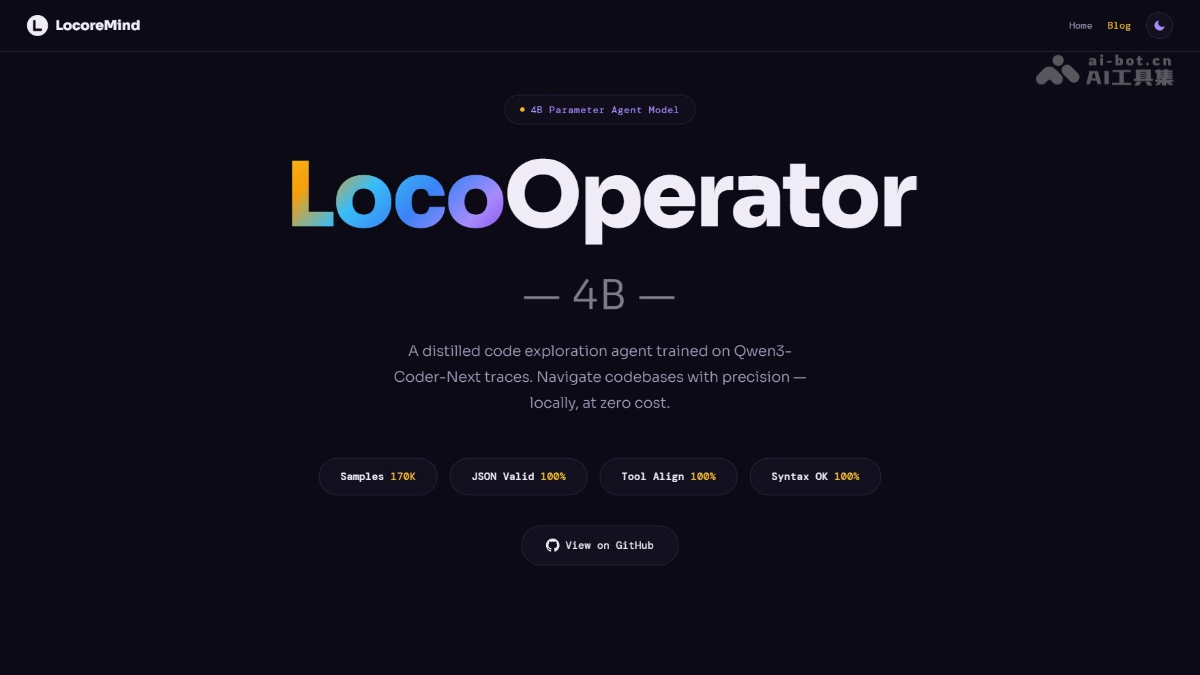
LocoOperator-4B's main features
-
Local sub-agent: Serves as a dedicated exploration agent in a two-tier architecture, replacing cloud-based large models to complete codebase navigation tasks and achieving zero API cost operation.
-
Seven types of tool calls: Supports Read for reading files, Grep for searching code, Glob for matching paths, Bash for executing read-only commands, Write for writing files, Edit for modifying files, and Task for delegating subtasks.
-
Structured output: Supports generating standard
<tool_call>JSON format, with a 100% JSON validity rate and 100% parameter syntax accuracy, and can be directly integrated into agent loops such as Claude Code. -
Multi-turn dialogue processing: Supports 3-33 turns of dialogue depth, completing continuous exploration and analysis of complex codebases within a 50K context window.
-
Efficient local deployment: The 4B parameter scale supports GGUF quantization, and can run locally on devices such as Mac Studio via llama.cpp, enabling fast responses without an internet connection.
LocoOperator-4B's technical principles
- Knowledge distillation architecture: The model adopts a full-parameter supervised fine-tuning (SFT) method, using Qwen3-Coder-Next as the teacher model, taking its reasoning trajectories on codebase exploration tasks as supervision signals, and distilling them into a 4B-parameter student model, enabling the small model to learn the large model's tool-call decision patterns.
- Data construction method: Exploration scenarios are collected from diverse open-source projects (scipy, fastapi, etc.), generating 170,356 multi-turn dialogue samples covering 3-33 turns of dialogue depth, ensuring the model's generalization ability on complex codebase navigation tasks.
- Training configuration optimization: Based on the Qwen3-4B-Instruct-2507 base model, using 4×H200 GPUs, BF16 precision, an effective batch size of 32, and a learning rate of 2e-5, trained for about 25 hours at a maximum sequence length of 16,384 tokens, using the qwen3_nothinking template to eliminate chain-of-thought interference.
- Structured output constraints: Through template training and format enforcement, the model output strictly conforms to the
<tool_call>JSON specification, achieving 100% syntax accuracy and avoiding the empty-parameter issue present in the teacher model.
LocoOperator-4B's project address
- Project official website:https://locoremind.com/blog/loco-operator
- GitHub repository:https://github.com/LocoreMind/LocoOperator
LocoOperator-4B's application scenarios
- Replacing cloud-based sub-agents: Replace the default sub-agent in tools such as Claude Code, handling exploration tasks such as file reading and code search locally, avoiding the consumption of cloud API quota on every call.
- Offline code analysis: Analyze codebase structure in a network-free environment, quickly locating key files and function implementations through natural language queries, suitable for security-isolated development environments.
- Batch project review: Execute standardized queries on multiple open-source projects, automatically generating codebase navigation reports for architectural evaluation or security audits prior to technology selection.
- Edge Device Programming Assistance: Deployed on laptops or industrial control computers, it provides on-site developers with instant code exploration support without relying on remote server responses.
- AI Agent Teaching Demonstration: As a lightweight tool invocation example, it is used to demonstrate and teach the working mechanism of AI Agents, reducing the learning cost of understanding multi-turn dialogues and structured output.