
What is LLM Wiki
LLM Wiki is a self-running personal knowledge base launched by Karpathy, breaking through the limitation of traditional RAG of "retrieving from scratch on every query." LLM Wiki uses Schema files to guide the LLM in actively maintaining a structured Markdown Wiki, "compiling" raw materials into a persistent knowledge body with cross-references and contradiction annotations. Supported by a three-layer architecture (raw materials/Wiki/Schema), knowledge continuously accumulates and thickens with use, rather than being repeatedly derived. Humans focus on asking questions and curating, while the LLM handles maintenance work, making Obsidian the IDE, the Wiki the codebase, and the LLM the programmer.
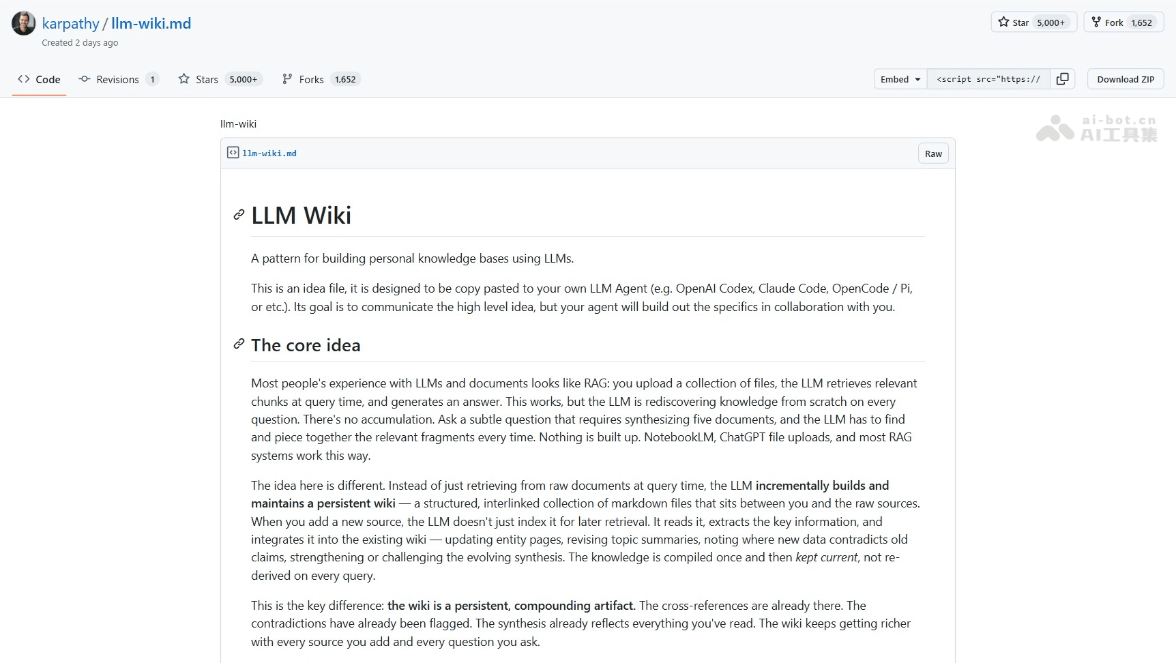
Main features of LLM Wiki
- Knowledge ingestion: Place raw materials (PDFs, articles, etc.) into the
raw/directory. The LLM automatically extracts key information, writes summaries, and updates entity pages, concept pages, and related cross-references in the Wiki in a linked manner (one piece of material may trigger updates to 10-15 pages). - Smart query: Answer questions based on already compiled Wiki content, with output supporting multiple formats such as Markdown, comparison tables, Marp slides, and matplotlib charts.
- Health inspection: Periodically and automatically check the knowledge base for contradictions, outdated conclusions, orphan pages, and missing references, and propose new research directions.
- Index maintenance: Automatically maintain the
index.md(table of contents, replacing traditional RAG's vector retrieval) andlog.md(timeline log), supporting medium-scale (about 100 articles/400,000 characters) knowledge management without the need for a complex database.
How to use LLM Wiki
- Environment preparation: Install Obsidian as the reader, and prepare an LLM Agent such as Claude Code as the maintainer.
- Initialize directories: Create a folder structure containing
raw/(raw materials),wiki/(generated content), andCLAUDE.md(Schema configuration). - Configure Schema: Copy the content of the Karpathy Gist to the Agent and have it generate configuration files that define the Wiki structure, page format, and workflow.
- Ingest materials: Place new files into the
raw/directory and instruct the Agent to process them. The LLM will automatically extract key information and update the summaries, entity pages, and cross-references in the Wiki in a linked manner. - Query and archive: Ask the Agent questions to obtain comprehensive answers based on the Wiki, and instruct it to save high-quality answers back into the Wiki as new pages to enable continuous knowledge accumulation.
- Health inspection: Periodically instruct the Agent to check the Wiki for contradictions, outdated conclusions, and orphan pages, keeping the knowledge base structure clear and the content consistent.
- Browse and use: Open the
wiki/folder in Obsidian to view the latest updates in real time, click bidirectional links, and use the graph view to explore knowledge connections.
Key information and usage requirements of LLM Wiki
- Essence: Let the LLM actively maintain a continuously accumulating structured knowledge base, rather than traditional RAG's "retrieving from scratch on every query."
- Architecture: Three-layer structure: raw/ (raw materials, read-only) → wiki/ (Markdown generated by the LLM) → Schema (such as CLAUDE.md rule configuration).
- Core operations: Ingest (ingesting materials automatically updates multiple pages) → Query (answers based on the Wiki and can be archived) → Lint (periodic health checks for contradictions and gaps).
- Key Mechanisms: Knowledge is compiled once and continuously kept fresh; cross-references and contradiction annotations persist, growing richer with use.
Core Advantages of LLM Wiki
- Compounding Knowledge Accumulation: Breaking through the limitations of traditional RAG, which retrieves from scratch and discards after each query—the Wiki is a persistent, accumulable artifact: new materials are automatically integrated into the existing knowledge network, and cross-references and contradiction annotations continuously accumulate.
- Zero Maintenance Burden: The LLM handles all tedious maintenance work, automatically updating 10-15 related pages, annotating contradictions between new and old data, and maintaining indexes and cross-references. Humans only need to focus on curation and asking questions, with no manual organizing required.
- No Infrastructure Needed at Medium Scale: Within the scale of 100 articles/400,000 characters, efficient retrieval is possible using only Markdown index files, without vector databases, embedding models, or complex RAG architectures, greatly lowering the technical barrier.
- Dynamic Self-Reinforcement: High-quality Q&A can be archived back into the Wiki with one click to become new pages; the exploration process itself continuously enriches the knowledge base, forming a "use it and it grows" flywheel effect.
LLM Wiki Project Address
- GitHub Repository:https://gist.github.com/karpathy/442a6bf555914893e9891c11519de94f
Comparison of LLM Wiki with Similar Competing Products
| Comparison Dimension | LLM Wiki | NotebookLM (RAG Representative) |
Mem (AI Note-Taking Representative) |
|---|---|---|---|
| Knowledge Model | Active compilation, continuous accumulation |
Passive retrieval, pieced together from scratch each time |
AI automatically organizes, but no explicit compilation layer |
| Maintainer | LLM full-time maintenance (automatically updates multiple pages, annotates contradictions) |
No maintenance, ad-hoc retrieval each time |
AI black-box processing, users find it hard to intervene in rules |
| Core Architecture | Three-layer separation: raw/ (read-only) wiki/ (written by LLM) Schema (rules layer) |
Single layer: raw materials directly serve as retrieval source |
Two layers: note content + AI associations |
| Indexing Mechanism | Markdown index files (no vector database needed at medium scale) |
Vector embeddings + similarity retrieval |
Proprietary algorithm (black box) |
| Customizability | White-box control: through CLAUDE.mdcustom page formats, update rules, workflows |
Fixed process: cannot intervene in retrieval and generation logic |
Black-box limitations: can only toggle features, cannot define maintenance rules |
| Output Accumulation | High-quality answers can be archived back into the Wiki to form new pages |
Answers disappear into Conversation history |
Can be saved but lacks structured archiving mechanism |
| Technical threshold | Only requires Markdown files + Obsidian |
Depends on Google infrastructure |
Depends on third-party cloud services |
Application scenarios of LLM Wiki
- Personal growth: Track goals, health, mental state, and self-improvement journey, organize diaries, articles, and podcast notes, and build a structured cognitive graph about oneself.
- Academic research: Conduct in-depth study on a specific topic for weeks or months, read papers and reports, and gradually build a comprehensive knowledge system containing evolving arguments.
- Reading companion: When reading a book, organize it chapter by chapter, establish linked pages for characters, themes, and plot threads, and ultimately form a complete knowledge network similar to Tolkien Gateway.
- Enterprise/team knowledge base: Connect Slack conversations, meeting minutes, project documents, and customer communication records, and have the LLM automatically maintain a real-time updated internal Wiki without additional manual effort.