
What is LLaDA-Image
LLaDA-Image is a 6B-parameter unifiedimage generationand editing model open-sourced by Ant Group's inclusionAI. The model adopts an innovative route of pure-image pretraining first, followed by language alignment, using a fully diffusion-based architecture (LLaDA2.0-mini for understanding + 6B DiT for generation) to achieve text-to-image, instruction editing, and Chinese-English text rendering. The Turbo version requires only 2–4 steps to produce an image, and ranks first among open-source models in both the Chinese and English tracks of Qwen-Image-Bench.
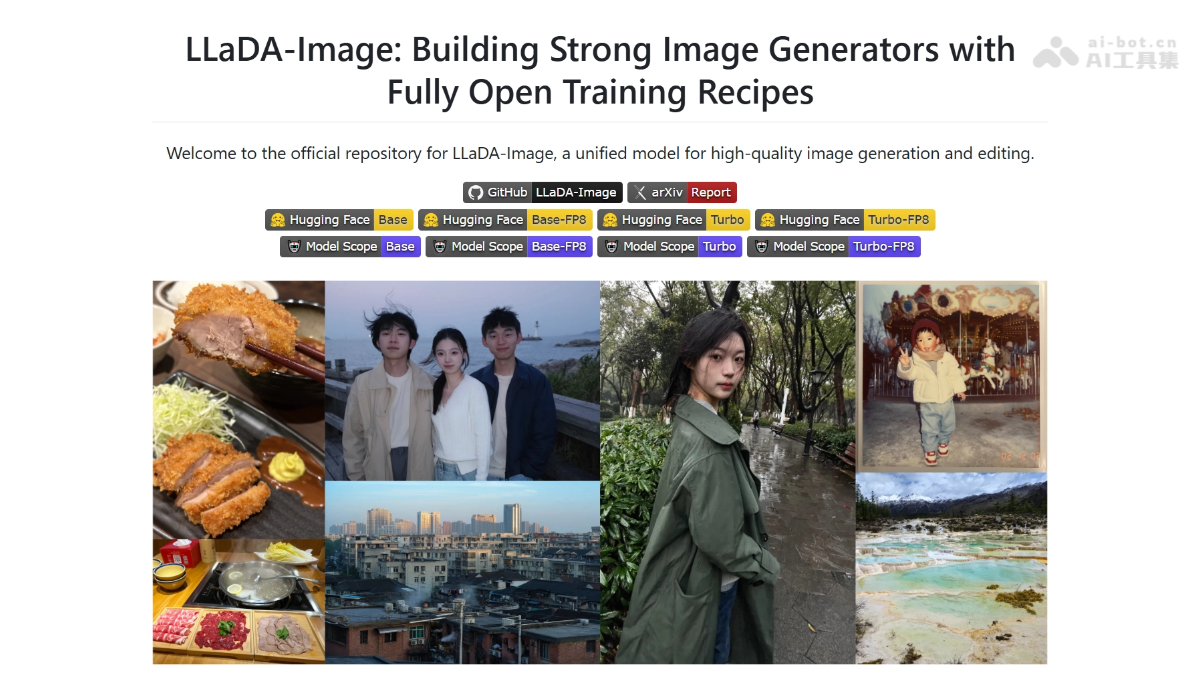
Main Features of LLaDA-Image
-
Text-to-Image Generation: Generates high-fidelity, detail-rich photorealistic images based on natural language descriptions.
-
Instruction-Based Image Editing: Upload a reference image and enter a natural language instruction to precisely modify specified regions while keeping the rest unchanged.
-
Chinese-English Bilingual Text Rendering: Accurately renders Chinese and English text in generated images, supporting posters, typography, and artistic text design.
-
VQ Conditional Generation: Uses visual quantization (VQ) tokens as conditional input to achieve controllable image generation.
-
Reference Image Editing: Uses an uploaded image as a reference for editing operations such as style transfer and content modification.
-
Turbo Fast Inference: The distilled model requires only 2–4 sampling steps to generate 1024×1024 high-quality images.
Technical Principles of LLaDA-Image
-
Fully Diffusion-Based Unified Architecture: The model consists of an understanding module, LLaDA2.0-mini (an MoE-based diffusion language model), and a generation module, 6B DiT. Both use diffusion models as their backends and are bridged by a Connector, decoupling semantic understanding from pixel generation.
-
Staged Training Strategy: Adopts a "learn to draw first, then learn to follow instructions" route: first conducting pure-image pretraining and mid-training to establish strong visual generation priors, then introducing paired language supervision to complete text-visual alignment.
-
High-Quality Data Construction: Generation training cumulatively uses approximately 220 million samples, 98% of which are real images; image-text descriptions in the language alignment stage are generated and verified by Qwen series large models to ensure instruction-following accuracy.
-
Efficient Training Optimization: The entire pipeline uses parameter-agnostic RMSNorm instead of LayerNorm and adopts the Muon optimizer, improving the stability and efficiency of large-scale training.
-
Twin-DMD Fast Distillation: The Turbo version compresses the Base model through Twin-DMD distillation technology, generating 1024×1024 high-quality images with 2–4 sampling steps, achieving a balance between speed and quality.

Follow WeChat and reply "Open Source" to join theAI Open-Source Project Communication Group
How to Use LLaDA-Image
-
Environment Setup: Install dependencies such as Python 3.11, PyTorch 2.8, Diffusers 0.39.0, and FlashAttention 2.8.3 to set up a local inference environment.
-
Obtain Weights: Download the model files for LLaDA-Image (high-fidelity version) or LLaDA-Image-Turbo (fast version) from Hugging Face or ModelScope.
-
Text-to-Image Generation: After loading the model, enter the description text. For the Base version, set 50 steps and guidance scale 5.0; for the Turbo version, set 2–4 steps and guidance scale 1.0, to generate 1024×1024 images.
-
Instruction-based image editing: Upload a reference image and enter a natural language editing instruction (e.g., "change the background to a seaside"), and the model automatically keeps unedited areas unchanged.
-
Note the size specifications: The input size for text-to-image and VQ conditional generation must be a multiple of 16, and for editing tasks must be a multiple of 32.
Core advantages of LLaDA-Image
-
Leading open-source performance: Ranks first among open-source models in both the Chinese and English tracks of Qwen-Image-Bench, with an overall score surpassing mainstream open-source models such as FLUX.2 Max.
-
Unified generation and editing: A single model supports both high-quality text-to-image and fine-grained instruction-based image editing, with no need to switch between different models.
-
Ultra-fast inference: The Turbo distilled version requires only 2–4 sampling steps to generate 1024×1024 high-fidelity images, greatly reducing waiting time.
-
Chinese and English text rendering: Possesses excellent Chinese and English text generation capabilities, suitable for design tasks such as posters, typography, and artistic text.
-
Photo-level realism: Based on pretraining data of 98% real images, the generated results feature natural lighting, rich details, and a high degree of realism.
LLaDA-Image project addresses
- GitHub repository:https://github.com/inclusionAI/LLaDA-Image
- HuggingFace model library:https://huggingface.co/collections/inclusionAI/llada-image
- arXiv technical paper:https://arxiv.org/pdf/2609.03796
Comparison of LLaDA-Image with similar competitors
| Comparison dimension | LLaDA-Image | FLUX.2 [dev] |
|---|---|---|
| Development team | Ant Group inclusionAI | Black Forest Labs |
| Parameter count | 6B (DiT) + diffusion language understanding module | 32B(dense) |
| Underlying architecture | Fully diffusion unified architecture (DiT + dLLM) | Flow Matching |
| Generation and editing | A single model uniformly supports text-to-image and instruction editing | Editing requires coordination with the FLUX Kontext branch |
| Fast inference | Turbo version generates images in 2–4 steps | Klein distilled branch generates images in 4 steps |
| Chinese and English text rendering | Native support, with outstanding poster and typography results | Excellent in English, with relatively limited Chinese support |
| Training data transparency | The paper discloses 220 million samples, 98% real images | The specific data composition is not publicly disclosed |
Application scenarios of LLaDA-Image
-
E-commerce visual design: Generate product hero images with one click based on product descriptions, or quickly replace backgrounds and adjust lighting through instructions, reducing shooting and post-production costs.
-
Marketing poster production: With excellent Chinese and English text rendering capabilities, directly generate commercial posters and social media graphics with brand slogans and campaign information.
-
Social media content creation: Provides bloggers and creators with photo-level portrait, landscape, and lifestyle image generation, supporting stylized editing and rapid image output.
-
Game and film concept design: Rapidly produce character and scene concept art based on text, and iteratively modify details through instructions, accelerating the early-stage creative process.
-
Personal photography retouching: After uploading a photo, use natural language instructions to remove clutter, replace the sky, adjust color tones, and perform other operations, keeping unmodified areas unchanged, replacing complex photo editing software.