
What is FLUX.2
FLUX.2 is launched by Black Forest LabsAI image model, designed for real-world creative workflows. The model supports multi-image reference of up to 10 images, generates high-quality images up to 4MP resolution, and possesses extremely strong detail expression and text rendering capabilities. FLUX.2 offers multiple versions, including the high-performance FLUX.2 [pro] version, the customizable-parameter FLUX.2 [flex] version, the open-source FLUX.2 [dev] version, and the upcoming FLUX.2 [klein] version. The model combines a vision-language model with a flow transformer architecture, significantly improving real-world knowledge understanding and image generation quality, and advancing open innovation and broad application of visual intelligence technology.
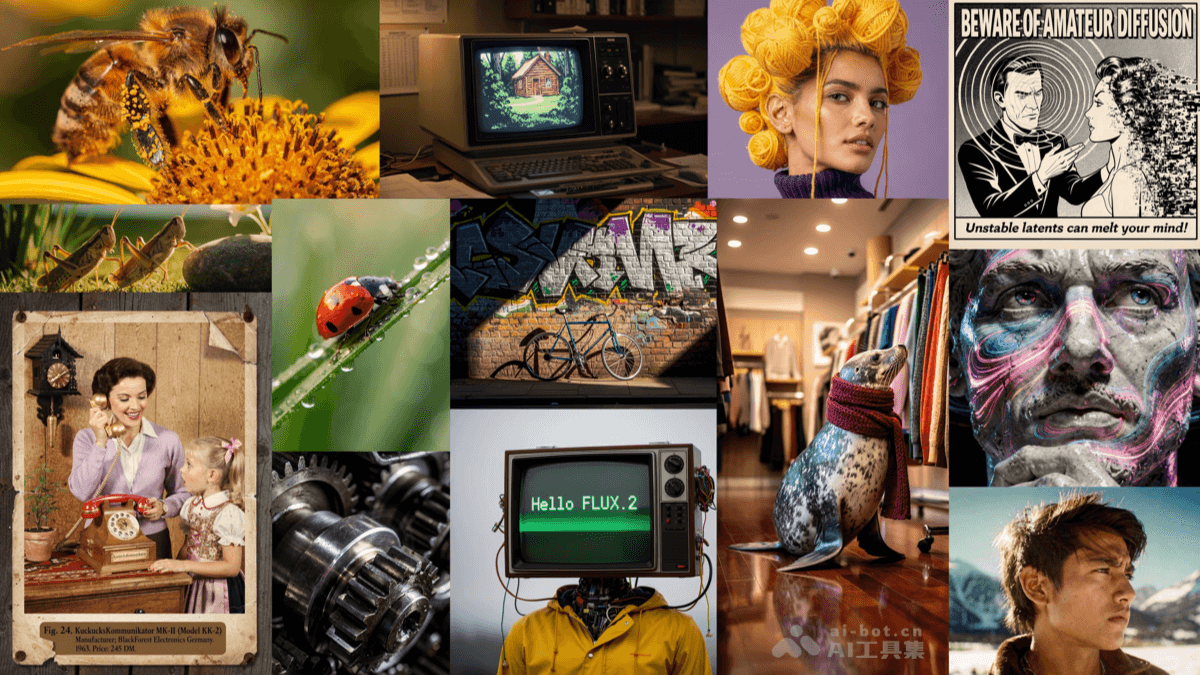
Main Features of FLUX.2
-
Multi-image reference: The model supports referencing up to 10 images simultaneously, maintaining consistency of characters, styles, and products.
-
High-resolution image generation: The model supports image editing up to 4MP, suitable for product photography, visualization, and photographic-grade applications.
-
Complex text rendering: The model can handle complex typography, infographics, memes, and UI design, and supports readable small text.
-
Instruction-following capability: Improved adherence to complex, structured instructions, including multi-part prompts and compositional constraints.
-
Real-world knowledge: Stronger performance in lighting, spatial logic, and scene coherence, generating images that are more consistent with reality.
Technical Principles of FLUX.2
- Latent Flow Matching Architecture: FLUX.2 adopts a latent flow matching architecture. By performing flow matching in latent space, the model can efficiently handle image generation and editing tasks while maintaining the coherence and consistency of generated images. The design of this architecture enables FLUX.2 to perform excellently in handling complex image synthesis tasks, especially in multi-image reference and high-resolution generation.
- Coupling of Vision-Language Model and Flow Transformer: FLUX.2 combines Mistral-3 24B parameter vision-language model (VLM) with a flow transformer. The vision-language model provides the model with rich real-world knowledge and semantic understanding capabilities, enabling FLUX.2 to better understand complex prompts and scene logic. The flow transformer focuses on capturing spatial relationships, material properties, and compositional logic in images, compensating for the shortcomings of traditional architectures. This coupling enables FLUX.2 to perform excellently in generating complex scenes and details, especially when handling multi-image reference and complex text rendering.
- Optimization of Variational Autoencoder (VAE): FLUX.2 introduces a new variational autoencoder (VAE) for optimizing latent representations. The VAE provides the optimal trade-off among learnability, image quality, and compression rate. By retraining the latent space, FLUX.2 resolves the "learnability-quality-compression" trilemma, achieving higher image quality and better generation efficiency.
- Multi-image reference and style consistency: FLUX.2 supports referencing up to 10 images simultaneously. Through advanced multi-image fusion algorithms, it ensures consistency in style, characters, and product details in generated images. The multi-image reference capability makes FLUX.2 particularly suitable for creative workflows that need to maintain brand style or scene coherence, such as advertising design, product visualization, and film and television post-production.
Project Address of FLUX.2
- Project official website:https://bfl.ai/blog/flux-2
- HuggingFace model repository:https://huggingface.co/collections/black-forest-labs/flux2
How to use FLUX.2
-
FLUX.2 [pro]: Use directly through BFL Playground or BFL API, suitable for production environments, no local deployment required.
-
FLUX.2 [flex]: Use through bfl.ai/play or BFL API, with adjustable generation parameters, suitable for developers who need fine-grained control.
-
FLUX.2 [dev]: Visit the Hugging Face model repository, download the open-weight model, and run it locally with the reference inference code, suitable for developers doing customized development.
-
FLUX.2 [klein](coming soon): The FLUX.2 open-source version is suitable for developers, participate in Beta testing https://docs.google.com/forms/d/e/1FAIpQLScOIvOkHN2fPbD8cFsAf7MQJfqu2bnEmoNb0x1k3ismTLLm-Q/viewform,进行本地实验和创新。
-
FLUX.2 – VAE: A new variational autoencoder for latent representations, serving as a foundational component that supports other FLUX.2 models, available in the Hugging Face model repository.
FLUX.2 Application Scenarios
-
Advertising Production: FLUX.2 can quickly generate high-quality product advertising images, support multiple image references to maintain brand style consistency, and can also generate creative advertising content based on complex prompts.
-
UI/UX Design: , the model supports complex layout and text rendering, can generate user interface prototypes and design mockups, helping designers quickly realize creative ideas.
-
Brand Promotion: Through high-resolution image generation and editing, create visual content for brands, ensuring consistency of brand image across different media.
-
Film and Television Special Effects: Used to generate realistic scenes, props, and characters, support multiple image references to maintain visual style continuity, and reduce the time and cost of special effects production.
-
Animation Production: By generating high-quality animation frames and backgrounds, accelerate the animation production process while maintaining consistency in animation style.