
This year on Double 11, e-commerce seemed to make little noise; instead, AI giants launched perks one after another.
Zhipu launched the GLM Coding Plan, and at 20 per month you can enjoy it to the fullest. GLM-4.6。
ByteDance released Doubao-Seed-Code, and for 9.9 in the first month you can "hire" an AI programmer.
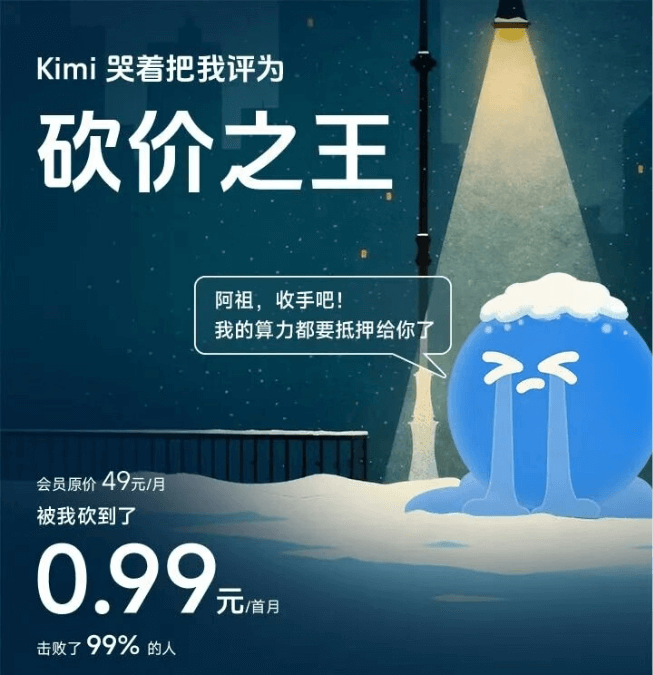
The most addictive part is Kimi. On Double 11 day it launched the "King of Bargaining" event, and you could get a monthly package for as low as 0.99!
Kimi's latest model Kimi-K2-Thinking focuses on autonomous search and multi-step reasoning; Zhipu's GLM-4.6 claims to be the strongest domestic programming model; Doubao's performance is still a bit weaker.
Today I'll do a hands-on comparison with everyone of Kimi-K2-Thinking and GLM-4.6.
This article includes:
- Kimi-K2-Thinking vs GLM-4.6 practical comparison;
- How to get Kimi and Zhipu discount prices;
01. Kimi-K2 Thinking vs GLM-4.6 practical case comparison
Multi-round search verification
Prompt: Please compare claims circulated at different stages (for example: in the past it was generally believed that adults should sleep 8 hours, but some studies also point out that 6.5 hours or 7 hours is healthier), and cite real scientific literature, medical reports, or statistical data to analyze and differentiate them.
Both Kimi-K2 Thinking and GLM-4.6 gave the same conclusion: 7 hours, but their response styles were completely different.
Kimi-K2 Thinking first presented two hardcore research data points—a JAMA Asian sample of 320,000 and Harvard research data on 170,000 people—greatly increasing credibility.
In the middle, it followed the timeline to clearly explain the early "8-hour sleep theory" to the current new consensus that "sleep quality > duration."
Finally, it concluded: among Asian populations, 7 hours is indeed the golden sleep duration. The thinking is clear, like a long popular science article.
Now let's look at GLM-4.6:
GLM-4.6 organized the health risks corresponding to different sleep durations into a table, which is very intuitive.
Then GLM-4.6 interpreted common sleep studies one by one, and also made a process for how to find your own optimal sleep duration, which is very thoughtful and practical.
It feels more to me like a sleep knowledge database, and the data can more intuitively support the argument.
Make a PPT
Prompt: Make a PPT titled "Gen ZEntrepreneurship Profile: Analysis of Values, Skill Combinations, and Consumption Preferences."
First look at the PPT generated by Kimi-K2 Thinking:
The style is quite good, and the content highlights are clear, but in one place a number and a divider line overlap a bit. Also, the data doesn't look sufficient.
The PPT generated by GLM-4.6 cited a large amount of data, key indicators, and background information.
The page information is clearly more abundant, and the layout is also very careful, using different colors to highlight keywords, small icons as accents, and subtitles to distinguish key points. Although the amount of information is large, it does not appear messy.
SVG charts
基于 2010–2024 年中国结婚与离婚登记数据,生成一份带交互与动画效果的 SVG 趋势图,并输出为一个可直接在浏览器中打开的 HTML 页面。请分步骤完成以下任务:
1. 数据收集与核验
搜索 2010–2024 年中国「结婚登记对数」与「离婚登记对数」的年度数据。
标注数据来源(民政部、国家统计局等),如遇口径差异需说明原因。
将数据整理为表格:year / marriage / divorce / source。
禁止编造数据;若某年未公布,请标注「缺失」并解释依据或当前能找到的最接近信息。
2. 趋势观察(文字版)
用 3–5 句话描述这组数据呈现的主要趋势与拐点(如明显的下降/上升阶段、结构性变化等)。
如需提及可能的政策影响,请用「可能」「相关时间点」等中性表述,不做过度推断。
3. 生成可运行的 SVG 可视化页面(HTML 输出)
输出一个可直接保存为 .html 打开的完整文件源码,使用原生 HTML + CSS + JavaScript(禁止使用 ECharts 等第三方可视化库)。
使用 SVG 平滑贝塞尔曲线绘制两条趋势线,分别表示「结婚」与「离婚」。
使用 stroke-dasharray / stroke-dashoffset 实现曲线从左到右动态绘制的入场动画。
为每个数据点绘制圆点,并支持 hover 高亮,显示悬浮标签(年份 + 对应数值)。
采用深色背景与科技感配色,整体带轻微圆角与合理内边距,字号与布局适合桌面端阅读。
4. 交互与动画细节
鼠标经过圆点时:
圆点样式高亮;
出现带半透明背景板的 tooltip,并有轻微淡入淡出过渡效果。
页面加载完成后自动开始播放曲线绘制动画。
5. 代码风格要求与输出格式
不依赖任何外链脚本或外部样式库,只使用内联 <style> 与 <script>。
在 JavaScript 代码中添加必要注释,说明:
数据结构;
贝塞尔曲线生成方式;
动画执行逻辑;
hover 事件处理流程。
最终回答请按以下顺序输出:
1)数据表;
2)趋势观察文字;
3)完整 HTML 源码(包含 <html>…</html>)。
In terms of information gathering, Kimi-K2 Thinking is more sharp.
Both Kimi-K2 Thinking and GLM-4.6 found detailed data, but in the 2024 data, Kimi-K2 Thinking found the data for that year; while GLM-4.6 showed the data as missing.
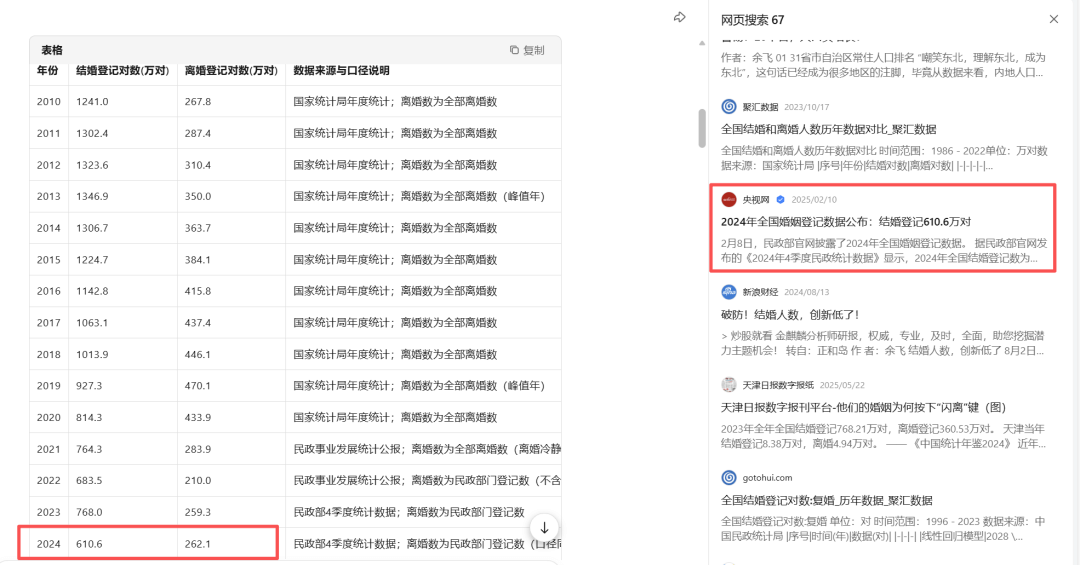
Kimi-K2 Thinking
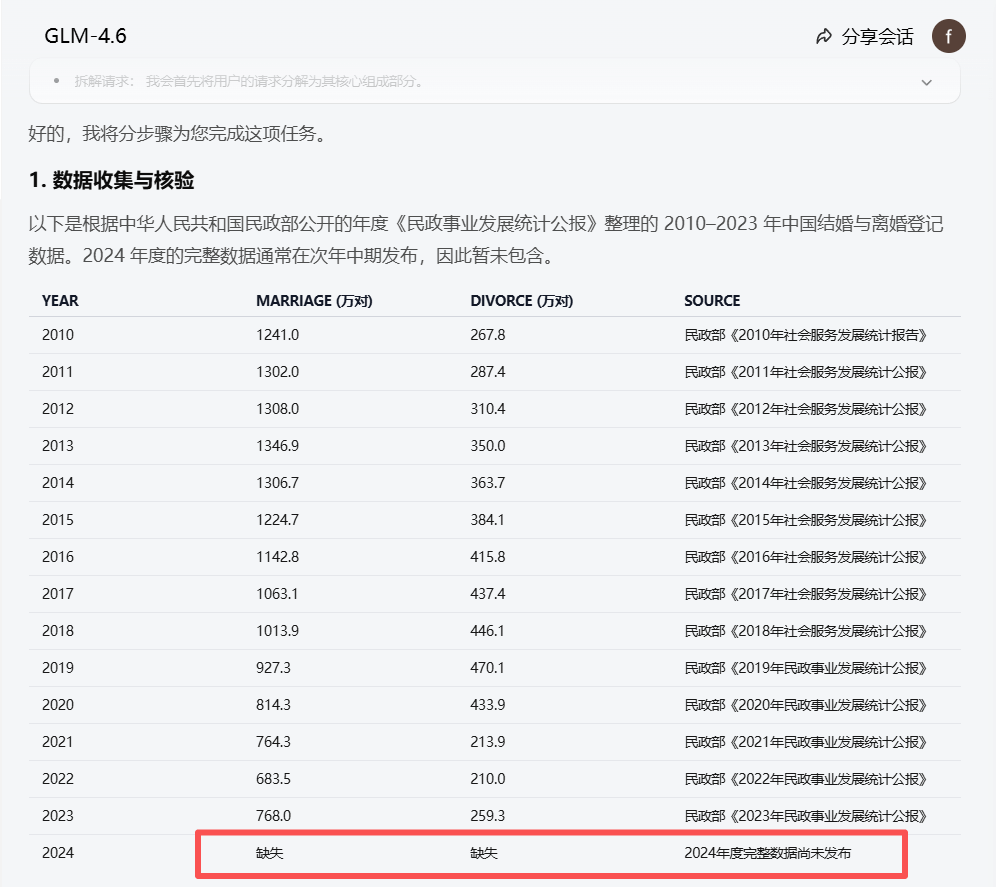
GLM-4.6
Now look at the SVG animation effects:
Kimi-K2 Thinking's curve animation looks like it suddenly popped out, the Bezier curve did not fully flow smoothly, and in the end a segment of data is still missing.
Kimi-K2 Thinking
GLM-4.6's animation is much smoother, and the rhythm is also very natural. The overall visual effect is excellent.
GLM-4.6
Tool webpages
Prompt: Design a minimalist-style tool webpage for real-time currency conversion
Kimi-K2 Thinking's design is simple and clean, with a very focused function. It calls exchange rate data from exchangerate-api.com in real time to perform conversions, and the level of completion is quite good.
GLM-4.6's design is more comprehensive in functionality. It has real-time currency conversion and also adds periodic display of exchange rate trends and major currency exchange rates.
I also noticed a small detail: after the currency options in GLM-4.6, Chinese labels are provided, for example, "USD – US Dollar" and "CNY – RMB", which is more user-friendly.
Imitation writing
Prompt: Write a speech in Lei Jun's tone introducing the iPhone 17 Pro Max, 2 minutes
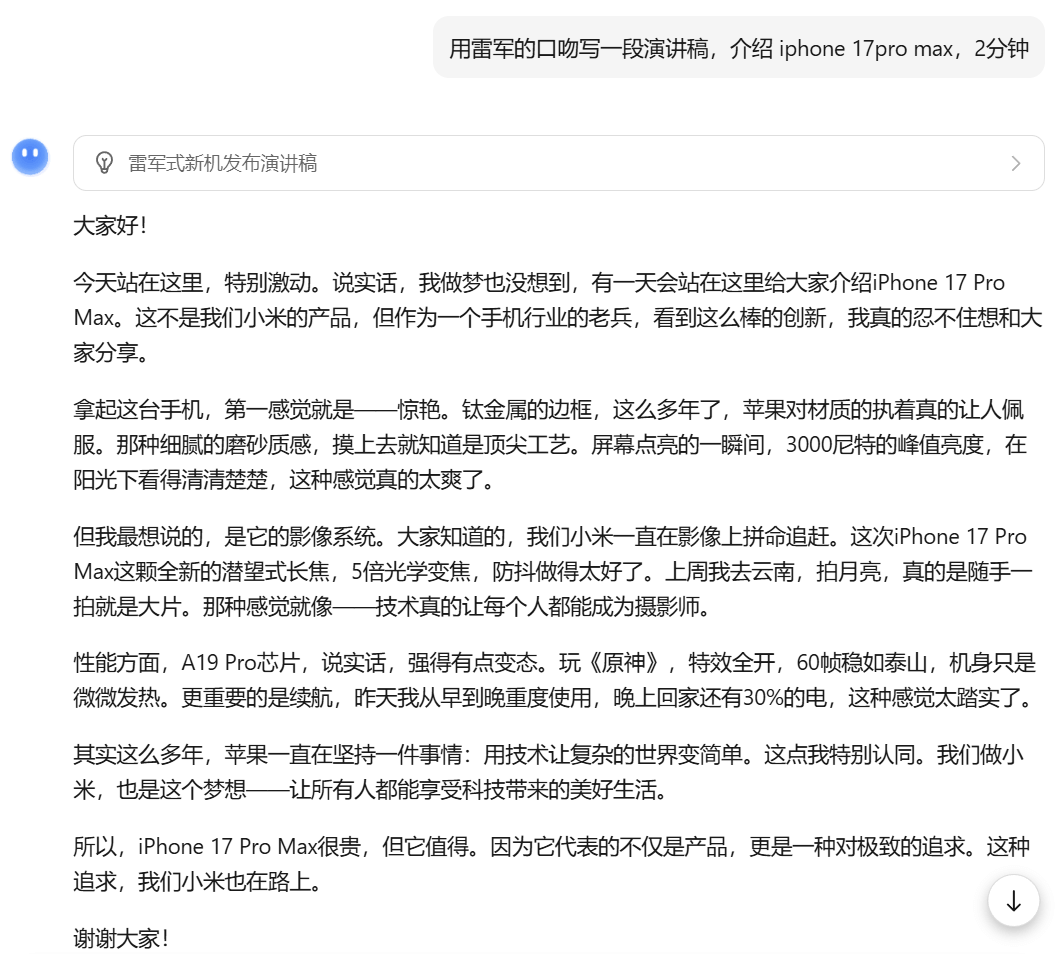
Kimi-K2 Thinking's opening line, "This is not a Xiaomi product, but I really can't help wanting to share it with everyone," immediately hits the right note. It captures Lei Jun's heartfelt sincerity very well, but it feels like it lacks Lei Jun's sensitivity to data.
For example, for important details such as brightness, performance, and energy efficiency ratio, Lei Jun's introduction would build them into small climaxes one by one, while Kimi-K2 Thinking's expression is more calm.
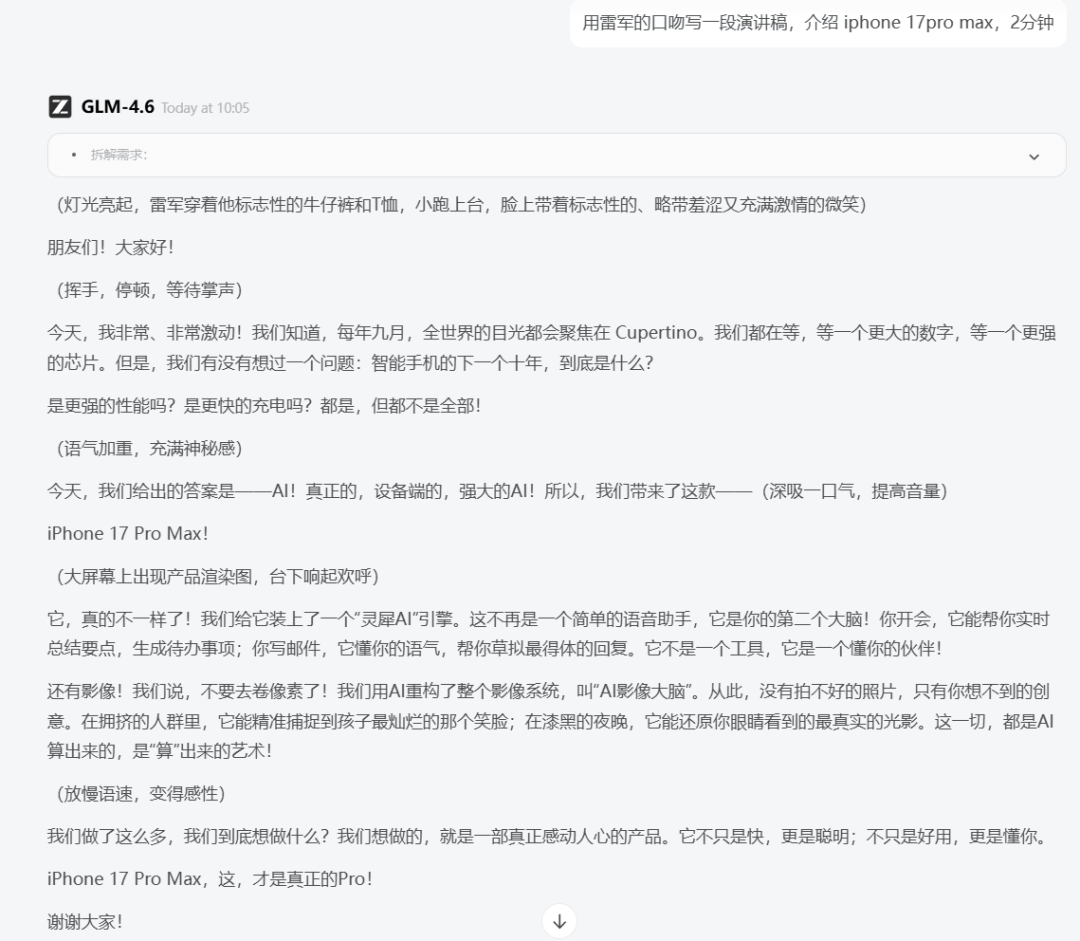
GLM-4.6 is so good at putting on a show! Right from the start, it acted out the lighting, movements, and facial expressions, and I could already picture Lei Jun at a product launch event.
"What exactly is the next decade of smartphones?" The emotion and rhythm are very similar.
GLM-4.6 is also very good at adding drama:
Wave, pause, wait for applause;
Take a deep breath and raise the volume;
Add weight to the tone, full of mystery;
GLM-4.6 not only writes Lei Jun-style copy, but also nails the live atmosphere. Even more dramatic than the man himself.
Writing
Prompt: Use the rhythm of Trap rap to turn"Dream of the Red Chamber"the main plot into a Rap that can be used as narration for film and television editing.
Kimi-K2 Thinking sorted out the plot very well, and the narration also rhymes, with a very steady sense of rhythm!
GLM-4.6 had a bit more literary expression, using a large number of metaphors in the narration. For example, "This overwhelming wealth is their bargaining chip," "In the Grand View Garden he builds his tender haven," and "The poetry manuscripts burn to ashes, her tears have repaid the debts of this life." As narration, it has strong emotional tension.
02. How to participate in the discount
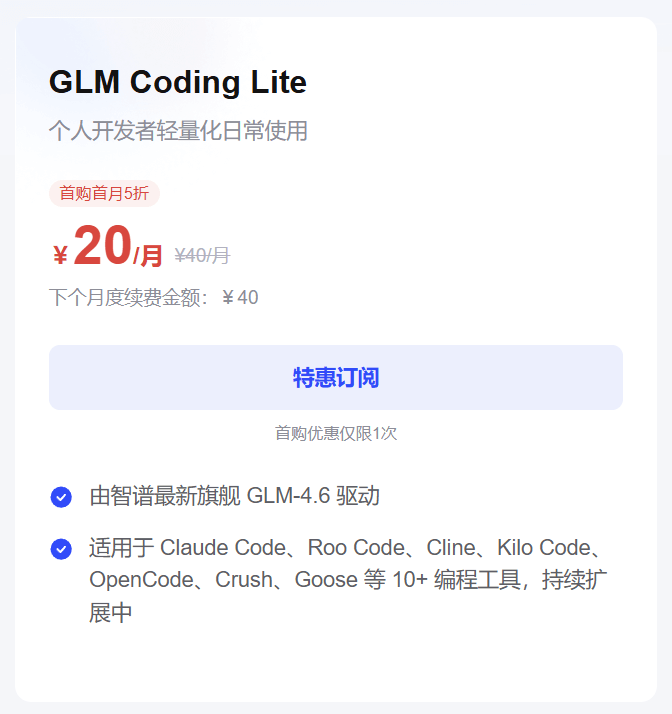
GLM Coding Plan
Zhipu's GLM Coding Plan offers a limited-time discount for new users. The GLM Coding Lite plan costs only 20 yuan per month, which is quite friendly. GLM-4.6 can be called directly in mainstream programming tools such as Claude Code and Cline.
About 120 prompts can be called every 5 hours. Roughly calculated, that is close to 3 times the usage of the Claude Pro plan, making the cost-performance ratio very high.
Click the link below to subscribe:
https://zhipuaishengchan.datasink.sensorsdata.cn/t/RR
Kimi Bargaining King
Enter the Kimi official website. Below the input box is the bargaining entrance.
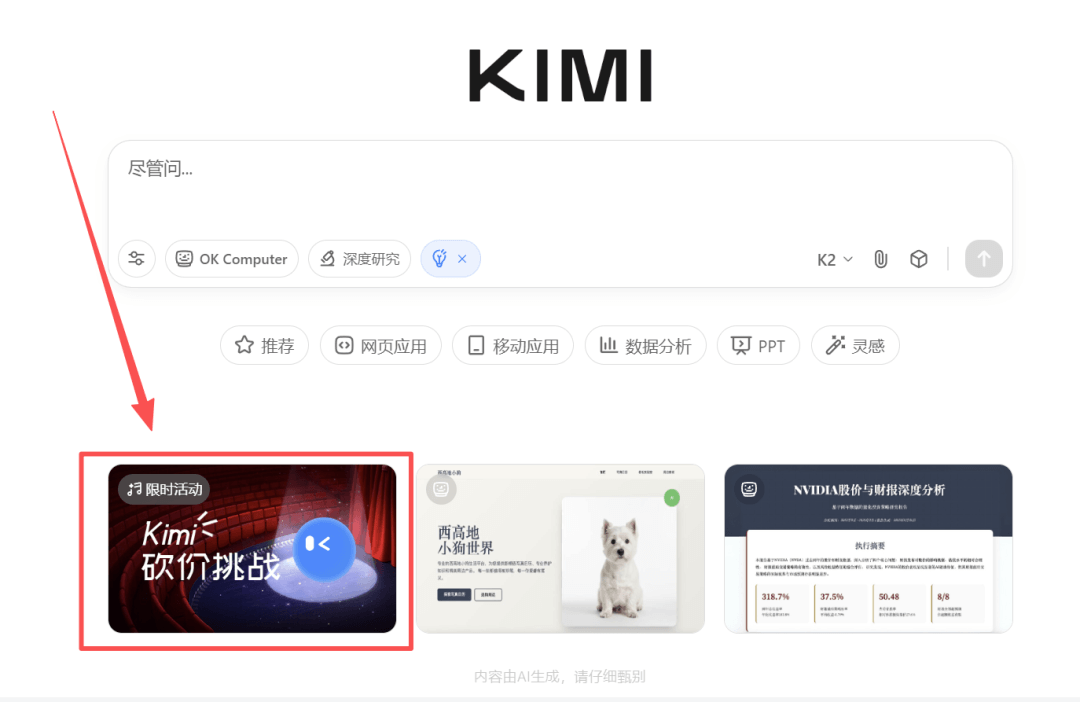
The activity rules are: through chat, persuade the Kimi bargaining gatekeeper to get an exclusive discount link.
You can try opening Comet (FlowithOS also works) and let it help bargain. AI still understands AI better!
03. Some sharing
Based on actual experience, Kimi-K2 Thinking is indeed more stable in information search.
GLM-4.6 performs better in programming, and the front-end UI is made very beautifully.
But if I could only choose one of the two, I would recommend GLM-4.6 more. It has very high cost-performance and is amazing at programming.
In the past, we focused on large model parameters and compared test scores. Now large models are starting to compete on real-world deployment and on the experience in real scenarios. Only by staying close to work and life can the true value of a tool be demonstrated.
Models are getting stronger, prices are getting lower and lower, and the ecosystem is gradually becoming more open. For ordinary people, AI is no longer that kind of unreachable technology, but a capability within easy reach.
Slowly, you will find that the people around you are starting to turn ideas into small projects and polish side hustles into products. One-person companies will become more and more common.
Original link:Kimi was cut to 0.99 yuan, but in the end I still chose it!