
What is K2-Think
K2-Think is jointly launched by the United Arab Emirates' Mohamed bin Zayed University of Artificial Intelligence (MBZUAI) and G42open-source reasoning model, with 32 billion parameters, it performs excellently in multiple fields such as mathematical reasoning, code generation, and scientific knowledge, especially achieving outstanding results in mathematics competition benchmarks. The model achieves efficient reasoning through techniques such as long chain-of-thought supervised fine-tuning and reinforcement learning, and reaches an inference speed of over 2000 tokens per second on the Cerebras Wafer-Scale Engine. The model's open-source nature and efficient reasoning capabilities make it an extremely attractive choice for building advanced AI reasoning systems.
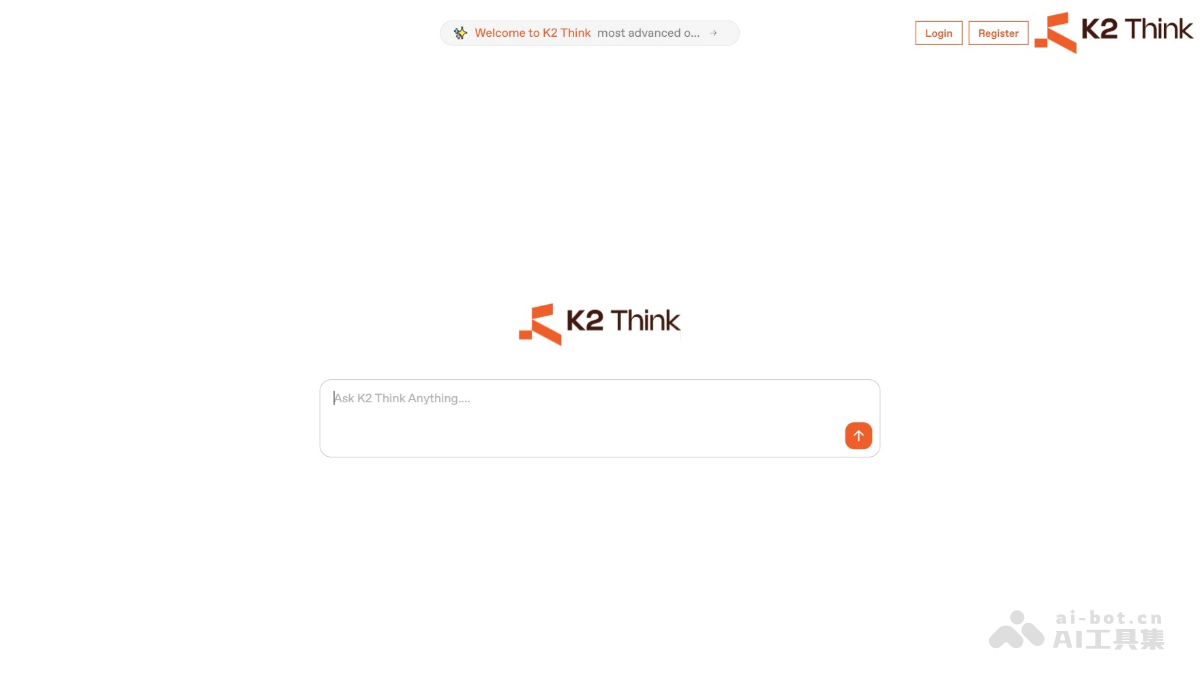
K2-Think's main features
- Mathematical reasoning: Performs excellently in mathematical problem-solving, achieving high scores in mathematics competition benchmarks such as AIME and HMMT, and can handle complex mathematical problems.
- Code generation: Can generate high-quality code, supports multiple programming languages, and is suitable for programming assistance and code generation tasks.
- Scientific knowledge Q&A: Also has strong knowledge reserves and reasoning capabilities in the scientific field, answering science-related questions.
- Multi-domain reasoning: In addition to mathematics, code, and science, K2 Think can handle multiple types of reasoning tasks.
- Safety and reliability: Performs excellently in safety, can effectively refuse high-risk content, and possesses strong dialogue robustness and data protection capabilities.
K2-Think's technical principles
- Long Chain-of-thought Supervised Finetuning: Through supervised learning, the model is trained for long chain-of-thought, better understanding and generating complex reasoning processes.
- Reinforcement Learning with Verifiable Rewards (RLVR): Based on reinforcement learning technology, combined with a verifiable reward mechanism, it optimizes the model's reasoning process and improves the accuracy and reliability of reasoning.
- Agentic Planning: Performs agentic planning before reasoning, helping the model better organize the reasoning process and improve reasoning efficiency.
- Test-time Scaling: Dynamically adjusts the model's parameters during the reasoning process, adapting to different reasoning tasks and improving the model's generalization ability.
- Speculative Decoding: Adopts a speculative method during the decoding process, predicting possible outputs in advance to accelerate the reasoning process.
- Inference-Optimized Hardware: Uses high-performance hardware such as the Cerebras Wafer-Scale Engine to achieve efficient inference computation and significantly improve inference speed.
K2-Think's project address
- Project official website:https://www.k2think.ai/
- GitHub repository:https://github.com/MBZUAI-IFM/K2-Think-SFT
- HuggingFace model library:https://huggingface.co/LLM360/K2-Think
- arXiv technical paper:https://arxiv.org/pdf/2509.07604
K2-Think's application scenarios
- Mathematics tutoring: Helps students solve complex mathematical problems, providing detailed solution steps and reasoning processes, used in mathematics competition tutoring.
- Programming education: Provides students with assistance in code generation and debugging, helping users better understand and master programming languages and algorithms.
- Science learning: Answer questions in the field of science and assist students with scientific experiment design and data analysis.
- Mathematical Research: Assist researchers in exploring mathematical problems, verifying mathematical conjectures, and providing computational and reasoning support.
- Scientific Experiments: Help design experimental plans, analyze experimental data, and predict experimental results.