
What is Index-Translate
Index-Translate is a multilingualtranslationmodel family open-sourced by Bilibili's Index LLM team, built onQwen3.5and licensed under Apache-2.0. The text model covers 150 languages and is available in three sizes: 2B/9B/35B-A3B, supporting translation instructions such as terminology, formatting, and content preservation. The Index-Translate family also includes Index-Echo speech translation, Index-Homura syllable-controllable translation, and Index-NativeLong long-document translation.
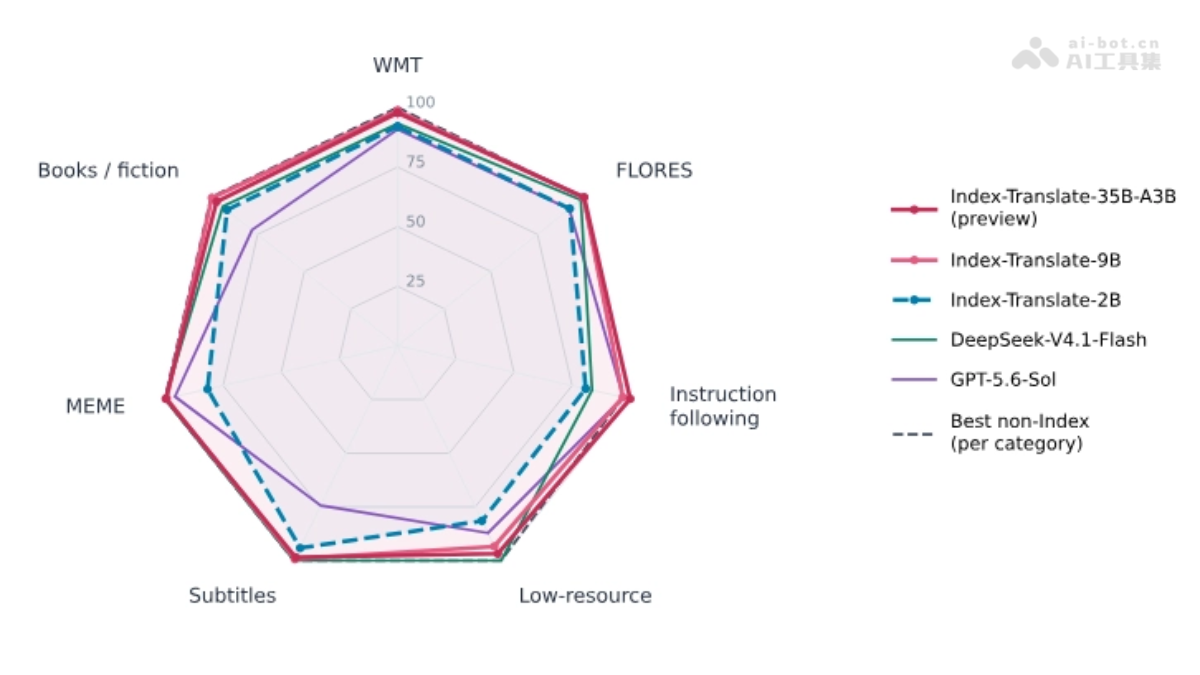
Main features of Index-Translate
- Index-Translate text translation: Translates text and structured content across 150 languages, and can simultaneously execute instruction requirements such as terminology unification, format preservation, and translation of specified fields.
- Index-Echo speech translation: Supports speech-to-speech (S2ST dubbing) and speech-to-text (S2TT subtitles), referencing the speaker's timbre characteristics in the source audio when generating dubbing.
- Index-Homura syllable-controllable translation: Accepts a target syllable count as input, automatically adjusts the wording and length of the translation, and provides text that matches the duration for video dubbing.
- Index-NativeLong long-document translation: Inputs the full text at once and generates the translation continuously, using long context to maintain consistency of character names, terminology, and conceptual hierarchy throughout.
Technical principles of Index-Translate
- Base model and unified architecture: The entire family is built on Qwen3.5 and fine-tuned with multilingual corpora and translation instruction data, enabling the text model to acquire both translation capability and constraint-following capability within a single architecture; inference is deployed with vLLM, and the text model uses greedy decoding by default to ensure stable and reproducible output.
- Index-Echo speech translation: Uses a cascaded "recognition → translation → synthesis" pipeline. S2ST connects to CosyVoice speech synthesis after translation, and extracts the speaker embedding of the source audio and injects it into the synthesis module to achieve timbre cloning; audio is processed in 60-second windows, retaining the historical context of the previous 5 windows to maintain discourse coherence.
- Index-Homura syllable control: Injects the target syllable count as an explicit condition into the prompt and, combined with sampling decoding, lets the model simultaneously perform wording selection and length planning during translation, restructuring sentence structures to hit the syllable budget; on SandGlass, 81.92% of outputs have a syllable deviation of no more than 10%.
- Index-NativeLong long-document translation: Uses a native full-text input approach, reading the entire document at once and then continuously generating the translation. With an ultra-long context window, it "remembers" the usage of character names and terminology from earlier text during generation, maintaining consistency without an external glossary; this differs from traditional chunked translation, which relies on adjacent context and automatic glossaries.
- Evaluation methods: In addition to general benchmarks such as FLORES and WMT26, the team built four task sets: instTrans, MEME, SandGlass, and long-document multi-length evaluation. Translation quality and instruction following are scored separately, making them closer to real usage scenarios.

Follow WeChat and reply "open source" to join theAI open-source project communication group
How to use Index-Translate
Method 1: Deploy the text model locally (using 2B as an example)
-
Clone the repository:
git clone https://github.com/bilibili/Index-Translate.gitand enter the project directory. -
Install dependencies: Run
pip install -U vllmandpip install -r inference/llm/requirements.txt, prepare a vLLM environment with Qwen3.5 support. -
Start the service: run
vllm serve IndexTeam/Index-Translate-2B --host 127.0.0.1 --port 8000 --max-model-len 4096to bring up the model service locally on port 8000. -
Run translation: open a new terminal and run
python inference/llm/translate.py "你好,世界" --target en --model IndexTeam/Index-Translate-2Bto get the translation. -
Custom integration: the client requests
http://127.0.0.1:8000/v1by default, and you can connect to your own service via--base-url/--api-keyor the environment variableOPENAI_BASE_URL/OPENAI_API_KEY.
Option 2: Use specialized translation capabilities
-
Syllable-controllable translation: call
inference/llm/syllable_translate.py, using--syllablesto pass in the target syllable count. -
Long document translation: call
doc_translate.py, using--directionto specify fixed template directions such as zh-en / zh-ja. -
Speech translation: follow the repository's S2TT subtitle guide or S2ST dubbing guide, using
s2tt.pyordub.pyto process audio and video.
Option 3: Deployment-free experience
-
Online Demo: visit https://index-translate.bilibili.com/ directly to experience four types of translation: text, speech, syllables, and long documents.
-
Browser extension: after deploying the model locally, you can translate web pages via the Chrome/Edge/Firefox extension.
Index-Translate's core advantages
-
Broad language coverage: the text model supports translation among 150 languages, with outstanding performance on low-resource languages; 35B-A3B has an off-target rate of only 2.4% on FLORES_minor_pair.
-
Strong instruction following: during translation, it simultaneously executes requirements such as terminology consistency, format preservation, and field specification; 9B scores 0.7725 on instTrans_minor instruction following, the highest among all compared models.
-
Understands community memes: the MEME evaluation is optimized for community expressions such as homophones, abbreviations, and jokes, and can accurately and fluently translate memes like "结芬" and "狒瘾".
-
Speech translation preserves timbre: when Index-Echo generates dubbing in the target language, it references the speaker characteristics of the source audio, achieving cross-language dubbing with the original voice style.
-
Syllable-controllable dubbing adaptation: Index-Homura accepts a target syllable count and reorganizes sentences according to the budget; 81.92% of outputs have a syllable deviation of no more than 10%, directly serving video dubbing scenarios.
-
Consistent long documents: Index-NativeLong natively translates full texts, maintaining consistency of character names and terminology in long texts without an external glossary, and correctly distinguishing concept hierarchies.
Index-Translate's project addresses
- GitHub repository:https://github.com/bilibili/Index-Translate
- HuggingFace model library:https://huggingface.co/collections/IndexTeam/index-translate
- Technical paper:https://github.com/bilibili/Index-Translate/blob/main/docs/Index_Translate_Series_Technical_Report.pdf
Comparison of Index-Translate with similar competing products
| Comparison dimension | Index-Translate (Bilibili) | Doubao-Seed-Translation(ByteDance) |
|---|---|---|
| Product nature | Open-source model family, weights can be downloaded for local deployment | Closed-source commercial API, only callable via Volcano Engine |
| Language coverage | 150 languages | 28 mainstream languages (Chinese/English/Japanese/Korean/German/French/Spanish/Russian, etc.) |
| Official quality claims | FLORES 0.8794、instTrans IFscore 0.8336 | Chinese-English translation approaches DeepSeek-R1, and multilingual performance exceeds or matches GPT-4o / Gemini-2.5-Pro |
| Context length | 2B supports 262K, 9B supports 229K tokens | 4K context, 3K output length |
| Long-document translation | Index-NativeLong supports 64K-level full-text consistent translation | Basically unusable (a 4K window cannot fit long documents) |
| Instruction following | Supports 10 categories of constraints including terminology/format/content preservation | No dedicated constraint-following capability; achieved through general prompt engineering |
Application scenarios of Index-Translate
-
Video localization dubbing: Use Index-Echo to translate videos and dub them into the target language while preserving the original speaker's timbre, and use Index-Homura's syllable control to make the dialogue match the on-screen duration, suitable for film and television dramas, courses, and Vlogs going overseas.
-
Multilingual subtitle generation: Through S2TT speech-to-text capability, automatically generate multilingual subtitles such as Chinese/Japanese/English/Spanish for speeches, livestreams, and short videos, serving cross-language content distribution.
-
Community content going overseas: When translating danmaku, moments, and posts, preserve the original meaning of memes (such as "狒瘾" -> "FFXIV itch"), topic tags, and emoji structure, so that gaming and ACG cultural content does not lose its context in overseas markets.
-
Long-document and web novel translation: Use Index-NativeLong to translate entire novels, glacier史, and other long texts, maintaining consistency in character names, terminology, and concept hierarchy without manually maintaining a glossary, suitable for web novels and publishing going overseas.
-
E-commerce and product material localization: Follow instructions to translate only specified columns of a product CSV while preserving headers and IDs, or translate announcement JSON in a structured way, so that the translations can be directly integrated into downstream business systems and reduce localization process costs.