
What Is Ideogram 4
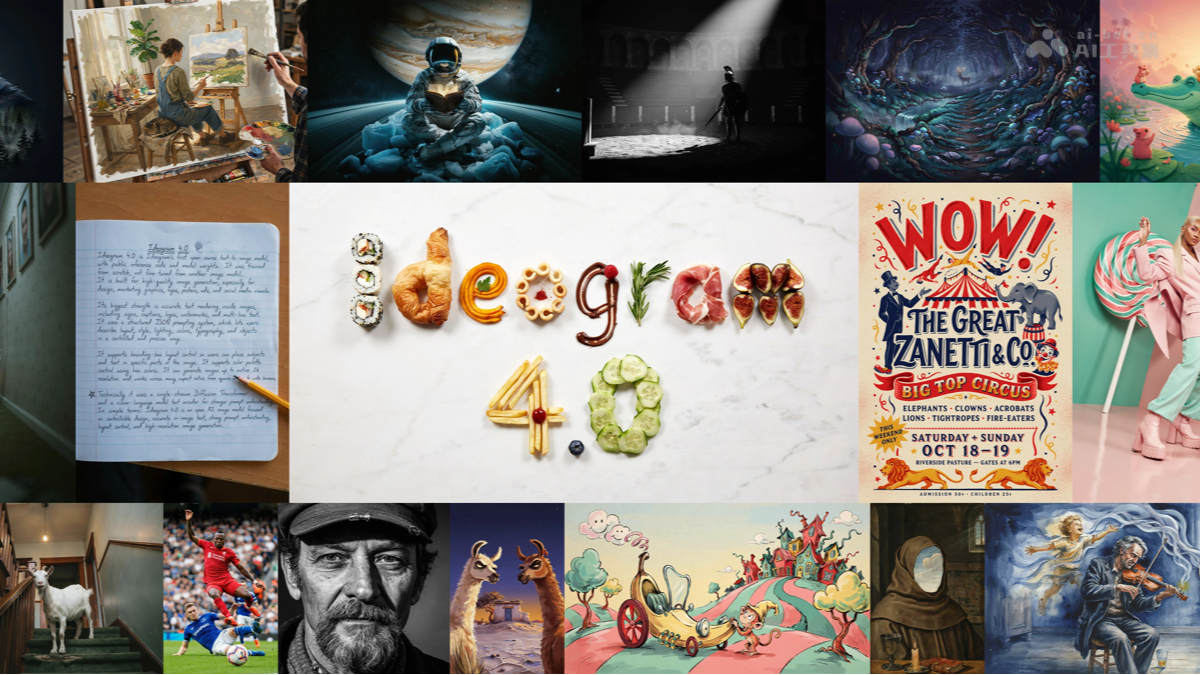
Ideogram 4 is Ideogram's first open-source text-to-image generationmodel, with 9.3 billion parameters, trained from scratch rather than fine-tuned based on existing models. The model is designed for high-quality image generation, with outstanding performance especially in design, marketing graphics, logos, posters, advertisements, and social media visual content. The model supports a structured JSON prompt interface, features industry-leading multilingual text rendering capabilities, deep language understanding, explicit bounding-box layout and palette control, and can natively generate 2K resolution images.
Ideogram 4's Main Features
-
Accurate Text Rendering: Accurately generates signs, titles, logos, watermarks, and multi-line text within images.
-
Structured JSON Prompt System: Precisely describes layout, style, lighting, color, fonts, and object positions through JSON.
-
Bounding-Box Layout Control: Supports placing subjects and text in specific areas of the image for precise composition.
-
Palette Control: Supports color control through hexadecimal color values.
-
Multi-Aspect-Ratio Native Generation: Supports multiple aspect ratios from square to ultra-wide banners, with native 2K resolution output.
-
Multilingual Support: Has best-in-class multilingual text rendering capabilities.
Ideogram 4's Technical Principles
- Single-Stream Diffusion Transformer Architecture: Ideogram 4 uses a single-stream Diffusion Transformer (DiT) as its core generation architecture, equipped with a vision-language model (VLM) text encoder, enhancing understanding of complex prompts and achieving more precise image generation and text-semantic alignment.
- Trained from Scratch Rather Than Fine-Tuned: The model has 9.3 billion parameters and is trained completely from zero, not fine-tuned based on any existing image model. Its independent training path has allowed it to form a unique capability boundary in design-oriented image generation, focusing on native generation of high-quality visual content.
- Structured JSON Prompt System: The model introduces a structured JSON prompt interface, supporting users in describing layout, style, lighting, color, fonts, and object positions in a precise and controllable way. Compared with natural language prompts, the JSON format provides more fine-grained control and reduces the randomness of prompt engineering.
- Bounding-Box Layout and Palette Control: The technology supports explicit bounding-box layout control, allowing subjects and text to be precisely placed in specific areas of the image; it also supports palette control through hexadecimal color values, enabling precise customization of image colors.
How to Use Ideogram 4
-
Online Experience: Directly visit Ideogram official website to generate images online.
-
Local Deployment: Download the inference code and model weights from GitHub, and use the Diffusers library to load and run.
-
JSON Prompts: Input prompts in structured JSON format to precisely control layout, style, and color.
-
Choose a Quantized Version: Choose the nf4 (CUDA, supports Diffusers) or fp8 (all platforms) version according to hardware.
Ideogram 4's Core Advantages
-
Open-Source Leadership: Far ahead in the Design Arena open-source model leaderboard, with an Elo score of 1285, far surpassing the second place.
-
Design Frontier: In the overall ranking, it is second only to closed-source models such as GPT Image 2,GPT-Image-1.5 and Gemini 3.1 Flash, placing it at the forefront of the design field.
-
Precise and Controllable: The JSON prompt system provides more precise image control than natural language.
-
High-Resolution Native Output: Directly generates clear 2K images without the need for upscaling.
-
Non-Commercial Friendly Open Source: Inference code and weights are fully public, encouraging innovation in the research community.
Ideogram 4 Project Address
- Project Official Website:https://ideogram.ai/blog/ideogram-4.0/
- GitHub Repository:https://github.com/ideogram-oss/ideogram4
- HuggingFace Model Library:https://huggingface.co/collections/ideogram-ai/ideogram-4
Comparison of Ideogram 4 with Similar Competitors
| Dimension | Ideogram 4.0 | FLUX.2 [dev] | Recraft V4.1 |
|---|---|---|---|
| Developer | Ideogram | Black Forest Labs | Recraft AI |
| Parameter Scale | 9.3B | ~12B | Not disclosed |
| Open-Source Status | Weights + code open source (non-commercial) | Fully open source (Apache 2.0) | Closed source (API/subscription) |
| Design Arena Elo | 1285(First in open source / fourth overall) | 1170 (second in open source) | 1245 (sixth overall) |
| Core Architecture | Single-stream DiT + VLM text encoder | Flow Matching Transformer | Proprietary vector + raster hybrid architecture |
| Text Rendering Capability | ⭐⭐⭐ Industry best | ⭐⭐ Good | ⭐⭐⭐ Excellent (vector text) |
| Prompting Method | JSON structured + natural language | Natural language | Natural language + vector editing |
| Layout Control | Precise control via bounding boxes + color palette | Limited (depends on prompts) | Moderate (supports layer concept) |
| Resolution | Native 2K | Up to 2K | Up to 2K |
| Multilingual Support | Best | Average | Good |
Application Scenarios of Ideogram 4
-
Brand Visual Design: Supports generating corporate visual identity materials containing precise brand text, logos, and slogans, such as business cards, letterheads, and brand manual illustrations.
-
Marketing Posters and Advertising: Quickly create promotional posters, event banners, and social media ad images, supporting multi-line text layout and precise color control.
-
Publication Layout: Generates high-quality mixed text-and-image designs for book covers, magazine interior pages, and album covers, ensuring text is clear and readable.
-
E-Commerce Product Display: Generates product main images, detail page headers, and promotional materials, supporting placement of the product subject and marketing copy in specific areas.
-
Social Media Content: Creates high-quality text-and-image posts for platforms such as Instagram, Xiaohongshu, and Twitter, supporting native output in multiple aspect ratios.