
What is Hy-Memory
Hy-Memory is a memory plugin launched by Tencent Hunyuan and designed specifically for OpenClaw and other long-term collaborative Agents. Through a 6-layer memory framework × System1/System2 dual system × evolutionary chain three-tier architecture, it enables Agents to truly remember reliably, remember correctly, remember lightly, and understand you better. It ranks first among similar frameworks in the two authoritative evaluations LongMemEval and PersonaMem, reducing the number of memories by 70%+, increasing information density by 45%, and achieving write speeds 8 times that of similar systems.
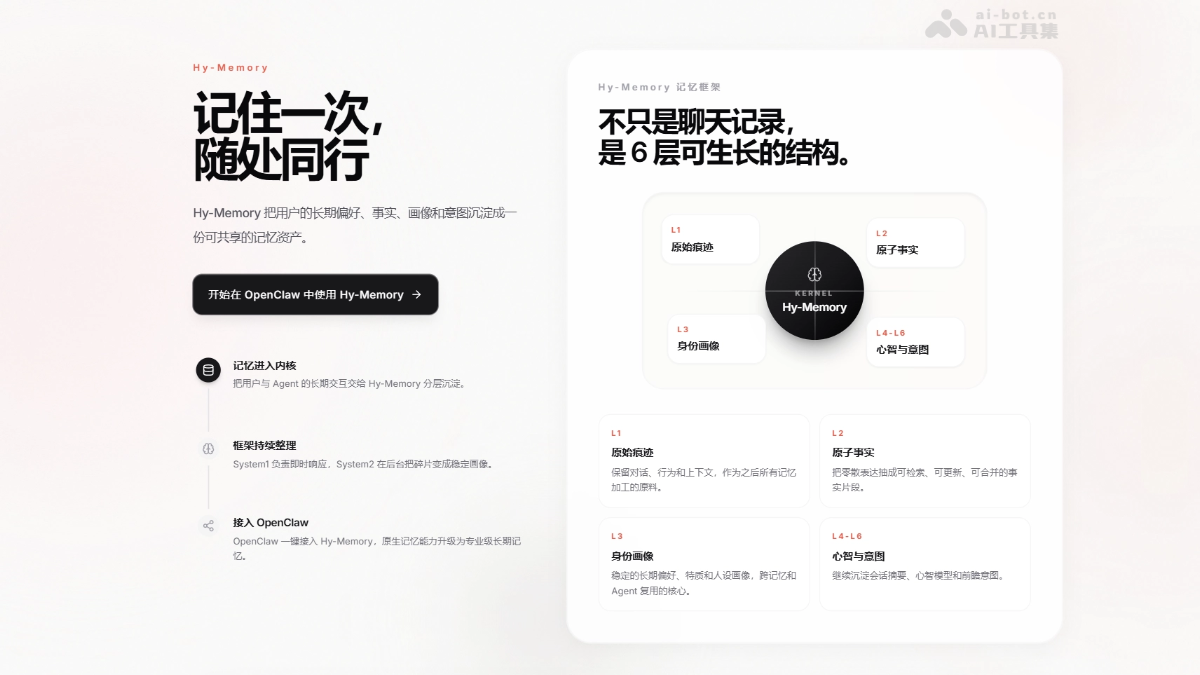
Main features of Hy-Memory
-
Six-layer memory framework: Divides memory into six layers: raw traces, atomic facts, identity profiles, session summaries, mental models, and prospective intentions, with each layer having independent responsibilities and retrieval weights.
-
System1/System2 dual system: System1 processes L1-L4 memory writes in real time at the millisecond level, while System2 asynchronously consolidates L5-L6 higher-order cognition in the background.
-
Evolutionary chain mechanism: Connects memories into causal chains through supersedes pointers; hitting any node automatically expands the complete evolution of attitudes.
-
Memory merging and deduplication: Automatically merges similar facts and refreshes conflicting preferences, avoiding the coexistence of old and new information that forms a noisy database.
-
Cross-Session continuous memory: Supports continuing today what was closed yesterday, allowing the Agent to seamlessly continue the context of long-term tasks.
Technical principles of Hy-Memory
-
Layered storage architecture: L1 raw dialogue, L2 atomic facts, L3 identity profiles, L4 session summaries, L5 mental models, L6 prospective intentions, with each layer using a different processing strategy.
-
System1 fast path: When the user sends a message, it writes raw traces in real time, extracts facts, updates profiles, and compresses session summaries, closing the loop at the millisecond level.
-
System2 slow path: Runs asynchronously in the background, abstracting mental models from behavior and predicting prospective intentions, consolidating at the second-to-minute level.
-
Evolutionary chain pointer structure: When a new memory is written, it points to the old memory through a supersedes pointer, forming a bidirectionally traversable causal chain.
-
Attention gate mechanism: Sets attention judgments in System1 to decide which information is worth processing and writing into deep memory.
How to use Hy-Memory
- Integration method: Integrate Hy-Memory with one click through OpenClaw, upgrading native memory capabilities to professional-grade long-term memory.
- Lite mode: Only performs writes and retrieval, with zero LLM cost, the fastest integration, suitable for those who want reliable memory immediately but do not yet need understanding.
- Pro mode: MemAgent synchronously performs extraction, summarization, and reflection, but without a background worker, suitable for those who want memory to organize itself.
- Ultra mode: Fully runs the System1 + System2 kernel, with the asynchronous slow path continuously replaying and summarizing, suitable for those who want the system to become more like the user the more it is used.
Core advantages of Hy-Memory
- Higher memory density: Single-item information density reaches 130.5 tokens/item, 2.5 times that of mem0 and 1.5 times that of Graphiti.
- Fewer memories: An average of 82.3 items/user, only about 1/4 of mem0 and Graphiti, solving the problem of memory fragmentation.
- Faster write speed: 12.3 s/k tokens, 1/8 of Graphiti, without slowing down the response speed of the main pipeline.
- Leading evaluation results: LongMemEval 85.20%, PersonaMem 76.91%, both ranking first among similar frameworks.
- Complete causal evolution: The evolution chain preserves the complete path of attitude evolution, avoiding the problem of the overwrite school only remembering the latest or the accumulation school having incomplete recall.
Hy-Memory project address
- Project official website:https://memory.hunyuan.tencent.com/
Comparison of Hy-Memory with similar competing products
| Dimension | Hy-Memory | mem0 | Graphiti |
|---|---|---|---|
| LongMemEval total score | 85.20% | 47.00% | 68.32% |
| PersonaMem total score | 76.91% | 65.82% | 64.86% |
| Write time (s/k tokens) | 12.3 | 15.6 | 97.8 |
| Number of memories/user | 82.3 | 309.8 | 362.3 |
| Information density per item (token/item) | 130.5 | 52 | 89.2 |
| Memory architecture | 6-layer hierarchy + evolution chain | Single-layer vector | Graph structure |
| Dual-system processing | System1 + System2 | None | None |
Application scenarios of Hy-Memory
-
Long-term project collaboration: When following up on complex projects over several weeks, the Agent can remember the reasons for each decision and the options that were ruled out.
-
Personal knowledge management: Accumulates the user's work habits and decision-making mental models, understanding the user's preferences better the more it is used.
-
Fitness/health planning: Records the evolution of attitudes toward training methods, avoiding recommending options the user has already tried and found problematic.
-
Creative assistance: Tracks changes in creators' attitudes toward distribution channels and gives suggestions that align with their values.
-
Learning tutoring: Remembers students' learning progress, weak knowledge points, and ways of understanding, providing continuous guidance.