
What is Hunyuan Image-to-Video
Hunyuan Image-to-Video is an open-source image-to-video model launched by Tencent Hunyuan. Users can upload an image and provide a brief description to make the image move and generate a 5-second short video. The model supportslip sync, motion-driven and automatic background sound effect generation, and other features. The model is suitable for a variety of characters and scenes such as realistic, anime, and CGI, with a total parameter count of 13 billion. The Tencent Hunyuan Image-to-Video model has been launched on Tencent Cloud, and users can experience it through the Hunyuan AI Video official website. The Hunyuan Image-to-Video model is open-sourced on mainstream developer communities such as Github and HuggingFace, including weights, inference code, and LoRA training code. Developers can train derivative models such as custom LoRAs based on it.
Main Features of Hunyuan Image-to-Video
- Image-to-Video Generation: Users only need to upload an image and enter a brief description, and the model can transform a static image into a 5-second short video, while also supporting automatic generation of background sound effects.
- Audio-Driven Features: Users can upload an image of a person and input text or audio, and the model can accurately match the lip movements, making the person in the image "speak" or "sing," with facial expressions that match the tone.
- Motion-Driven Features: After users upload an image and select a motion template, the model can make the person in the image perform actions such as dancing, waving, and doing gymnastics, suitable for short video creation, game character animation, and film and television production.
- High-Quality Video Output: Supports 2K high-definition image quality, suitable for a variety of characters and scenes such as realistic, anime, and CGI.
Technical Principles of Hunyuan Image-to-Video
- Image-to-Video Generation Framework: HunyuanVideo-I2V integrates the information of the reference image into the video generation process through image latent concatenation technology. The input image is first processed by a pre-trained multimodal large language model (MLLM) to generate semantic image tokens, which are then concatenated with video latent tokens to achieve cross-modal full attention computation.
- Multimodal Large Language Model (MLLM): The model uses an MLLM with a Decoder-only structure as the text encoder, significantly enhancing the ability to understand the semantic content of the input image. Compared with traditional CLIP or T5 models, MLLM performs better in image detail description and complex reasoning, and can better achieve deep fusion of image and text description information.
- 3D Variational Autoencoder (3D VAE): To efficiently process video and image data, HunyuanVideo-I2V uses CausalConv3D technology to train a 3D VAE, compressing videos and images in pixel space into a compact latent space. This design significantly reduces the number of tokens in subsequent models and enables training at original resolution and frame rate.
- Dual-Stream-to-Single-Stream Hybrid Model Design: In the dual-stream stage, video and text tokens are processed independently through multiple Transformer blocks to avoid mutual interference; in the single-stream stage, video and text tokens are connected for multimodal information fusion. This design captures the complex interactions between visual and semantic information, improving the coherence and semantic consistency of generated videos.
- Progressive Training Strategy: The model adopts a progressive training strategy, gradually transitioning from low resolution and short videos to high resolution and long videos. This improves the convergence speed of the model and ensures the high quality of generated videos at different resolutions.
- Prompt Rewriting Model: To address the variability in language style and length of user prompts, HunyuanVideo-I2V introduces a prompt rewriting module, which can convert user-input prompts into a format that is easier for the model to understand, improving the generation results.
- Customizable LoRA Training: The model supports LoRA (Low-Rank Adaptation) training, allowing developers to train video generation models with specific effects using a small amount of data, such as effects like "hair growth" or "character motion."
Hunyuan Image-to-Video Project Address
- Github Repository: https://github.com/Tencent/HunyuanVideo-I2V
- Huggingface Model Library:https://huggingface.co/tencent/HunyuanVideo-I2V
How to Use Hunyuan Image-to-Video
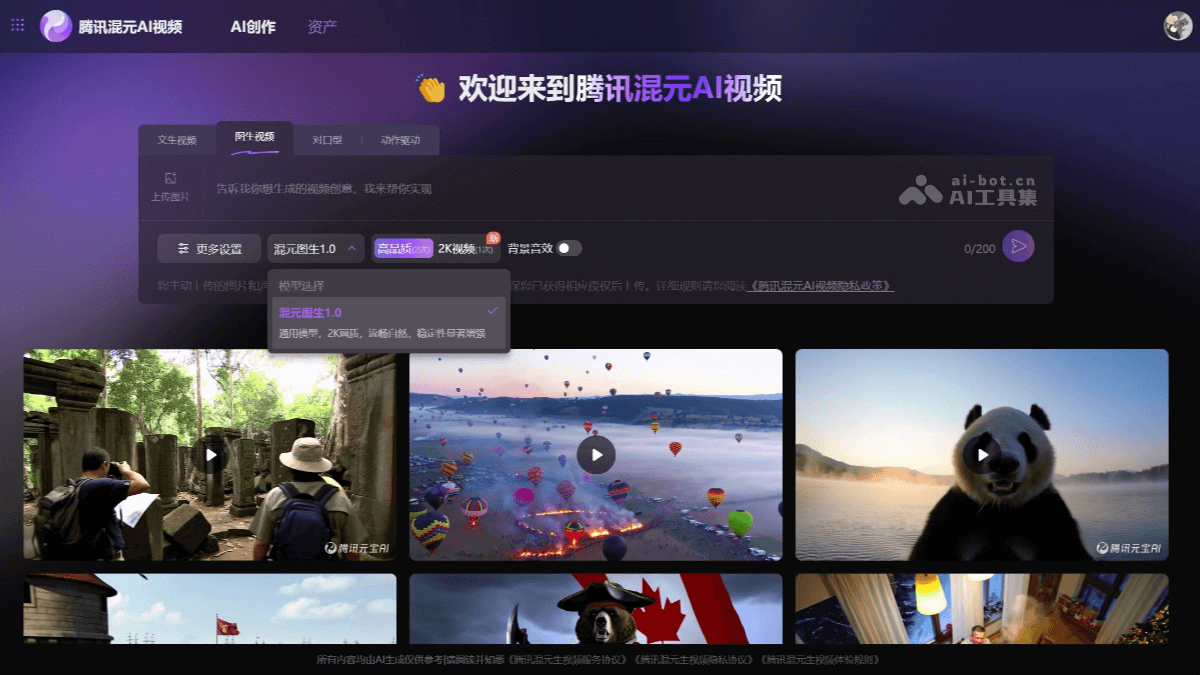
- Experience via the Hunyuan AI Video Official Website: Users can directly visitTencent Hunyuan AI Video Official Website, select Image-to-Video, upload an image and enter a brief description to generate a 5-second short video.
- Use Tencent Cloud API Interface: Enterprises and developers can apply for an API interface through Tencent Cloud to achieve more efficient video generation and customized development.
- Deploy Open-Source Model Locally: For users who need greater customization, the Tencent Hunyuan Image-to-Video model has been open-sourced on GitHub and supports local deployment and customized development.
- Hardware Requirements
- GPU: NVIDIA GPU, CUDA support, minimum 60GB VRAM (for generating 720p video), recommended 80GB VRAM.
- Operating System: Linux (official test environment).
- CUDA Version: CUDA 11.8 or 12.0 recommended.
Application Scenarios of Hunyuan Image-to-Video
- Creative Video Generation: Generate short videos by uploading images and descriptions.
- Special Effects Production: Achieve customized special effects through LoRA training, such as hair growth, character motion, etc.
- Animation and Game Development: Quickly generate character animations and reduce production costs.