
What Is HiDream-O1-Video-1.0
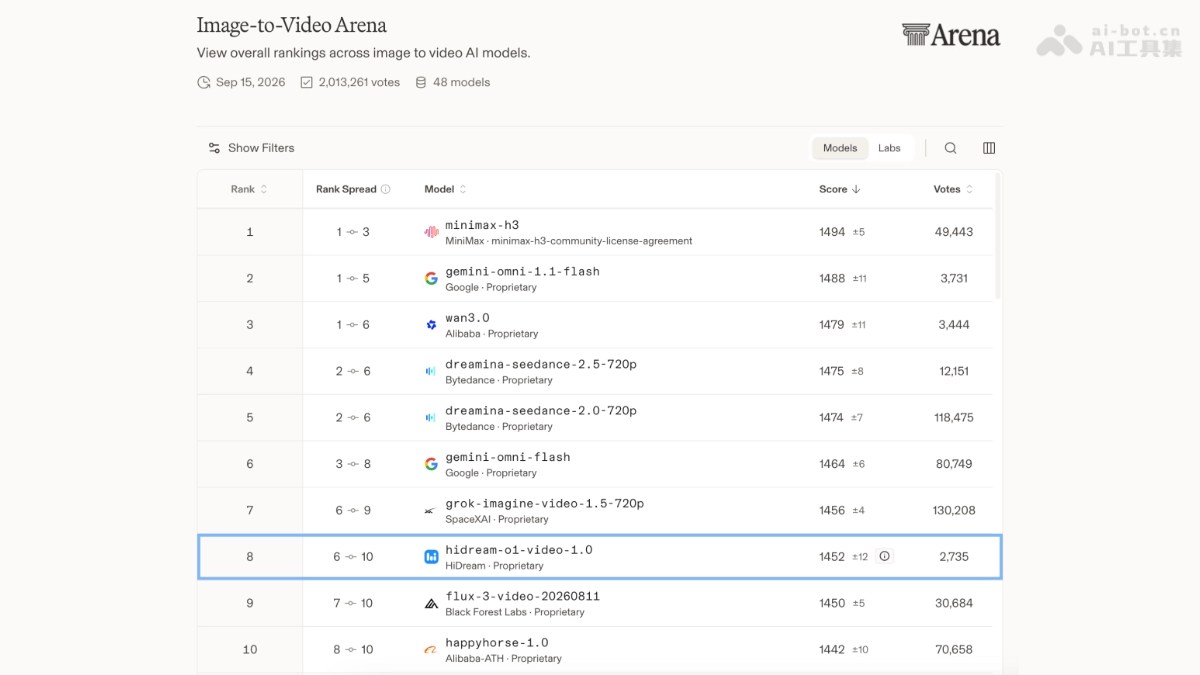
HiDream-O1-Video-1.0 (abbreviated as HD-V1) is the native omni-modalvideo generation modellaunched by HiDream.ai. It supports multimodal inputs such as text, images, and videos, and can directly generate 5–20 second 1080p videos in one step. The model is oriented toward physics-compliant generation and native audio-visual integration. It ranks fourth globally on the Artificial Analysis image-to-video leaderboard (With Audio) and eighth on the Arena.ai blind test leaderboard, marking that Chinese AI video has entered the global first tier.
Main Features of HiDream-O1-Video-1.0
-
Multimodal Input: Supports multiple modalities such as text, images, and videos as generation conditions.
-
High-Fidelity Direct Video Output: Generates 5–20 second 1080p high-quality videos in one step.
-
Intent Understanding: A front-end multimodal understanding module structurally plans colloquial input into professional schemes such as shots, characters, actions, and sound effects.
-
Physics-Compliant Generation: Physical laws such as gravity, collision, and inertia are written into the generation logic, so image deformation and motion fit the real world.
-
Intelligent Duration Planning: Automatically determines video duration based on event logic and narrative rhythm, rather than mechanically filling a fixed window.
-
Audio-Visual Integration: Text, video, and audio signals are jointly modeled to achieve native synchronization of lip sync, sound effects, and visuals.
-
Narrative and Character Consistency: Adopts a process of planning first, then joint generation, then Reward alignment, ensuring coherent long-shot narrative and no character drift.
Technical Principles of HiDream-O1-Video-1.0
- Native Omni-Modal Unified Architecture: HD-V1 adopts HiDream's self-developed native omni-modal architecture. From the very beginning of the architecture design, it is oriented toward unified representation of text, video, and audio. The three are jointly modeled, mutually constrained, and aligned in the same generation process. Visual motion drives sound rhythm, dialogue and sound effects feed back into shot emotion, and text conditions run throughout.
- Front-End Multimodal Intent Understanding Module: The model first uses a multimodal understanding model to deeply understand and structurally plan user input, converting colloquial and vague natural language into professional fields such as shot duration, scene location, present characters, actions and expressions, shot size and composition, camera movement and focal length, dialogue, and background sound. The deeper the understanding, the more stable the planning; the more stable the planning, the less likely the subsequent joint generation is to go off track, avoiding intent omission, shot jumping, and character drift from the source.
- Generation Logic with Inherent Physical Laws: How objects fall under gravity, how collisions provide feedback, how inertia continues, how light and shadow decay, and how space remains continuous.
- Three-Stage Generation Process of Planning—Generation—Alignment: HiDream proposes the technical approach of planning first, then joint generation, and then multimodal Reward alignment: the model first plans narrative and character states at the global level, constrains visuals, actions, and semantics during joint generation, and uses multimodal reward signals to uniformly align image quality, coherence, and physical plausibility, ensuring overall self-consistency under the mutual influence of characters, emotions, and motivations in long shots.
How to Use HiDream-O1-Video-1.0
- Confirm Open Status: The model is currently in internal testing and has not yet been fully publicly launched. You need to apply for early access.https://n1y46cmwsp.feishu.cn/share/base/form/shrcnVBeO99NQQWARxNirglcbct。
- Scan the QR Code to Fill Out the Application Form: Long-press to scan the QR code and enter the application form page.
- Submit application information: Fill in your personal/company information and usage requirements as required by the form, then submit and wait for official review.
- Wait for activation notice: After the review is passed, you will receive beta testing eligibility.
- Experience model capabilities: After obtaining eligibility, you can input text, images, or videos through the official entry point and generate 5–20 second 1080p audio-video integrated videos with one click.
Core advantages of HiDream-O1-Video-1.0
- Native omni-modal architecture: The industry's first video model to jointly model text, video, and audio signals, with native integrated audio-video generation.
- Physics-guided generation: Physical laws such as gravity, collision, inertia, light and shadow attenuation, and spatial continuity are truly understood by the model and written into the generation logic. Image deformation, motion feedback, and foley effects all conform to real causality.
- Deep intent understanding: A front-end multimodal intent understanding module structurally plans colloquial and fragmented user input into professional schemes such as shot duration, shot size and composition, camera movement, actions and expressions, and dialogue sound effects, avoiding intent misinterpretation and jarring cuts at the source.
- Duration follows narrative: Breaks the traditional logic of "filling content into a fixed duration window." The model autonomously plans duration based on the logic of event development and narrative rhythm, avoiding meaningless waiting after actions are completed or padding with slow motion.
- Narrative coherence and character consistency: Adopts a technical path of planning first, then joint generation, and then using a multimodal Reward pair. Combined with Diffusion RL and a Reward model aligned with human cognition, it ensures that characters, emotions, and motivations remain coherent and do not drift across continuous shots.
Comparison of HiDream-O1-Video-1.0 with similar competitors
| Comparison dimension | HiDream-O1-Video-1.0 (HiDream.ai) | Google Veo 3.1(DeepMind) |
|---|---|---|
| Native audio-video synchronization | ✅ Joint modeling of text/video/audio, native integration | ✅ Synchronously generates dialogue, sound effects, and ambient sound, with error <0.1 seconds |
| Generation duration | 5–20 seconds,duration autonomously planned by the content | Single segment 4–8 seconds, extended up to 148 seconds |
| Output specifications | 1080p | 720p/1080p, enterprise edition 4K super-resolution |
| Physical laws | ⭐ Core selling point: physical laws written into the generation logic (gravity/collision/inertia/light and shadow) | Strong physical simulation, but not an architecture-level core narrative |
| Intent understanding | ⭐ Front-end multimodal intent module, structurally plans fields such as shots/sound effects | Relies on Gemini prompt understanding, fewer control options, no camera control system |
| Multimodal input | Text, images, videos | Text, up to 3 reference images, video extension |
| Leaderboard performance | Artificial Analysis image-to-video (With Audio) global fourth; Arena.ai blind test eighth | Artificial Analysis text-to-video ELO about 1098 |
Application scenarios of HiDream-O1-Video-1.0
-
Advertising and marketing short films: Directly outputs 1080p product videos with integrated audio and video, eliminating post-production dubbing costs, while physically realistic material expression suits high-quality product displays.
-
Short video/social media content creation: The 5–20 second adaptive duration naturally matches the rhythm of short videos, and conversational prompts can generate finished videos with sound effects and lip sync.
-
Film and television previsualization and storyboarding (Previs): Structurally plan shots, shot sizes, camera movement, and sound effects, helping directors quickly validate narrative pacing and visual feasibility before shooting.
-
E-commerce product dynamic display: Input product images to generate usage scenario videos, with realistic physical object motion, and synchronized Foley improves conversion rates.
-
Education and popular science content: Transform fragmented knowledge points into dynamic demonstrations with accurate physical laws, and synchronized audio and visuals lower the threshold for understanding.