
What is HiClaw
HiClaw is an Agent team collaboration system open-sourced by Alibaba, positioned as the "Team Edition OpenClaw". The system introduces a Manager Agent as an AI steward, automatically coordinating multiple Worker Agents to complete complex tasks. HiClaw's core highlights include: Workers do not hold real credentials (only Consumer Tokens), providing secure isolation against leaks; a built-in Matrix server allows you to check in and intervene from your phone at any time; conversational Worker creation, with automatic task dispatch and progress monitoring. The system is suitable for independent developers and one-person companies to quickly assemble an AI employee team, achieving "one person commanding multi-Agent collaboration".
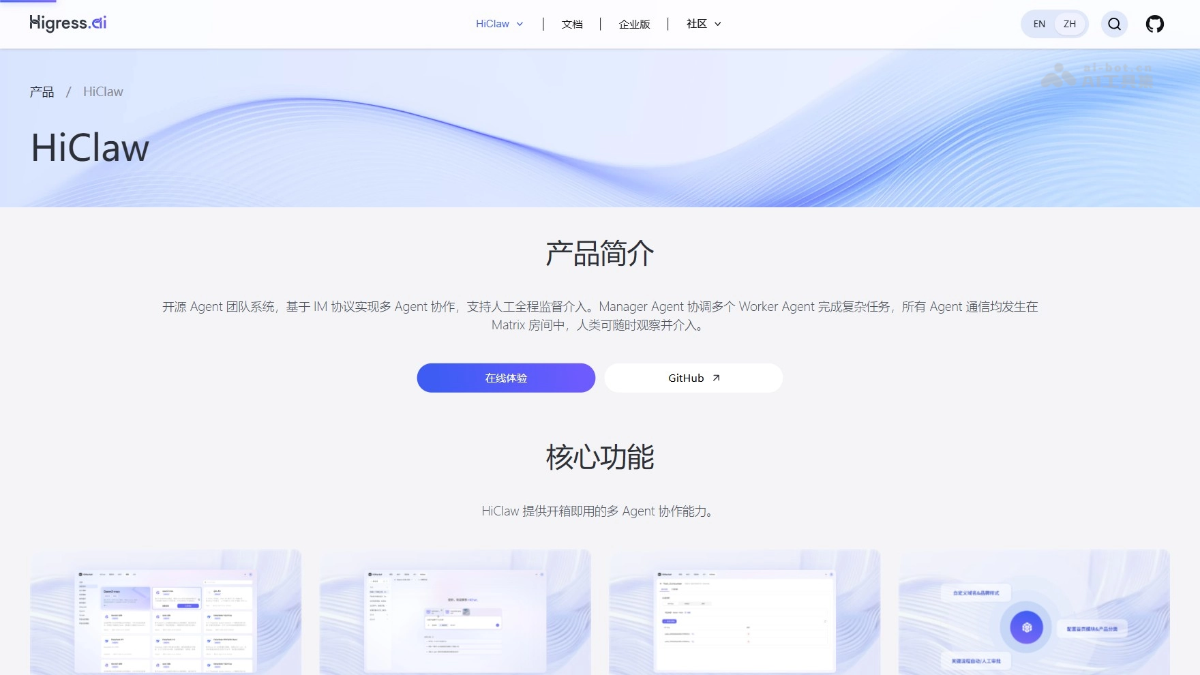
HiClaw's main features
-
Manager-Agent coordination: The Manager Agent acts as an AI steward, automatically creating Workers, assigning tasks, and monitoring execution progress through natural language conversation, without the need to manually configure each Agent.
-
Multi-Agent collaboration: Supports creating multiple Worker Agents by role (such as frontend, backend, product), with each Worker having an independent skill set and memory space, avoiding task mixing and context contamination.
-
Secure credential management: Workers only hold a Consumer Token issued by Higress. Sensitive credentials such as real API Keys and GitHub PATs are stored centrally in the AI gateway, so even if a Worker is compromised, core credentials cannot be leaked.
-
Built-in IM system: Integrates the Tuwunel Matrix server and Element Web client, requiring no integration with Feishu or DingTalk bots, and supports real-time communication on browsers and mobile devices out of the box.
-
Human supervision and intervention: All Agent communication takes place in Matrix group chat rooms. Administrators can observe the conversation flow at any time and directly @ any Agent to intervene or correct.
-
Dynamic skill loading: Workers have built-in find-skills capability, can proactively retrieve and install skills.sh community skills, and also support switching to a private skill library to meet enterprise customization needs.
-
File sharing storage: Uses MinIO as a centralized file system. Intermediate artifacts such as code and documents are transferred through file sharing rather than group chat, keeping the conversation context concise.
-
One-click deployment and operations: A single command completes the full installation of the Higress gateway, Matrix server, MinIO storage, Manager, and Web client, and supports in-place upgrades and data persistence.
HiClaw's technical principles
- Layered architecture design: HiClaw uses a four-layer architecture to achieve separation of responsibilities. The user layer interacts with the system through the Matrix protocol; the coordination layer has the Manager Agent responsible for task decomposition and Worker lifecycle management; the execution layer deploys stateless Worker Agent containers; the gateway layer uses the Higress AI Gateway to uniformly proxy all external service access and host real credentials. Layering ensures that even if a Worker is attacked, it cannot reach sensitive information, while also making it easy to independently scale components at each layer.
- Secure credential flow mechanism: When a Worker starts, it obtains a Consumer Token from the Manager. The token only identifies the identity and has no actual permissions. When a Worker calls an LLM or GitHub API, the request first passes through the Higress Gateway, which injects the corresponding real API Key based on the Token identity and then forwards it to the upstream service. The design achieves complete isolation of credentials: the Manager knows the task content but cannot access keys, and the Worker executes tasks but cannot export credentials, eliminating credential leakage risks at the architectural level.
- Thundering herd prevention and message routing: When implementing multi-agent collaboration based on Matrix group chats, HiClaw designs a precise wake-up mechanism. By default, group chat messages do not trigger any agent; only when the message content @-mentions a specific agent or contains specific keywords will the corresponding agent call the LLM to respond. This avoids the wasted cost of all agents performing inference on every message, while maintaining the continuity of the group chat context, making communication overhead controllable during multi-person, multi-agent collaboration.
- Hierarchical Storage and State Management: The system adopts a dual-storage strategy to separate different types of data. The Matrix server retains only conversation messages and decision records as the agent's "memory" context; MinIO object storage is responsible for saving large intermediate artifacts such as code files, documents, and temporary data. Workers themselves are designed to be stateless, accessing files by mounting shared volumes, and can be destroyed once tasks are completed. This both controls LLM context length to reduce costs and enables rapid start/stop and elastic scaling of Workers.
HiClaw's project address
- Project official website:https://higress.ai/hiclaw
- GitHub repository:https://github.com/higress-group/hiclaw
HiClaw's application scenarios
- Full-stack development for independent developers: A solo developer can quickly assemble a virtual team, creating multiple Workers for frontend, backend, testing, and more to develop in parallel. The Manager automatically coordinates dependencies, achieving the efficiency of "one person matching a whole team," suitable for independent contracting or side projects.
- Rapid MVP validation for one-person companies: Entrepreneurs describe product requirements in natural language, and the Manager automatically breaks them down into subtasks such as PRD writing, technology selection, core development, and release material preparation, assigning them to Workers in different roles for execution, completing the entire process from idea to launch within a few days.
- Enterprise digital employee pilot: Enterprises can deploy HiClaw locally and privately, handing repetitive work (such as data report generation, code review, and document organization) to an agent team, while human employees focus on decision-making and innovation, gradually exploring human-machine collaboration models.
- Open source project maintenance: Open source maintainers create Workers to handle daily affairs, such as automatically replying to issues, generating changelogs, reviewing PRs, and synchronizing document translations. The Manager monitors task status and reminds maintainers to intervene when anomalies occur.