
These past few days, GPT-6 Astra after its release, everyone has been discussing one thing: when it comes to achieving AGI, has GPT-6 Astra already won by too much?
I came across Jensen Huang saying that AGI has indeed arrived because of GPT-6 Astra.
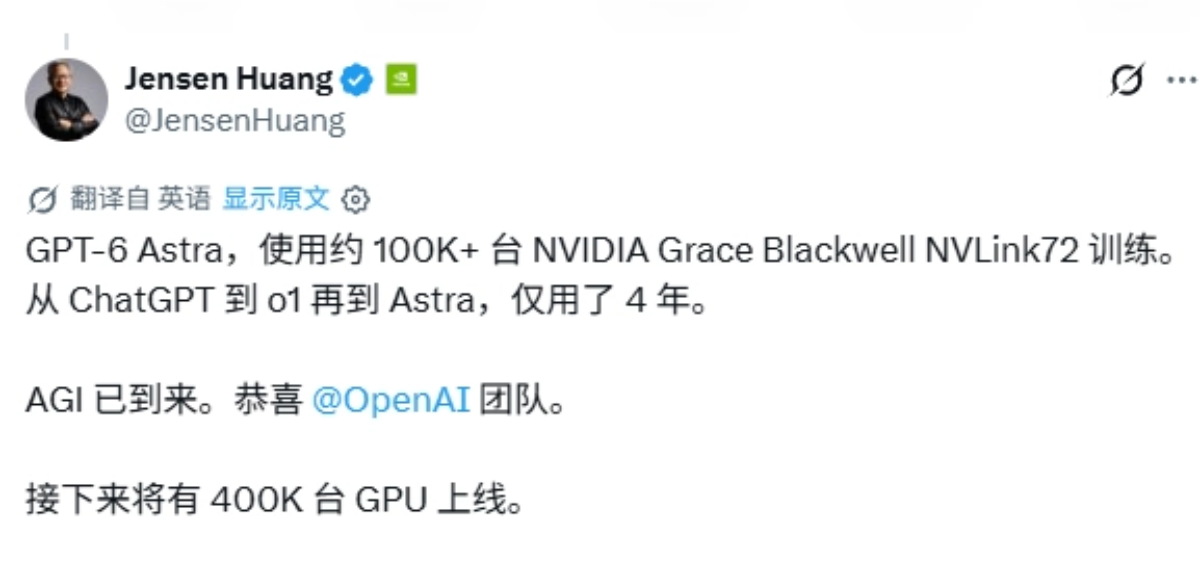
But isn't this really just because OpenAI uses his company's products, so he's flattering his client daddy a bit?
Only comparison reveals the truth. I put GPT-6 Astra and Claude Fable 5.1 into several cases and tested them hands-on. Everyone will see at a glance who is ahead when it comes to achieving AGI.
01. GPT-6 Astra VS Fable 5.1
case 1 A late-night bookstore in a suitcase
Packing a bookstore into a suitcase shows at the same time how a model arranges space, preserves details, and uses lighting to convey time.
Prompt:
Make a desktop miniature model in Blender: an open old suitcase, inside which is a two-story late-night bookstore. It must have stairs connecting the upper and lower levels, bookshelves along the walls, an upstairs reading corner, and a cat lying on the edge of the suitcase; make the inside of the lid into a small skylight with stars. Keep the handle and locks recognizable as a suitcase.
Warm light inside the bookstore, cool ambient light outside; design the structure and materials yourself. Use a three-quarter camera angle from the front and slightly above to clearly see the two levels and the stairs; all models must use Blender's built-in geometry and materials.
Deliver only one complete Python script. After running it, save an editable .blend and render a 1280×720 PNG. No animation, no downloading assets, no accompanying explanation.
GPT-6 Astra:
Blender file:
Rendered image:
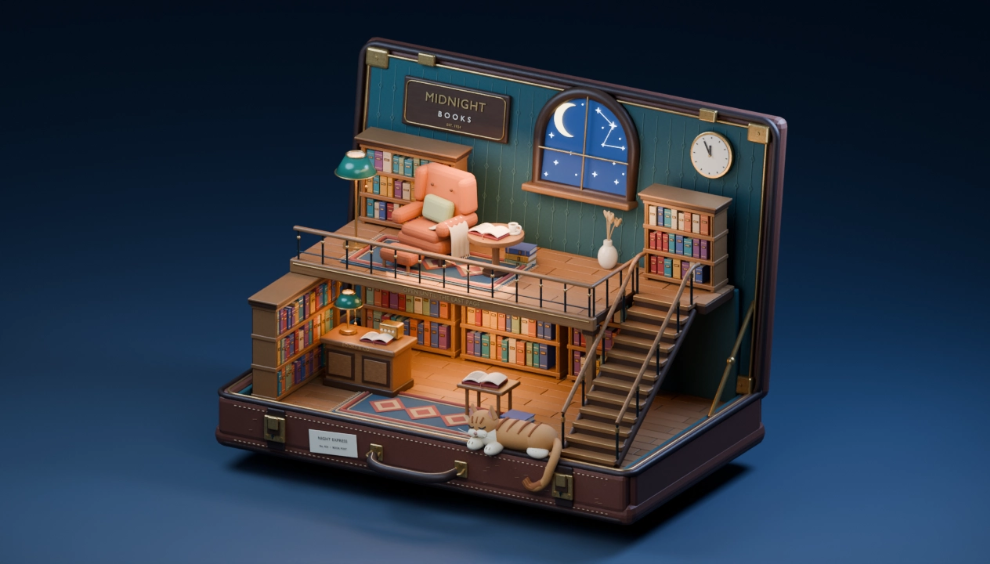
GPT-6 Astra's two levels are clearly visible, the stairs connect to the second floor, and the handle, locks, and suitcase lid still preserve the look of a suitcase. The warm indoor light and cool outdoor light are distinct, and the late-night bookstore atmosphere holds up.
Zoom in and there are still open book pages, buttons on the chair back, and a blanket on the armrest. These details make the reading corner look more like someone has sat there. However, the suitcase body and books are quite tidy, and the worn feel of an old suitcase could still be added.
Claude Fable 5.1:
Blender file:
Rendered image:
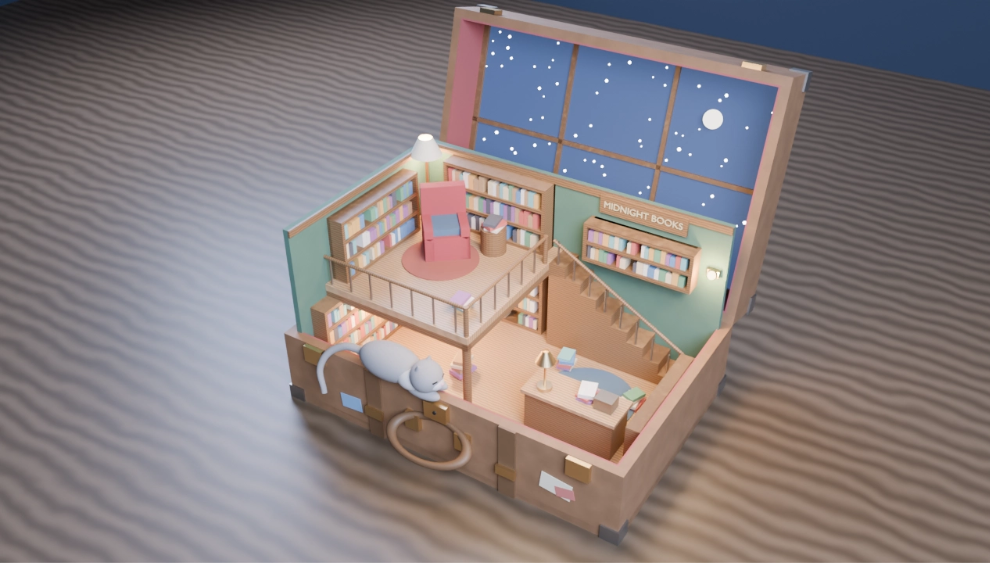
Claude Fable 5.1 also completed the structure. On the left is the second-floor reading area, on the right are the stairs, and a first-floor counter is left in the front, which is easy to understand.
The difference is mainly in lighting and materials. The pink chair, light-colored book spines, and bright floor make the scene look more like a toy house staged in daylight; the furniture also retains a fairly obvious block-assembly feel.
For this one I choose GPT-6 Astra. Both completed the main structure, but GPT-6 Astra made the nighttime atmosphere and everyday details fuller.
case 2 Send raindrops into a flowerpot
A small game must be actually playable. Collision problems that can't be seen in screenshots directly affect the player experience.
Prompt:
Make a single-screen web mini-game called Send the Rain Home. The scene is the exterior wall of a residential building on a rainy night; draw windows, a clothesline, a T-shirt, socks, and a flowerpot at the bottom. The player controls a bright raindrop. The raindrop keeps falling. Press the spacebar to switch the wind to left or right. The horizontal wind speed and falling speed are fixed.
Avoid the clothing and fall into the flowerpot to succeed; touching clothing, going out of the left or right boundary, or landing anywhere else at the bottom counts as failure. The starting point and obstacles are fixed, and arrange a route that can be completed. Provide clear wind direction, success, and failure feedback. Press R to restart from the initial state.
Use Canvas, scene 960×640, design the visual style yourself. Deliver only one offline HTML, make only one level, and do not add sound effects, menus, external resources, or explanations.
GPT-6 Astra:
In GPT-6 Astra's residential building, there are desk lamps, curtains, and books, and the clothes have stripes, pockets, and stitching; the scene details are rich.
What is more worth looking at is how raindrops hit the clothes. GPT-6 Astra uses the same set of contours of the clothing to draw the image and determine collisions, and the gap under the sleeve is also included in the calculation. When the spacebar is held down, it also filters out repeated system key presses, so the wind direction does not jump around continuously.
Claude Fable 5.1:
Claude Fable 5.1's large wind-direction arrow is very eye-catching, the flowers bloom after success, and the reason for failure and how to restart are also clear; the level can actually be completed.
The problem is that the collision area is larger than the clothes drawn. In existing operation records, raindrops were judged as wetting the hanging yellow T-shirt while still in the blank area at the upper left of the yellow T-shirt. The player clearly saw a gap, yet still lost.
GPT-6 Astra wins this item. Claude Fable 5.1's feedback is complete, but the collision error affects operation.
case 3 Small bookstore space renovation
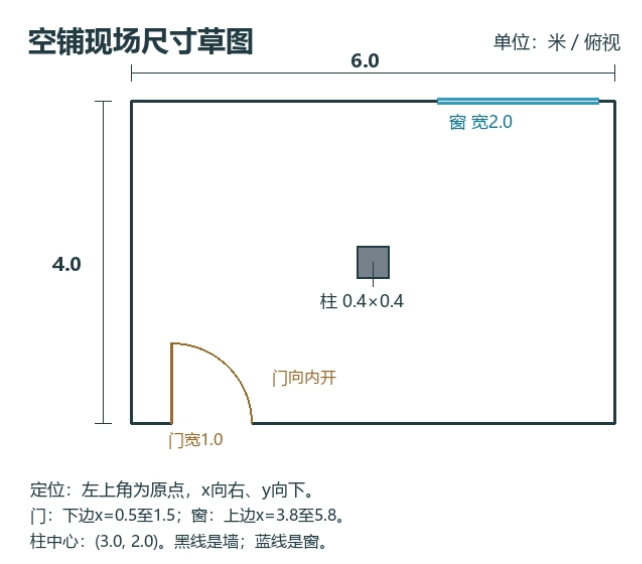
Fixing the doors, windows, and columns, then requiring passage space to be left, allows checking whether the dimensions marked by the model actually exist.
Materials:
Prompt:
Based on the attachment, convert this empty 6×4-meter shop into a small bookstore and draw a 900×650 color top-down conceptual layout plan. Preserve the positions of the door, door-opening direction, windows, and columns.
Arrange book walls, one checkout counter, and four reading seats. The continuous passage from the entrance to the interior must be at least 90 centimeters, and furniture must not block the door-opening area or overlap with columns. Design the furniture shapes, materials, and arrangement yourself, mark functions, main dimensions, and passage width, and make the difference between tables, chairs, and bookshelves visible in the drawing.
Deliver only one standalone SVG, drawn with vector shapes and text, without referencing images, external fonts, or resources, and without explanation.
GPT-6 Astra:
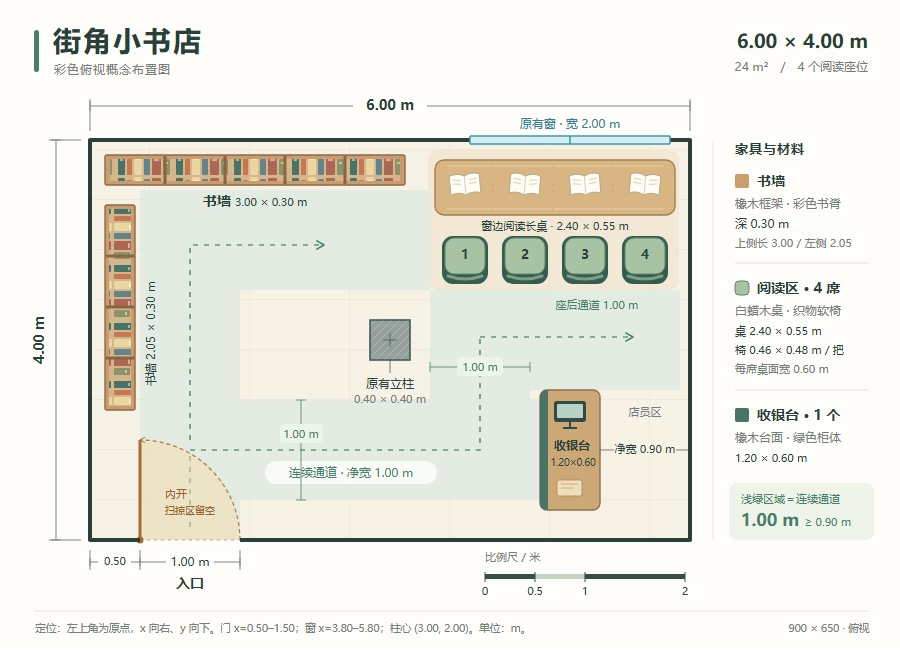
GPT-6 Astra places the four seats beside the long table by the window, uses light green areas to draw the continuous passage, reserves the main branches at 1 meter, and also leaves 0.9 meters of staff space behind the checkout counter. The positions of the door, windows, and columns are all correct, and the furniture also avoids the door-opening area.
Claude Fable 5.1:
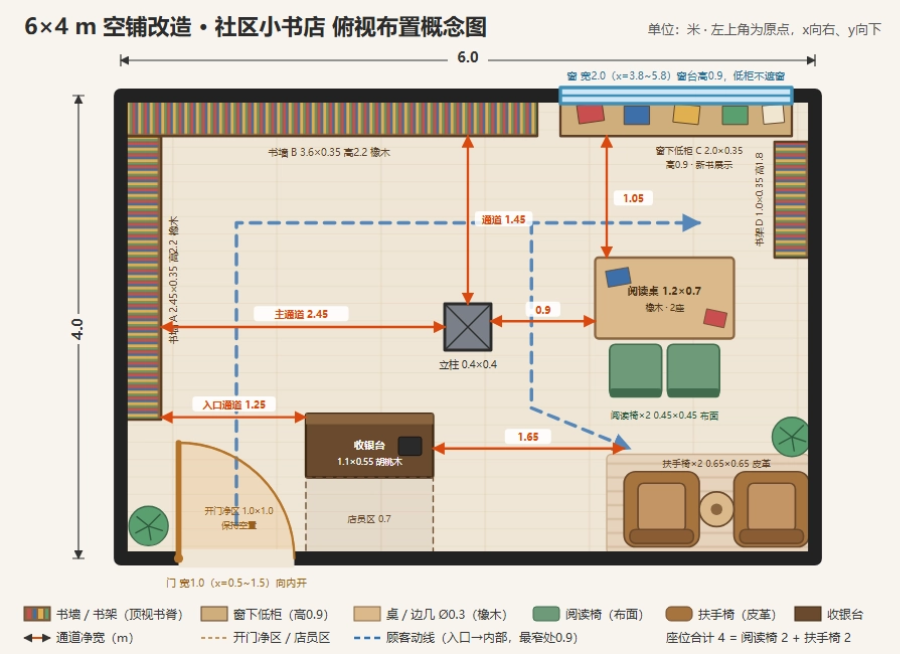
Claude Fable 5.1's reading approach is more varied: two chairs at the table, plus two armchairs, and there is also a low cabinet for new book displays under the window.
However, the local spacing in the lower-right reading corner is about 0.64 meters, yet the legend generally says the narrowest point is 0.9. The main passage has a route that meets the requirements; the problem lies in the mismatch between the local space of the reading corner and the annotation, so it cannot be said on that basis that the entire plan is impassable.
GPT-6 Astra is more reliable for this item. Four seats lined up along the long table is indeed monotonous, but the passage and dimensions are easy to verify. For this kind of conceptual layout plan, I would prioritize preserving these basic conditions, then adjust the furniture's interestingness.
case 4 Business diagram before and after the event
Putting overall and group changes in the same chart makes it possible to compare whether the model truly depicts the relationships between the data.
Prompt:
Make a 1000×700 data diagram for a coffee shop staff meeting. Before the event: 100 member-entry visitors, 40 payments; 900 ad-entry visitors, 90 payments. After the event: 800 member-entry visitors, 288 payments; 200 ad-entry visitors, 16 payments. The two entries do not overlap, and each person pays at most once.
At the same time, show the overall conversion rate, the conversion rate of each of the two entries, and the two-week customer flow composition, so the store manager can clearly see the relationships among the changes. Choose the title and chart forms yourself, write the key values in the chart, and keep the explanatory text to no more than 60 Chinese characters in total.
Deliver only one standalone SVG, with editable graphics and text, without external resources, and without an analysis process.
GPT-6 Astra:
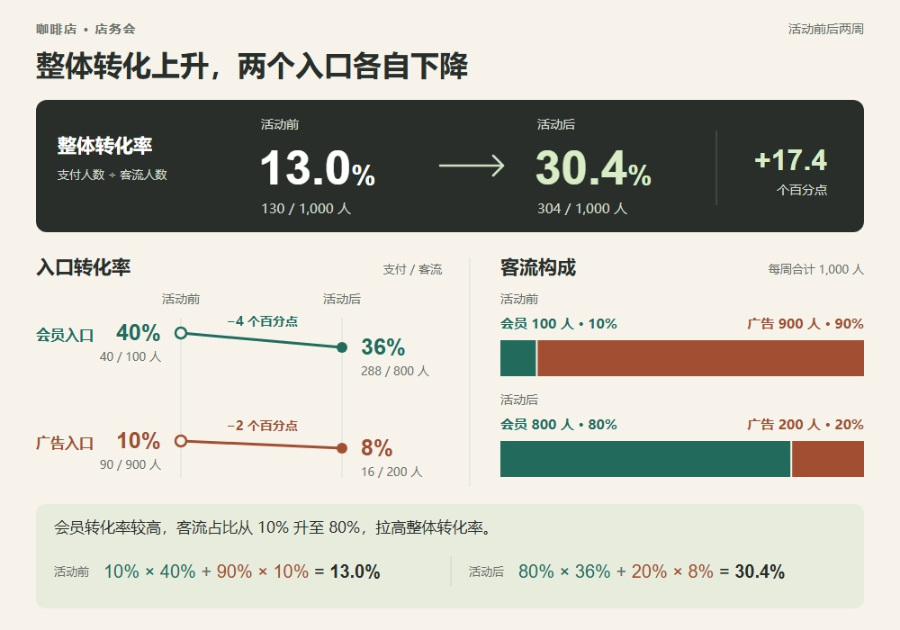
GPT-6 Astra got the numbers right and laid them out clearly. The overall conversion rate is shown at the top, the downward trends of the two entrances are plotted at the bottom left, and traffic share is plotted at the bottom right. The colors are consistent throughout, making it easy to check the numbers.
Claude Fable 5.1:
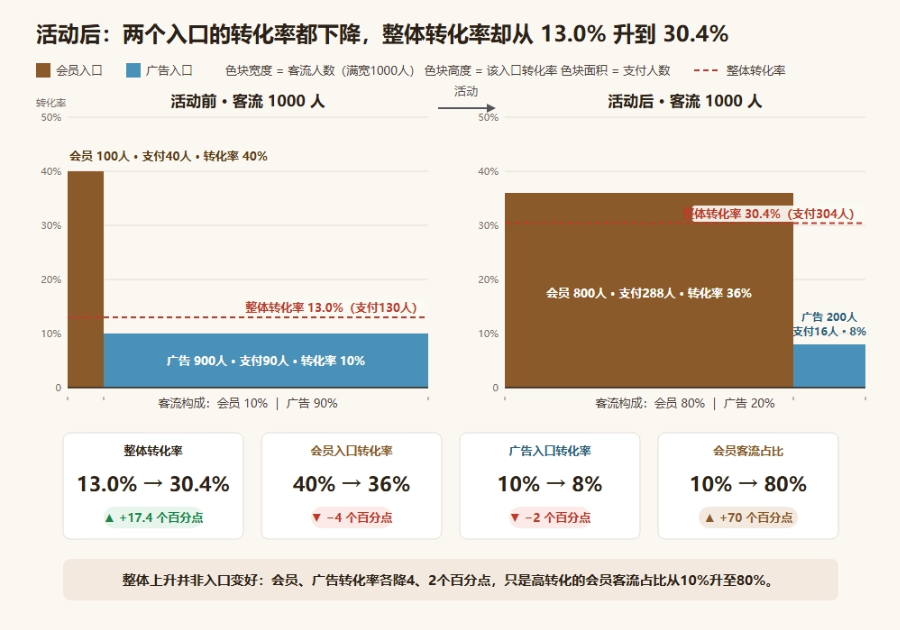
Claude Fable 5.1's approach is better suited to explaining this problem: the width of a block represents the number of visitors, the height represents the conversion rate, and the area corresponds to the number of payers.
After the campaign, the member block became slightly shorter but noticeably wider. Once they understand the legend, the store manager can see in the same chart why the member entrance's conversion rate fell while the number of payers still increased.
Claude Fable 5.1 wins this one, with the advantage that the graphic itself explains the relationship.
case 5 Old Book Night Market poster
Letting Chinese characters serve as both the title and the main visual shows whether a model can balance character-form creativity with event information.
Prompt: Design a 900×1200 vertical poster for "Old Book Night Market," with the large character "书" as the main visual, connecting the shapes of book pages, alleys, or windows with the character form; design the specific composition yourself.
The image uses dark blue and warm yellow. It must clearly write: Old Book Night Market; September 19, 19:00—22:00; East Hall; free admission. The main visual can be interesting, but the event information must be easy to find.
Deliver only a standalone SVG, made with vector shapes and editable Chinese text, without referencing images, external fonts, or resources, and without explanations.
GPT-6 Astra:

GPT-6 Astra's "书" character is very striking, with book pages and windows directly integrated into the strokes, and the event information concentrated in a solid warm yellow area at the bottom. When scaled down to a small image, the main subject's outline and the information area are still there.
Claude Fable 5.1:

Claude Fable 5.1 builds the "书" character into a glowing building, paired with silhouettes, a moon, and string lights, giving a stronger night market atmosphere. The date, time, and free admission are also clear.
There is not much difference between the two in this one. I value the "书" character main visual specified in the prompt more, so I choose GPT-6 Astra; Claude Fable 5.1's book-page characteristics are weaker, and its visual focus leans more toward the building and street.
case 6 Moon phase diagram for children
Drawing both the illuminated side in space and the lunar surface seen from Earth can check whether the model explains both perspectives clearly.
Prompt:
Draw a 1000×700 moon phase explanation diagram for a 10-year-old child, covering only new moon, first quarter, full moon, and last quarter.
Facts: The Moon itself does not emit light; sunlight illuminates about half of the Moon. As the Moon orbits Earth, the proportion of the illuminated part we see changes; ordinary moon phases are not caused by Earth's shadow blocking it.
Distinguish "spatial positions viewed from above the north side of the orbit" from "the lunar surface seen from Earth," with sunlight coming from the left; use the standard convention for the lunar surface with lunar north up as seen from the Northern Hemisphere. Draw the correspondence between the 4 positions and the corresponding moon phases, label the viewpoints clearly, and keep the total explanation to no more than 80 characters.
Deliver only a standalone SVG, design the visual style yourself, do not use external resources, and do not include explanations.
GPT-6 Astra:
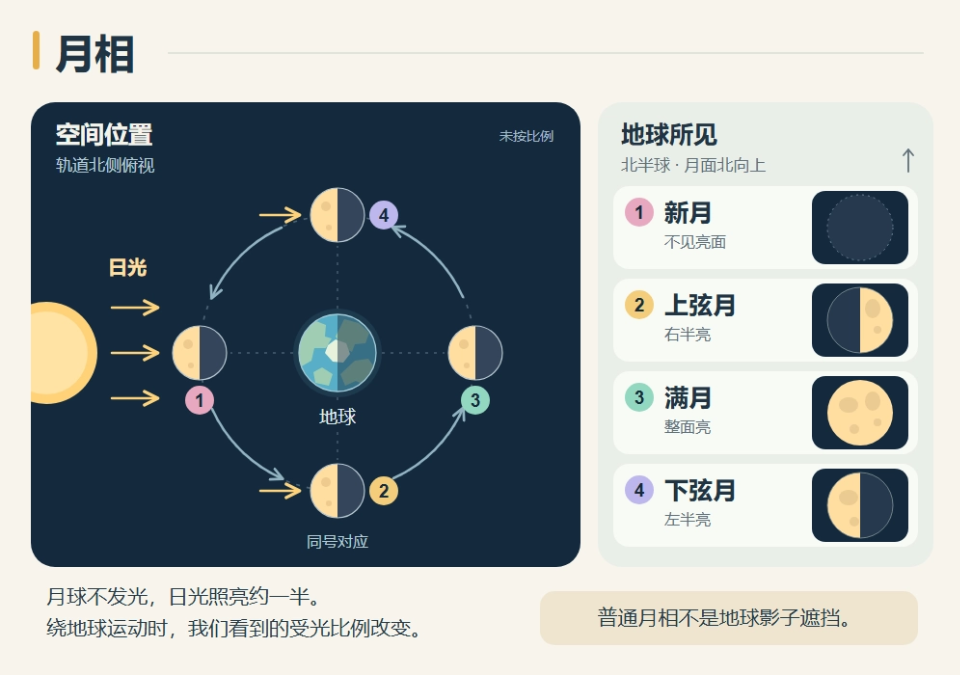
GPT-6 Astra divides spatial positions and what is seen from Earth into left and right panels, pairing them with numbers in different colors. The division is clear, but there are only numbers beside the orbit, so children need to look to the right side to find the corresponding names.
Claude Fable 5.1:
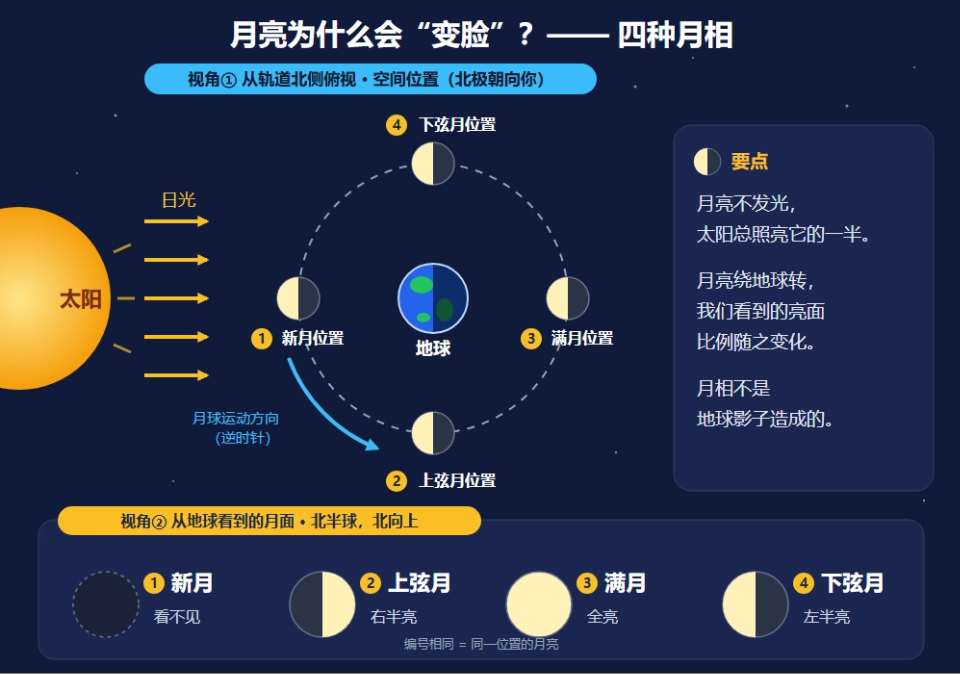
Claude Fable 5.1 writes the moon phase names directly beside the orbit, uses thick blue arrows to indicate the direction of motion, and then arranges the four lunar surfaces horizontally at the bottom. If you want to find where the first quarter is, you can find it directly in the spatial diagram, then look below to see what the lunar surface looks like.
I choose Claude Fable 5.1 for this one. I value the direct labeling of names and the ease of comparison more.
case 7 Camping lantern exploded view
Drawing both a complete view and an exploded view of the same product shows whether the model maintains consistency in shape, proportions, and materials.
Prompt:
Design a product concept exploded view of a "mushroom-shaped portable camping light" on a 1000×700 canvas. On the left is a three-quarter view of the complete light, and on the right, along the same vertical axis, show the transparent cover, LED disc, cylindrical battery compartment, and base separated, while retaining the top handle.
The complete view and the exploded view must correspond to the same shape, with component axes and proportions consistent, and use a few leader lines to label names. Use vector layers to distinguish transparency, metal, and warm glow; design the specific form and color scheme yourself, and do not write engineering performance or specifications.
Deliver only a standalone SVG, do not reference images, external fonts, or resources, and do not include explanations.
GPT-6 Astra:
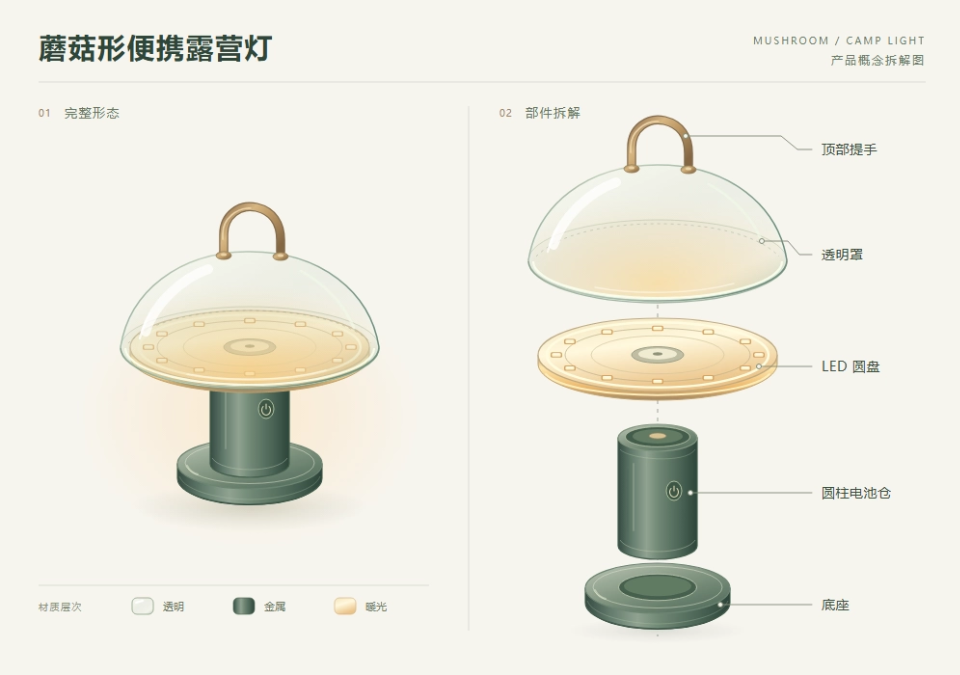
GPT-6 Astra's transparent cover outline, light panel dimensions, LED arrangement, battery compartment button, and base groove all correspond on both sides. The internal structure is visible through the lampshade, and the materials are distinguishable.
Claude Fable 5.1:
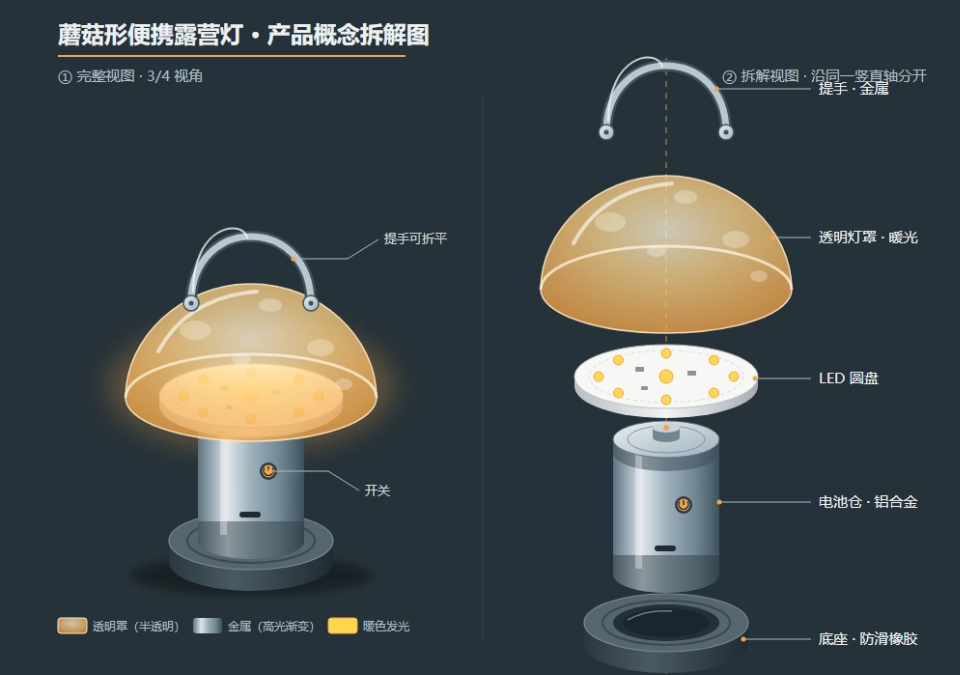
Claude Fable 5.1 also maintains the same components and scale, with silver metal, orange-yellow lampshade, and dark base clearly differentiated, and the handle is even separated out on its own. The lower right part is a bit tight, and the whitespace could be adjusted.
This item is a tie. Both completed the most critical component correspondence, with respective trade-offs in materials and layout, and there is no need to force a winner with the existing results.
case 8 Midnight Radio
Make the frequency, waveform, and city lights change together, then switch window sizes to check both visual feedback and page layout.
Prompt:
Make a single-screen "Midnight Radio" webpage, like a desktop radio. Display an 88–108MHz frequency scale, the current frequency, a play button, and a city skyline outside the window. Design the main materials, fonts, and color scheme yourself, with clear knobs, scale, and display area.
When dragging the knob or its corresponding slider, the current frequency, waveform, and city light color change synchronously; the play button controls whether the waveform moves, without playing real audio. Default 98MHz, desktop 960×640, and it can still be operated at 360 pixels wide on mobile.
Deliver only an offline HTML, with CSS and JavaScript inline, graphics drawn with CSS, SVG, or Canvas, and no backend, external resources, or explanation.
GPT-6 Astra:
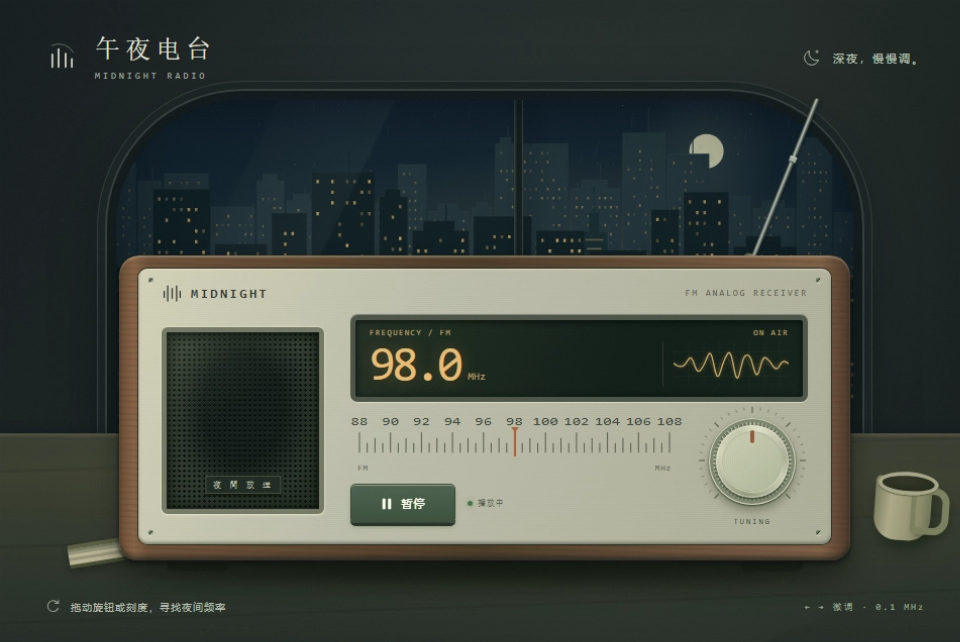
GPT-6 Astra uses a wooden frame, light-colored panel, and dark screen to create the radio's texture. When tuning, the numbers, waveform, and city window lights change together, and the frequency pointer can align with the scale.
At mobile size, the speaker moves to the bottom, the scale numbers actively decrease, and the main controls remain complete. The desktop auxiliary text is a bit small and the window lights are a bit dim, which are areas this result could still improve.
Claude Fable 5.1:
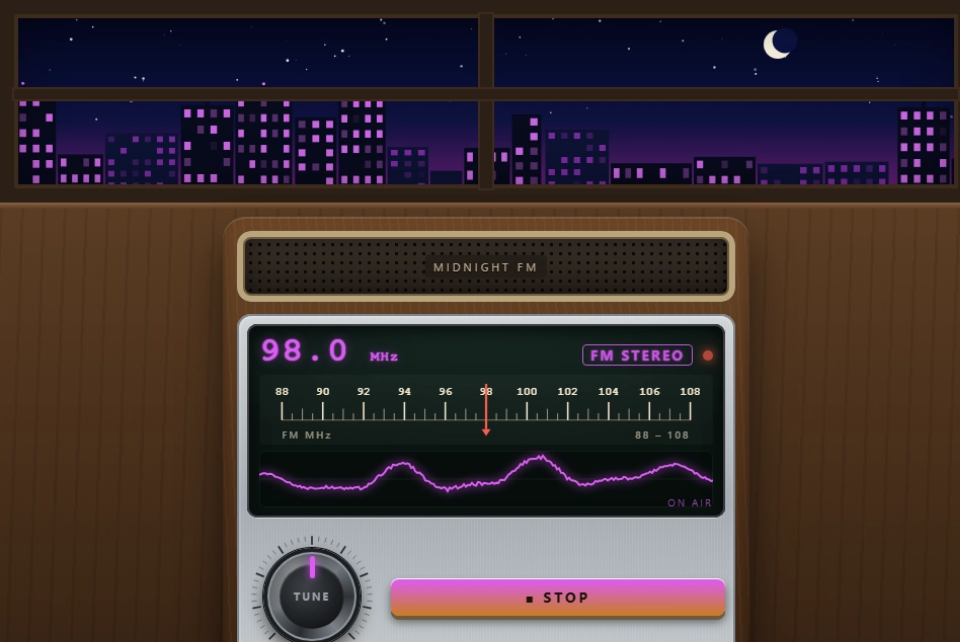
Claude Fable 5.1's metal knob and purple waveform are very striking, and the tuning, play, and pause logic all hold up.
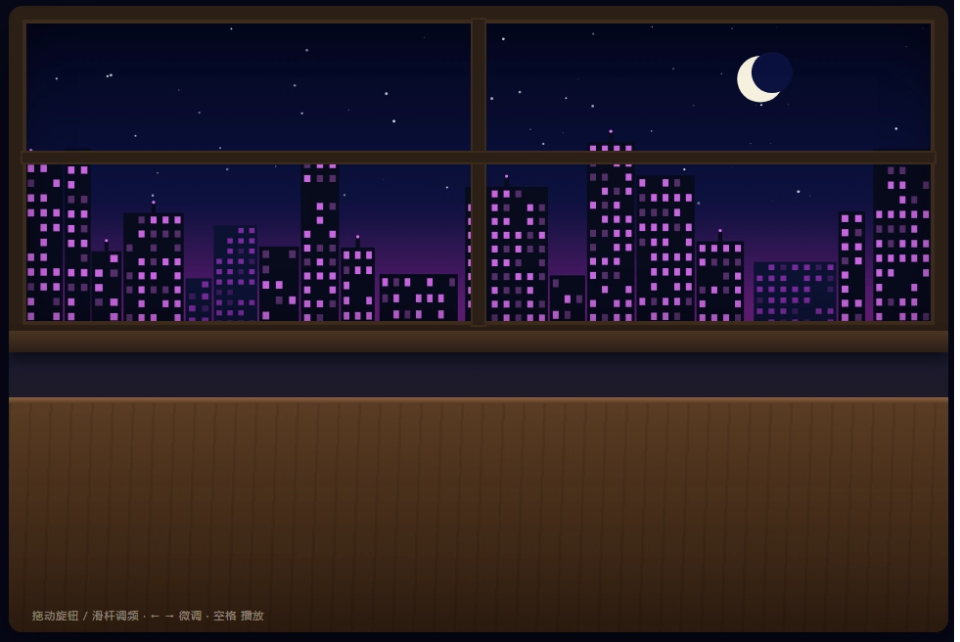
But at a page size of 1280×720: the entire radio is cropped outside the frame. This size is an extra check and should be viewed separately from the specified sizes in the prompt; it exposes a layout failure that appears when the window becomes wider.
GPT-6 Astra wins this item. Claude Fable 5.1 already got the tuning logic right, but whether the interface can appear completely also affects delivery.
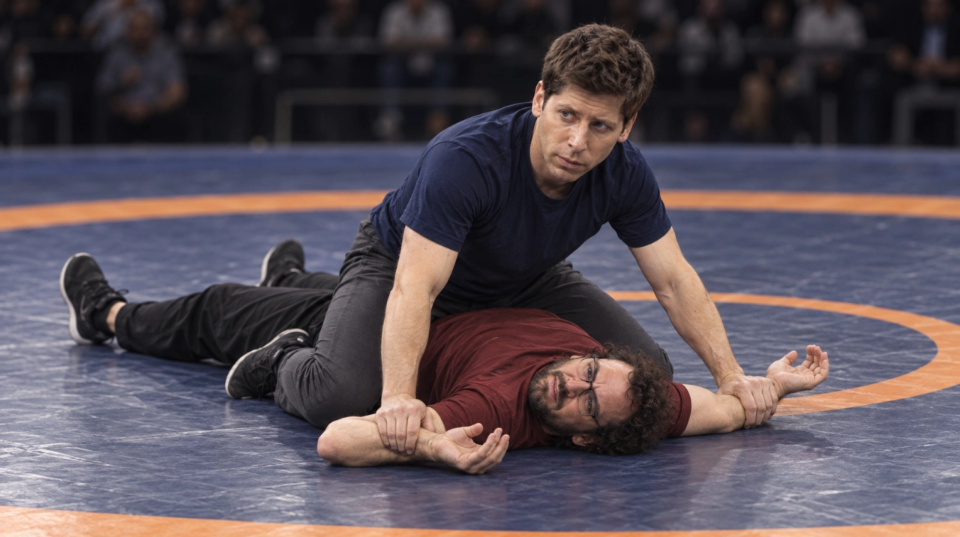
PS: These past few days I also ran a rather fancy case with GPT-6 Astra alone, and I'm sharing it here for everyone to see.。
02. Comparison Summary
After running these 8 cases, if I had to choose a model closer to my expectations for AGI, I would choose GPT-6 Astra.
03. Some Sharing
I prefer to see GPT-6 Astra as a beginning. When AI can understand goals, call software, and advance complete tasks, enterprises will reconsider which work can be handed to models and at which step humans should participate.
If models can help researchers design experiments, analyze results, and drive the next generation of models to become stronger, recursive self-improvement, or RSI, may take shape.
This path has not yet been proven to work, but whichever of OpenAI and Anthropic can turn model capabilities into sustained R&D progress earlier will have a better chance of accelerating the pace toward AGI.
The definition of AGI will continue to be debated, but the way work is distributed may change first. Companies will calculate how much human labor and how many model calls a task requires, and individuals may also take on projects that previously required team collaboration.
Before AGI's arrival becomes a consensus, hiring demand, collaboration methods, and career value may already begin to adjust.
Original link:After trying GPT-6 Astra and Fable 5.1, here are my real impressions