
New models keep coming out lately, and everyone says they're very strong.
Leaderboards neatly list rankings for tasks in various directions, but most of the time our actual experience doesn't match the rankings on the leaderboards at all—rankings can't be equated with user experience.
So today I'll directly take the recently released GPT-6 Astra,Claude Fable 5.1,Gemini 3.8 Flash and run a multi-case comparison to see which one is actually more comfortable to use.
Without further ado, let's start testing!
01. Hands-On Model Testing
case 1 A Late-Night Bookstore in a Suitcase
Packing a two-story bookstore into a single suitcase lets us compare the models' spatial arrangement, detail trade-offs, and lighting handling at the same time.
Prompt:
Use Blender to make a desktop miniature model: an open old suitcase, inside which is a two-story late-night bookstore. It must have stairs connecting the upper and lower levels, wall-mounted bookshelves, an upstairs reading nook, and a cat lying on the edge of the suitcase; the inside of the lid is made into a small skylight with stars. Keep the handle and latches that make it recognizable as a suitcase.
Warm light inside the bookstore, cool ambient light outside; design the structure and materials yourself. Use a three-quarter camera angle from the front and slightly above, so both floors and the stairs are clearly visible; all models use Blender's built-in geometry and materials.
Deliver only one complete Python script; after running, save an editable .blend and render one 1280×720 PNG. No animation, no downloading assets, no explanations.
GPT-6 Astra:
Blender file:
Render:
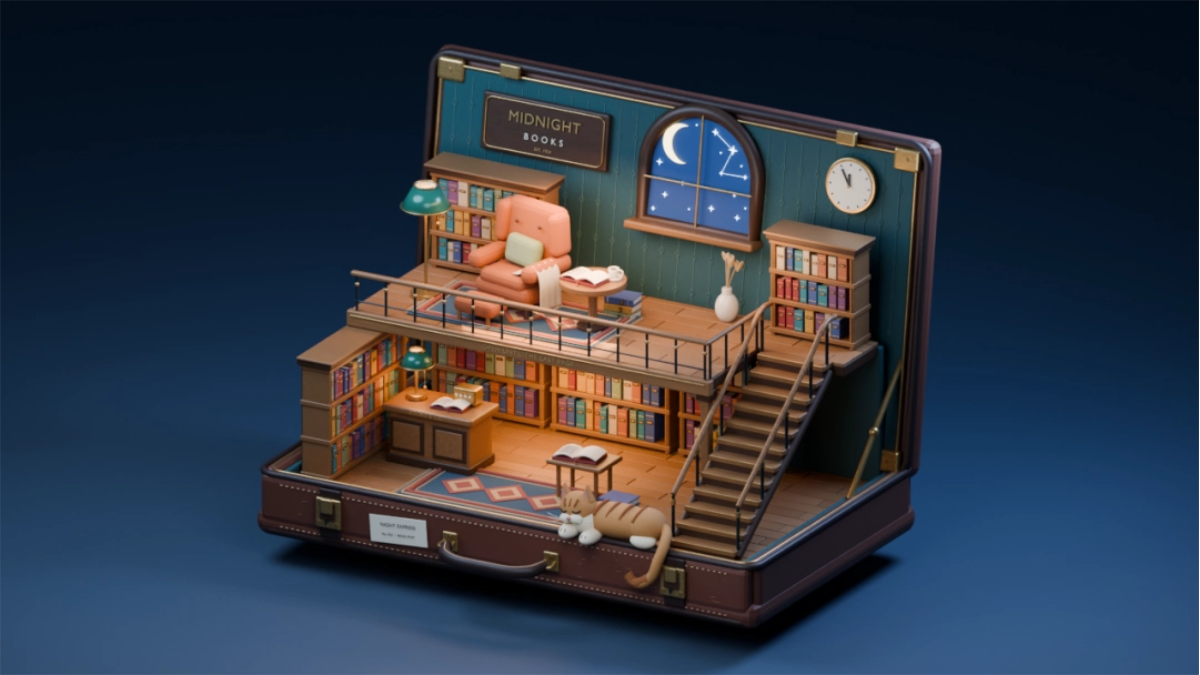
GPT-6 Astra's strongest point is the spatial arrangement. The entire suitcase also falls completely within the frame, and the handle, latches, and lid all retain their recognizability.
The details widen the gap further: spine decorations, open book pages, buttons on the chair back, and a blanket on the armrest make the reading nook feel more like a place someone actually uses.
Claude Fable 5.1:
Blender file:
Render:
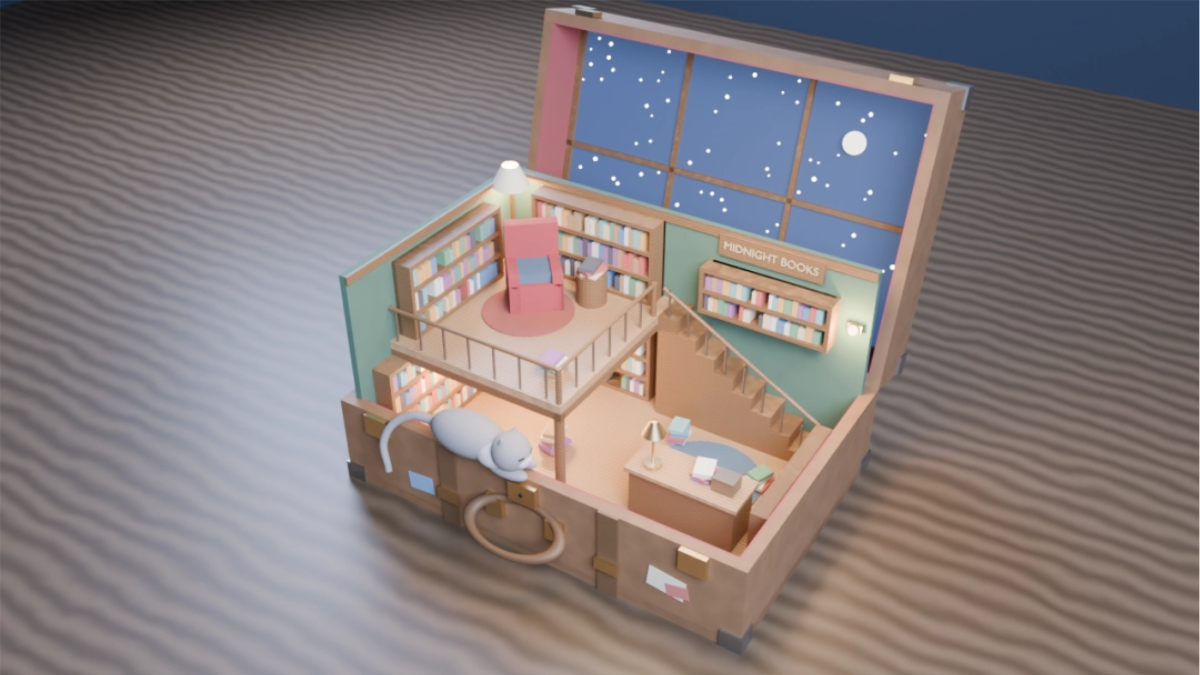
Claude Fable 5.1's layout is very intuitive: the upstairs reading area is arranged on the left, the stairs are on the right, and the ground-floor counter is in front. The stairs connect to the second floor, and the suitcase, bookshelves, starry window, and cat are all recognizable.
The main deductions are in lighting and materials. The overall lighting is too bright; the pink chair, light-colored book spines, and bright floor make the scene look more like a toy house photographed in daylight, with the late-night feel conveyed mainly by the stars outside the window.
Gemini 3.8 Flash:
Blender file:
Render:
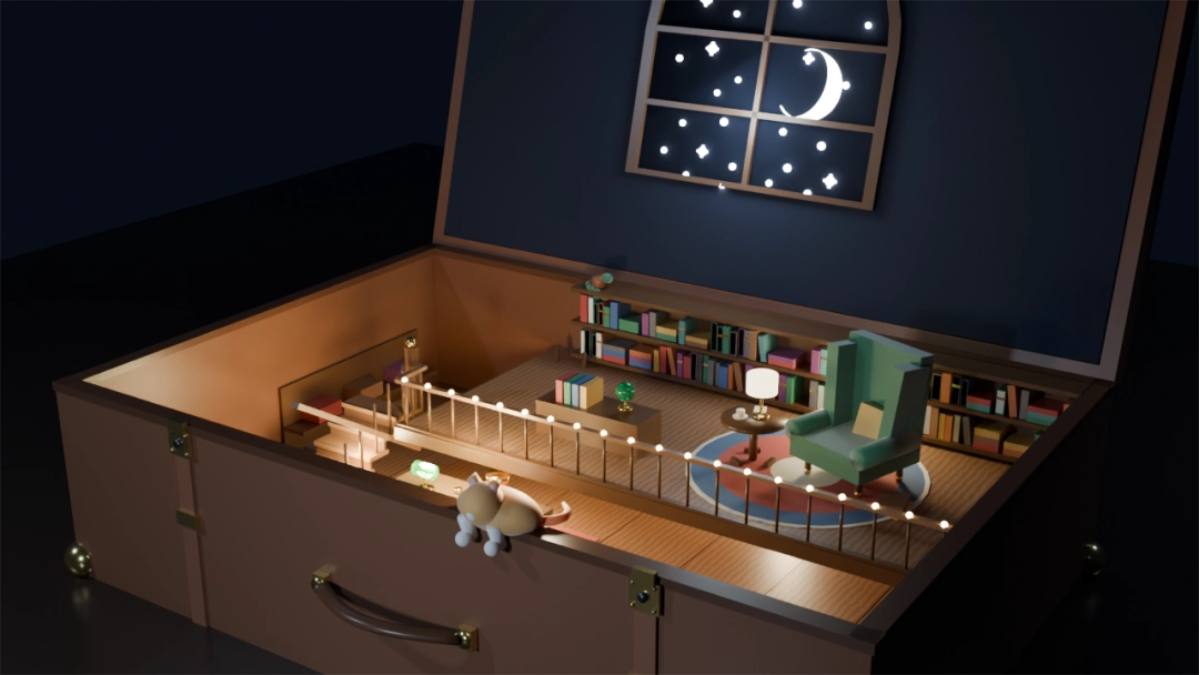
Gemini 3.8 Flash's green armchair, round rug, table lamp, and string lights on the railing form a fairly clear reading nook.
But there is a gap between the top of the stairs and the second-floor platform, and railings are placed on the connecting side, so the passage is not handled smoothly, and the chair's silhouette is a bit stiff.
case 1 ranking: GPT-6 Astra first, Claude Fable 5.1 second, Gemini 3.8 Flash third.
case 2 Send the Raindrop into the Flowerpot
Using wind-direction switching to control a drop of rain lets us compare scene art, motion feedback, and collision handling within the same small gameplay.
Prompt:
Make a single-screen web mini-game called "Send the Rain Home." The scene is the exterior wall of a residential building on a rainy night; draw windows, a clothesline, a T-shirt, socks, and a flowerpot at the bottom. The player controls a bright drop of rain; the raindrop keeps falling, press the spacebar to switch the wind to the left or right, and the horizontal wind speed and falling speed are fixed.
Avoid the clothing and fall into the flowerpot to succeed; touching clothing, going out of the left or right boundary, or landing anywhere else at the bottom counts as failure. The starting point and obstacles are fixed, and arrange a route that can be completed. Provide clear wind-direction, success, and failure feedback, and press R to restart from the initial state.
Use Canvas, scene 960×640, design the visual style yourself. Deliver only one offline HTML, make only one level, do not add sound effects, menus, external resources, or explanations.
GPT-6 Astra:
GPT-6 Astra's residential building feels the most lived-in. Inside the windows there are desk lamps, curtains, and books; the clothing has stripes, pockets, and stitching, and the exterior walls also have pipes and subtle textures. The title, objective, wind direction, and control hints are clearly laid out, and the game scene and interface are not crammed together.
The shortcoming is that the level is rather lenient. There is a large amount of adjustment space left between the two rows of clothing, and the visual details are richer than the level changes.
Claude Fable 5.1:
Claude Fable 5.1's large wind-direction arrow is the most eye-catching, and there are also direction hints beside the raindrops. The high-contrast clothing, warm-colored windows, and red glow at the left and right edges make obstacles and danger zones very easy to identify. The three-row clothing level can be completed, the flower blooms after success, and the reason for failure and how to restart are also explained clearly.
The main problem is that the collision range is clearly larger than the clothing outlines. Although the basic functions are complete, collision fairness affects the actual experience more than whether the interface is eye-catching, so this round ranks third.
Gemini 3.8 Flash:
Gemini 3.8 Flash's four rows of clothing form multiple passages, and the falling speed is also faster. The raindrop trails, the clothing deflecting with the wind, and the blooming animation after success make both cutting through the wind and reaching the finish line have visible feedback.
The clothing tilts with the wind, but the collision box is always a fixed rectangle, and the clothing outlines and the actual hitbox do not fully coincide.
case 2 ranking: GPT-6 Astra first, Gemini 3.8 Flash second, Claude Fable 5.1 third.
case 3 small bookstore space renovation
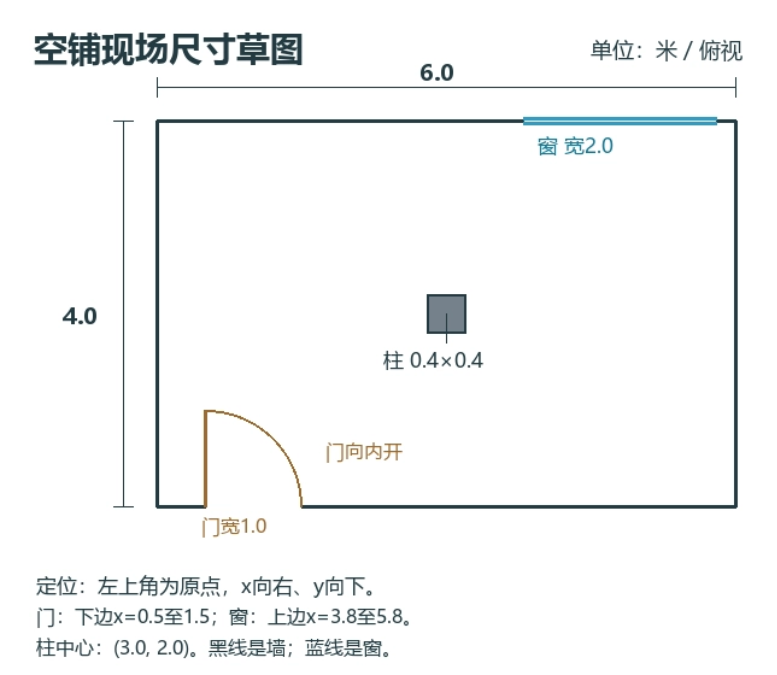
By giving fixed doors, windows, and columns, then letting the model arrange furniture, it is possible to see clearly whether the model understands the sketch, and whether the beautiful layout it draws can accommodate the required functions.
Materials:
Prompt:
Based on the attachment, convert this empty 6×4 meter shop into a small bookstore, and draw a 900×650 color top-down conceptual layout. Keep the positions of the door, door swing direction, windows, and columns.
Arrange book walls, one checkout counter, and four reading seats. The continuous passage from the entrance to the interior must be at least 90 centimeters, and furniture must not block the door swing area or overlap with the columns. Design the furniture shapes, materials, and arrangement yourself, mark the functions, main dimensions, and passage width, and make the difference between tables, chairs, and bookshelves visible in the drawing.
Deliver only one standalone SVG, drawn with vector shapes and text, without referencing images, external fonts, or resources, and without attaching explanations.
GPT-6 Astra:
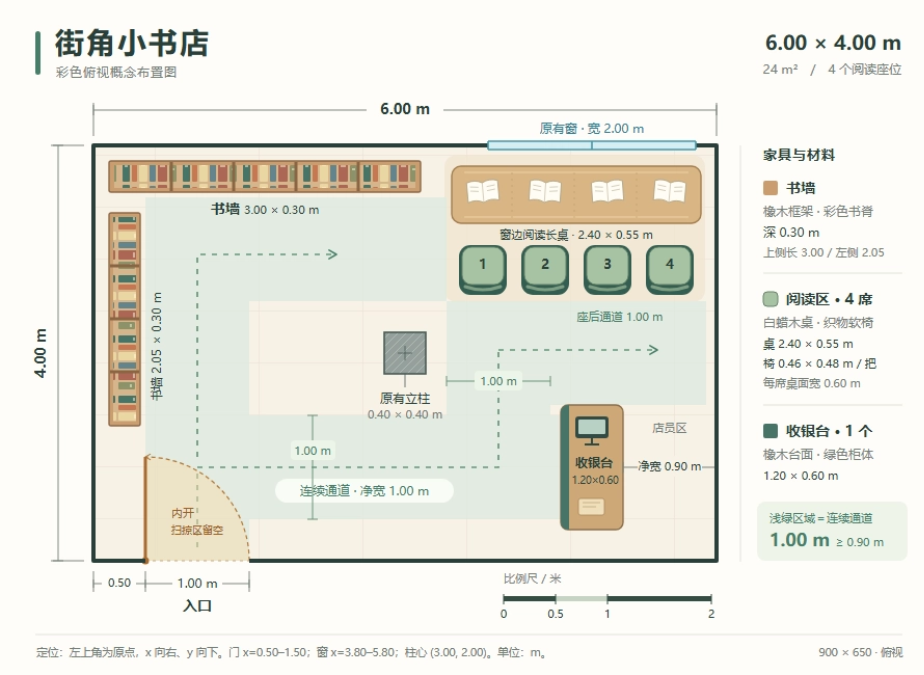
GPT-6 Astra concentrated the four reading seats by the window, placed book walls on the north and west sides, and put the checkout counter in the lower right corner. The door opening, inward swing direction, windows, and column positions are all consistent with the original drawing, and the furniture avoids the door swing area and the columns. The light green area directly shows the extent of the continuous passage, the main branches are reserved at 1 meter wide, and 0.9 meters of staff space is also left behind the checkout counter.
The shortcoming is that all four seats are arranged along the same long table, so the reading setup is rather monotonous.
Claude Fable 5.1:
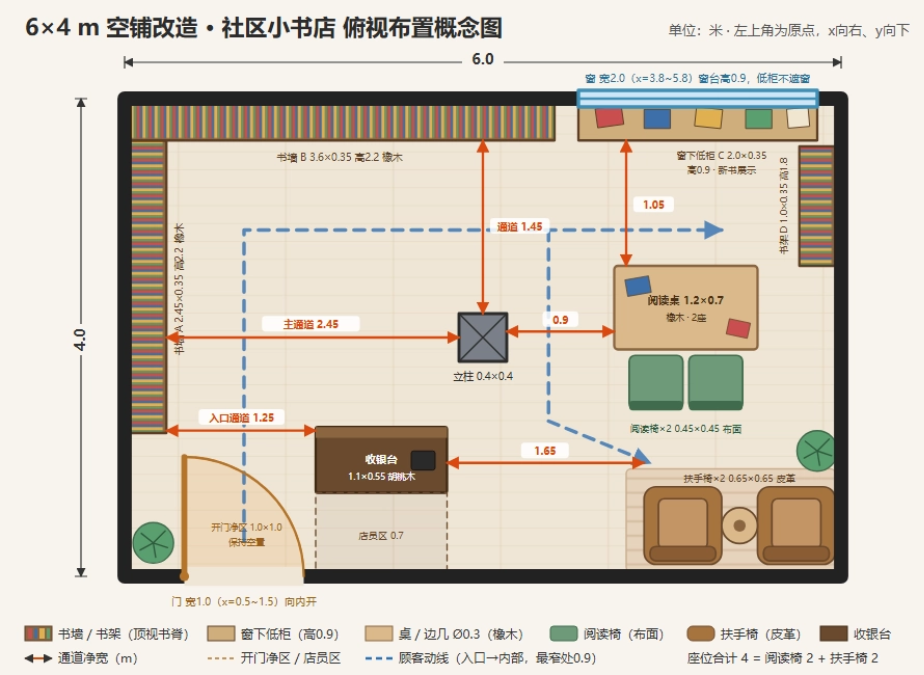
Claude Fable 5.1 arranged two reading chairs at the table and two armchairs, with a low cabinet for new book displays under the window. The four seats have different ways of being used, and the checkout counter is close to the entrance, making it convenient to watch people coming and going. The door, windows, columns, and door swing direction are all kept correct.
The problem is in the lower-right reading corner. The local spacing is only about 0.64 meters, yet the legend vaguely says the narrowest point is 0.9.
Gemini 3.8 Flash:
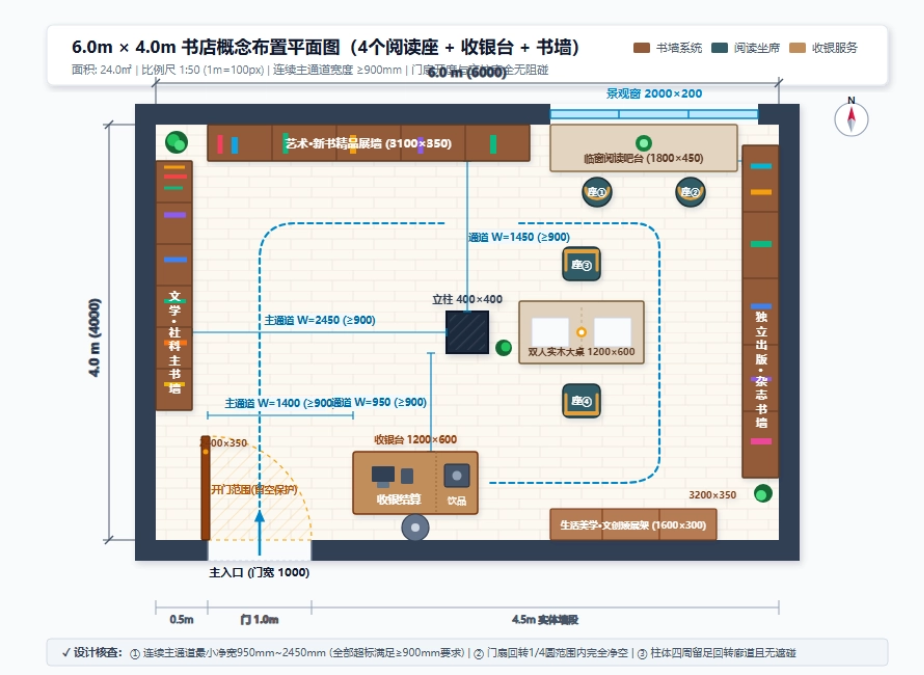
Gemini 3.8 Flash preserved the correct coordinates of the doors, windows, and columns, and also arranged two seats by the window and two seats at the table. Multiple book walls and a checkout counter with beverage equipment make the functions look rich.
However, the spacing by the window was marked incorrectly, running into the bar counter itself, and it was obscured by furniture drawn later. The circulation route passed through an overly narrow gap, leaving only 39 centimeters in one spot. The staff space was insufficient, with only 25 centimeters behind, yet a staff chair with a diameter of 26 centimeters was placed there.
case 3 ranking: GPT-6 Astra first, Claude Fable 5.1 second, Gemini 3.8 Flash third.
case 4 business diagram before and after the event
Having the model plot the overall and group changes on the same chart makes it possible to compare whether the calculations are correct, and also to see whether the model helps the store manager understand changes in the customer source composition.
Prompt:
Create a 1000×700 data diagram for a coffee shop operations meeting. Before the event: 100 member entries, 40 payments; 900 ad entries, 90 payments. After the event: 800 member entries, 288 payments; 200 ad entries, 16 payments. The two entry sources do not overlap, and each person pays at most once.
Show the overall conversion rate, the conversion rate of each of the two entry sources, and the two-week traffic composition at the same time, so the store manager can clearly see the relationships among the changes. Choose the title and chart format yourself, write the key values in the chart, and keep the explanatory text to no more than 60 characters in total.
Deliver only one standalone SVG, with editable graphics and text, no external resources, and no analysis process attached.
GPT-6 Astra:
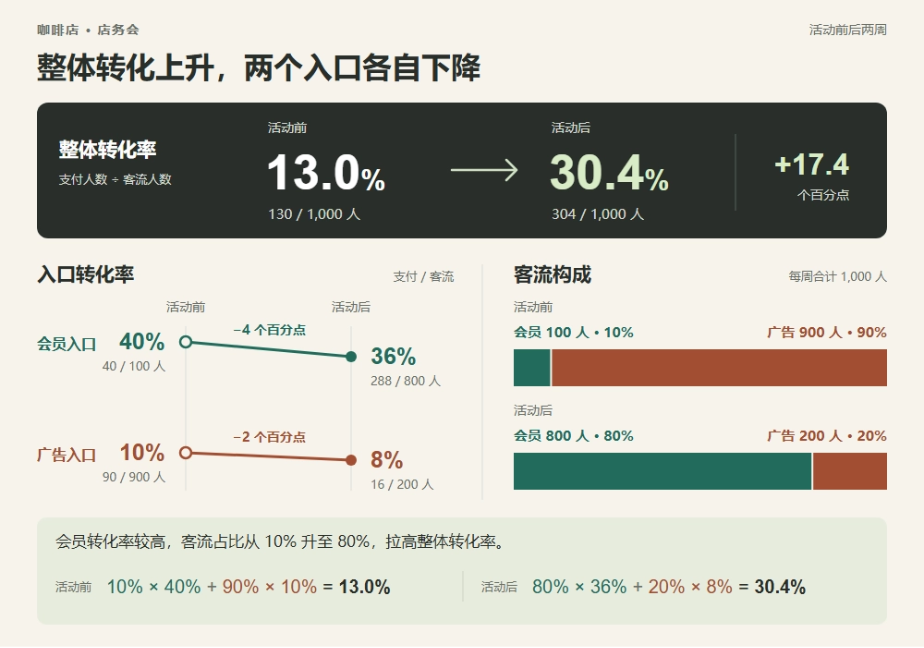
GPT-6 Astra arranged the reading order very clearly: at the top, it uses large type to show the rise in the overall conversion rate; at the lower left, it uses two declining lines to show the entry conversion rates; and at the lower right, it uses stacked bars to show the traffic composition. Green always represents members, and brown always represents ads, so readers can compare different areas along the colors.
Claude Fable 5.1:
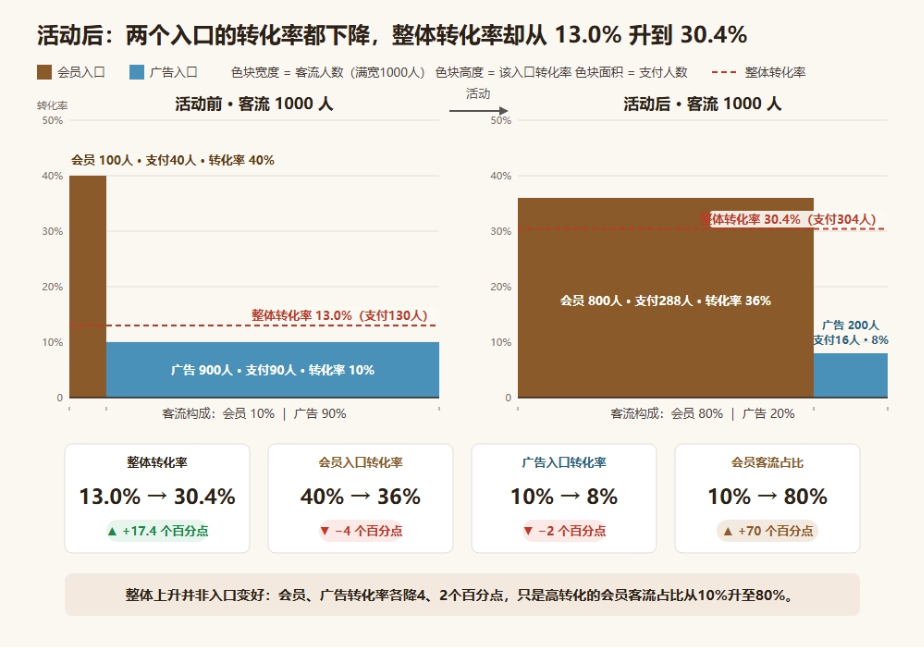
Claude Fable 5.1 uses color-block width to represent traffic count and height to represent entry conversion rate, so the area corresponds to the number of payments. After the event, the member color block becomes slightly shorter but clearly wider; the ad color block becomes narrower and shorter. After understanding the legend, the store manager can see in the same chart the relationship between the decline in entry conversion rates, the change in traffic composition, and the growth in the number of payments.
Gemini 3.8 Flash:
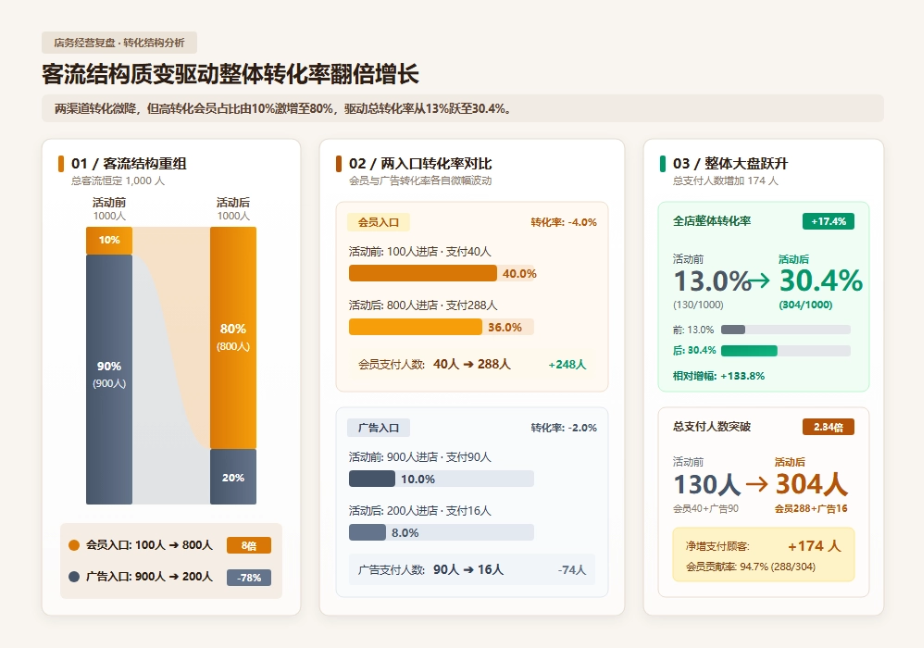
Gemini 3.8 Flash uses three columns to organize traffic, entry conversion rates, and overall results, with consistent color coding, and the change in which the member share expands on the left is also very obvious. The main conversion rates, payment counts, and relative increases are all calculated correctly.
However, it confuses percentages with percentage points, the scales of the two entry bar charts are inconsistent and this is not noted, and it also uses many small font sizes and nested cards, so when reduced to the body text of an article, the reading burden is greater than that of the other two.
case 4 ranking: Claude Fable 5.1 first, GPT-6 Astra second, Gemini 3.8 Flash third.
case 5 old book night market poster
Using a single Chinese character as both the title and the main subject of the image makes it possible to compare how the models handle character shape, negative space, and information hierarchy.
Prompt:
Design a 900×1200 vertical poster for “Old Book Night Market,” using the large character “书” as the main visual, and connecting the shapes of book pages, streets and alleys, or windows with the character form; design the specific composition yourself.
The image uses dark blue and warm yellow. It must clearly write: Old Book Night Market; September 19, 19:00–22:00; East Hall; free admission. The main visual can be interesting, but the event information must be easy to find.
Deliver only one standalone SVG, completed with vector shapes and editable Chinese text, without referencing images, external fonts, or resources, and without explanation.
GPT-6 Astra:

In GPT-6 Astra, the character 书 occupies most of the central area of the image, and its thick strokes form a clear outline against the dark blue background. It can be recognized from the image, and the text is closely connected to the bookstore theme.
The entire bottom warm-yellow area is used to centrally place the date, time, location, and admission information; the event title and information are not squeezed by the illustration.
Claude Fable 5.1:

Claude Fable 5.1 builds the book character into a set of glowing buildings, with silhouettes, the moon, and string lights jointly conveying the night market scene. The date and time use a large font size, and free admission is placed separately in a yellow capsule-shaped area, still easy to find when scaled down.
But the glyph details rely more on repeated small windows and triangular roofs, and the book-page characteristics are less direct than in GPT-6 Astra. The visual center of gravity of the entire character leans toward the buildings and street.
Gemini 3.8 Flash:
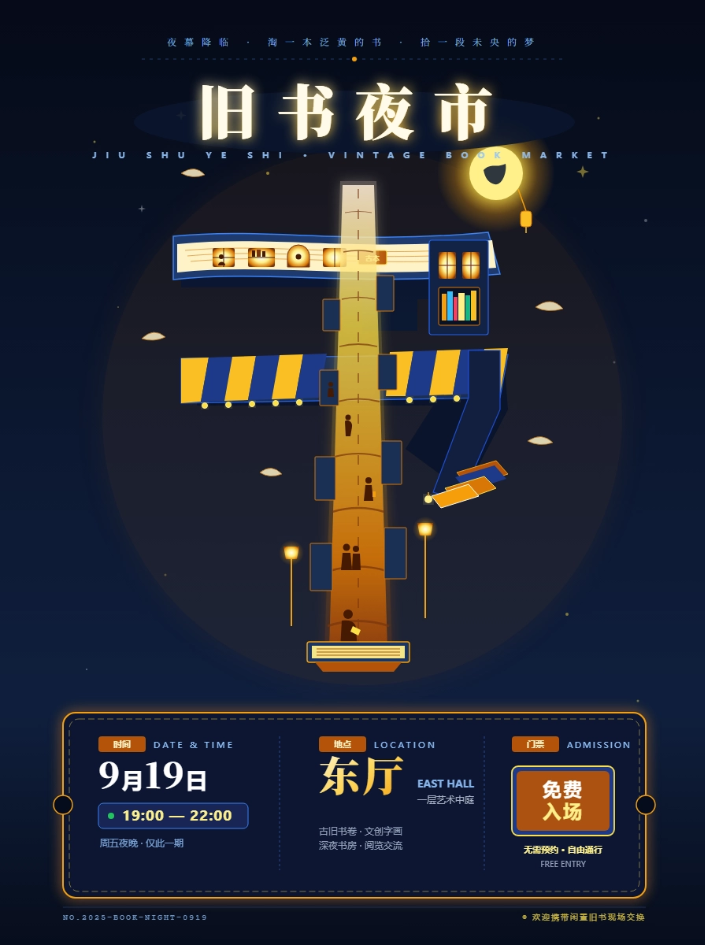
Gemini 3.8 Flash has quite a few local ideas: there are open book pages that become crossbeams, and details such as the awning corresponding to the second horizontal stroke; however, these parts do not form a sufficiently clear and unified outline of the book character.
But the bottom ticket splits the information into three columns and adds English labels, explanatory small text, and decorative lines; in the thumbnail, the specific time is harder to read clearly.
The most unacceptable part is that it arbitrarily added: an art atrium on the first floor, no reservation required, only this one session, on-site exchange, and other event arrangements, and added a 2025 ticket number and Friday night.
case 5 ranking: GPT-6 Astra first, Claude Fable 5.1 second, Gemini 3.8 Flash third.
case 6 A moon phase diagram for children
The same diagram needs to distinguish the illuminated side in space from the moon phase seen on Earth, so it can be checked whether the schematic drawn by the model is consistent with the explanation.
Prompt:
Draw a 1000×700 moon phase explanation diagram for a 10-year-old child, covering only new moon, first quarter, full moon, and third quarter.
Facts: The Moon itself does not emit light; sunlight illuminates about half of the Moon. As the Moon orbits Earth, the proportion of the illuminated part we see changes. Ordinary moon phases are not caused by Earth's shadow blocking it.
Distinguish between “the spatial position viewed from the north side of the orbit” and “the lunar surface seen from Earth”; sunlight comes from the left. The lunar surface uses the standard convention of north up for the Northern Hemisphere. Draw the correspondence between the 4 positions and the corresponding moon phases, clearly label the viewpoints, and keep the total explanation to no more than 80 characters.
Deliver only a standalone SVG, design the visual style yourself, do not use external resources, and do not attach an explanation.
GPT-6 Astra:
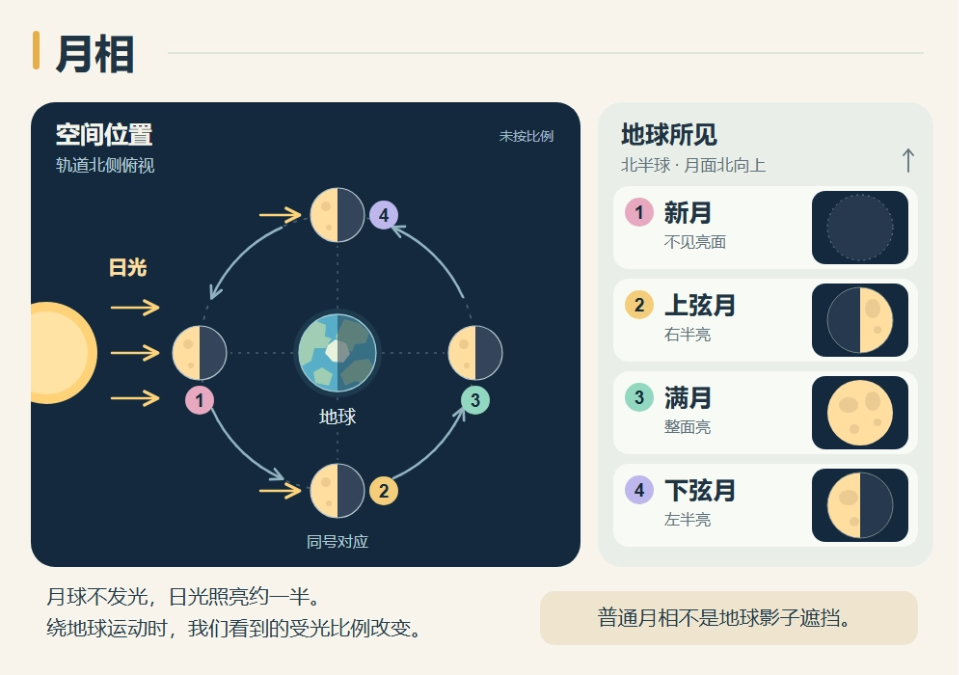
GPT-6 Astra places the spatial positions and the Earth view in left and right panels with different background colors, and uses four sets of differently colored numbers to correspond to them. Children can first look at the Moon's position on the left, then find the lunar surface on the right by the same color and number, making it easier to understand that half of the Moon is always illuminated in space, while different moon phases can be seen from Earth.
GPT-6 Astra's minor shortcoming is that only numbers are marked beside the orbit, without directly writing names such as the new moon position, so children need to check the right side to confirm.
Claude Fable 5.1:
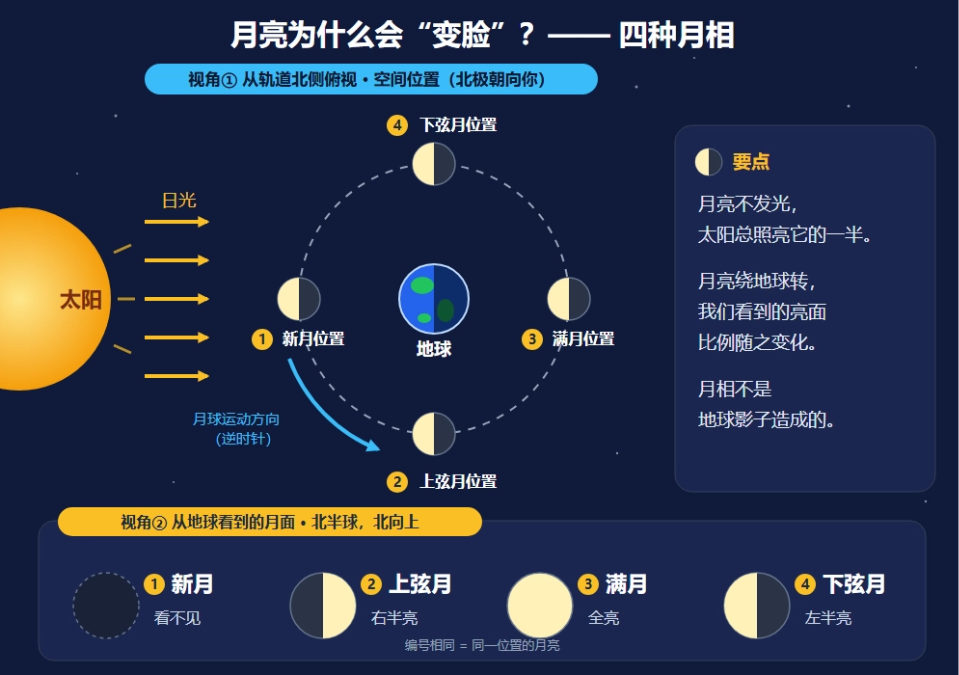
Claude Fable 5.1's advantage is sufficient labeling: the positions of the four moon phases are written directly beside the orbit, a thick blue arrow indicates counterclockwise motion, and the four moon phases are arranged horizontally in order at the bottom. Children can both look up names in the spatial diagram and compare the lunar surface changes at the bottom.
Gemini 3.8 Flash:
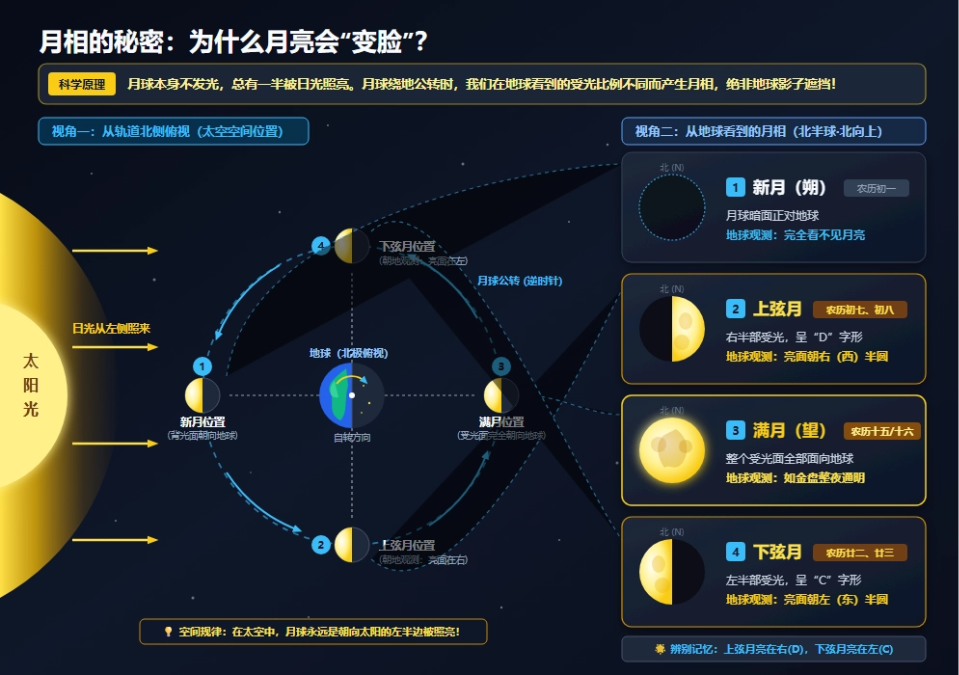
Gemini 3.8 Flash also distinguishes spatial positions from the Earth view, and the illumination direction and moon phases of the four moons are also drawn correctly.
But the actual image has three clear problems. First, a large black fill appears in the cross-region dashed line. Second, the newly added rotation direction arrow on Earth is drawn clockwise. Third, the explanatory text clearly exceeds 80 characters.
case 6 ranking: Claude Fable 5.1 first, GPT-6 Astra second, Gemini 3.8 Flash third.
case 7 Camping lantern exploded view
Taking the same lantern apart into parts that can correspond to one another makes it possible to compare whether the model maintains perspective and proportions, and also to see clearly how the model distinguishes the transparent cover, metal, and light-emitting parts.
Prompt:
Create an exploded product concept view of a "mushroom-shaped portable camping lantern" on a 1000×700 canvas. On the left is a three-quarter view of the complete lantern; on the right, along the same vertical axis, separately show the transparent cover, LED disc, cylindrical battery compartment, and base, while retaining the top handle.
The complete view and the exploded view must correspond to the same design, with consistent component axes and proportions, and a small number of leader lines labeling the names. Use vector layering to distinguish transparency, metal, and warm-colored illumination. Design the specific shapes and color scheme yourself; do not write engineering performance or specifications.
Deliver only a standalone SVG, do not reference images, external fonts, or resources, and do not include explanations.
GPT-6 Astra:
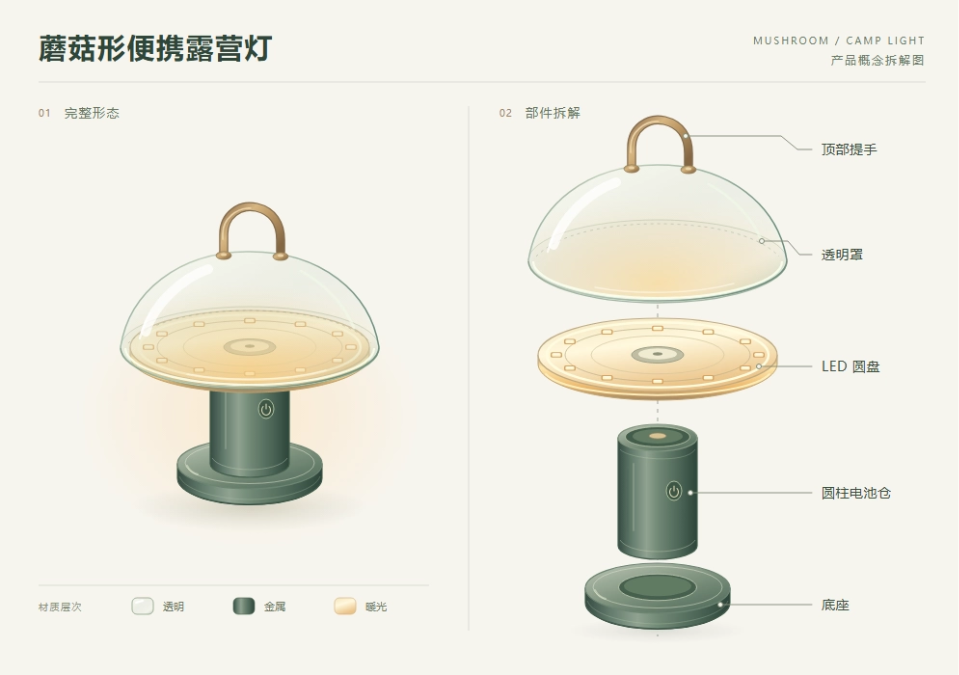
GPT-6 Astra's complete lantern and exploded view match directly: the outer contour of the transparent cover, the dimensions of the light disc and the arrangement of the LEDs, the button on the battery compartment, and the grooves on the base all remain consistent.
The material layering is fairly natural. It is relatively easy for the reader to see the relationship between the lampshade, light source, and support structure.
Claude Fable 5.1:
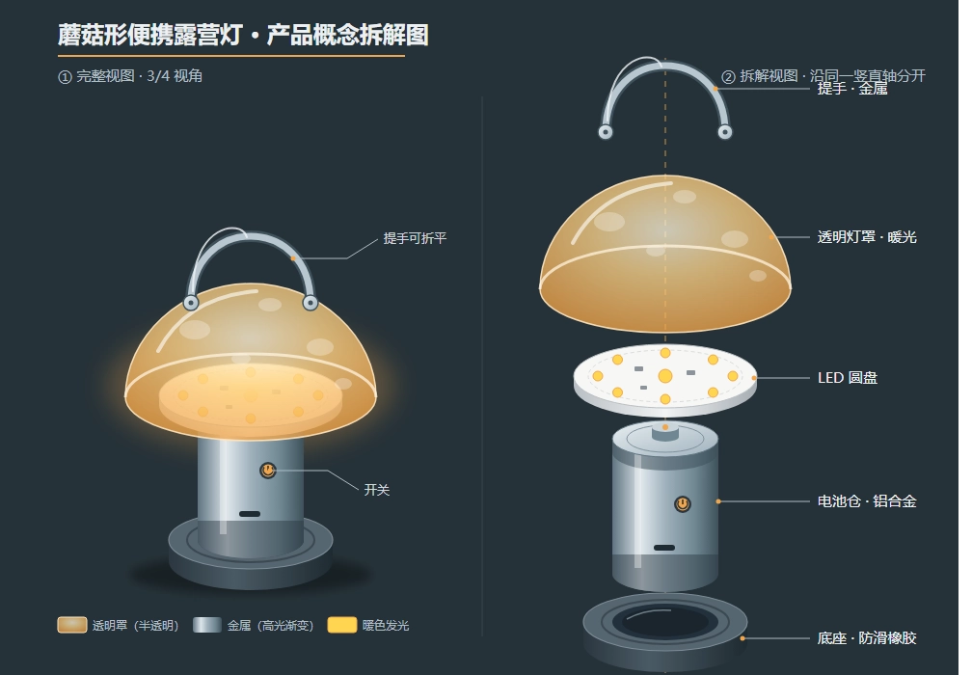
Claude Fable 5.1's complete lantern and exploded view likewise reuse the same components, with the lampshade, LED disc, battery compartment, base, and handle all kept at the same scale. The distinction between the silver metal, orange-yellow lampshade, and dark base is clear, and the switch, port, and separately exploded handle are also relatively easy to identify.
Gemini 3.8 Flash:
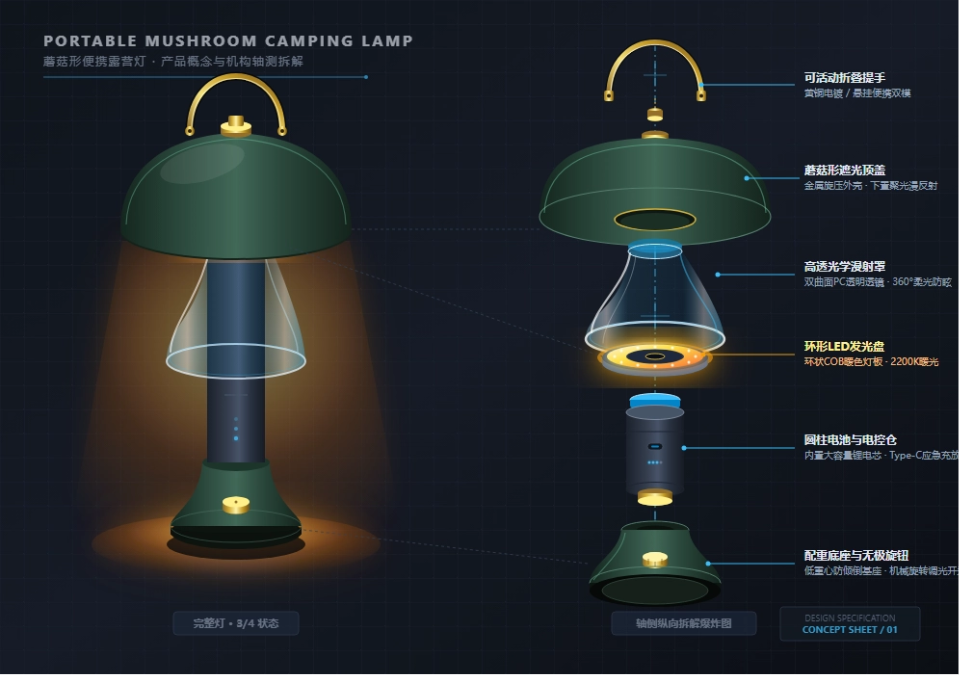
Gemini 3.8 Flash chose a dark green metal top cap, brass handle, and conical transparent cover, and the effect of warm light falling on the ground is also very obvious. The style of the complete lantern is unified, and the components on the right are roughly arranged along the same central axis, with different drawing methods for the transparent, metal, and illuminated areas.
However, this work did not consistently preserve the proportions of the components between the left and right images. After being exploded, the battery compartment becomes a short cylinder, and the transparent cover is also compressed shorter while its width remains unchanged.
Gemini 3.8 Flash also added specifications or functional claims such as 2200K warm light, Type-C emergency charging and discharging, and 360° soft light anti-glare, which conflicts with the original prompt's restriction of "do not write engineering performance or specifications."
case 7 ranking: GPT-6 Astra and Claude Fable 5.1 tie for first, Gemini 3.8 Flash second.
case 8 Midnight Radio
Let the FM tuning knob change the colors and waveform in the interface, making it possible to compare whether the models produced complete visual feedback and whether the interface remains clear before and after interaction.
Prompt:
Make a single-screen "Midnight Radio" webpage, like a tabletop radio. Display an 88–108 MHz frequency scale, the current frequency, a play button, and a city skyline outside the window. Design the main materials, fonts, and color scheme yourself, with clear knobs, scale, and display area.
When dragging the knob or its corresponding slider, the current frequency, waveform, and city light colors change synchronously; the play button controls whether the waveform moves, and no real audio is played. Default 98 MHz, desktop 960×640, and operable on a 360-pixel-wide phone.
Deliver only one offline HTML, with CSS and JavaScript inline, and graphics drawn with CSS, SVG, or Canvas; do not add a backend, external resources, or explanations.
GPT-6 Astra:
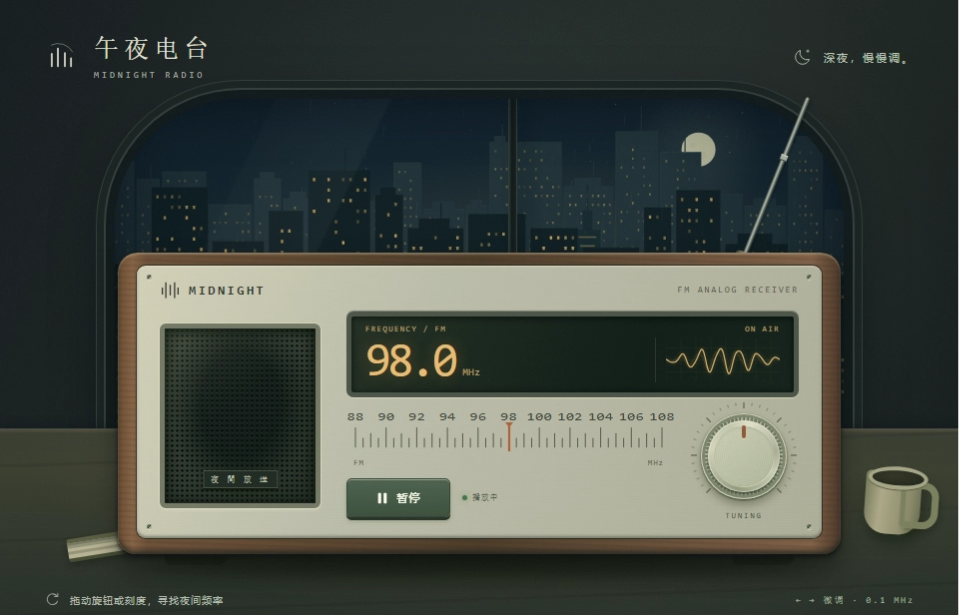
GPT-6 Astra's radio feels the most like a physical object. The wooden outer frame, light-colored panel, dark screen, and fine speaker grille each have their own texture, and the highlights on the knob edges also convey thickness.
The shortcoming is that the auxiliary text on the desktop is rather small, and the city window lights are also relatively dim, so when the screenshot is scaled down it is less eye-catching than the bright waveforms of the other two.
Claude Fable 5.1:
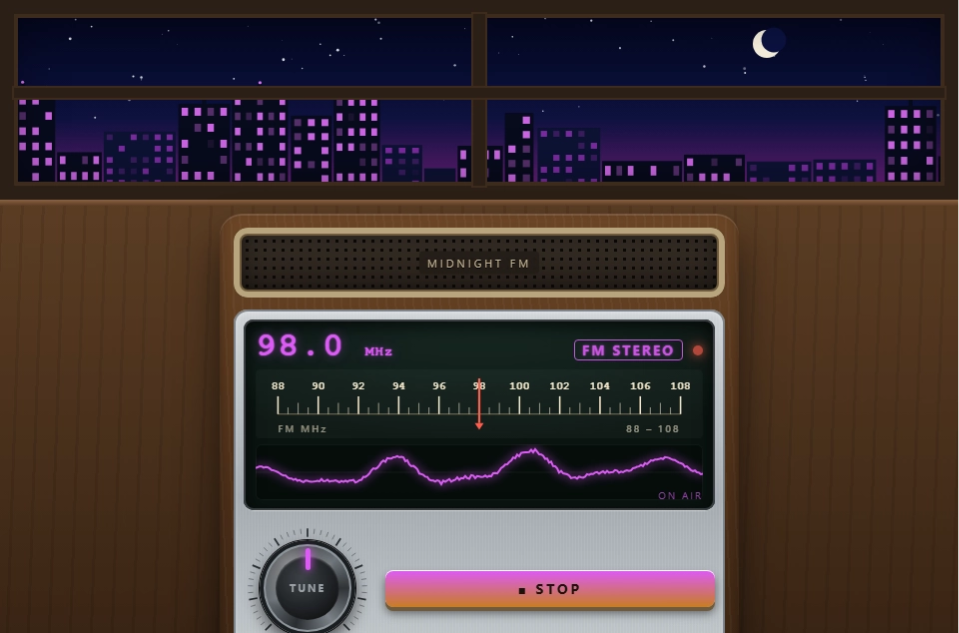
Claude Fable 5.1's silver panel, metal knob, and purple display area are sharply distinguished, the waveform area is large, and the changes in the city window lights are also very eye-catching. The pointer aligns with the frequency scale, tuning can change the waveform and lights, and play and pause both work.
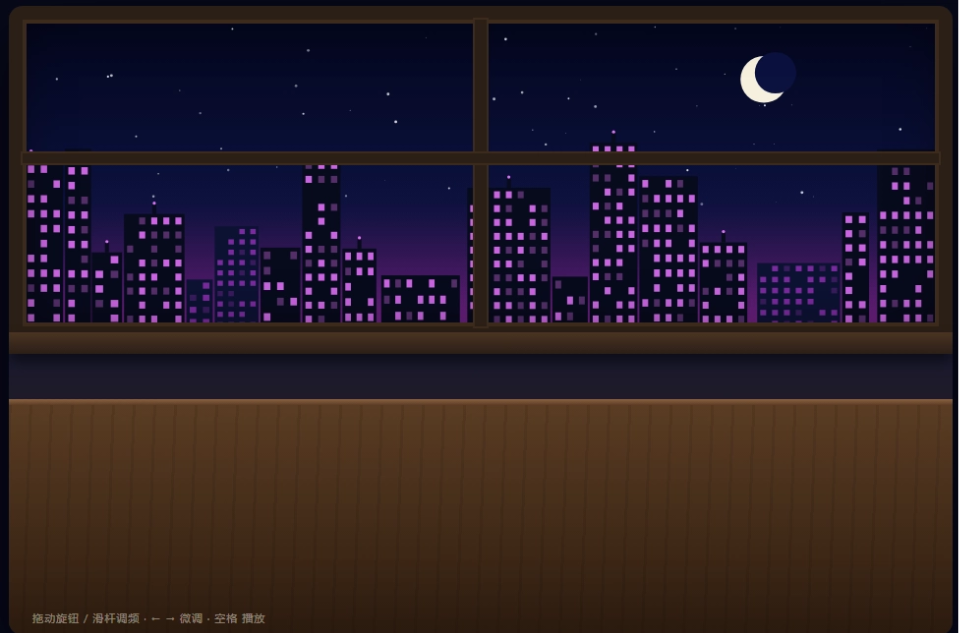
The Gemini 3.8 Flash uses a dark brown body, gold markings, and a green oscilloscope, making its retro radio characteristics very clear. The five virtual stations are the highlight of this result.
When approaching a preset station, the station name and lock status are displayed, and the waveform becomes smooth; after leaving the station, a noise waveform appears, and the city window lights change color with the station.
case 8 ranking: GPT-6 Astra first, Gemini 3.8 Flash second, Claude Fable 5.1 third.
PS: In the final actual test, the one that cost the most was surprisingly Gemini 3.8 Flash. Claude Fable 5.1, which seemed the most expensive, actually cost one third less than Gemini 3.8 Flash.
02. Test summary
After completing these 8 cases, I rank the overall performance of this round as: GPT-6 Astra first, Claude Fable 5.1 second, Gemini 3.8 Flash third.
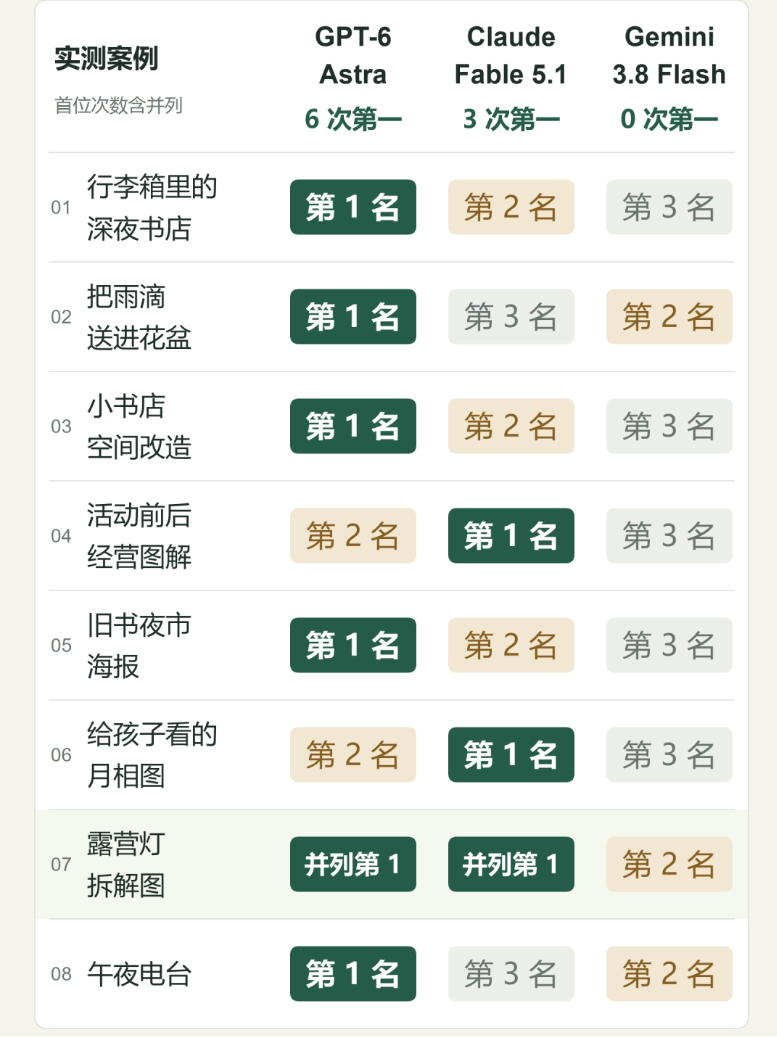
GPT-6 Astra's advantage lies in considering space and detail together. In the suitcase bookstore, the handle, clasps, and lid retain recognizability, while the reading corner also shows open book pages, chair-back buttons, and a blanket. Readers can easily find the main subject of the image and also easily find the information they need.
Claude Fable 5.1 is better at arranging the relationships between pieces of information. The business diagram uses color block width to represent customer traffic and height to represent entrance conversion rate, so the area corresponds to the number of paying customers. After understanding the legend, the store manager can see in the same chart that both entrances' conversion rates declined, but the share of member customer traffic expanded, so the overall conversion rate still rose.
Gemini 3.8 Flash has some designs worth keeping. The raindrop game has four rows of clothing, wind deflection, and successful blooming, and the midnight radio adds five virtual channels, switching between smooth waveforms and noise waveforms when tuning. But in several other items, Gemini 3.8 Flash's handling of structural and factual constraints is not reliable enough.
For visual and interactive tasks, I will prioritize using GPT-6 Astra for drafting; when encountering diagrams that need to explain data relationships or scientific concepts, I will compare Claude Fable 5.1's approach as well. Gemini 3.8 Flash's designs in game feedback and virtual station seeking can be referenced, but before delivery, geometric relationships, dimension annotations, and newly added text need to be checked item by item.
03. Digging deeper
Generative models have begun to enter the first round of production for visual assets: Blender scripts, SVG diagrams, and interactive HTML can all be generated in one round of conversation.
The commercial value shown by these 8 cases is very concrete. Models can compress initial drafts that previously required separate participation from modeling, design, and front-end into a single generation. The direction of the finished product can be seen earlier, first judging whether the creative idea holds up, then deciding which parts are worth investing manual refinement in, reducing early communication and ineffective rework.
These capabilities can be used for WeChat official account illustrations, event posters, educational diagrams, brand proposals, product demos, and lightweight web pages. Small teams can skip a round of low-fidelity sketches, outsourcing teams can prepare client proposals faster, and product teams can also validate interaction ideas before formal development.
The commercial value of model selection is ultimately reflected in whether the team can use less communication and rework to push the first version as quickly as possible to a state that is publishable, demonstrable, and verifiable.
Original link:GPT-6 Astra, Claude Fable 5.1, Gemini 3.8 Flash three-model horizontal comparison, who is the winner