
With the rapid development of artificial intelligence technology, the way we obtain information is undergoing a profound revolution. Represented byChatGPT, Wenxin Yiyan, and others, large language models (LLMs) and search engines integrated with AI features (such as Google's AI Overviews) have shifted from the traditional "list of links" model to a model that directly provides "generative answers." Under this new paradigm, a brand-new field of digital marketing,Generative Engine Optimization (GEO) has emerged. This report systematically explains the core concepts of GEO for beginners in the AI field and compares them with classicSearch Engine Optimization (SEO) through a comprehensive, multi-dimensional comparative analysis. The report will deeply explore the fundamental differences between the two in goals, working principles, content strategies, measurement metrics, and future trends. Through easy-to-understand analogies, detailed charts, and real case analyses, it helps readers understand why GEO is not a substitute for SEO, but a necessary evolution and strategic complement in the AI era, and provides clear action guidelines for enterprises and content creators to seize opportunities in the upcoming era of fully AI-driven search.

From information retrieval to answer generation
Over the past two decades, when users searched for information on the internet, their behavior patterns were almost fixed: open Google or Baidu, enter keywords, and get a list of "blue links" sorted by relevance. The user's task was to filter, click, read, and piece together the answer they wanted from this list. The core of the process was "Information Retrieval," and the technology that helped websites stand out in the list was what we know as SEO (Search Engine Optimization). SEO's goal is very clear: improve rankings and win clicks.
The rise of generative AI, especially the maturity of large language models (LLMs), has given birth to a new generation of "answer engines." AI conversation tools such as ChatGPT and DeepSeek, or new search engines such as Perplexity AI and Google's AI Overviews, do not just provide links; they can directly understand complex questions users ask in natural language and generate a structurally complete, content-synthesized answer in real time.
This shift changes the user's role from "information filterer" to "answer obtainer." For example, use a simple analogy to understand the transformation:
- Traditional search (the world of SEO) : It is like a huge library, and the search engine is the librarian, providing a list of books (search results pages) that may contain the answer according to the request (keywords). The user needs to flip through and search one by one. The role of SEO is to make books look more attractive and titles more eye-catching, so they are placed in the most prominent position on the shelf.
- Generative search (the world of GEO) : It is more like having a highly knowledgeable private research assistant. The user asks him a question, and he reads the relevant books in the entire library, summarizes and distills them for the user, and directly gives the user a customized research report (an AI-generated answer). Whether a book can be seen, understood, trusted, and ultimately cited by the assistant in his report has become a brand-new topic.
SEO (Search Engine Optimization)
Before deeply understanding GEO, one must have a clear understanding of SEO.
What is SEO?
SEO (Search Engine Optimization) is the sum of a series of strategies and practices that can improve a website's ranking in the organic search results of traditional search engines (such as Google, Baidu, and Bing). The core goal is to obtain more free, high-quality organic traffic, and to achieve business objectives through organic traffic, such as brand exposure, lead acquisition, or online sales.
The Core Working Principles of SEO
Traditional search engines are like diligent librarians. Through "crawlers" programs, they continuously crawl webpage content on the internet and, combined with complex algorithms (such as Google's famous PageRank algorithm), index and rank webpages. The work of SEO is to cater to this set of algorithmic rules from three main aspects:
- Technical SEO : Ensure that search engine crawlers can easily access, crawl, and understand website content.
- Website Speed Optimization: Ensure pages load quickly; no one likes to wait.
- Mobile-Friendliness: Ensure the website displays and works perfectly on phones and tablets.
- Website Structure and URL Design: Clear navigation and concise URLs let users and crawlers understand at a glance.
- XML Sitemap: Submit a "website map" to search engines, telling them which pages are on the website.
- On-Page SEO : Focuses on the optimization of individual webpage content, with keywords as the core.
- Keyword Research: Analyze which words and phrases target users will use when searching.
- Content Creation: Create high-quality, original, and valuable content around keywords (articles, blogs, product descriptions, etc.).
- Page Element Optimization: Strategically deploy keywords in the page title (Title), meta description (Meta Description), headings at all levels (H1, H2, etc.), and body text.
- Off-Page SEO : Concerns the website's reputation and authority across the entire internet. The key factor is backlinks.
- Link Building: When high-quality, high-authority websites link to a website, search engines will consider your website trustworthy and recommended, thereby improving its ranking.
How to Measure the Success of SEO
There is a very mature quantitative indicator system for measuring whether SEO work is successful:
- Organic Traffic : The number of users who visit a website through non-paid search results; this is the most core indicator.
- Keyword Rankings : The specific position of target keywords in search results. The higher the ranking, the more traffic is usually obtained.
- Click-Through Rate (CTR) : The proportion of users who click through to the website after a webpage is displayed in search results. A high CTR means the website's title and description are very attractive.
- Bounce Rate: The proportion of users who leave after visiting a page without performing any other action. A high bounce rate means the content does not match user expectations.
- Conversion Rate: The proportion of visitors who complete the desired action (such as purchase, registration, download); this is the ultimate indicator for measuring the business value of SEO.
SEO revolves around "keywords" and "links," with "ranking" and "traffic" as its main goals, and is a systematic project integrating technology, content, and backlinks.
GEO (Generative Engine Optimization)
What is GEO?
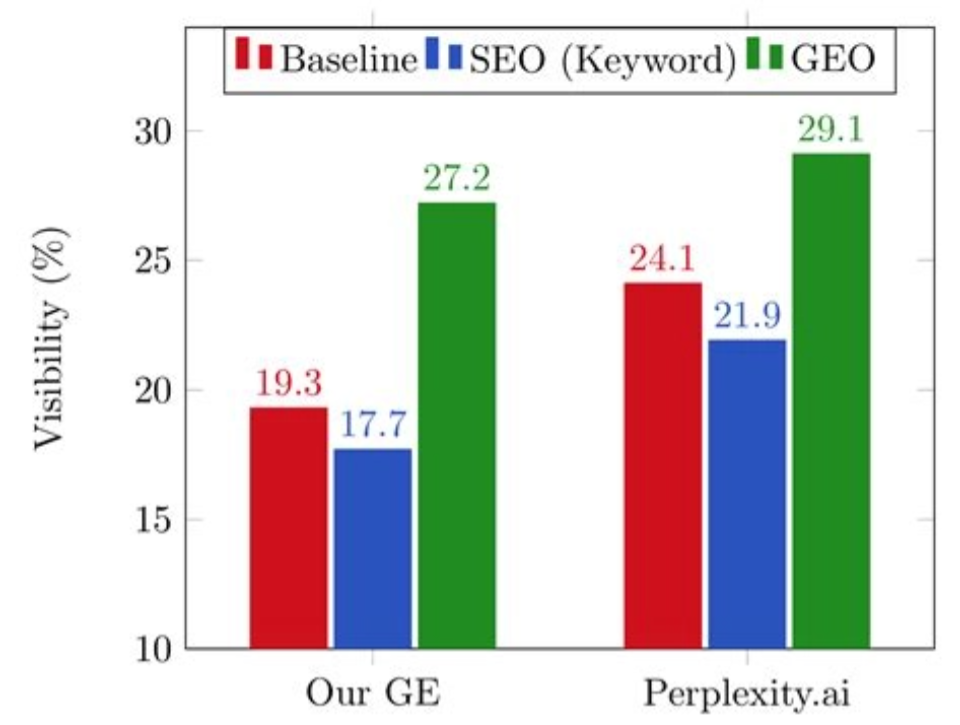
GEO (Generative Engine Optimization) is a new digital marketing paradigm born directly from the rise of generative AI and large language models (LLMs). Users are no longer satisfied with searching for links; AI automatically integrates information from across the web and generates direct answers. The goal of GEO is to enable brands, products, or viewpoints to be preferentially learned, understood, and trusted by AI models, and ultimately to be positively cited, recommended, or mentioned in generated answers.
The Core Working Principles of GEO
The core of GEO is "semantic understanding" and "authority building." AI engines seek to truly understand the meaning of information, its context, and the credibility of information sources. GEO strategies have undergone a fundamental shift:
- Semanticization and Structuring of Content: To help AI better "read and understand" content, information needs to be organized in a language AI can understand.
- Conversational and Factual Content: Create content that can directly answer questions such as "Who," "What," "Why," and "How." The content style should tend toward concise, clear, and factually accurate.
- Structured Data): Use markup languages such as Schema.org to "tag" content. For example, clearly tell AI "this is a product," "its price is $999," "its rating is 4.8 stars."
- Extreme Application of the E-E-A-T Principle: E-A-T (Expertise, Authoritativeness, Trustworthiness) is an important standard by which Google evaluates content quality, and E (Experience) was later added. In the GEO era, the importance of E-E-A-T has been elevated to an unprecedented height. When generating answers, AI models strive to avoid providing erroneous or harmful information and will preferentially adopt widely recognized authoritative sources.
- Clarify Author Identity: Show the expert background and qualifications of the content creator.
- Cite Authoritative Sources: Link to government websites, academic papers, recognized industry reports, and so on within the content.
- Build Brand Authority: Become a recognized expert in a specific field by continuously producing high-quality content.
- Multimodal Content Optimization: Modern AI models can understand not only text, but also images, videos, and audio. Adding detailed descriptions (Alt Text) to images and providing accurate subtitles and summaries for videos can help AI understand information more comprehensively and increase the chances of being cited.
GEO'sMethods for Measuring Success
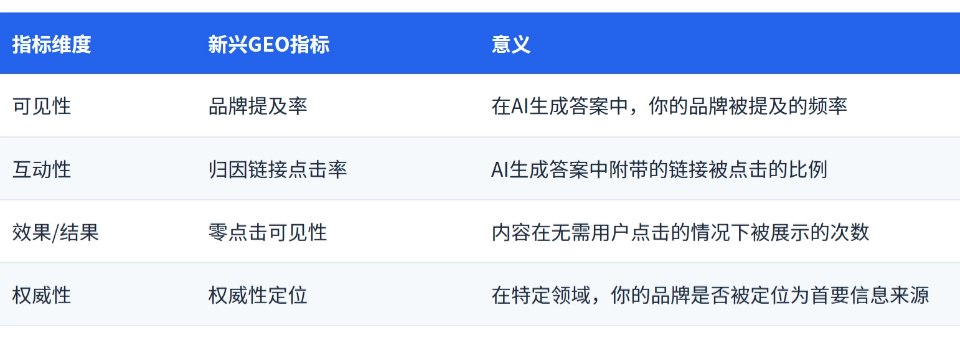
The success of GEO cannot be measured simply by website traffic or rankings; what it pursues is brand exposure and influence in "zero-click" scenarios. Core KPIs include:
- Citation/Mention Rate : The frequency with which a brand, product, or content is cited or mentioned in AI-generated answers related to a specific topic.
- Answer Accuracy : Whether the information stated by AI when mentioning a brand or product is accurate and error-free. Incorrect statements can harm the brand.
- Attributed Link CTR : When AI generates answers, it sometimes includes links to information sources. The click-through rate of links is an important metric for measuring the traffic-driving effect of GEO.
- "Zero-Click" Visibility : The number of times content is displayed as part of an answer without requiring a user click. This is a pure metric for measuring brand exposure.
- Authority Positioning : In AI Q&A within a specific field, whether the brand is frequently positioned as the primary or core source of information.
Comprehensive Comparison of GEO vs. SEO
Both GEO and SEO serve to enhance digital visibility, but there are vast differences in strategic thinking, tactical execution, and performance evaluation. For beginners, direct comparison is the fastest way to grasp the essence of both.
Fundamental Differences in Goals and Battlefields
- SEO's battlefield: The traditional search engine results page (SERP), a list composed of ten blue links.
- SEO's goal: To appear at the top of the list and attract users to click through to the website.
- GEO's battlefield: The AI chatbox or answer overview area.
- GEO's goal: To become the answer itself, or to become a core part of the answer, directly influencing users' perceptions and decisions.
Comparison of Algorithm Mechanisms
- Algorithms SEO faces: Mainly ranking algorithms. They score each webpage according to a set of preset rules (such as keyword relevance, number and quality of links, user behavior signals, etc.), and then sort by score. Optimizers guess the rules and adjust strategies through "reverse engineering."
- Algorithms GEO faces: Mainly generative models, namely large language models (LLMs), which learn world knowledge, language patterns, and logical relationships by reading massive amounts of data.
Similarities and Differences in Content Strategy
- Keywords vs. Entities and Concepts:
- SEO: Keywords are the core, and content creation and optimization revolve around specific search terms.
- GEO: Entities and Concepts are the core. AI will associate all related concepts, such as "Steve Jobs," "iPhone," "Silicon Valley," etc. GEO content needs to build a rich semantic network around a topic.
- Content Forms and Styles:
- SEO: To achieve better rankings, the creation of "ultimate guide"-style long-form content is encouraged, striving for thoroughness.
- GEO: Prefers concise, precise, and factually clear content. Content units that can be easily broken down and recombined into answer snippets are more favored. Use lists, Q&A, subheadings, and other forms more often to make content structured.
- The Role of Links:
- SEO: Backlinks are a key external signal for measuring authority.
- GEO: Backlinks are still important, and outbound links citing authoritative sources and a clear internal link structure are equally critical. The former proves that the content is well-supported, while the latter helps AI understand the knowledge system within the website.
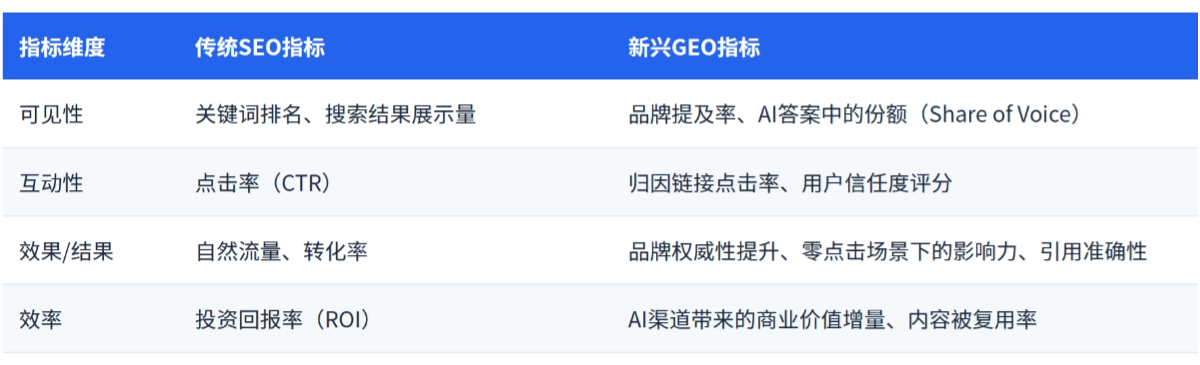
Evolution of Measurement Metrics (KPIs)
We have already introduced the KPIs of both separately. The table below can more clearly show the evolution of metrics from SEO to GEO.
Future Outlook and Action Guide
As AI technology continues to iterate, the importance of GEO will become increasingly prominent. For businesses and individual creators who have just encountered the concept of GEO, how should they plan their future strategy?
SEO is dead? No, it has evolved!
A common misconception is that "GEO will replace SEO." This is an incorrect assertion. More accurately, GEO is an evolution built on a solid SEO foundation.
- SEO is the foundation: A website that is technically flawless, has solid content, and enjoys a good external reputation is the prerequisite for any advanced optimization. If a website cannot be smoothly accessed by AI crawlers, or if the content quality is low, talking about GEO is like building castles in the air.
- GEO is the superstructure: Once the SEO foundation is laid, a GEO strategy can maximize the value of content, transforming it from isolated information points into authoritative nodes in the entire knowledge network.
The future digital marketing strategy will inevitably be a hybrid of SEO and GEO (Hybrid Approach). The two will work together to cover the entire chain from users' active searches to AI-assisted decision-making.
An action guide for AI beginners
In the face of the wave of AI search, do not be anxious. Starting now, take the following steps to gradually integrate GEO thinking into content creation:
- Write for Humans, Structure for Machines: Always create clear, useful, and engaging content for human readers. After creating it, think about how to make the content "AI-friendly." Use clear heading hierarchies (H1, H2, H3), use more bullet points and numbered lists, and split long paragraphs into short paragraphs.
- Build real authority, not tricks: Focus on the areas you are best at and continuously produce in-depth and original insights. If possible, demonstrate professional qualifications or industry experience. Do not be afraid to cite sources more authoritative than yourself; this can increase the credibility of the content.
- Embrace structured data: Many website content management systems (such as WordPress) now have plugins that help users easily add structured data. Start with the basics, such as adding "Article" markup to articles and "Product" markup to products.
- Start measuring GEO metrics: Regularly use AI tools (such as ChatGPT, Perplexity) to ask key questions in your field. Record whether the brand or website is mentioned and whether the mentioned content is accurate. Observe how competitors perform in AI answers.
- Integrate strategies and run dual tracks in parallel: Do not abandon the existing SEO work. Keyword research and link building are still very valuable. When planning SEO content, add the dimension of GEO thinking, such as: besides being able to rank, can this article directly answer a specific question from users? Can the core viewpoint be summarized and cited in one sentence?
Conclusion
Search engines have evolved from "information retrieval tools" into "knowledge generation engines," requiring all participants in digital content to evolve from "chasers of traffic" into "contributors of knowledge" and "shapers of authority."
SEO, as the classic bridge connecting users and websites, remains important, but its boundaries are being redefined. GEO, as a new language for effectively communicating with machines in the AI era, represents the future of digital marketing. For AI beginners, understanding the differences and connections between the two is a required course. Mastering SEO allows you to gain a foothold in today's digital world; embracing GEO allows you to seize the initiative in tomorrow's intelligent world. The ultimate victory belongs to visionaries who can create outstanding value for both humans and AI.