
What is FireRedAudio
FireRedAudio is a general-purpose audio language model launched by the Xiaohongshu FireRed team, based on a 9B-parameter Qwen3.5 autoregressive LLM. The model uses independent continuous representation channels for understanding and generation respectively (Audio Encoder and RedAE), which then feed into a shared LLM for unified inference. The model simultaneously supports ASR, audio question answering, understanding of recordings up to 1 hour long, Zero-shot TTS, instruction TTS, and speech editing, and has achieved leading performance in evaluations such as MMAU, MMSU, multilingual ASR, and Instruct TTS.
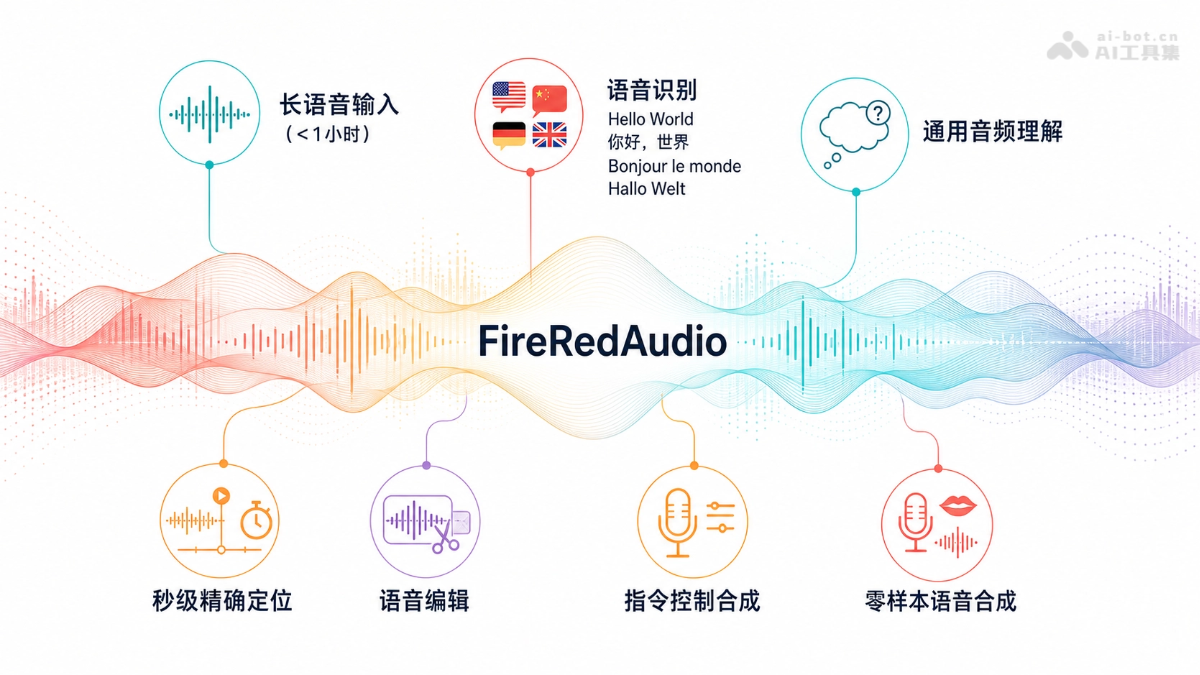
Main Features of FireRedAudio
-
Audio Understanding: Achieves the best results in the table on comprehensive audio question answering evaluations such as MMAU and MMSU, covering understanding of speech, music, and environmental sounds.
-
Multilingual ASR: Supports recognition of 102 languages, with an average error rate of 14.94% on FLEURS-102, showing particularly outstanding performance on low-resource languages.
-
Zero-shot TTS: Given any reference speech, it can synthesize new content, with Chinese and English content accuracy leading in the table.
-
Instruct TTS: Follows natural language instructions such as "read at a slower speaking rate," leading on all six evaluation metrics.
-
Speech Editing: Supports semantic-level deletion/insertion/replacement, as well as acoustic-level speed/pitch/volume changes.
-
Long Audio Processing: Supports recordings up to 1 hour long and can generate timeline-structured summaries with second-level precision.
Technical Principles of FireRedAudio
- Decoupled Continuous Representations: FireRedAudio does not force understanding and generation to share the same audio representation, instead designing independent continuous vector channels for each: the understanding side needs compact semantic features to support long-context modeling, while the generation side needs reconstructable fine-grained acoustic features to preserve timbre and prosody; the two complete unified inference within a shared LLM.
- Understanding Path: Audio is encoded by an Audio Encoder initialized from Whisper-large-v3, compressed by an Adapter into 12.5 continuous representations per second, and then fed into the 9B LLM, which directly outputs recognized text or understanding answers, adapting to ASR, audio question answering, and long-audio structuring tasks.
- Generation Path: Conditional audio is first compressed by RedAE (a deterministic autoencoder) into 25Hz, 64-dimensional continuous latents; during pretraining, semantic distillation is performed through a frozen teacher encoder to preserve content cues; a Patch Encoder aggregates every 4 frames into one audio step (6.25Hz) before sending it to the LLM; for each audio-step token the LLM predicts, its hidden state drives a flow-matching DiT to generate new latents, which are finally restored by the RedAE Decoder into 24kHz waveforms.
- Five-Stage Progressive Training: Training successively completes Adapter alignment, Audio Encoder adaptation, joint training of understanding and generation, multi-task post-training, and 200k long-context extension, accumulating approximately 2.66T non-padding multimodal tokens, progressively stacking capabilities rather than mixing all tasks at once.
- Shared Inference Hub: The 9B Qwen3.5 autoregressive LLM serves as the only trainable backbone, responsible for cross-modal reasoning, task planning, and context modeling; understanding and generation are decoupled only at the input representation layer and unified at the inference layer, enabling the model to both "understand" and "speak" without sacrificing information fidelity on either side.

Follow on WeChat and reply "Open Source" to join theAI Open Source Project Communication Group
How to Use FireRedAudio
-
Environment Setup: Read the environment and dependency installation instructions from the GitHub repository, and prepare the runtime environment.
-
Obtain weights: Download the model weights and configuration files from the official Hugging Face page.
-
Run the example: First run the minimal inference example provided officially to verify the model version, audio sampling rate, and output path.
-
Verify understanding: Test ASR and audio question answering separately to confirm that the understanding path works properly.
-
Verify generation: Test Zero-shot TTS and Instruct TTS separately to confirm that the generation path works properly.
-
Audio format: In generation tasks, keep the input and output at a 24 kHz sampling rate, and record the number of DiT sampling steps and peak VRAM usage.
-
TTS settings: For Zero-shot TTS, initialize the acoustic history with the last two audio steps of the reference speech; other generation tasks use zero initialization.
-
Hardware evaluation: Evaluate VRAM requirements based on the 9B backbone weights, KV cache, and DiT sampling overhead; long-audio tasks require additional reserved context cache space.
FireRedAudio's core advantages
-
Unified architecture: A single 9B autoregressive LLM handles both audio understanding and generation, avoiding the capability fragmentation caused by stitching together multiple modules.
-
Decoupled representation: Understanding and generation each use the continuous representation channel best suited to themselves, preserving both semantic compactness and acoustic details.
-
Leading performance: Achieves the best results in the table on all six metrics: MMAU, MMSU, 102-language ASR, and Instruct TTS.
-
Long audio support: Through 200k context extension, it can process recordings up to 1 hour long and output structured timelines with second-level precision.
-
Full-stack coverage: A single model supports six major tasks: ASR, audio question answering, Zero-shot TTS, Instruct TTS, and semantic/acoustic speech editing.
FireRedAudio project address
- GitHub repository:https://github.com/FireRedTeam/FireRedAudio
- HuggingFace model library:https://huggingface.co/FireRedTeam/FireRedAudio
- arXiv technical paper:https://arxiv.org/pdf/2608.24168
Comparison of FireRedAudio with similar competing products
| Comparison dimension | FireRedAudio | Qwen3.5-Omni-Plus |
|---|---|---|
| Positioning | A general understanding and generation model focused on the audio domain | A general omni-modal model covering text/image/audio/video |
| Architecture | 9B autoregressive LLM + decoupled continuous representation (Audio Encoder / RedAE) | A larger-scale end-to-end multimodal architecture that processes all modalities uniformly |
| Understanding evaluation | MMAU test 80.9, MMSU 83.3, both the best in the table | MMAU test 79.9, MMSU 80.7, slightly lower than FireRedAudio |
| Multilingual ASR | FLEURS-102 average WER 14.94%, with significant advantages on low-resource languages | FLEURS-102 average WER 23.66%, with slightly weaker multilingual coverage |
| Generation capability | Supports Zero-shot TTS, Instruct TTS, and speech editing, with DiT outputting 24kHz waveforms | Supports speech synthesis and understanding, but does not focus on speech editing and fine-grained acoustic control |
| Long audio | 200k context supports 1-hour recordings, with a strict@0 pass rate of 73.6% | It has long-audio processing capability, but the paper does not present structured evaluation at the same scale for 1 hour |
Application scenarios of FireRedAudio
-
Intelligent meeting assistant: Automatically transcribe a 1-hour meeting recording into structured minutes with second-level timestamps, and extract key decisions and to-do items.
-
Multilingual content localization: Input a Chinese video, automatically recognize the original audio, and generate multilingual dubbing such as English and Japanese, while preserving the original speaker's timbre and emotional style.
-
Podcast/audiobook post-production: Adjust speech rate, volume, or replace specific sentences through natural language instructions, completing speech editing without re-recording.
-
Intelligent customer service voice interaction: Understand user voice inquiries in real time (including environmental noise and accents), and generate reply speech with a specified timbre and speech rate, enabling end-to-end voice dialogue.
-
Audio content moderation and retrieval: Perform structured understanding of massive content on long-audio platforms, supporting semantic-level retrieval and annotation such as "find all segments mentioning price fraud".