
What is Faraday
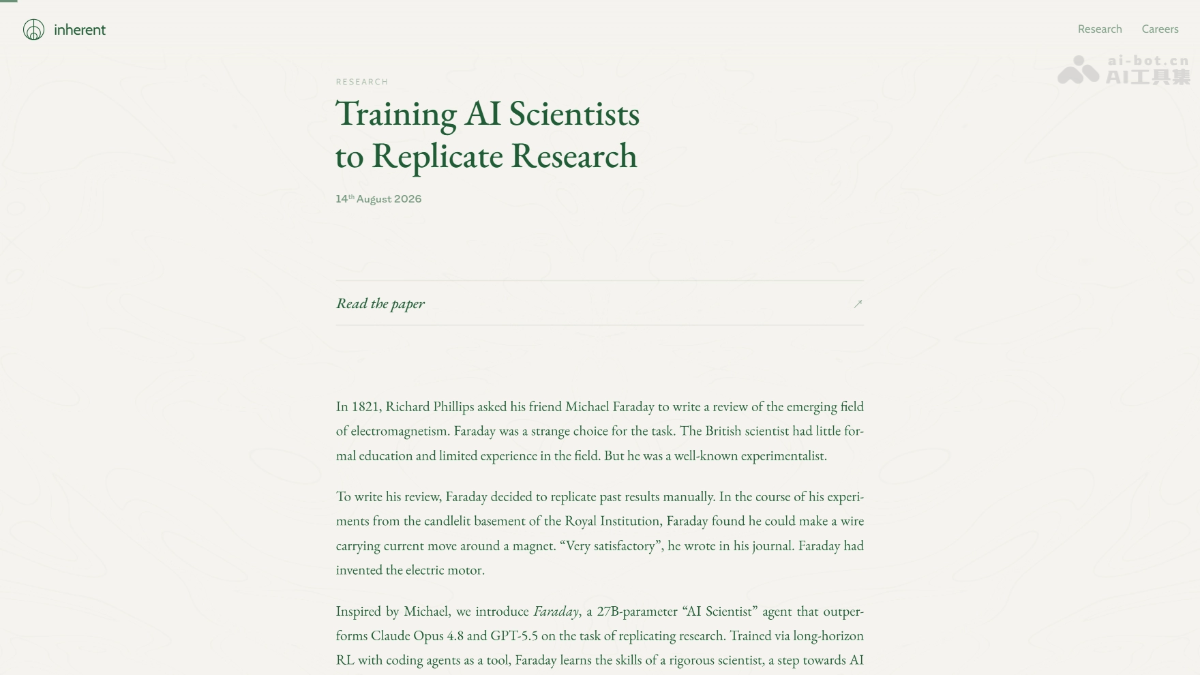
Faraday is an AI scientist agent introduced by the London AI lab Inherent, built on the 27-billion-parameter Qwen 3.6 model and trained through reinforcement learning. Faraday can, like a human PhD student, autonomously read papers, design experiments, and reproduce research results without knowing the answers in advance. On the paper reproduction benchmark Replica, Faraday outperforms Claude Opus 4.8 and GPT-5.5。
Faraday's Main Features
- Autonomous Paper Reproduction: Reads academic papers with result figures and tables masked, infers the experimental methods, and autonomously designs and executes reproduction experiments within 60 minutes + limited GPU resources
- Scientific Experiment Design: When faced with experiments that cannot be reproduced at full scale, it can scale them down while remaining faithful to the original paper's core claims, demonstrating "research taste"
- Tool-Calling Programming: Uses Codex GPT-5.5 as an external coding tool, taking responsibility for scientific decisions itself while delegating code execution to a professional programming agent
- Cross-Domain Generalization: Trained on ML papers and tested on AI-for-Science papers, it possesses cross-domain transfer capability
Faraday's Technical Principles
- Base Model Selection: Faraday is built on Qwen 3.6-27B, with only 27 billion parameters. The team endowed it with scientific decision-making ability through post-training with reinforcement learning, delegating code implementation to external tools, verifying that scientific intelligence and engineering intelligence can be decoupled.
- Coding Agent as a Tool (CAT) Architecture: Faraday calls Codex GPT-5.5 as an external programming assistant via a shell tool; Faraday focuses on high-level scientific decisions, including understanding papers, designing experimental plans, and allocating computational resources, while Codex is responsible for specific code writing and debugging execution.
- Replica Task Space: The training data comes from the automatically generated Replica benchmark, covering 100 well-known papers from 1990–2026 with a total of 310 reproduction tasks; Gemini 2.5 Pro is used to automatically identify and mask result figures and tables in the papers to form tasks, and the Agent must autonomously reproduce them within the strict limits of 60 minutes and 1/7 of an H200 GPU.
- Rubric-based Judge Reward System:To address the challenge that reproduction tasks have no definitive answers, the system first uses Claude Opus 4.7 to automatically generate a dedicated scoring rubric for each task (hiding the original gold plot to prevent overfitting), and then uses Codex GPT-5.5 as the executing judge to review the codebase, git history, and interaction records within 10 minutes, giving a reward signal from 0–1 across five dimensions: visual matching, support for scientific claims, experimental fidelity, resource utilization efficiency, and scientific integrity.
- Long-Horizon Reinforcement Learning Training: Faraday uses a modified GRPO algorithm combined with LoRA fine-tuning (rank=128), performing post-training in a 128K token context window with a learning rate of 6×10⁻⁶; each batch uniformly samples papers covering different eras, ensuring that training is not dominated by a single scientific paradigm and achieving stable long-horizon optimization for non-verifiable tasks.
How to Use Faraday
Faraday is currently in the research release stage, and no public API, product interface, or experience entry point has yet been launched.
Faraday's Core Advantages
- Small Model, Big Capability: Based on the 27-billion-parameter Qwen 3.6, it surpasses Claude Opus 4.8 and GPT-5.5 on paper reproduction tasks, proving that scientific intelligence does not need to rely on ultra-large-scale models.
- Tool-Decoupled Architecture: Adopting the Coding Agent as Tool (CAT) paradigm, Faraday focuses on scientific decision-making and delegates code implementation to Codex GPT-5.5, achieving an efficient division of labor between scientific intelligence and engineering intelligence.
- Cultivation of research taste: Acquires "research taste" through reinforcement learning, and can still design scaled-down experiments faithful to the original paper when resources are limited, rejecting hardcoding and cheating shortcuts.
- Cross-domain generalization: Trained on ML papers, it still maintains a task win rate of over 60% when tested on AI-for-Science papers, demonstrating strong cross-domain transfer capability.
- Scalable benchmark: Automatically generates a task space based on Replica, expanding from 100 papers to 310 reproduction tasks, providing a scalable data foundation for AI scientist training.
- Stable long-horizon RL
Successfully extends GRPO reinforcement learning to long-horizon, non-verifiable scientific research tasks, achieving stable training through a per-task rubric judge and turn-level credit assignment.
Faraday's project address
- Project official website:https://inherentlabs.ai/research/training-to-replicate
- arXiv technical paper:https://arxiv.org/pdf/2608.13331
Comparison of Faraday with similar competitors
| Comparison dimension | Faraday (Inherent) | The AI Scientist (Sakana AI) |
|---|---|---|
| Core positioning | Focuses on "paper reproduction", verifying the reliability of existing research results | End-to-end autonomous scientific research—the full process from hypothesis generation to paper writing |
| Base model | Qwen 3.6-27B (small model + external tools) | Calls frontier models such as Claude/GPT as the foundation |
| Working method | Reproduces paper figures like a human PhD student, using Codex as a programming tool | Autonomously proposes research ideas, runs experiments, and writes LaTeX papers |
| Task scope | Reproduces specific result figures in published papers (Replica benchmark) | Generates complete research topics from scratch and produces submittable papers |
| Verification method | Automatic Rubric-based Judge + human expert evaluation of reproduction quality | Verified through peer review at a real academic conference (ICLR Workshop) |
| Open-source status | The paper and Replica benchmark have been made public; the model is not open-sourced | The AI Scientist v1/v2 code has been open-sourced on GitHub |
Faraday's application scenarios
-
Academic paper reproduction verification: Research institutions can use Faraday to batch-verify the reproducibility of published papers, addressing the "reproducibility crisis" in the machine learning field.
-
PhD student research training: As a "virtual research assistant", it helps PhD students cultivate experimental design and scientific taste by reproducing classic papers.
-
AI-for-Science experimental verification: In fields such as materials science, weather forecasting, and bioinformatics, it automatically reproduces experimental results in interdisciplinary papers.
-
Research benchmarking: Provides a standardized Replica evaluation framework for AI scientist Agents, used to measure the capabilities of different models on scientific research tasks.
-
Research method auditing: Journal reviewers or funding review agencies can use Faraday to quickly examine the authenticity and reproducibility of experimental results in submitted papers.