
What is Earth-2
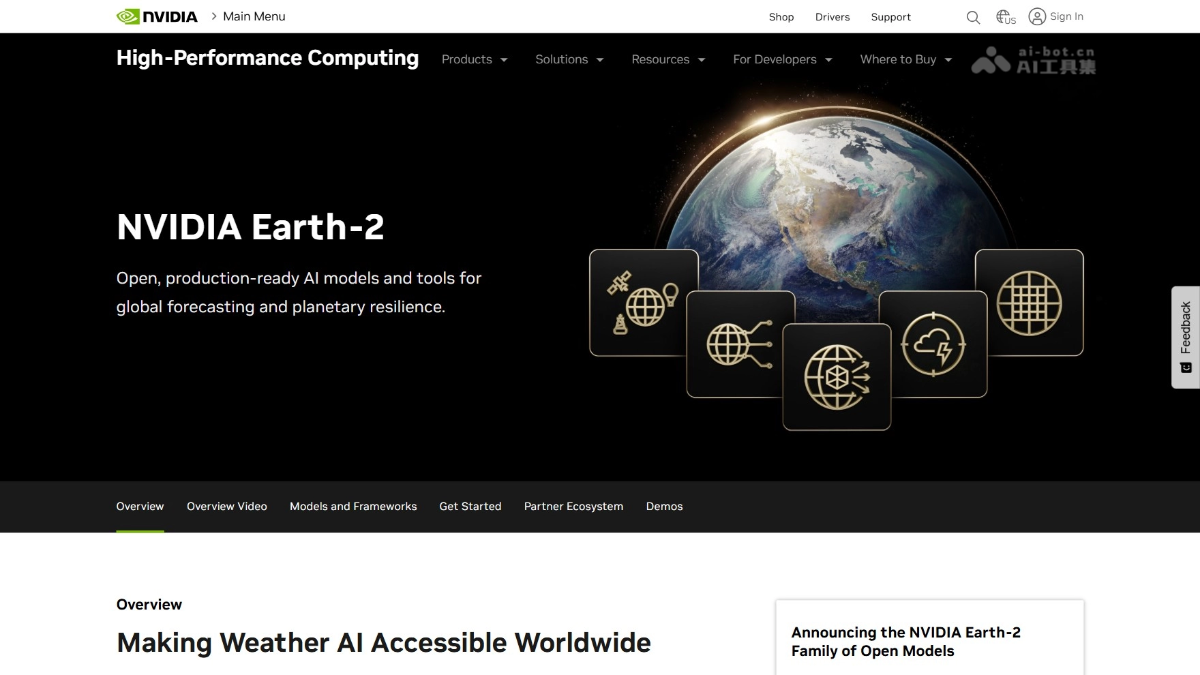
NVIDIA Earth-2 is the world's first fully open-source AI weather prediction model family launched by NVIDIA. Based on three core architectures—Atlas, StormScope, and HealDA—it respectively achieves 15-day global medium-range forecasting, 0-6 hour kilometer-scale nowcasting, and second-level initial condition generation. Compared with traditional numerical weather prediction, which relies on supercomputers to solve physical equations, Earth-2 adopts an end-to-end AI pipeline, delivering a thousandfold speed increase and sharply reduced energy consumption, enabling meteorological agencies, enterprises, and developers worldwide to build autonomous and controllable high-precision forecasting systems based on open-source models. This marks the official entry of weather AI into the era of industrial deployment.
Main Features of Earth-2
- Medium-Range Weather Forecasting (Earth-2 Medium Range): Based on the Atlas architecture, it provides global weather forecasts up to 15 days ahead, predicting more than 70 meteorological variables such as temperature, pressure, wind speed, and humidity. Its accuracy surpasses leading open models such as Google DeepMind's in key industry benchmarks.GenCastand other leading open models.
- Nowcasting (Earth-2 Nowcasting): Based on the StormScope architecture, it uses generative AI technology to directly process satellite and radar data, predicting short-term extreme weather from 0 to 6 hours ahead and generating local storm forecasts at kilometer-scale resolution within minutes.
- Global Data Assimilation (Earth-2 Global Data Assimilation): Based on the HealDA architecture, it solves the most time-consuming problem in weather forecasting—initial condition generation. Tasks that take traditional supercomputers hours to complete require only seconds on GPUs. Combined with medium-range models, it can build the strongest forecasting pipeline currently fully driven by AI.
- AI Downscaling (Earth-2 CorrDiff): It uses conditional diffusion models to achieve generative AI downscaling, with speed 500 times faster than traditional methods and energy efficiency improved by 10,000 times. It supports refining coarse-grained forecasts to street level and generating more datasets to better assess the probability distribution of weather events.
- Visualization Services: Based on NVIDIA Omniverse and the OpenUSD 3D framework, it supports global-scale climate simulation and the aggregation and visualization of geospatial datasets, enabling high-resolution interactive exploration in the cloud.
Technical Principles of Earth-2
- Atlas Architecture: The Atlas architecture is the core of the Earth-2 medium-range prediction model. It uses deep learning networks to process global-scale spatiotemporal sequence data and replaces the complex physical equation solving process in traditional numerical weather prediction with an end-to-end AI pipeline. It can greatly improve prediction efficiency while maintaining high accuracy, achieving global forecasts of more than 70 meteorological variables up to 15 days ahead.
- StormScope Architecture : The StormScope architecture is the technical foundation of the Earth-2 nowcasting model. It uses generative AI technology to directly learn from and infer satellite and radar imagery, without relying on traditional physical equations to simulate atmospheric motion. This enables the model to capture the dynamic evolution of storm systems more quickly and accurately, becoming the first AI architecture to surpass traditional physical methods in storm dynamics simulation.
- HealDA Architecture: The HealDA architecture is the core innovation of the Earth-2 global data assimilation model. Through GPU parallel computing capabilities, it completely reconstructs the data assimilation process, compressing the task of generating initial atmospheric conditions—which takes traditional supercomputers hours—into seconds. It achieves efficient coupling between observational data and prediction models, laying the foundation for building a fully AI-driven end-to-end forecasting pipeline.
- CorrDiff Technology: CorrDiff technology implements generative downscaling based on conditional diffusion models, using the super-resolution capabilities of generative AI to refine low-resolution atmospheric forecast data to a high-resolution local scale, achieving a 500-fold speed increase and a 10,000-fold energy efficiency improvement while maintaining physical consistency, making street-level accurate forecasting possible.
Earth-2 Project Address
- Project Official Website:https://www.nvidia.com/en-us/high-performance-computing/earth-2/
- GitHub Repository:https://github.com/NVIDIA/earth2studio
- HuggingFace Model Library:https://huggingface.co/collections/nvidia/earth-2
Earth-2 Application Scenarios
- Weather Forecasting Services: Meteorological agencies can fine-tune the open-source Earth-2 models using local data to build a fully autonomous and controllable national-level weather forecasting system that conforms to the country's geographical characteristics.
- Extreme Weather Warnings: Through models such as FourCastNet, predict extreme weather events such as typhoons, heavy rain, and heatwaves up to three weeks in advance, generating 1,000 ensemble forecast members to buy valuable response time for disaster prevention and mitigation.
- Clean Energy Management: Accurately predict changes in wind fields and solar irradiance, optimize output forecasts for wind farms and photovoltaic power stations, and enhance the capacity to absorb renewable energy.
- Precision Agriculture Planting: Guide farmers in precisely scheduling irrigation, fertilization, sowing, and pest and disease control, reduce losses from meteorological disasters, and improve crop yield and quality.
- Aviation and Shipping Safety: Monitor weather conditions along routes in real time, avoid hazardous weather such as clear-air turbulence and thunderstorms in advance, optimize flight paths and takeoff and landing times, and improve flight punctuality and flight safety levels.