
What is GenCast
GenCast is a revolutionary AI weather forecasting model launched by DeepMind, based on diffusion model technology, providing global weather forecasts up to 15 days. GenCast surpasses the world's top medium-range weather forecasting system ENS in 97.2% of forecasting tasks, especially excelling in predicting extreme weather events. Compared with traditional models, GenCast can generate forecasts in 8 minutes, significantly improving forecasting efficiency. GenCast has been open-sourced, including code and model weights, to support the broader weather forecasting community and research.
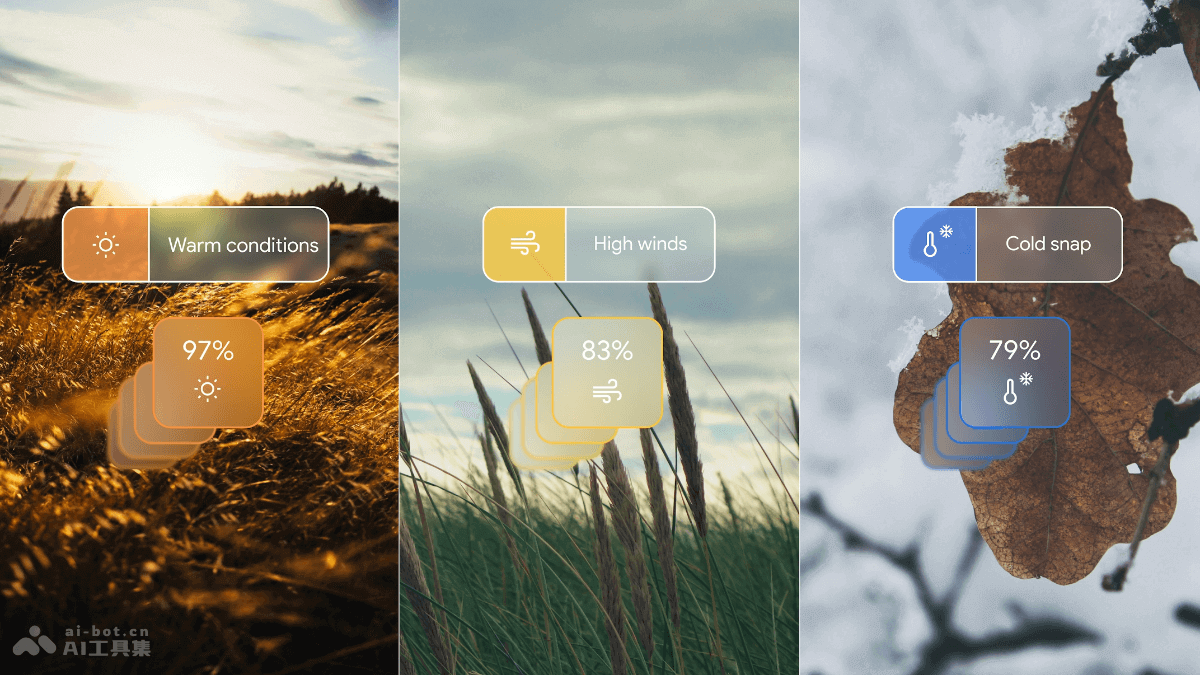
Main features of GenCast
- Medium- and long-range weather forecasting: Provides global weather forecasts up to 15 days, updated every 12 hours.
- High-resolution forecasting: The model runs at 0.25° latitude-longitude resolution, providing high-resolution forecasts.
- Ensemble forecasting: Unlike traditional single forecasts, GenCast generates 50 or more forecast ensemble members, each representing a possible weather trajectory and expressing uncertainty.
- Extreme weather forecasting: GenCast excels at predicting extreme weather events, such as heatwaves, strong winds, tropical cyclones, etc.
- Fast forecasting: On Google Cloud TPU v5, GenCast takes only 8 minutes to generate a 15-day weather forecast ensemble.
Technical principles of GenCast
- Diffusion model: Based on diffusion models, a type of generative AI model used to generate new samples in fields such as images, video, and music. The model generates samples of future states from noise based on an iterative refinement process.
- Adaptation to Earth's spherical geometry: GenCast is specifically adapted to Earth's spherical geometry and can learn to accurately generate complex probability distributions of future weather scenarios.
- Conditional probability distribution: The GenCast model models the conditional probability distribution of future weather states given current and previous weather states.
- Neural network architecture: GenCast uses a neural network architecture containing an encoder, processor, and decoder. The encoder maps the input from the latitude-longitude grid to an internal learned representation, the processor (graph transformer) attends to its neighboring nodes, and the decoder maps the results back to the original grid.
- Training and forecasting: GenCast is trained using forty years of historical weather data from ECMWF's ERA5 archive, learning global weather patterns and autoregressively generating 15-day ensemble forecasts.
- Parallel generation: Since each time step is initialized from noise, forecast ensembles are generated by repeating the generation process with different noise samples.
GenCast project address
- Project official website:gencast-predicts-weather
- GitHub repository:https://github.com/google-deepmind/graphcast
- arXiv technical paper:https://arxiv.org/pdf/2312.15796
Application scenarios of GenCast
- Disaster prevention and management: GenCast can predict extreme weather events in advance, helping governments and rescue organizations reduce losses caused by disasters.
- Energy management: In the fields of wind and solar power generation, the accurate forecasts provided by GenCast optimize energy output prediction and improve energy utilization efficiency.
- Agricultural planning: GenCast helps farmers avoid risks caused by weather changes and reasonably arrange agricultural production activities.
- Transportation and logistics: GenCast provides critical weather information for aviation and maritime transport, ensuring transport safety and efficiency.
- Urban planning and construction:GenCast helps urban planners consider climate change and build infrastructure that is more resilient to weather changes.