
What is Dulus
Dulus is an open-source CLI AI Agent of about 12K lines of Python, supporting 40+ models including Claude, GPT, Gemini, DeepSeek, Kimi, Qwen, and more. Tools can directly capture the guest session of browser-based AI web apps, turning them into tool-calling agents with 27 tools such as file reading and writing, code editing, Bash execution, and Web search. Dulus supports MCP, plugin hot-reloading, sub-agents, offline voice, persistent memory, and automatic snapshots, and provides PyQt6 GUI, WebChat, and Telegram multi-platform entry points.
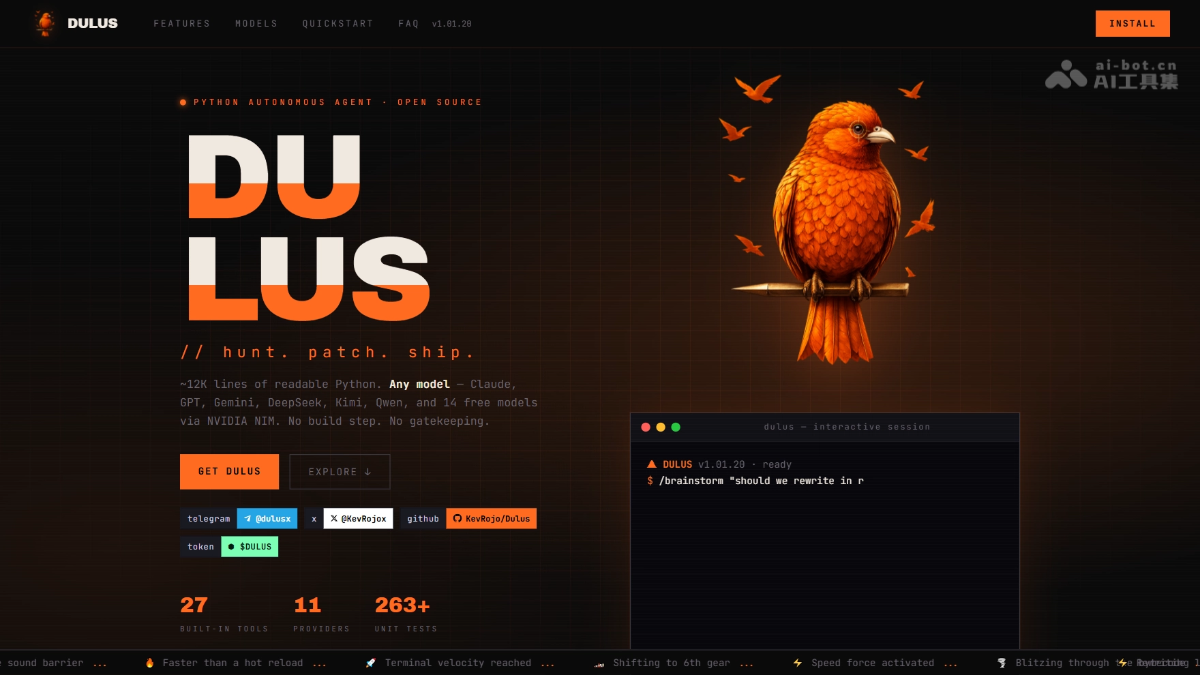
Main features of Dulus
-
Zero-key web session capture: automatically hijacks browser tabs such as Gemini, Claude.ai, Kimi.com, DeepSeek, and more, converting web conversations into a local Agent capable of tool calling.
-
27 built-in tools: covering Read, Write, Edit, Bash, Glob, Grep, WebFetch, WebSearch, NotebookEdit, GetDiagnostics, Memory, Tasks, Agents, Skills, and more.
-
Multi-provider model switching: supports Anthropic, OpenAI, Google, DeepSeek, Kimi, Qwen, Zhipu, MiniMax, Ollama, LM Studio, and custom endpoints, with
/modelreal-time switching during a session. -
MCP and plugin ecosystem: place
.mcp.jsonto register any MCP server; Auto-Adapter can hot-load any Python repository as a plugin with zero configuration. -
Sub-agents and task management: generates sub-agents of types such as coder, reviewer, and researcher in independent git worktrees, collaborates through message passing, and includes a built-in task board.
-
Offline voice and wake word: implements offline voice input based on Whisper-cpp, and voice output with Kokoro TTS; supports custom offline wake words such as "hey dulus".
-
Persistent memory and snapshots: dual-scope memory (user-level + project-level) ranked by confidence and recency; automatically creates Checkpoints each round, supporting one-click rollback of conversations and file states.
-
Multimodal interaction interfaces: provides four interaction methods: REPL terminal, Flask WebChat (accessible over LAN), PyQt6 native desktop GUI, and Telegram Bot.
-
Developer enhanced mode: SSJ Mode provides debugging capabilities such as raw token counts, streaming latency timing, tool call inspector, and prompt injection viewer.
How to use Dulus
- Installation: run
pip install dulusorcurl -fsSL https://raw.githubusercontent.com/KevRojo/Dulus/main/install.sh | bashfor one-click installation. - Configure keys: set any provider environment variable such as
export ANTHROPIC_API_KEY=sk-ant-..., or skip it entirely and use Ollama local models with browser hijacking mode. - Start interaction: enter
dulusin the terminal to enter the REPL, and use/model nvidia-web/deepseek-r1or/model ollama/qwen2.5-coderto select a model. - Enable zero-key mode: on first run, follow the wizard prompts to open the Gemini browser guest page; Dulus automatically captures the session, and tool calling can begin without an API Key.
- Execute tasks: directly enter natural language instructions such as "refactor the auth module", and the Agent automatically reads files, edits code, runs tests, and submits results.
- Extend capabilities: use
/plugin install 仓库名@URLto hot-load any Python tool library, or/mcpRegister external MCP server extensions.
Dulus's Core Advantages
-
Truly Zero-Cost Startup: No API Key, credit card, or login required; get a full tool-calling Agent within 30 seconds through browser guest mode, lowering the barrier to entry to the extreme.
-
Model Neutrality and Real-Time Switching: Not bound to a single provider, within the same session
/modelyou can seamlessly switch between models such as Claude, DeepSeek, Kimi, and supports automatic fallback chains. -
Hot-Pluggable Ecosystem Expansion: Auto-Adapter turns any Python repository into a plugin in seconds; MCP and Composio provide 800+ skills, and ecosystem expansion requires no waiting for official adaptation.
-
Full-Chain Offline Capabilities: Supports voice input and output, wake words, OCR, and Ollama local models, all of which can run in a completely disconnected environment, suitable for confidential networks and offline scenarios.
-
Unified Core Across Multiple Interfaces: Terminal, Web, desktop GUI, and Telegram share the same Agent core and memory state, allowing users to freely switch interaction surfaces according to the scenario.
Dulus's Project Address
- Project Website:https://dulus.ai/
- GitHub Repository:https://github.com/KevRojo/Dulus
Comparison of Dulus with Similar Competitors
| Comparison Dimension | Dulus | Claude Code | Aider |
|---|---|---|---|
| Provider Lock-In | Multi-provider neutral, real-time switching | Only Anthropic Claude | Multiple models, but configuration is cumbersome |
| API Key Requirements | Optional zero-key (browser hijacking) | API Key required | API Key required |
| Local/Offline Operation | Full support (Ollama + offline voice) | Not supported | Supports local models, no offline voice |
| Plugin Ecosystem | Auto-Adapter for any Python repository + MCP | No plugin system | Supports custom tools, smaller ecosystem |
| Sub-agents/Multi-Agent | Built-in multi-type sub-agents and message passing | No native sub-agents | Supports multi-file editing, no independent sub-agents |
| Voice Interaction | Offline Whisper + Kokoro TTS + wake word | Not supported | Not supported |
| Web/Telegram/GUI | All four interfaces available | Terminal only | Terminal only |
| Memory and Snapshots | Persistent memory + automatic Checkpoint rollback | Session-level memory | No native snapshot mechanism |
| Open Source and Size | ~12K lines of Python, install directly via pip | Closed source | Open source, functionality focused on coding |
Dulus's Application Scenarios
-
Personal Developer Coding Assistant: Replaces traditional IDE plugins, directly drives code reading, writing, refactoring, testing, and committing via natural language, and supports multi-model collaborative review.
-
Zero-Budget AI Experiments: Students or beginners can use Gemini guest mode to freely experience the advanced tool-calling capabilities of cutting-edge models without subscribing to paid APIs.
-
Offline/Confidential Environment Automation: Achieving fully privatized Agent workflows based on local Ollama models and offline speech in government, military, or corporate intranets.
-
Telegram Remote Operations: Sending commands to Dulus at home or on a server via Telegram on a mobile phone to perform remote operations such as file management and log troubleshooting.
-
Multi-Agent Collaborative Development: Assigning code writing, review, and testing to different sub-agents to advance in parallel, suitable for distributed development of large modules.