
What is Doubao Large Model 1.6
Doubao Large Model 1.6 (Doubao-Seed-1.6) is a multimodal deep thinking large model launched by ByteDance. The model supports three thinking modes: auto, thinking, and non-thinking. It can process multiple input forms such as text, images, and videos, and supports outputting high-quality text content. The model has a 256k long context window, a maximum input length of up to 224k tokens, and supports a maximum output length of 16k tokens, with powerful reasoning capabilities. The model performs excellently in multiple authoritative evaluations, with significantly improved reasoning and mathematical capabilities. Doubao 1.6 is widely used in fields such as content creation, intelligent dialogue, and code generation, providing enterprises and developers with a powerful AI productivity tool. Doubao 1.6 has been launched on Volcano Engine, and enterprises and developers can call the API to experience it.
The latest upgrade of Doubao Large Model 1.6 innovatively introduces four thinking length modes: Minimal, Low, Medium, and High, precisely balancing effectiveness, latency, and cost. It is the first large model in China to natively support 'tiered adjustment of thinking length.' Among them, compared with before the upgrade, the low thinking length mode reduces total output Tokens by 77.5% and thinking time by 84.6%, while maintaining the same effectiveness, greatly improving efficiency.

Main features of Doubao Large Model 1.6
- Reasoning capability: Significantly improved in reasoning speed, accuracy, and stability, capable of supporting the implementation of more complex business scenarios.
- Thinking while searching and DeepResearch: It has the capability to search while thinking, can search based on missing information, and provides recommendations after multiple rounds of thinking and searching. The DeepResearch feature supports quickly generating research reports.
- Multimodal understanding capability: The entire series natively supports multimodal thinking capabilities, and supports understanding and processing multimodal data such as text, images, and videos.
- Graphical user interface operation capability (GUI operation): Based on visual deep thinking and precise positioning, it can interact with and operate browsers and other software, efficiently executing various tasks.
The three models of Doubao Large Model 1.6
- doubao-seed-1.6: An all-around comprehensive model. It is an all-around comprehensive model and the first thinking model in China to support a 256K context. The model has multiple capabilities such as deep thinking, multimodal understanding, and graphical user interface operation. Users can flexibly choose to enable or disable the deep thinking feature according to their needs, and it supports an adaptive thinking mode. The adaptive mode automatically determines whether to enable deep thinking based on the difficulty of the prompt, greatly reducing tokens consumption while improving effectiveness.
- doubao-seed-1.6-thinking: A deep thinking enhanced version. It is an enhanced version focused on deep thinking in the Doubao Large Model 1.6 series. The model further improves basic capabilities such as code writing, mathematical calculation, and logical reasoning, and can handle more complex tasks. At the same time, it supports a 256K context, can understand and generate longer text content, and is suitable for scenarios requiring deep analysis and complex reasoning.
- doubao-seed-1.6-flash: An ultra-fast response version. It is the ultra-fast version in the Doubao Large Model 1.6 series, with deep thinking and multimodal understanding capabilities and support for a 256K context. The model has extremely low latency, with TOPT (Top-of-Pipeline Time) of only 10ms, and can quickly respond to user requests. The model's visual understanding capability is comparable to flagship models from competitors, and it is suitable for scenarios with extremely high requirements for response speed, such as real-time interaction and visual task processing.
Performance of Doubao Large Model 1.6
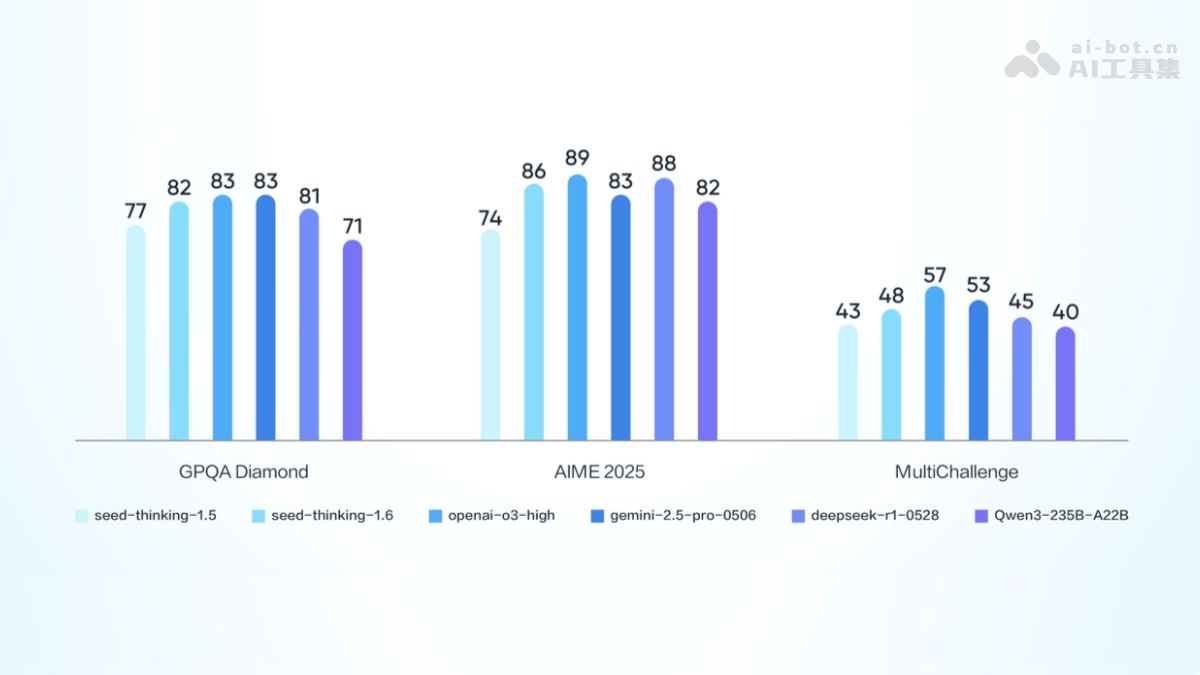
- GPQA Diamond test: The Doubao 1.6-thinking model achieved a score of 81.5, reaching the world's first tier and making it one of the best reasoning models currently.
- Mathematics evaluation AIME25: The Doubao 1.6-thinking model achieved a score of 86.3 points, an improvement of 12.3 points compared to the Doubao 1.5 deep thinking model.
Pricing model of Doubao Large Model 1.6
Doubao Large Model 1.6 is based on a unified pricing model. Whether or not deep thinking mode is enabled, and whether the input is text or visual, the token price is the same.
- Input length 0-32K:
- Input price: 0.8 yuan/million tokens.
- Output price: 8 yuan/million tokens.
- Input length 32K-128K:
- Input price: 1.2 yuan/million tokens.
- Output price: 16 yuan/million tokens.
- Input length 128K-256K:
- Input price: 2.4 yuan/million tokens.
- Output price: 24 yuan/million tokens.
- Input within 32K and output within 200 tokens:
- Input price: 0.8 yuan/million tokens.
- Output price: 2 yuan/million tokens.
How to use Doubao Large Model 1.6
- Register and log in to the Volcano Engine platform: Visit theVolcano Engineofficial website and complete registration and login as prompted.
- Activate the Doubao Large Model service: Enter the service page and find the service page for Doubao Large Model 1.6.
- Activate the service: Follow the page prompts to activate the Doubao Large Model 1.6 service.
- Choose a version: Choose the appropriate model version according to your needs (such as doubao-seed-1.6, doubao-seed-1.6-thinking, or doubao-seed-1.6-flash).
- Obtain an API key: After activating the service, the platform provides an API key for identity verification when calling the model.
- Call the model:
- Use the API interface: Doubao Large Model 1.6 is called based on the API interface.
- Build the request: Build the request data according to your needs, including input text, parameter settings, etc.
- Send the request: Use an HTTP request to send the data to the model's API interface.
- Receive the response: After the model finishes processing, it returns response data, including the generated text or other results.
- Example code (Python): The following is example code for calling Doubao Large Model 1.6 using Python:
import requests
import json

# API密钥和接口地址
api_key = "your_api_key"
api_secret = "your_api_secret"
model_version = "doubao-seed-1.6"  # 或doubao-seed-1.6-thinking、doubao-seed-1.6-flash
api_url = f"https://api.volcengine.com/v1/model/{model_version}"

# 请求数据
data = {
    "input": "你的输入文本",
    "parameters": {
        "max_length": 256,  # 输出的最大长度
        "temperature": 0.7,  # 随机性参数
        "top_p": 0.9,  # 核心采样参数
        "top_k": 50,  # 核心采样参数
        "do_sample": True  # 是否采样
    }
}

# 设置请求头
headers = {
    "Authorization": f"Bearer {api_key}",
    "Content-Type": "application/json"
}

# 发送请求
response = requests.post(api_url, headers=headers, data=json.dumps(data))

# 处理响应
if response.status_code == 200:
    result = response.json()
    print("模型输出:", result["output"])
else:
    print("请求失败,状态码:", response.status_code)
    print("错误信息:", response.text)
Project address of Doubao Large Model 1.6
- Project official website:https://console.volcengine.com/ark/region:ark+cn-beijing/model/detail?Id=doubao-seed-1-6
Application scenarios of Doubao Large Model 1.6
- Content creation: Generate advertising copy, news reports, stories, novels, etc., helping users quickly produce high-quality content.
- Intelligent dialogue: Used in intelligent customer service and chatbots to provide a natural and smooth multi-turn dialogue experience and improve user interaction efficiency.
- Code generation: Generate front-end code snippets according to requirements, assist developers in troubleshooting errors, and improve development efficiency.
- Educational tutoring: Answer subject questions, generate teaching resources, and assist students in learning and teachers in lesson preparation.
- Multimodal content generation: Combine image or video input to generate relevant text descriptions or creative content, assisting multimedia creation.