
What is Baichuan-M4
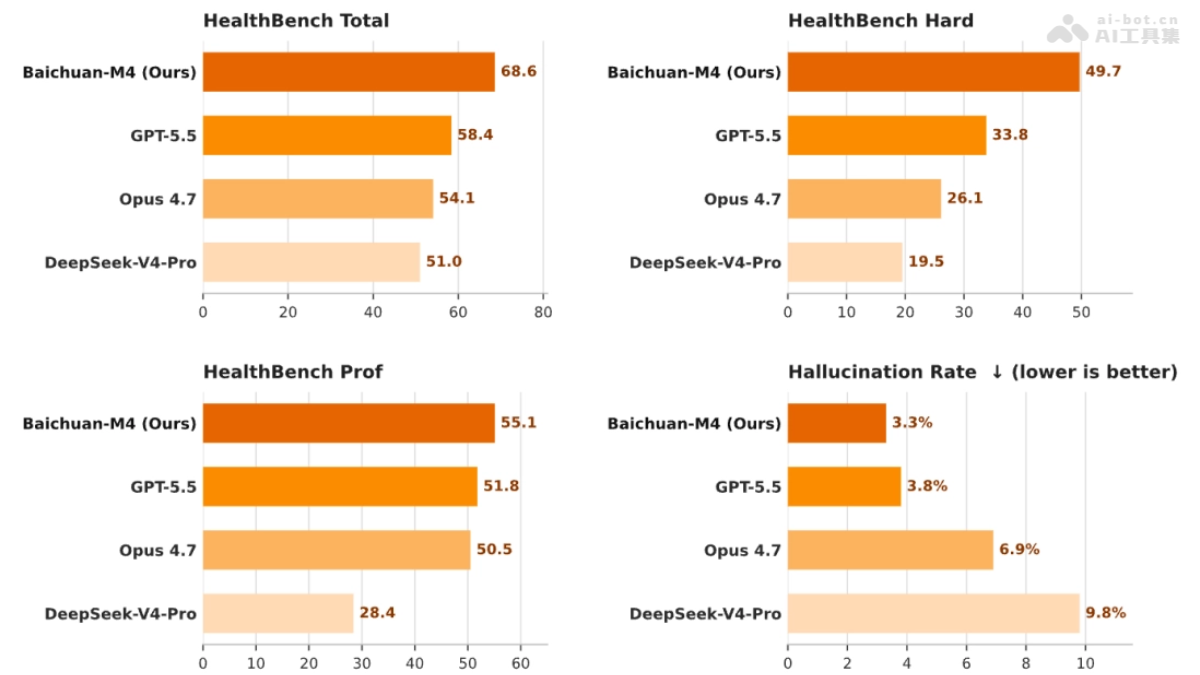
Baichuan-M4 is a new-generation medical-enhanced large model jointly launched by Baichuan Intelligence and Tsinghua University. It ranks first in the world simultaneously on the three authoritative HealthBench leaderboards: Comprehensive, Hard, and Professional, with a hallucination rate as low as 3.3%, the lowest in the entire industry. Baichuan-M4 breaks through the limitation of general large models passively responding and focuses on four core clinical capabilities: in-depth consultation, full-course memory, evidence anchoring, and autonomous Agent scheduling, enabling AI to truly move from being able to answer questions to being able to diagnose and treat.
Main features of Baichuan-M4
-
In-depth proactive consultation: Simulates a clinician's multi-round follow-up questioning, guiding patients to supplement symptom details and prioritizing the identification of critical and severe conditions, rather than passively waiting for complete information.
-
Full-course memory: Connects historical medical records, multi-round consultations, laboratory trends, and medication feedback, continuously grasping the patient's complete medical history across multiple conversations.
-
Evidence anchoring: Every medical conclusion generated precisely corresponds to a specific passage in an authoritative paper or guideline, ensuring traceability and verifiability.
-
Agent scheduling: Through Baichuan-Harness, it autonomously decides when to follow up, retrieve, or review medical history, and processes complex subtasks in parallel.
-
Safety constraints: Intercepts in real time违规 tool calls, unauthorized data access, and operations that do not comply with clinical standards.
Technical principles of Baichuan-M4
- OSCE-based dynamic consultation: Drawing on the objective structured clinical examination method used in medical education, it jointly built the SCAN-bench evaluation system with more than 150 frontline doctors. The model simulates the real consultation process through multi-round dynamic interaction, proactively asking about the nature and triggers of symptoms, gradually narrowing the diagnostic scope, and avoiding skipping key medical history in order to quickly reach a conclusion.
- Long-context full-course memory: Breaking through the memory limitation of single-round dialogue, it adopts a long-context clinical memory mechanism to continuously integrate structured medical records, summaries of previous consultations, examination results, and medication feedback. Across multiple interactions spanning different timelines, the model always grasps the patient's identity, past diseases, and changes in indicators, providing a personalized data foundation for precision medicine.
- Six-source evidence-based medicine and evidence anchoring: Relying on the "six-source evidence-based" paradigm, it retrieves only authoritative medical sources and does not scrape from the open web. It breaks down guidelines, expert consensus, and real diagnosis and treatment processes into more than 1,000 standardized clinical pathway units, covering more than 200 diseases. The model's output must be precisely anchored to specific passages in the original literature, not merely citing document numbers, ensuring citation precision reaches 90.0.
- Baichuan-Harness Agent architecture: As the central nervous system of the medical agent, it autonomously orchestrates the timing of calls to the three major modules: consultation, memory, and evidence-based medicine. When facing heavy tasks, it splits them into subtasks for parallel processing, reducing the context load of the main Agent; at the same time, it has built-in real-time safety guardrails to intercept unauthorized tool calls and data access, and supports iterative回流 of difficult online cases.
How to use Baichuan-M4
- Initial symptom description: Users describe their current physical discomfort or upload laboratory test reports through the Baichuan Intelligence product entry point.
- Proactive multi-round follow-up: M4 automatically initiates targeted follow-up questions, guiding users to supplement key information such as the location of symptoms, duration, triggers, and past medical history.
- Generate consultation card: After completing information collection, the model organizes the medical history and symptoms into a structured consultation card and provides preliminary medical visit recommendations.
- Continuous Follow-up Management: Users can supplement new symptoms or examination results at any time afterward, and M4 continuously tracks the progression of the condition based on full-course memory.
Core Advantages of Baichuan-M4
-
Comprehensive Evaluation Leadership: Ranked first in the world on all three HealthBench leaderboards, with a comprehensive score of 68.6, over 10 points ahead of the second-place GPT-5.5.
-
Lowest Hallucination Rate in the Industry: Factual hallucination rate is only 3.3%, significantly lower than GPT-5.5 (3.8%) and DeepSeek-V4-Pro (9.8%).
-
Breakthrough Leadership in Consultation Capability: SCAN-bench initial consultation 79.0, follow-up consultation 74.7, both clearly superior to mainstream general-purpose large models.
-
Extremely High Evidence-Based Accuracy: Baichuan-EBM evaluation citation accuracy reaches 90.0, far exceeding GPT-5.5 (54.7).
-
Long Memory Span: Long-context clinical memory score of 86.9, an improvement of 21.1 points over the previous generation M3.
-
Clinically Deployable: Over 1000 clinical pathway units covering more than 200 diseases, all validated by senior experts.
Baichuan-M4 Project Address
- arXiv Technical Paper:https://arxiv.org/pdf/2606.08982
Comparison of Baichuan-M4 with Similar Competing Products
| Comparison Dimension | Baichuan-M4 | GPT-5.5 |
|---|---|---|
| HealthBench Comprehensive | 68.6 (World's First) | 58.4 |
| HealthBench Hard | 49.7 | 33.8 |
| HealthBench Prof | 55.1 | 51.8 |
| Hallucination Rate | 3.3% (Lowest in the Industry) | 3.8% |
| SCAN-bench Initial Consultation | 79.0 | 68.8 |
| SCAN-bench Follow-up Consultation | 74.7 | 67.7 |
| Long-Context Clinical Memory | 86.9 | 81.7 |
| Evidence-Based Citation Accuracy | 90.0 | 54.7 |
| Consultation Mode | Native deep proactive follow-up questioning, simulating a clinician's multi-round inquiry | Relies on role-play prompt-driven interaction, prone to rushing to conclusions |
| Memory Mechanism | Full-course memory, integrating medical records and follow-ups across timelines | Limited context memory, prone to forgetting early information in long disease courses |
| Evidence Traceability | Precisely anchored to specific paragraphs of papers/guidelines | Literature-level citations, insufficient paragraph-level precision |
| Architecture Design | Baichuan-Harness Agent autonomous orchestration and scheduling | Requires external manual process orchestration for multi-module collaboration |
| Clinical Pathway Coverage | 1000+ standardized pathway units, 200+ diseases | No native clinical pathway system |
Application Scenarios of Baichuan-M4
-
Daily Health Consultation: When users experience physical discomfort, they obtain preliminary assessment and medical visit advice through multi-round follow-up questioning, avoiding blind medical visits.
-
Long-Term Chronic Disease Management: Continuously record medication feedback and indicator changes for patients with chronic diseases such as hypertension and diabetes, providing personalized follow-up reminders.
-
Pre-Visit Pre-Consultation: Patients complete symptom sorting before registering at the hospital and generate a structured consultation card, improving the efficiency of in-person consultations.
-
Cross-Regional Family Care: Children remotely monitor their parents' health, and the model combines long-term records to identify hidden risks such as early cardiac insufficiency.
-
Medical Education and Training: Dynamic interaction based on the OSCE method provides medical students with standardized, reusable clinical thinking training.