
What is AniTalker
AniTalker was launched by researchers from Shanghai Jiao Tong University's X-LANCE Lab and AISpeechAI lip-synctalking video generation framework, capable of converting a single static portrait and input audio into lifelike animated talking videos. The framework captures complex facial dynamics, including subtle expressions and head movements, through a self-supervised learning strategy. AniTalker utilizes universal motion representation and identity disentanglement techniques to reduce dependence on labeled data, while combining diffusion models and variance adapters to generate diverse and controllable facial animations, achieving effects similar to AlibabaEMOand TencentAniPortrait's.
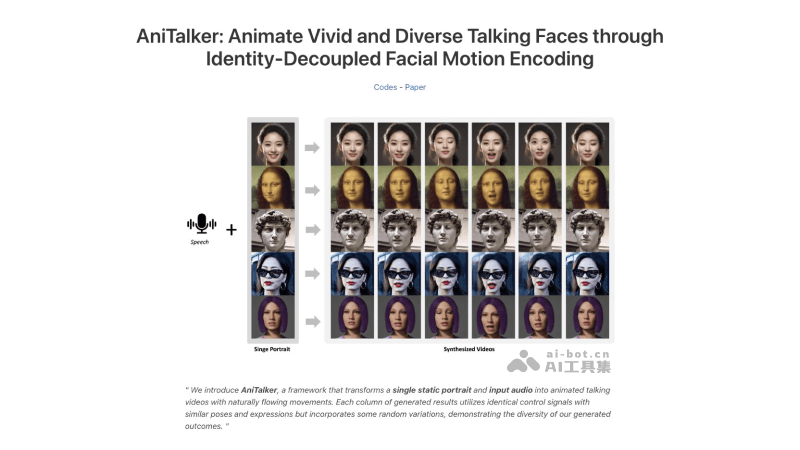
AniTalker's main features
- Static portrait animation: AniTalker can convert any single face portrait into a dynamic video, in which the person can speak and change expressions.
- Audio synchronization: The framework can synchronize the input audio with the person's lip movements and speech rhythm, achieving a natural conversation effect.
- Facial dynamic capture: Beyond just lip-sync, AniTalker can also simulate a series of complex facial expressions and subtle muscle movements.
- Diverse animation generation: Utilizing diffusion models, AniTalker can generate diverse facial animations with random variations, increasing the naturalness and unpredictability of the generated content.
- Real-time facial animation control: Users can guide the generation of animations in real time through control signals, including but not limited to head pose, facial expressions, and eye movements.
- Speech-driven animation generation: The framework supports directly using speech signals to generate animations without additional video input.
- Continuous long video generation: AniTalker can continuously generate long-duration animated videos, suitable for long conversations or speech scenarios.
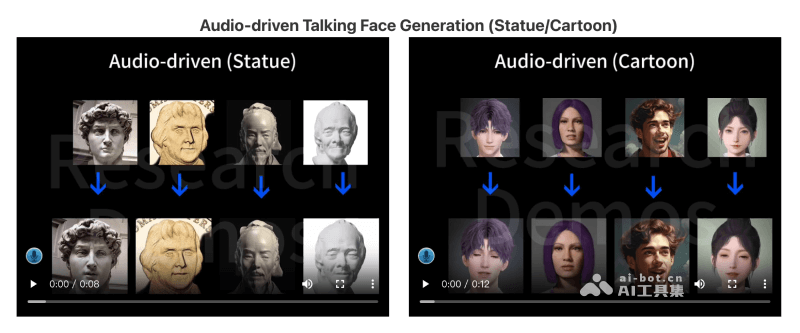
AniTalker official website entrance
- Official project homepage:https://x-lance.github.io/AniTalker/
- GitHub source code repository:https://github.com/X-LANCE/AniTalker
- arXiv research paper:https://arxiv.org/abs/2405.03121
AniTalker's working principle
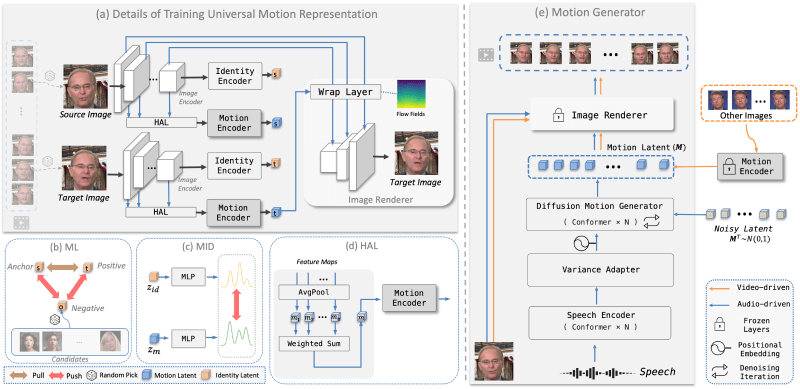
- Motion representation learning: AniTalker uses a self-supervised learning method to train a universal motion encoder capable of capturing facial dynamics. This process involves selecting source and target images from videos and learning motion information by reconstructing the target image.
- Identity and motion disentanglement: To ensure that the motion representation does not contain identity-specific information, AniTalker adopts metric learning and mutual information minimization techniques. Metric learning helps the model distinguish identity information of different individuals, while mutual information minimization ensures the motion encoder focuses on capturing motion rather than identity features.
- Hierarchical Aggregation Layer (HAL): Introduces HAL (Hierarchical Aggregation Layer) to enhance the motion encoder's ability to understand motion changes at different scales. HAL integrates information from different stages of the image encoder through average pooling layers and weighted sum layers.
- Motion generation: After training the motion encoder, AniTalker can generate motion representations based on user-controlled driving signals. This includes video-driven and speech-driven pipelines.
- Video-driven pipeline: Use the video sequence of the driving speaker to animate the source image, thereby accurately replicating the driving pose and facial expressions.
- Speech-driven pipeline: Unlike video-driven approaches, speech-driven methods generate video based on speech signals or other control signals, synchronized with the input audio.
- Diffusion models and variance adapters: Among speech-driven methods, AniTalker uses diffusion models to generate motion latent sequences and uses variance adapters to introduce attribute manipulation, thereby producing diverse and controllable facial animations.
- Rendering module: Finally, an image renderer is used to render the final animated video frame by frame based on the generated motion latent sequences.
- Training and optimization: The training process of AniTalker includes multiple loss functions, such as reconstruction loss, perceptual loss, adversarial loss, mutual information loss, and identity metric learning loss, to optimize model performance.
- Control attribute features: AniTalker allows users to control head pose and camera parameters, such as head position and face size, to generate animations with specific attributes.
Application scenarios of AniTalker
- Virtual assistants and customer service: AniTalker can generate realistic virtual faces for virtual assistants or online customer service, providing a more natural and friendly interactive experience.
- Film and video production: In film post-production, AniTalker can be used to generate or edit actors' facial expressions and movements, especially in scenes that cannot be achieved when capturing the original performance.
- Game development: Game developers can use AniTalker to create realistic facial animations for game characters, enhancing the game's immersion and the characters' expressiveness.
- Video conferencing: In video conferencing, AniTalker can generate virtual faces for participants, especially on occasions where privacy needs to be protected or more fun is needed.
- Social media: Users can use AniTalker to create personalized virtual avatars for communication and sharing on social media.
- News broadcasting: AniTalker can generate virtual news anchors for automated news broadcasting, especially when multilingual broadcasting is needed.
- Advertising and marketing: Enterprises can use AniTalker to generate attractive virtual characters for advertising or brand endorsement.