
Against the backdrop of machine learning currently facing complex tasks and high generalization requirements, ensemble learning, as an advanced paradigm that breaks through the performance bottleneck of a single model by constructing and combining multiple base learners, has become a core means of improving model robustness and prediction accuracy, relying on a solid theoretical foundation and outstanding practical effectiveness. This report systematically explains the complete knowledge system from the core idea of "collective wisdom" to mainstream methods such as Bagging and Boosting, and on to practical deployment and cutting-edge trends, providing readers with a systematic framework for understanding and applying this powerful tool.
What Is Ensemble Learning?
Ensemble learning is amachine learningparadigm whose core idea is to let multiple models work together and, by reasonably combining their prediction results, obtain a final prediction that is more robust and more accurate than any single model. It can be imagined as a "team decision": each base learner (also called a submodel) has its own "expertise" and "blind spots," and when they discuss, vote, or correct each other's errors together, the overall judgment becomes more reliable.
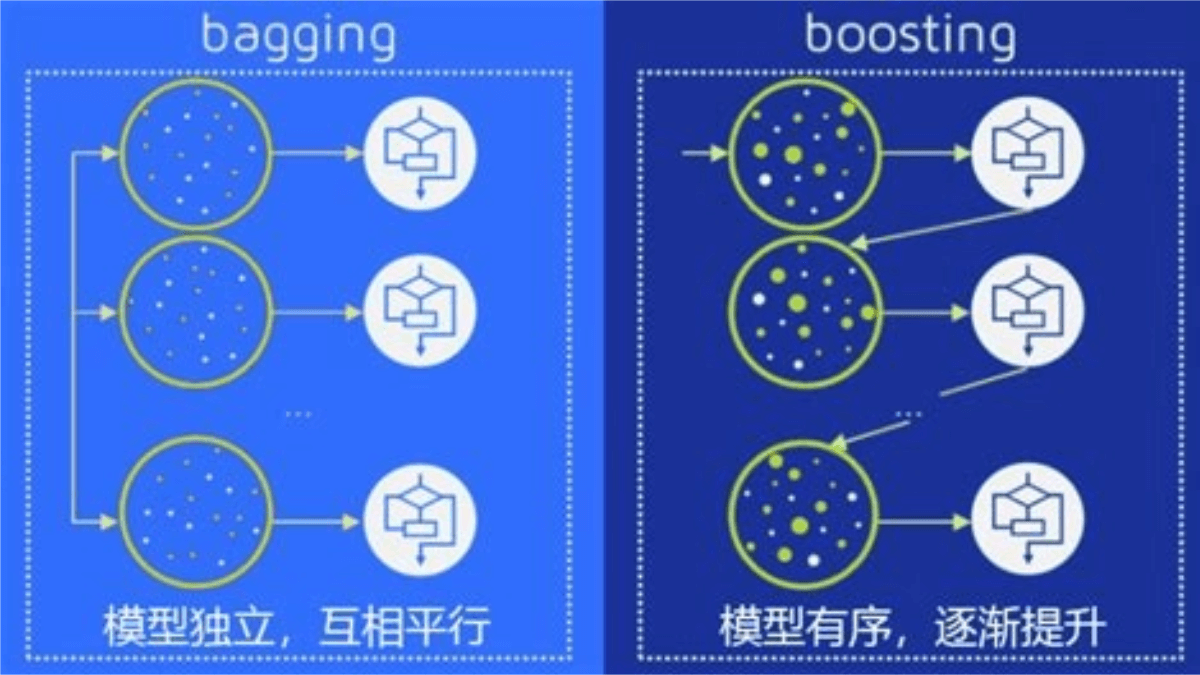
From a technical perspective, the implementation of ensemble learning mainly includes two major categories: parallel (such as Bagging and Random Forest) and sequential (such as Boosting). Parallel methods emphasize diversity, training multiple models on different training subsets or feature subspaces so that errors are not fully correlated; sequential methods emphasize step-by-step error correction, with each step focusing on the errors of the previous step and gradually elevating weak models into strong models through weighting or gradient descent.
"Ensemble Learning is a machine learning paradigm that solves the same problem by training multiple learners."
The Basic Principles of Ensemble Learning
The theoretical cornerstone of ensemble learning comes from profound insights in computational learning theory. Its origins can be traced to the Probably Approximately Correct (PAC) learning model, which provided an initial framework for the weighted voting of multiple classifiers. More critically, the equivalence theorem between weak learners and strong learners strictly proved that as long as the performance of a weak classifier remains slightly better than random guessing, an arbitrarily strong strong classifier can necessarily be constructed through an effective ensemble strategy. This discovery theoretically established the feasibility of ensemble learning and pointed out the core direction for its development.
Based on the above theory, the implementation of ensemble learning depends on two key assumptions: individual learners need to have basic accuracy, and they need to maintain sufficient diversity among themselves. In practice, through combination strategies such as voting or weighted voting, ensemble methods can pool the strengths of each learner so that their prediction errors statistically cancel each other out, systematically improving the model's generalization ability and robustness. It is precisely this rigorous theoretical guidance and ingenious algorithm design that elevate ensemble learning from an intuitive idea to a core paradigm for solving complex machine learning problems.
An In-Depth Analysis of Mainstream Ensemble Methods
Bagging
The implementation path of Bagging is extremely direct: perform sampling with replacement (Bootstrap) on the original training set to obtain several sub-training sets; independently train a base learner on each subset (commonly a decision tree); after training is complete, applymajority votingto the prediction results of all base learners (for classification) or averaging (for regression). This parallel training approach naturally has efficient computational characteristics (it can use multiple cores or distributed processing), and significantly reduces the model's variance through diverse subsamples. The structural diagram below further clarifies the workflow of Bagging: the outputs of multiple independent learners are sent to a combination module for voting to obtain the final decision.
Boosting
Boosting adopts a sequential learning strategy, where each round of base learners focuses on correcting the errors of the previous round. The most representative AdaBoost increases the weights of misclassified samples through exponential weighting; Gradient Boosting treats model training as a gradient descent process in function space, with common implementations including XGBoost, LightGBM, and CatBoost. In 2024-2025, these frameworks achieved dozens of times training speedup and significant accuracy improvements through techniques such as regularization, histogram optimization, and distributed computing, and have become the preferred solutions for Kaggle competitions and enterprise-level projects.
Stacking
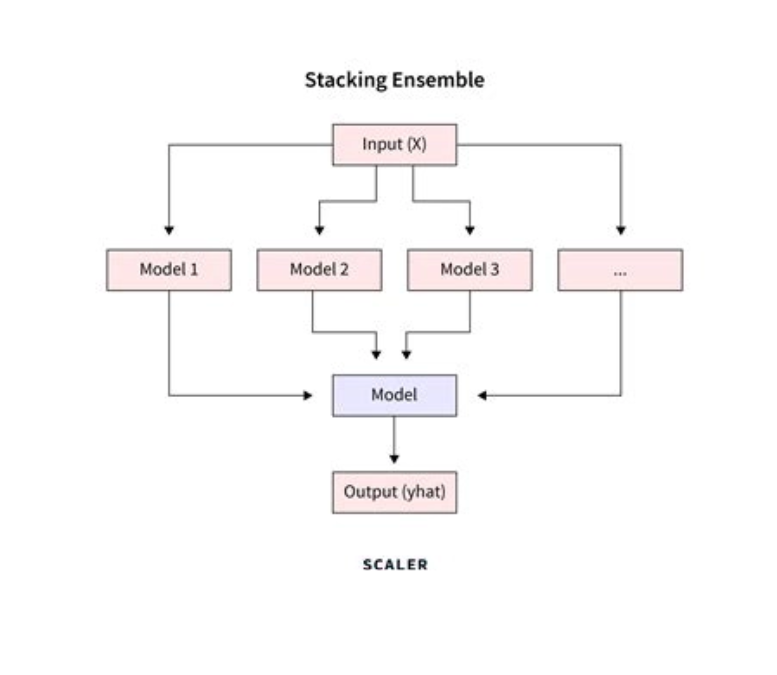
Stacking combines heterogeneous models hierarchically: the first layer consists of several base learners (such as decision trees, SVM, neural networks) trained on the complete training set, producing second-layer features (i.e., the prediction probabilities of the first layer) through cross-validation; the second-layer meta-learner (commonly logistic regression or a lightweight tree model) learns again on these features and outputs the final prediction. The advantage is that it can fully exploit the complementary information of different models, often achieving 3%-5% accuracy improvement in high-value scenarios such as financial risk control and medical imaging.
Random Forest
Random Forest is a combination of Bagging and feature subspace randomization. Each tree is trained on a Bootstrap-sampled subset, and at each node split only k features are randomly selected (k is much smaller than the total number of features), thereby further reducing the correlation between trees. Random Forest performs well on high-dimensional sparse data and can directly output feature importance, helping business stakeholders interpret model decisions.
Voting
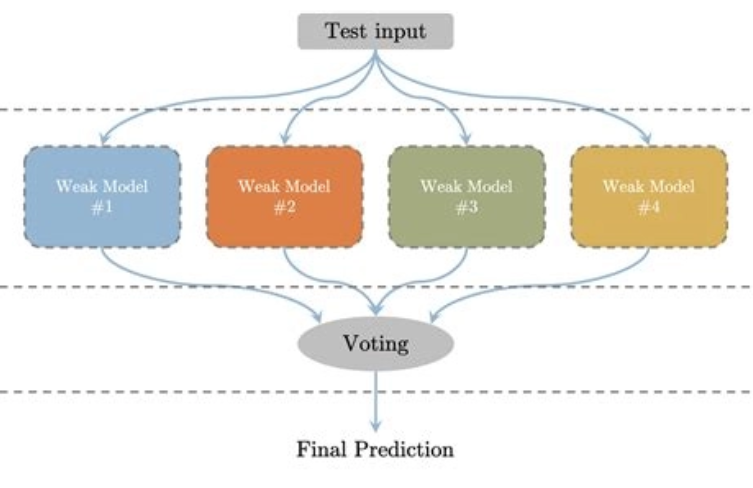
Voting is the most intuitive fusion method: hard voting (majority vote) or soft voting (probability-based weighted average) is performed on the predictions of several base learners. When the performance of the base learners is similar and their errors are not completely correlated, voting can quickly improve accuracy, and the implementation cost is extremely low, making it suitable as a rapid prototype or baseline model.
Full Practical Pipeline: Technical Applications of Ensemble Learning
Data Preparation and Feature Engineering
- Splitting: Use
train_test_splitto split the raw data into training/validation/test sets, ensuring the objectivity of evaluation. - Feature Processing: Standardize or normalize numerical features, and use one-hot encoding or target encoding for categorical features; in scenarios with extremely high feature dimensions, use principal component analysis (PCA) or information gain-based feature selection to reduce noise.
Base Learner Selection
| Scenario | Recommended Base Learner | Description |
|---|---|---|
| High variance, nonlinear features | Decision trees, Random Forest | Tree models are insensitive to feature scale and easily capture nonlinear relationships |
| Large-scale sparse features | Linear model (Logistic Regression) + Bagging | Reduce variance through Bagging |
| Need rapid iteration | LightGBM、CatBoost | Supports GPU and histogram acceleration, fast training speed |
| Cross-modal or deep features | Deep neural networks (CNN, Transformer) + Stacking | Use deep features as first-layer input, and the meta-learner performs secondary fusion |
Model Construction Example (Python)
from sklearn.ensemble import BaggingClassifier, VotingClassifier, StackingClassifier
from sklearn.tree import DecisionTreeClassifier
from sklearn.linear_model import LogisticRegression
from sklearn.svm import SVC
from xgboost import XGBClassifier

# Bagging 示例(基于决策树)
bag = BaggingClassifier(
    base_estimator=DecisionTreeClassifier(max_depth=5),
    n_estimators=120,
    max_samples=0.8,
    max_features=0.8,
    random_state=42,
    n_jobs=-1)

# Boosting 示例(XGBoost)
boost = XGBClassifier(
    n_estimators=350,
    learning_rate=0.04,
    max_depth=7,
    subsample=0.85,
    colsample_bytree=0.85,
    objective='binary:logistic',
    eval_metric='auc',
    n_jobs=-1,
    random_state=42)

# Stacking 示例(异构模型融合)
stack = StackingClassifier(
    estimators=[
        ('dt', DecisionTreeClassifier(max_depth=4)),
        ('svc', SVC(probability=True, kernel='rbf')),
        ('lr', LogisticRegression(max_iter=500))
    ],
    final_estimator=LogisticRegression(),
    cv=5,
    n_jobs=-1)
Hyperparameter Tuning and Cross-Validation
- Grid search (GridSearchCV) and random search (RandomizedSearchCV) are common tuning methods.
- For Boosting-family models, it is recommended to first tune the learning rate and tree depth, then gradually increase the number of trees to prevent overfitting.
- For Bagging and random forests, focus on
max_features、max_samplesand tree depth.
Model Evaluation and Interpretation
| Metric | Applicable Scenario |
|---|---|
| Accuracy | Binary or multiclass classification with balanced classes |
| F1‑Score | Class imbalance, with a focus on recall |
| AUC‑ROC | Tasks requiring ranking capability, such as financial risk control and fraud detection |
| Feature Importance (Mean Decrease Impurity) | Random forests, XGBoost; can help business users interpret the model |
Model interpretation tools such as SHAP and LIME can provide a local explanation for each prediction,satisfying regulatory requirements for model transparency.
Frontier Trends and Research Hotspots
- Automated Ensembling (AutoEnsemble): Combining AutoML and meta-learning to automatically search for the optimal combination of base models, feature subspaces, and fusion strategies, reducing the cost of manual hyperparameter tuning.
- Lightweight Boosting: Accelerated implementations of CatBoost and LightGBM in GPU and distributed environments, enabling Boosting to achieve real-time inference on edge devices (such as in-vehicle systems and IoT).
- Deep Ensembling: Using deep neural networks as base learners, combined with Stacking or Boosting, has shown the potential for cross-modal knowledge transfer in multimodal agents and large-model fine-tuning.
- Enhanced Interpretability: Through SHAP, LIME, and feature importance visualization, each prediction can be made interpretable, satisfying regulatory requirements for model transparency.
- Cross-Modal Ensembling: Unified feature fusion and model stacking across multiple sources of information such as images, text, speech, and structured data have achieved breakthroughs in scenarios such as intelligent customer service and smart cities.
Common Misconceptions and Best Practices
| Misconception | Correct Practice |
|---|---|
| Pursuing more base models while ignoring diversity | Ensure that the errors of base learners are not fully correlated (different algorithms, different feature subspaces) |
| Using high-noise data in Boosting | Preprocess anomalous samples or adopt Robust Boosting (such as regularization or subsampling) |
| Information leakage in Stacking (using the full training set for prediction) | Cross-validation must be used to generate first-layer predictions to prevent the meta-learner from seeing the true labels |
| Unlimited random forest tree depth leads to overfitting | Through max_depth、min_samples_leaf control the complexity of the tree |
| Focusing only on model accuracy while ignoring inference efficiency | Perform model compression, distillation, or pruning before deployment to ensure real-time business requirements are met |
Summary
In summary, ensemble learning, through the core principle of model collaboration, systematically addresses the bias-variance dilemma faced by single models, becoming a paradigmatic strategy for improving machine learning performance. Methodologically, Bagging, Boosting, Stacking, Random Forests, and voting methods constitute a richly layered technical system with distinct emphases, enabling practitioners to precisely match solutions according to data characteristics and business objectives. In engineering practice, a standardized process from data preparation to deployment monitoring has been established, combining powerful effectiveness with practicality. Looking ahead, with the deep integrated development of directions such as AutoML and explainable AI, ensemble learning will continue to serve as a key driving force for enabling artificial intelligence to achieve more reliable, more efficient, and more transparent decision-making in complex scenarios.