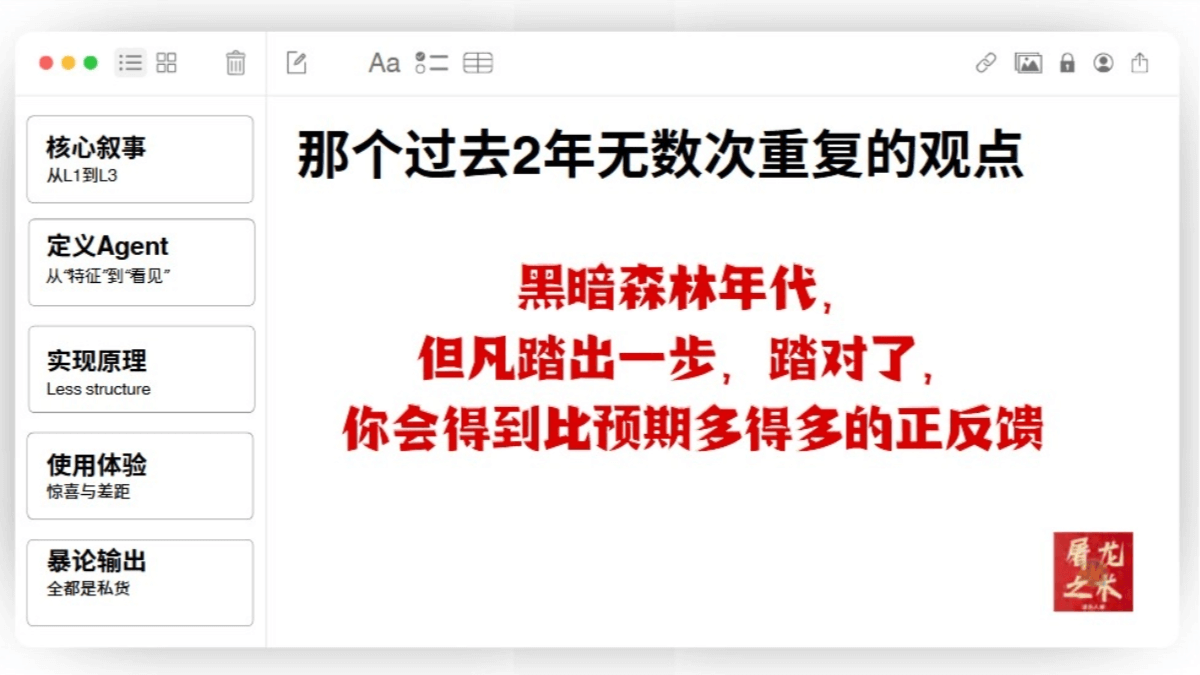
“Manus Has No Secrets” is a 70-page PPT written by Teacher Minghao explaining AI Agents. It mainly introduces the process of AI Agent technology from L1 to L3, and discusses the definition, implementation principles, user experience, and future development trends of AI Agents. Through the analysis ofManusand other Agent products, it deeply discusses the current state, challenges, and future directions of AI technology. (A verbatim transcript is attached at the end of the article)
Starting from the definition of an Agent, it proposes a shift from “features” to “seeing,” emphasizing that the core of an Agent lies in its generality and ability to handle complex tasks. An Agent is defined as an intelligent entity that can autonomously complete tasks, perform reasoning, and interact, with the goal of allowing users to achieve complex functions through simple natural language instructions.
It discusses the technical principles of Agent implementation, including the application of pretrained models, reinforcement learning, few-shot learning, and other technologies. It particularly mentions the concept of “Less structure,” emphasizing the importance of letting models autonomously explore thinking paradigms rather than relying on overly structured methods.
From the user’s perspective, it discusses the experience and perception of using Agents. Through specific use cases, it shows the advantages and shortcomings of Agents in practical applications. For example, Manus performs excellently when handling complex tasks, and in some cases may also experience performance degradation or errors.
It compares the gap between the performance of Agents in practical applications and expectations, and analyzes the problems and challenges existing in current Agent technology. Although Agents have made significant progress in complex task handling, multimodal interaction, and other areas, performance bottlenecks still exist in some tasks.
It focuses on introducing the background, design philosophy, and technological innovation of the Agent product Manus. Through its innovative interaction methods and powerful task-handling capabilities, Manus demonstrates the potential of Agent technology. Manus’s design philosophy is to allow users to complete complex tasks through simple natural language instructions, without requiring users to perform complicated operations.
From an industry perspective, the article analyzes the development of the AI industry over the past few years, as well as possible future development trends. It discusses the impact of technologies such as large models, Agent technology, and multimodal interaction on the AI industry, and how to promote the further development and application of AI technology.
It provides a comprehensive summary and reflection on the concept, technical implementation, user experience, and other aspects of Agents. It puts forward expectations and suggestions for the future development of Agents, including how to improve the generality, performance, and user experience of Agents, and how to establish advantages in market competition.
“Manus Has No Secrets—70-Page PPT Explains AI Agents”
Introduction
Hello everyone, I'm Minghao. I checked my Xiaoyuzhou backend, and it's been just over half a month since my last solo blog update on PPT. In the last episode, I talked about DeepSeek and some expectations for all Agents in 2025. But looking back now, I realize that my discussion of Agents at the time was actually somewhat vague. I basically took a clever shortcut in handling that chapter's content at that point. So, in retrospect, that segment didn't have many original viewpoints; it was more like a rearrangement and combination of existing information.
Why was that? To be honest, at that point in time, neither I nor the industry as a whole had a very clear understanding of Agents. This directly leads to today's topic. Over the past week or so, the entire AI industry has been talking about Manus. As an industry observer, I've gained deeper knowledge and understanding of this matter, which led to today's podcast episode.
Background and Significance of Manus
Two and a half months of 2025 have already passed, and I've made three super-long PPTs. Today's content is called 'Manus Has No Secrets.' Originally, I also added a subtitle: 'Will 2025 Be the Year of AI Agents?' But during the process of making the PPT, I found that this question might not need to be asked anymore. We now formally enter today's content, which has no secrets. This PPT has about five chapters. If you need them, you can also download my PPT document.
The titles of the five chapters are: Defining the Core Narrative, Principles of Agent Implementation, User Experience of Manus, and Some Final Blunt Outputs. I'm very glad that when you have a relatively good understanding of something, you can be more tolerant. When you don't understand it as well, you tend to just list information. Let's formally enter today's content.
From DeepSeek to Manus
About a month and a half ago, my previous PPT was titled 'Looking at the 2025 AI Industry Development from the Explosive Popularity of DeepSeek.' This PPT covered the entire process of DeepSeek's explosive popularity, the narrative of the AI industry over the past two years, new possibilities for building momentum, and a final chapter on Agents. But actually, I think the first three of these four chapters are old stuff. The fourth chapter was supposed to have some viewpoints and highlights, but limited by my knowledge and understanding of the industry, I feel that the fourth chapter about DeepSeek and AI Agents at that time wasn't ideal.
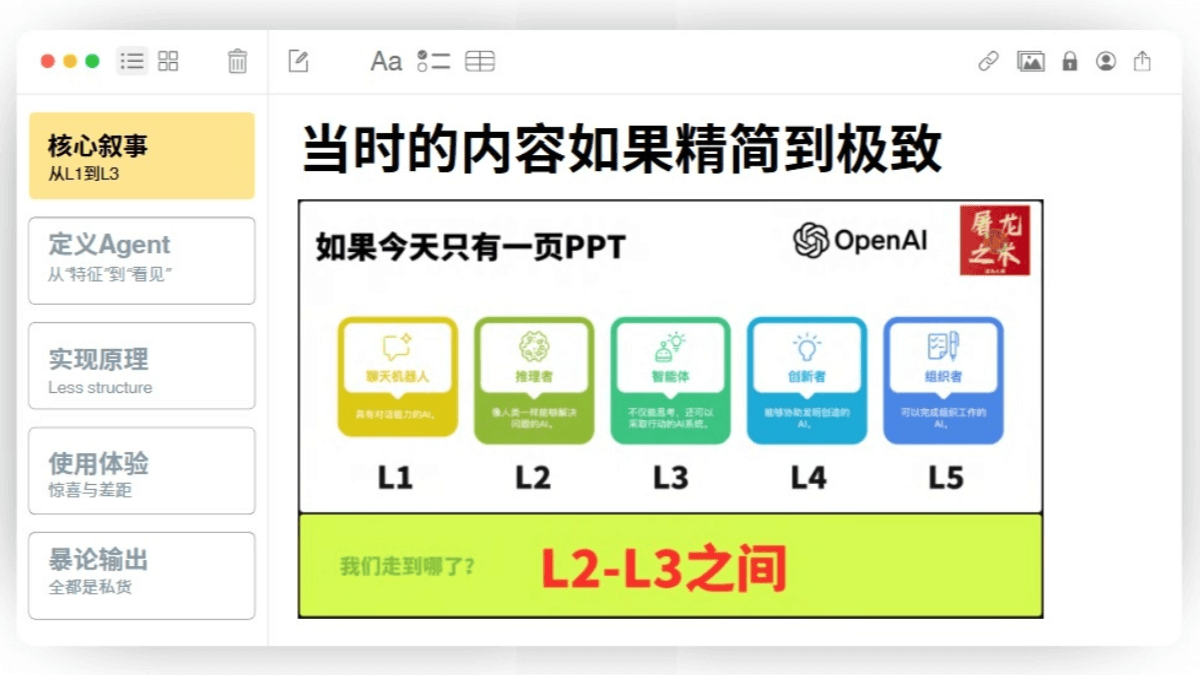
Fortunately, we've come to today's topic. Similarly, in my last podcast's PPT, I mentioned that if that roughly 70-page PPT were summarized in just one page, it would be the L1 to L5 defined by OMI. We are currently between L2 and L3. Specifically, L1 is Chatbot, represented by ChatGPT. Many products we can use today are L1. L2 is reasoning models, such as OpenAI's O1, DeepSeek 21, and a series of reasoning models released by leading manufacturers afterward. L3 is the most direct topic we're discussing today—Agents.
In the last PPT, I also mentioned that the concept of Agents has been infinitely generalized. Today, it's great that someone has defined it more clearly. So if today we were to summarize all content in just one PPT page, I could still use these PPTs to summarize.
Detailed Interpretation from L1 to L3
Let's talk about L1 to L3 in detail. Actually, when I was previously putting together the PPT, I didn't explain it in that much detail; I just listed some questions. For example, if we go further back from LE's Chatbot to the wave of model companies that emerged in 2014 and 2015 during the AI 1.0 era, they are actually still around today, such as China's AS Xiaolong. So, looking back, what was the biggest difference between AI 1.0 in that era and AI in the large model era? How did we get from the way things were then to large models, to GPT? And then think about the end of 2022—actually, in mid-2022 GPT had already released 3, and then released 3.5. It was not until November 30, 2022, when ChatGPT was released, that this industry was defined as having reached a node.
What I want to ask is, what does ChatGPT mean for GPT 3.5? This is L1. Then when moving from L1 to L2, from the release of OpenAI's O1 in September 2023 to the release of DeepSeek 21 in 2025, how did we get to L2? There is another point: why does every major update of large models seem to cause a wave of application companies to die? Extending this question, it becomes: are models and products ultimately unified or separate? Some may say the model is the product, while others may say models and products should be separate. So does this question have different answers at different stages?
My core idea is actually very simple: what I just asked about—how we went from the previous 1.0 era to the large model era, then from foundation large models to reasoning models, and today to exploring Agents.
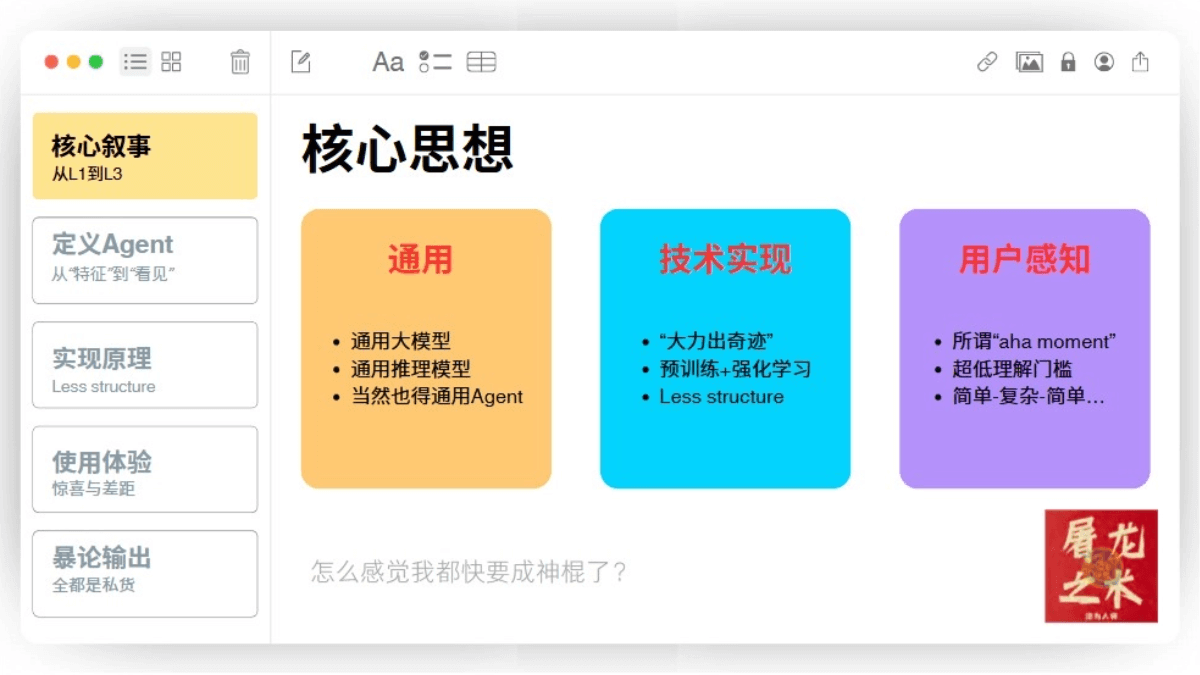
Keywords: general, technical implementation, user perception
The first keyword I wrote is "general," meaning that the large model at this step is called a general large model. When it came to reasoning models, we also began working on what are called general reasoning models. Because we have hardly made any vertical models for specific industries, right? Once reasoning models came out, they were general. If we push this further, if L3 is Agent, then should it also be a general Agent?
The second keyword is "technical implementation." We just asked how we walked step by step from the previous AI 1.0 to large models. We previously used a keyword: "brute force produces miracles," right? When it came to L2, reinforcement learning became important. At L3, or in the process from AI 1.0 to L1 and then to L2, you will find that a view everyone has always followed is to control as little as possible, give more data, and use more reinforcement learning methods to let the model itself learn. This is the process of technical implementation.
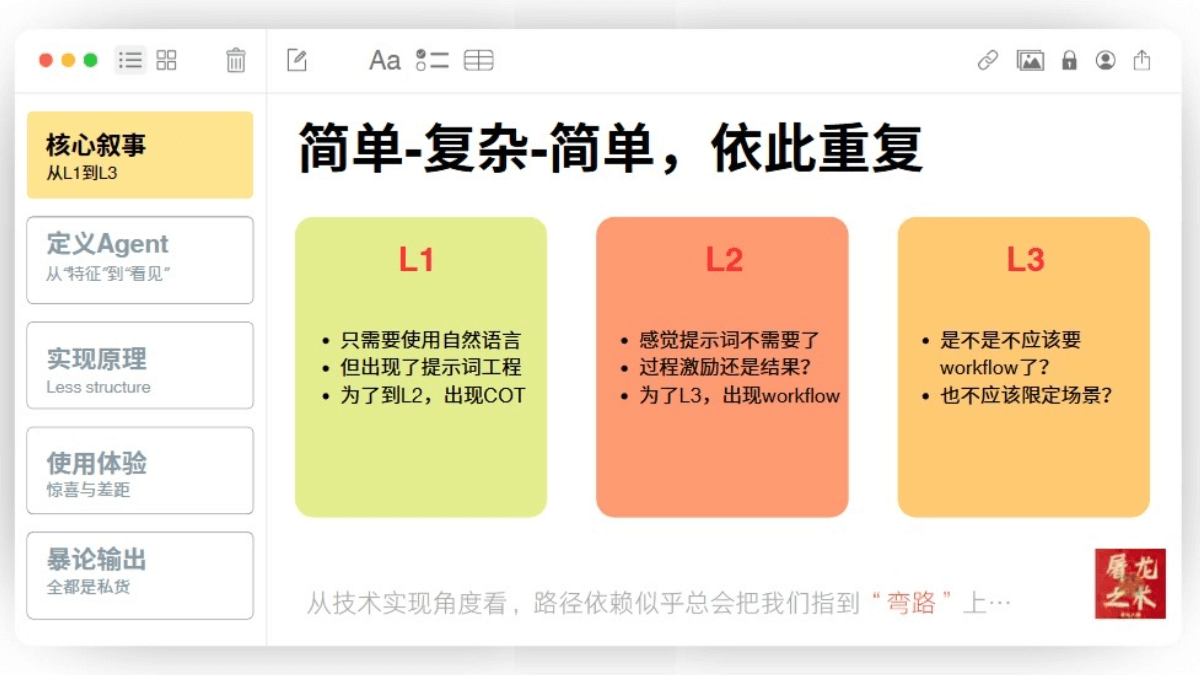
The third keyword is "user perception." That is, for a user, how do they perceive changes in technology? People often talk about the so-called "Aha Moment," that moment when users go wow as if they are seeing magic. For an ordinary person, is it really such a difficult thing to understand? Then you will find that from L1 to L2 to L3, it is always going through a process of changing from simple to complex and then from complex to simple, and then from simple to complex again. So if we summarize the whole process from L1 to L3, I think there are several keywords: general, technical implementation, user perception. It sounds a bit like fortune-telling, right? Let's look at them one by one.
The importance of generality
Let's first look at "general." I used a page from a PPT that Teacher Kaifu presented at a press conference when Innovation Works was just founded in 2015. He talked about how AI 2.0, that is, large models, overcame the limitations of AI 1.0's single-domain and multi-model approaches. For example, in the previous 1.0 era, we used a single dataset and then trained a fixed model in a single scenario. In the large model era, it became general, right? This appeared in the large model era.
The path of technical implementation
So how did we reach L2? If you're interested, you can go back and review my previous blog post on the DeepSeek episode in detail. After O1 was released, the world's mainstream model vendors all wanted to reproduce O1's reasoning model. So two paths or two technical approaches were used. One is called COT (chain of thought). People would think that letting the large model think about a problem step by step is called chain of thought. After chain of thought emerged, it became a training process in which we either provide incentives for each link in the chain or provide incentives for the result. So at the time there was one route, which was aimed at each process, namely PRI (process reward).
But the final result told everyone that, whether it was Kimi's O1, which emerged earliest, or DeepSeek's RE, when we look at their open-source articles and some social media posts by their employees, it ultimately proved to rely entirely on reinforcement learning from results. The whole process by which we reached L2 is that there is no need to impose more restrictions on the model itself during the process, just like when AlphaGo appeared and then AlphaZero appeared. That is, without needing to learn game records from humans, we can obtain a stronger AlphaGo model, and it broke free from human experience.
DeepSeek is the same. DeepSeek's base model is called V3. Reinforcement learning was done based on V3's model capabilities, with rewards only for the model's own results, and RE Zero appeared, just like AlphaZero. This is the whole process by which we reached L2. Then from RE Zero, after a little more pretraining, a simple increase in basic information, and data adjustments, we got R1, which we are using today. And R1's training plan and method also appeared on Llama and Qwen at the same time, and also improved the efficiency of those models. This is the entire process by which we reached L2.
Changes in user perception
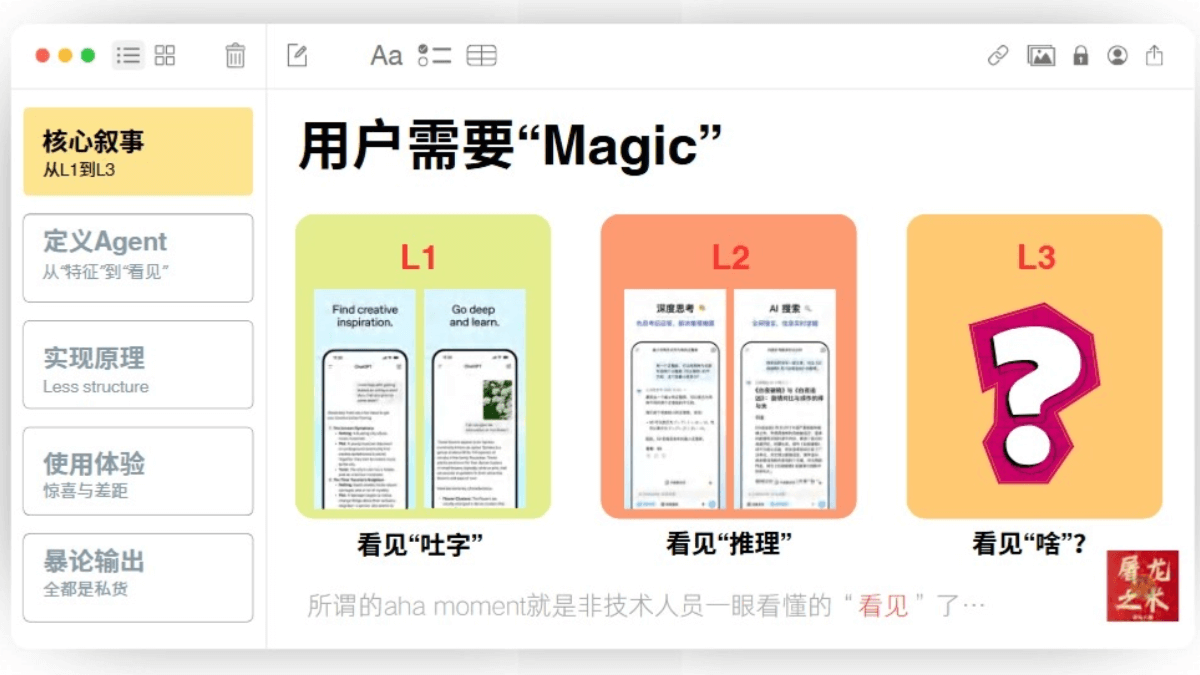
Looking at such a process, you will find that this is a purely technical route implemented at the model layer. So what about at the user layer? I have a saying: "users need magic," just like the Aha Moment. What is a Moment? It is that users, as non-technical people, see something very clearly. Seeing is very important.
Looking back at the L1 era, when ChatGPT was released, what did users see? To put it bluntly, they saw the machine "spitting out words." It was that simple, right? So in the L2 era, that is, with O1 or DeepSeek R1, what did users see? Users saw the model reasoning. Following the same logic, if L3 is Agent, or if that Aha Moment appears in the Agent section, then it should also be something users see, right? Users need magic.
Changes between simple and complex
Then let's talk about the keyword we just mentioned, "simple and complex." This is a repeated process. Looking at the L1 era, when ChatGPT had just been released, everyone said that we only needed natural language to interact with large models. But you found that very complex prompt engineering was needed, right? You needed to describe a lot, and even use strict formats to stimulate the model before it would give you a good answer. Then this was L1. By the time we got to L2, as we just said, chain of thought had appeared again, right? I wanted the model to think step by step, and then when R2 was really realized, you found that when we are now using various reasoning models such as DeepSeek's RE, it feels like that prompt engineering is not really needed anymore. The model itself may understand, but the process of training R was actually a process in which everyone took some detours.
There are many companies and many vendors using fiercely competitive methods. And now we're going to L3, we're going to do Agents. You'll find that many vendors are trying to define the model's execution using something called workflow. If we continue to follow this logic, from simple to complex and back to simple and then to complex and then to simple again, then shouldn't L3 also not need workflow, and also shouldn't it be limited to specific scenarios? Because you'll find that in these past several technological shifts, from the perspective of technical implementation, this kind of path dependency often leads us onto some detours, and in the end the ones that succeed are not the detours.
Summarize the process from L1 to L3
Let's summarize the first chapter, breaking it apart and crushing it from L1 to L3. The first keyword is "general-purpose," not vertical, not limited to specific scenarios, not setting boundaries. Of course, this will be very difficult, and the initial implementation will definitely be imperfect. General-purpose. Second, let the large model do it itself, don't intervene, don't add conditions, fewer restrictions, better incentives. Of course, for companies doing related work, what tests them more is the trade-off between cost and results. Third, make the operation foolproof, especially for users. Let users see, even seeing the implementation process is very important. We can't keep walking into complex areas again and again. Then what else is needed?
Enter Chapter Two: The Definition of Agent
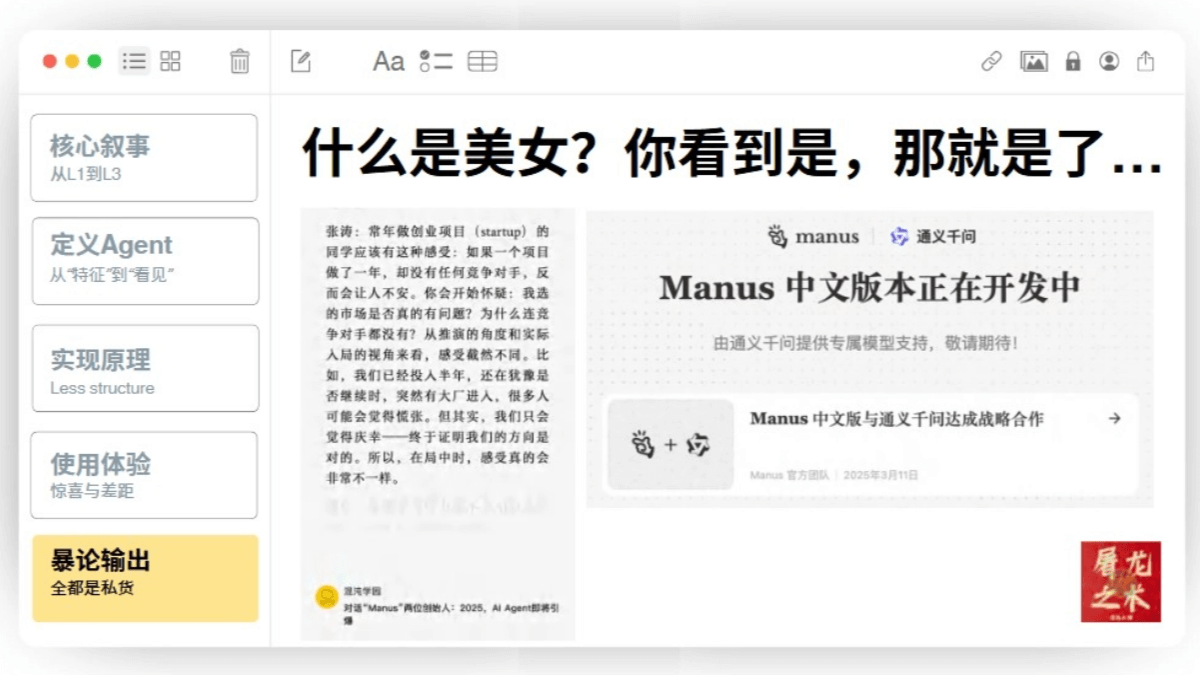
We enter Chapter Two, where we truly take a look at Agent. Actually, in the previous reasoning process from L1 to L3, some conclusions have gradually emerged. Let's still converge the boundaries a bit; this chapter is called Defining Agent, with the subtitle "From Features to Seeing." Because you'll find that in the process of Chapter One I talked about many features, just like that elephant in the room—we can describe its legs, describe its tail, describe its ears, describe its trunk; those are all its features. But if you want to define that elephant in a complete sense, you need to see it. Let's still look from the perspective of the two least Agent-like Agent directions. These are also the two directions I talked about more in the last DeepSeek PPT. One is search, and one is coding.
The Relationship Between AI Search and Agent
Let's talk about search first. At today's point in time, the leading AI search companies include Pop Lexi, Jasper, Kimi, and domestically, vertical platforms such as Meta, Nanom, and Zhihu. You'll find that there are also many questions directed at AI search companies. From the very first day AI search companies appeared, many people would ask: do AI search companies need to have their own models? If not, then isn't that just a wrapper? Right? So does the opportunity in AI search belong to traditional search engine companies or to startups?
After this wave of DeepSeek became popular, all US companies connected to DeepSeek. What is everyone's difference? Can differences in information sources really bring lasting competitive advantage? Can product design create an absolute gap?
There also seem to be many open-source AI search solutions. From the perspective of engineering implementation, it feels like there isn't much difficulty either. At the same time, is it meaningful to specialize in vertical searches in law, finance, healthcare, and other directions? When you hear these analyses, do you find them particularly familiar? This is AI search, right?
The Relationship Between AI Coding and Agent
From the perspective of AI Coding, the Chat products of leading large model companies could be programmed from the very first day they appeared. The driving force behind the evolution of coding capabilities must be the evolution of the large models themselves, especially the evolution that began with Cloud 3.5. It seems that all companies in AI Coding are essentially talks about Cloud 3.5 or 3.7. What is the moat of these projects? Can the boundaries of engineering experience products create a gap?
There are also many open-source solutions for AI Coding, and all major companies will most likely build them. Will there be a brand effect for the products? Does it make sense to go vertical? If you focus on a vertical scenario in either frontend or backend, you will find that similar questions are frequently asked. But is there an answer to this question? Probably not.
The Generalization of the Agent Concept and the Lack of Consensus
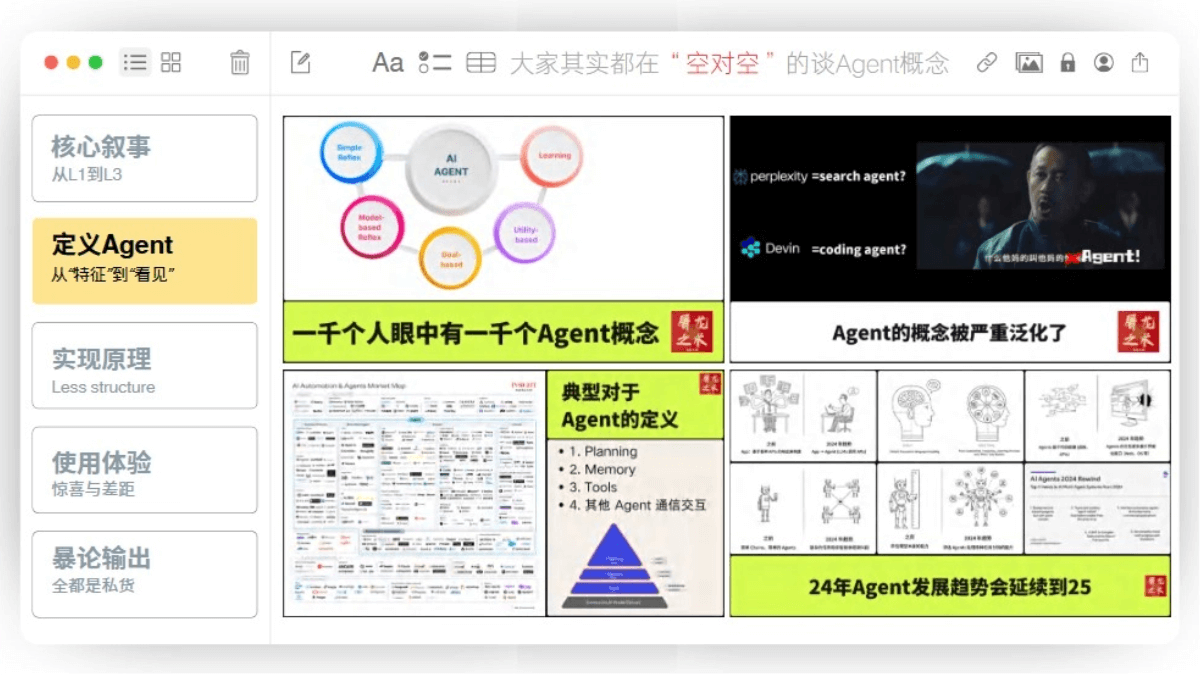
So this goes back to what I said at the very beginning. I also listed four slides from the Agent chapter in my previous DeepSeek PPT. For example, "1,000 studies, 1,000 Agent concepts"—the concept of Agent has been severely generalized. Then there are some typical definitions of Agent, including the development of the Agent industry in 2024. But you will find that in this kind of discussion, people are mostly talking in the abstract without grounding. Because no consensus has been reached. Let me remind you: up to this slide, my PPT has not mentioned anything about Manus, nothing at all. Starting from this slide, let's look at various aspects of Manus.
Manus's Core Philosophy: Let Users See
My first description of Manus is "all work." In order to let users see, I emphasized many times earlier that seeing is very important. I captured a screenshot of a case on Manus's official website, where they analyze Tesla's stock price. In the screenshot of the webpage, you will see his entire to-do list. Then he checks various websites and obtains various charts. After the charts are done, he makes them into a webpage and gives it to you.
Essentially, at the product level, all of Manus's work is to let users see. Remember. What was L1's seeing? It was seeing the output of words. What was L2's seeing? It was seeing reasoning. What is Agent's seeing? It is seeing the Agent at work—all work is to let users see. So how is this done to let users see? Let's look at the third part, which is Manus's implementation principles, with the subtitle "Less Structure, less control, fewer restrictions."
Chapter 3: Manus's Implementation Principles
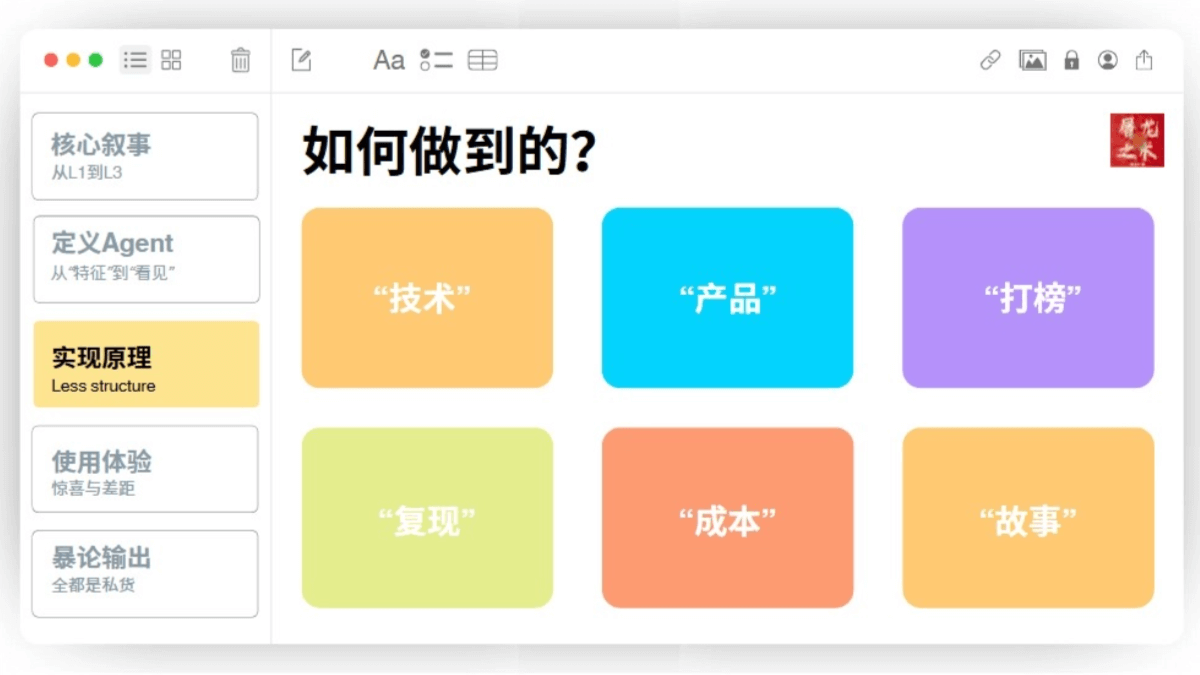
In Chapter 3, I further divided it into six subsections, namely technology, product, bundling, cash cost, and a short story. Let's look at them one by one. First, technology. Actually, before Manus, there were already many so-called Agent products. Even in 2023, there were already some open-source or closed-source Agent products. For example, Auto GPT, Ison Pic's Computer Use, and the Auto GLGLM mainly released by OpenAI's Deep Research. In fact, everyone's underlying logic seems to be roughly the same: the Agent breaks down tasks, executes tasks, and gives results. And because of the recent maturity of reasoning models, in the first step of breaking down tasks, it seems there is no difficulty anymore. At the same time, because of protocols like MCP launched by SOPIC, which allow large models to use various tools and APIs. After the emergence of this kind of protocol, including the series of A0 frameworks released by OpenAI yesterday, it seems that letting models use tools and build architectures is no longer a threshold either.
Many people will ask, why didn't it become explosively popular earlier? What was missing? Take Manus as an example. Before Manus was released, they actually showed their test version to some investors and very senior partners. At the time, someone asked the team a question, asking the Manus team how many workflows they had written themselves. Everyone can guess what the answer was. The answer was 0. Do you remember how we achieved L2's existing COT (Chain of Thought), and then PRM (Process Reward Mechanism) to incentivize the process, but found it was wrong, and in the end the approach was not to preset any restrictions or architecture, and only incentivize through results. In this logic, Manus is the same as all previous model companies reproducing O1, with no preset flow.
So conversely, why is it called "general"? If you once preset a certain workflow, then you are actually not that general. You may only perform relatively well within a few scenario boundaries that you have preset. Then why is that? Or, why must I mark "Less Structure" in red on this page? Because in several previous videos about OpenAI's release of O1, a core researcher at OpenAI expressed this view. Just don't teach it, directly give incentives, and give as few various restrictions as possible. The fewer the restrictions, the better the model performs. This same sentence also appeared in the PPT of Manus's closed-door sharing session the next day, shared by their product partner Teacher Zhang Tao with Pick, called "Less Structure, More Intelligence" - less control, better intelligence.
If we look at Manus from the perspective of product form, there is a relatively simple analogy. This analogy was also borrowed from a KOL's form when our tech team was organizing YC before. That KOL is called Product Level 2, and he made a very vivid analogy. Of course, this analogy may be a very common and easily thought-of way after we saw Manus at this point in time, which is to give AI a virtual machine. Looking back, Pop Lexi is equivalent to giving AI search, with Monica as a representative of companies that are more plugin- and chatbot-oriented, or AI search-type companies. Maybe what is given to AI is a browser; Kexi is like this, maybe what is given to AI is an IDE editor; and today what Manus gives AI is a virtual machine.
Let me give another more realistic real-world scenario example. This example was also given by the Manus team at their closed-door sharing session the next day. They said that when we previously used large models, it was a bit like hiring an intern. This intern has a doctoral degree and knows a lot. But in the process of using this intern, you only gave him a pen and paper. Then what do you think he can do? If you only give him a pen and paper, what can he do? But if you also give him a browser, what else can he do? If you also give him access permissions to various core databases inside your company, for example, what else can he do? If you also give him some necessary training and requirements, what will he be able to accomplish?
Going all the way down this path is actually what Manus is doing. Give it a virtual machine, give it a browser, give it the necessary database access permissions, and at the same time do a certain amount of training. This is Manus. So as for users, what exactly did we see? We have said it countless times before: what users see is very important.
What exactly did users see?
So what exactly did the user see? First, they saw Manus planning a task, with a very detailed to-do list. Second, you would see it executing this to-do list—whether it was checking web pages, calling APIs, programming, writing code, in all kinds of ways, you would see it working there. Third, you would see its summarization and conclusion. After completing all these tasks, it had to check one by one whether they were finished, and turn every step of the work it had done into an overall summarized whole. The final step gives you a complete delivery: a PDF file, a webpage, an article, a copywriting piece, or even a program, a piece of code—anyway, a complete delivery to you. So you saw it planning, executing, summarizing, and finally delivering to you. Well then, at this point you will find that Manus has done it.
The Manus team's next step: performance evaluation
For the Manus team, what comes immediately after they finish is to see how well this works. So on the Manus official website there is a chart that is a scoring table, comparing them with OpenAI's DeepSeek and SOTA (State of the Art), which are also two similar Agent products. And their leaderboard is called GAI benchmark. In L1, this benchmark is also divided into three tiers: L1 is the easiest questions, L2 is a bit harder, and L3 is the hardest questions. Let's take a look at what this GAI is. It is actually a question bank, right? And this question bank has roughly more than 400 questions, letting the model calculate these questions, or rather testing it with these questions, to see the accuracy rate of correct answers, and then to measure the Agent's capability.
We just said it has three levels. Beginner questions usually do not require tools, or at most require one tool, and can achieve results in no more than five steps. Intermediate requires executing 5 to 10 steps, and different tools must be used in combination. L3 advanced requires the AI to be able to execute action sequences of arbitrary length, use any number of tools, and have broad access to world knowledge. That sounds scary, right? Let's look at specific examples, such as what L1 questions are roughly like. Another example is: what is the name of the winner of the Markov competition after 1977 in the 20th century, the only one whose nationality is recorded as a country that no longer exists? Do you understand? Beginner questions, what are intermediate questions?
In the 2015 Metropolitan Museum of Art exhibition named after that year's Chinese zodiac, how many of the twelve zodiac animals had their hands visible? The second level, the third level. In a YouTube 360-degree VR video uploaded in March 2018, the narration was voiced by the voice actor for the Gollum character in The Lord of the Rings. After the first appearance of a dinosaur in the video, what number did the narration immediately mention? If you were given an internet-connected computer, how many do you think you could answer? For questions like this, so this kind of question is extremely difficult.
A case of Manus solving a complex problem
Manus has a very interesting little example, which the Manus team also talked about at the closed-door meeting that day. At the time, they tested a GAIL3 question. What was this question? In a National Geographic-style YouTube video link, various penguins walked out of and back into the frame, and the Agent was asked to count how many species of penguins appeared at the same time in a single frame at most. Do you understand this question? And what did Manus do? Manus first opened this video link, then the first action it took was to press K on the keyboard, then took screenshots one by one to record which species of penguin appeared in which frame, and finally concluded that the frame with the most had three species of penguins. That was not the end. After finishing, the next action Manus went back to check was to press 3 on the keyboard, and finally confirmed the answer.
I'm not sure whether to use YouTube, or whether to use video websites. Do you know what the K and 3 in YouTube's shortcuts are for? K is pause. Of course, some people say the spacebar also pauses. Yes, the spacebar also pauses, but the spacebar may cause changes to that scroll bar next to it. K is entirely only for pausing the video. What is 3? YouTube's shortcuts 1 through 9 correspond to 10% to 90% of the video progress. This is what AI is doing.
Manus's generality and cost considerations
So besides this GAI, what else was done? Actually, not many people talked about this, because only they mentioned it at the closing meeting that day. Everyone knows that today YC should be the incubator that has invested in and researched the most projects in the incubator field at this point in time today. In one of its batches there may be one or two hundred projects, and now 70% to 80% are AI projects. If everyone is interested, you can go look through the summary I did with technology last year. Our summary was for 2024, and then in the latest batch of YC projects in 2025, there may be more than a hundred projects related to AI Agents.
The Manus team did such a thing: they pulled out all these projects. Because your projects may be in healthcare, law, sales, finance, or even a smaller scenario like 4S dealership sales. No matter what you do, you will always have an official website, and on your official website there will always be an introduction about the business, whether it's images, video, or text descriptions. The Manus team pulled out all the descriptions of these YC25WG Agent projects and had Manus redo the sidelining. The final result is that it can roughly cover 76% of these various different Agents. Is this step called generality? Or is it somewhat like what DeepSeek did after making RE, simultaneously training Llama and Qwen.
Then let's consider the next small topic. The topic of cost was also raised by the Manus team. They said the Manus team believes that at this point in time, in the Agent era, especially in the AI Agent era, the metric for measuring a business probably should not be the conventional ones like DAU (daily active users), MAU (monthly active users), retention. There should be a core metric called AHPU (Agent Hours Per User), which is the time a user spends using an Agent. Think about it, for example, whether we now use DeepSeek, Doubao, Quark, Hunyuan, or Yuanbao. How long does one conversation with it consume? 5 seconds? 10 seconds? 20 seconds? At most 30 seconds, right? But if everyone has used Manus, you'll find that a complex task handed to an Agent may take at least ten-plus minutes even when fast, and when slow may take several hours or even longer. Then think about how big the gap in computing power cost is in between? It may not be ten times or a hundred times, but even a gap of 1,000 times or 10,000 times.
At the same time, because of this time gap, their own statistics say that on average, the cost consumed per question by DeepSeek is about 20 US dollars on average. SOTA is about ten US dollars, and they are now about two US dollars. After some open-source solutions reproduced Manus's functionality, some technical personnel went to re-implement it using open-source solutions. From what I remember seeing in some solutions, doing some tasks may also require 30 US dollars in computing power cost.
Agent's impact on the token economy
This huge expansion of cost triggered another question, which became a PPT page when I was doing the 2024 summary at the beginning of the year. The content of that PPT was forwarding Nie's founder Xiuhan's estimate of the Token market. He made such an estimate at the beginning of this year.
He said that at the beginning of this year, in China, basically we don't count the applications of large model vendors themselves, but if we count third-party calls. If an application can consume tens of billions of tokens per day, then it is basically a relatively large vertical app. Tens of billions of tokens roughly means your computing cost is 5,000 yuan per day. There are probably a few hundred such apps, consuming just a few million per day. For the whole year, this is a market of several billion to nearly 10 billion. This is the visible ceiling of the business model of third-party calls to large models at that point in time.
And importantly, everyone will say, and I also mentioned this in the previous episode of the podcast under NS sum, that basically every 12 months the cost of computing power will drop by 10%, will drop tenfold. If we further consider that multimodal iteration may bring another tenfold, then every year it is dropping by a hundredfold. So in an extreme scenario, a user using AI entirely through video generation for 2 hours would use about 3 billion tokens. Each product with 1 million DAU per user would be 3 quadrillion in investment consumption, which is 300,000 times the current level, and that is the extreme state. Today you will find that people used to worry whether, if costs drop a hundredfold this year, the business growth of this third-party market can reach 100, is a question mark. But with this new measurement method of Agent, you will find that 100x is really too easy.
If we expand a bit further on the AHPU we mentioned earlier, this metric is more like a single-threaded metric. If multithreading is concurrent, because if everyone uses Manus you will find that many Manus users have Manus execute many tasks at the same time. Then if you are a resumption provider, what should your maximum allowed concurrency be? If you consider that during these parallel processes there is user intervention and some new processes will be restarted, then it seems this number can be calculated infinitely. So a conclusion emerged, which is that my friend, the author of Gongshi Fensiji, posted the weekend before last that because he was in the United States communicating with many investors, he would find that no matter how we evaluate Manus, no matter what, this week may be the first week of discussing the token changes brought by Agent. We have truly begun to discuss the impact of Agent on token changes.
The origin story of Manus
Finally, a small story: the Manus team was not originally working on Manus. In fact, they first wanted to make a browser, an AI browser. And very coincidentally, if you know this industry, you should know that the United States previously had a very famous browser called Up, but Up has confirmed that it will stop updating. It is also very coincidental that the day Up confirmed the notice of stopping updates was also the day the Manus team decided not to make a browser.
Why would everyone find that a browser is not quite suitable as an Agent? Its carrying capacity is actually a very understandable state from the user experience level. But today with Manus, after you finish assigning the task, you can leave. But if it is a browser, it has to occupy your screen, you cannot do anything else, you cannot even disconnect from the network, you cannot do any other operations, you will interrupt it. That’s why Manus chose another path. I give him a virtual machine, he can run on the virtual machine. As long as the task is downloaded, he can go. So the browser becomes a middleman, abandoned. So in reverse, back to my title, if anyone still remembers, the title of this episode is “Manus Has No Secrets.”
Why is it said that Manus has no secrets?
Why do people say Manus has no secrets? Manus's core team has three people: CEO Xiaohong, Chief Scientist Pek, and product partner Teacher Zhang Tao. In February, Xiaohong was interviewed on Xiaojun's podcast, and she mentioned that when it comes to AI today, the existing capabilities for doing Agents are still not enough. There should be a virtual machine Chatbot, there should be a computer in the cloud, and the code it writes, the things it needs to look up through a browser, should all be executed on that computer. Because it is a virtual machine, it does not matter if it breaks; it can just get another one. It can even destroy that virtual machine after the current task is completed. So I myself think that architecture is called a virtual server, a browser that can write code itself to call APIs, and can handle all kinds of complex tasks. This is what we are doing.
In October 2024, Pek open-sourced a model, also a reasoning model made by reproducing O1. At this point today, reinforcement learning is used in the execution of many tasks on Manus with less architectural control, and that is the set of open-source models used. In October 2024, on the last page of Teacher Zhang Tao's February PPT about DeepSeek, he mentioned the inspiration TPC gave him in product use. He said it is necessary to provide excellent product value. In my understanding, that is the "seeing." Teacher Zhang said, if you want 95% of people to use the first application, what should an AI application look like? If doing an Agent and obtaining observations of the external world are very important, that can still be added. So you discover that before Manus was released, these three core founders had already talked about all the execution technical paths, implementation principles and solutions, and product design. So there is no secret.
Announcements and user feedback about Manus
On the second day after Manus became popular, they issued an announcement. I want to reread here what Teacher Zhang Tao posted on March 6. He said first, apologies to users and media friends who have been following Manus. We know many people have not experienced Manus in the past 17 hours. For the team, it was no different from an adventure full of all kinds of accidents. We completely underestimated everyone's enthusiasm. At the beginning, the original intention was just to share the stage-by-stage gains in exploring the form of Agent products. Therefore, server resources were completely prepared at the level of releasing a demo in the industry, and we never expected it would cause such a big stir. The invitation code mechanism is currently being used because the server capacity at this moment is indeed limited, and there is no other choice.
In the last paragraph, the Manus everyone currently sees is still a little baby in swaddling clothes, and it is still far from the experience we want to deliver to everyone in the official version.
It is still very far. In aspects such as model hallucinations, friendliness of deliverables, and running speed, there is still a lot of room for improvement. After I finish telling all the preceding story, you can understand why Manus issued such an announcement at that point in time.
Chapter Four: The User Experience of Manus
Okay, entering our fourth part, let's try using this Manus. I found some cases from friends around me: Teacher Liu Fei, Junyu, Li Jigang, Da Congming, Lan Xixi. Everyone and I are all on Jike, so Boss Ma must remember to pay me.
First look at Teacher Liu Fei. Teacher Liu Fei made several cases, and I picked two. The first is that he hoped to have Manus score the current AI large models, and then it produced a report that looked quite decent. The second requirement was to make a summary of the podcast industry: platforms, share, content distribution. This leans toward what I call the collection and organization of basic information. For Manus, as things stand today, this is a relatively low-threshold matter, and it does it quite well.
Then let's look at this demo for the region. The WeChat public account called Maowo, or you can go check its experience with Manus. Among the several cases it did, a few are relatively representative. One is what I call the ability to collect complex information, not simple information organization. For example, one task was to have it collect the official icons of several apps. Judging from the result, it may have only completed 70%. Because some icons, for example, had the wrong format, and the model would lazily change the file name extension itself. Then its second task was to have it go to the customs official website to obtain the monthly export values of some trading partners. From the execution, it looked in the wrong place; it did not really go to the customs official website to find these things. So in terms of data, it is not particularly ideal. So from the summary of the Manus cases, the collection and organization of complex information may not yet be so easy for Manus, or you need to give Manus clearer destination instructions. For example, in the customs case, you have to tell it, just look here.
Then Teacher Li Zhigang, as the king of prompts, right? He did two tests. One was, for example, making a PDF about ancient Chinese Peking opera. This task was completed very well. The production of the Peking opera, including its presentation as a PDF format, was very good. Then he had me use HTML plus some visualized images to explain reinforcement learning. From the task of making an HTML webpage to explain a concept, the task itself was completed. But you will find that those diagrams and icons still need to be improved.
Then Da Congming, that is Cyber Shaanxi, gave an even harsher test and had it make a Doom. Doom is the most original shooting game. In the end, something came out, and this thing can run. Apart from not having the gun image of a firearm, it can move left and right and can be controlled with the keyboard. Having a map, and this thing being able to run, is actually already very good. This is Da Congming's case.
What I want to talk about a bit more is this case of mine and Teacher Lanxi. The two of us used the same case, and the two of us had not communicated beforehand; we independently gave Manus such a task. What was this task? Very interesting. This was also that a few days ago H6Z released the Top 100 AI applications list that is updated every half year. It is divided into the Top 50 web AI applications and the Top 50 mobile app AI applications. Then after this list came out, we at the same time gave Manus several tasks. What were they? To see how many in this list were made by Chinese companies or Chinese teams.
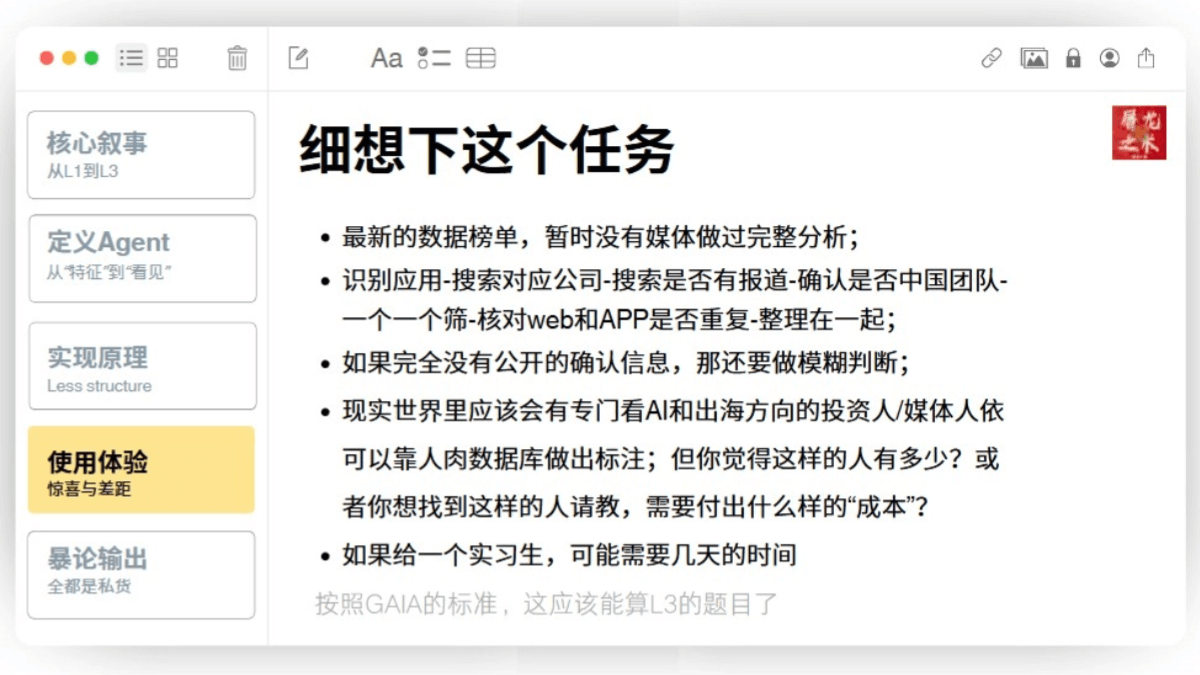
Everyone think carefully about this task. First, this list had just been released, and at that point in time there were not yet professional media doing analysis. Of course today there already are, but at that point in time there were none. Think about the execution process of this task. First, Manus had to identify these app icons and names. Then it had to search the corresponding company official websites or news reports, and then confirm whether they were Chinese teams, and it had to filter them one by one. At the same time, more importantly, as I just said, this list of 100 has 50 web and 50 APP. But you should know that among the 50 web and 50 APP there are duplicates. For example, ChatGPT must be both in web and in APP, so the model also had to check the duplication with external APPs, and finally organize them together and give me the result.
So without fully public confirmation information, some fuzzy judgment is still required. For example, the team might be in Singapore, right? So how should these teams be counted? Then in the real world, if this task specifically looks at AI going overseas, or at investors and media in this direction, a person can manually produce such annotations, right? But how many such people do you think there are? In China, or if you want to find such people to consult, what kind of cost would you need to pay? If you give this work to an intern, how long do you think he would need to finish it? I think this question, according to the GIA test bank standard we just talked about, should already count as L3.
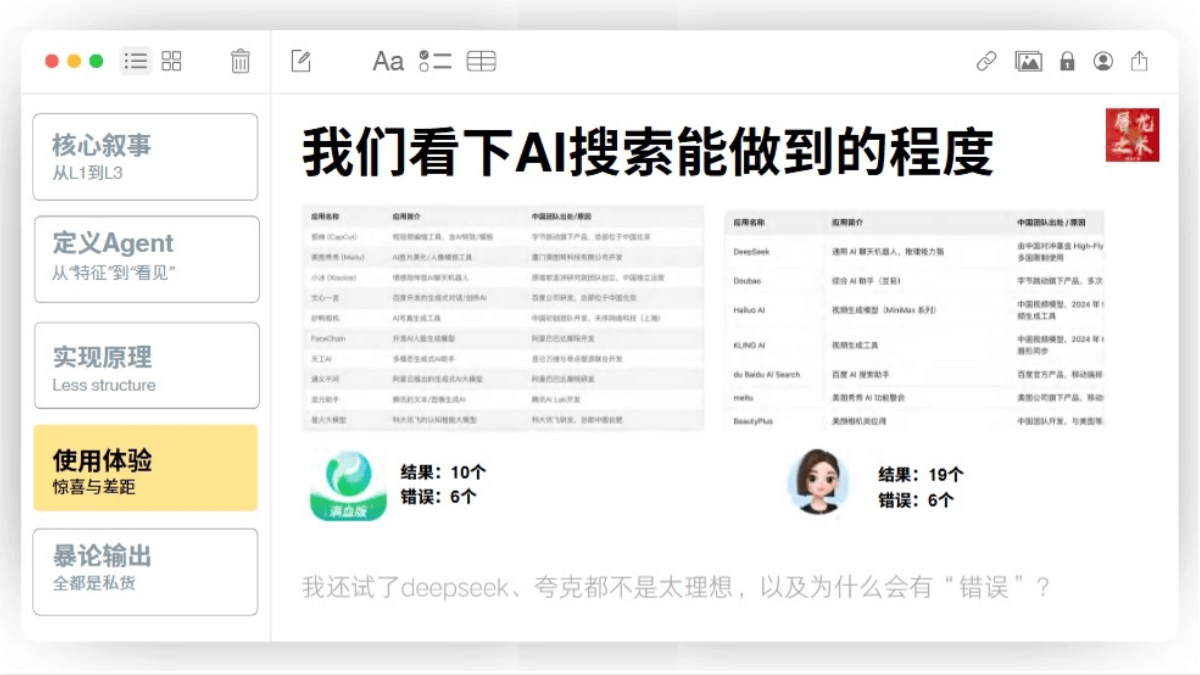
Let's look at the results. I think, well, let's not look at the results first. I likewise threw this question to AI search tools at this point in time today. For example, I gave it to Tencent's Yuanbao, to Doubao, to DeepSeek, and to Quark. The worst performer was Tencent's Yuanbao. It told me ten, but if you look closely at the ten it gave, six out of the nine were not on that hundred list. It made things up about six of them.
At the numerical level, the one that gave the most results was Doubao, which gave 19, but six of them were also not on that list, and some were even mismatched. DeepSeek and Quark were not particularly ideal either. Everyone is also wondering why there are errors, why there is nonsense, right? Hallucination.
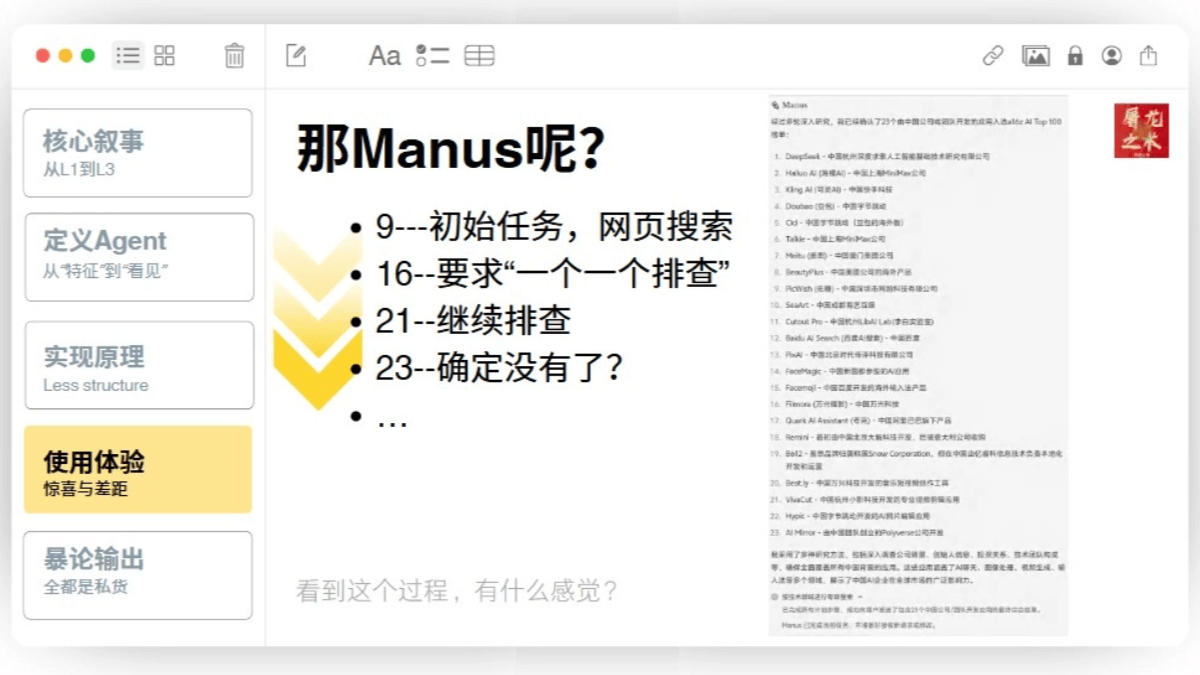
So to what extent did Manus do it? The first time I assigned it the task, the result it returned to me, that number was nine. How did nine come about? Very simple. When H6Z released this list, it was accompanied by an article. That article was about the analysis and description of this list. In that list, 19 Chinese apps were mentioned. Manus's first return of the task to me was a lazy result. When I saw this result, I said you need to check one by one, so I gave a second prompt, that is, an addition to the second task. Then it said okay, I will check them one by one. Then the second time it returned 16 to me. The third time I said you need to keep checking, there must be more, and it went to check again. The third time it returned 21 to me, and at that time it asked. The fourth time I asked whether it was sure there were no more? Then it went to check again, and finally returned 23 to me.
By this step, the system prompted that the context length was limited. In terms of the conclusion, the real number should be more than 23, but it should already be a number very close to it. So what do you feel when you see this process?
Those just now all seem to be good results, right? So is there anything bad? Yes, of course. For example, in this task with Teacher Li Jigang, we both found that, for example, we both wanted it to make some schematic diagrams, but I did not tell it where to make these diagrams, so it drew some stick-figure diagrams in a stick-figure style, very ugly, very simple, right? For example, I made one similar to military transportation to customs data; I asked it to find Spring Festival travel data, and likewise it looked in the wrong place, and the result it gave me was not good. Then for example, I asked it to make a PPT, and I hoped it would have screenshots and the content of the source web pages, and it directly screenshotted a web page. As a result, that web page was not logged in, and a QR code was pasted on it. Then all the image positions were also wrong, and there was not much layout information either. This is not an ideal result, right? But it looks like it is working seriously, it just does not do it very well. Is there anything worse?
Of course there is. The most common one is what I just said: the context limitation is subject to the limitations of the large model itself. So it is often found that after a task is executed multiple times, it will prompt you that in a particularly long context, you had better use a new conversation. For example, a virtual machine may have some problems; the virtual machine needs to restart, and if it cannot restart, it keeps restarting. Then perhaps because the user's load is too high, it needs to rest for a few minutes and try again. So it is not perfect, it is not even very imperfect, it has many problems, and the success rate is not that high.
Because, for example, the standard L3 questions in GAIA, it probably has only a 57% success probability, so more than 40% are unsuccessful, right? So how exactly should we rationally view this matter, or view Manus? I use the view of Yize, a self-media blogger who was also one of the earlier testers of Manus in this wave. He said it is at the level of an intern, lacks practical experience, is a bit lacking in flair, and is like an in-school university student working 24 hours with high throughput. The level of the final product depends on the level of the Agent core and the quality of accessible data. This is a relatively rational evaluation, I think.
Chapter Five: Controversies and Reflections on Manus
Okay, after we finish talking about usage, let's talk about today's last chapter. I call it "Violent output is all dead goods." I listed a few keywords. The first keyword is "good for nothing." The second keyword is "isn't it just Talk." The third keyword is "open source, reproduced in three hours." The fourth keyword is "no technological innovation." The fifth keyword is "definitely cannon fodder." The sixth keyword is "marketing definitely cost money." Let's talk about them one by one.
"Good for nothing." Indeed, you will find that at today's point in time, for a general or so-called general Agent product, it is very difficult to require it to do everything perfectly in every vertical category, especially in highly vertical scenarios. But there is a problem here, and this problem, or this scenario, is a very interesting scenario.
On the day Manus became popular, a journalist friend called to chat with me and ask me, because he knew I had an invitation code, and he knew I was using it. He is someone who does not pay that much attention to the tech industry, a journalist for what counts as mass media. So his first question was a very plain one: "Is it useful?" My first reaction when I heard this question was that I first had to think about how to answer it. I paused for a moment, and then I added a disclaimer. What was this disclaimer? I told him, I said many current test cases will have better solutions, so the answer to this question can only represent myself. But please remember the "
general" they emphasize means what? That is, for example, if today you ask it to make a PPT, tools specifically for making PPT will definitely have better solutions than it. But it is not specifically prepared for PPT, right?
This actually brings up a story from 1995 when Bill Gates went on a program to talk about the internet. The host asked, I heard that a major news event happened on the internet a couple of days ago, that you could listen live to a baseball game. Then the other person said, "Yes," and then the host asked, "Then what is my radio for?" Then he also said that recently some car website had launched where you could look up all kinds of car data. The host asked again, "Then what is my car magazine for?" I think it is the same.
"Isn't it just Talk"?
After "general," the second keyword is "isn't it just Talk." This has probably appeared too many times in all kinds of places over the past period. Isn't it just a wrapper? My answer is very simple: "isn't it just" is a lazy way of speaking, and even a bit arrogant.
What is "Talk Popularity"? Is it Talk Seek, is it Talk Yuanbao, and a bunch of applications that have integrated DeepSeek? Is it Talk? On this topic, I found the views of three of my fellow investors on Twitter and Geek Park.
First is Yusen. Yusen is an investor in Manus, so he is an interested party. He posted this passage. He said that in January 2013 he saw a product called Pop Lexi, found it quite interesting when he used it, and immediately went to ask a big-shot friend who was very experienced in both search and AI. He took one look and said, "A bit interesting, but this has no moat. I can whip one out over the weekend." Later, he really did send me a prototype over the weekend.
In mid-2023, a good friend asked me if I was interested in investing in Pop Lexi at a valuation of a few hundred million US dollars. I was already using it often by then, but I remembered what that big shot had said, so I politely declined. "Do wrapper applications really have no moat?" Then a partner at Guangsu also said the same thing on Twitter: technology may often not be the ultimate metric in an absolute sense. What can truly form a moat is the product, network effects, sales channels, the brand—it is these things.
Another partner who runs a USD fund was even more direct. He said, "Sir Gan Process Move Works all seem to be wrappers, but they are already at a $50 million A2, and they are already valued at $1 billion." Of course, some will also say, "You investors don't know shit." Anyway, of course, wrappers in the pure sense are still very hot. Likewise, on H6Z's Top 50 APP list for this issue, six are wrappers in the pure sense. Even the app icons look very much like ChatGPT, and the functions they provide are also true wrappers around large models.
"Open-source reproduction in 3 hours"?
The third keyword is "open-source reproduction in 3 hours." Yes, the open-source solutions that reproduced Manus in 3 hours followed very quickly, right? The two most famous now are Open Manus and OW. Are they powerful? Very powerful. But what I want to say is that for a user who wants to actually use these open-source solutions, you first have to download the code from GitHub, set up the environment locally, deploy a server in the cloud, call APIs of various models, and in the end may even have to execute things via the command line. That sounds like the barrier is a bit too high, right?
Then I will quote a sentence from Gefei. He said, "Whipping up a demo by hand is fast; operating a product well is very hard." Those who can also defend themselves wrongly only considered the 2 in the 4-2-4 time allocation principle. What is the first one? The first is discovering demand. Before others discovered this demand and made this product, he did not whip one out. After others released it, imitating it superficially is of course easier. The second 2 is that he also only implemented the most core function. He did not see, nor reproduce, the large amount of detailed work others did behind the scenes, so the imitation fails badly. The third 4 is publicity and promotion. At the moment, he did not consider that this is long-term work.
"No technological innovation"?
The fourth keyword is "no technological innovation." So what exactly is innovation? Looking only at the AI large model industry over the past two years, it seems there is only one situation: only large models count as foundational technology, only they count as innovation. So previously there was a conclusion that said, "Before the technological capabilities of large models converge, everyone should be cautious about doing traffic acquisition." I just want to ask, then what is a product? Aren't we all looking forward to 2025 as the year when AI products, AI applications, and AI Agents explode?
Let me give two more realistic cases. One is also a geeky netizen who said in a reply to a Manus comment, "I asked a friend who is a finance director and usually doesn't care about AI. After looking at Manus, he said, 'This is what I expected AI to look like.'" Another good friend of mine is a university teacher. He said, "Yesterday I went back to Fudan and had dinner with the teachers, and I recommended various uses of AI to them. The teachers said they can no longer keep up with the times, but they really want to try. Manus is the kind of thing that is a bit more foolproof, has no intervention capability, and it's okay if the completion quality is a bit worse." More importantly, the third one was posted by a former employee of the Manus team. He said, "From my perspective, Manus is the best manifestation of Monica company's ability to seize opportunities. But interpreting Manus this way is too shallow, because their engineering practice and accumulation of Agent workflow are real."
What I participated in was only the first domestic launch of an Agent from September to October 2023. The to-do list in it was all best practices after studying the solutions of various Agents at that time. Then in March 2024, I worked on the GPT S platform, and from early 2024 I had been continuously accumulating browser technology and accumulating a large amount of understanding of how to utilize browser context. In November 2023, I started working on search. The ability for an Agent to obtain information online also requires accumulation, but I was not involved in that part. In July 2024, through Rost, I gained experience in growing social traffic. In November 2024, in the Coding product, the understanding of each model's Coding ability. Indeed, each thing is a relatively thin layer. But it is also a fact that the combinatorial innovation formed by these building blocks in this window is strong enough. But it is also that they may have both cognition and sufficient engineering ability to carry out an air strike in this small window.
"Marketing definitely cost money"?
The fifth keyword is "marketing definitely cost money." This should be a very important topic in this wave of discussion about Manus. Let me lay out the timeline:
-
At 12 noon on March 5, Teacher Zhang Tao sent me a WeChat message. He said, "We will release their new product at 10 p.m. Tomorrow, that is, at 10:30 on March 6, we will have the first round of communication with friends. If you are interested, I will send you the Tencent Meeting number."
-
On the evening of March 5, founder Xiaohong and Teacher Zhang Tao posted this video on Jike. Xiaohong posted it at 11 p.m. on March 5, and Teacher Zhang Tao posted it at 0:17 a.m. on March 6.
-
From 9:10 p.m. to 11:50 p.m. on March 5, the Cyber Zen Mind Big Smart official account reposted Manus's official video, and at 7 a.m. on March 6 posted a test, which was the several demos he tested.
-
Kazike, at 6 a.m. on March 7, stayed up all night and made an experiential piece of content.
This was all the content of the first wave of dissemination, and nothing more. Up to this point in time, all the introductions we could see came from these two Jike posts and the pushes from two official accounts. Then, actually, after the video was released it blew up, and then there was the demonstration meeting the next day. So the closed-door meeting the next day had long been expected; it was not a clarification meeting. He had long wanted to introduce this thing of his to friends.
For those on the scene, I can name a few good friends around me. For example, Teacher Qu Kai is there, Keji is there, Huasheng is there, Agent Universe is there, Yize is there, Uncle Huang is also there, and I am there too, and some friends—we will all be there, some at the offline event in Beijing, some online. What I can guarantee is that none of us took any money from Manus. None. So at that point in time, Manus also issued an announcement saying, "We have never opened any paid channel for obtaining invitation codes, and we have never invested any marketing budget." As an individual who personally participated, I absolutely believe this announcement from this team.
From the results, Huasheng's Zeekr post is also very representative. He said, "Actually, it all started when the team made a pretty good product, chatted with friends in the circle, and asked everyone to test it. The way things developed should have completely exceeded their expectations and control, and that's all." So why were people willing? I used a two-character keyword: "good karma." Also, in my previous DeepSeek PPT, I recommended that if you want to understand DeepSeek's technical implementation, watch a 2-hour video. That video is called "The Best Tribute Is Learning." Who made that video? Teacher Zhang Tao made it. More importantly, in my blog, the previous episode about DeepSeek, "Distance and Misunderstanding," was made by me, Lili, Zhang Tao, and another teacher.
During this past period, Teacher Zhang Tao, in this way, in a sense accumulated enough good karma. We non-technical people, who do not understand technology that deeply, should thank Teacher Zhang Tao for his evangelism. So why was there such a strong first batch of voluntary promoters? Because of good karma.
Of course, many people may not believe it, so let me put it another way in reverse. Because at 8 a.m. on March 6, there was already a question about Manus on Zhihu. At that time, the top-ranked answer said, "There is nothing wrong with the first AI product discovered and reviewed by self-media before technical practitioners." He said there was no heat on Hacking News and V2EX because their friends are not in the tech circle; their friends are us.
Another example: this wave of spread began with the Geek official account and Xiaoyuzhou. On the morning of March 6, starting from this smallest circle, it first spread to the core tech media circle, then to the financial media circle. By that day, some party and central media reported on it. If you think this marketing was designed, how much money would you need, and how many relationships would you need to cultivate in advance? I know many PR people from big companies listen to my podcast. If I gave you enough budget today, could you reproduce this kind of spread? The answer is self-evident, right?
Some people will also say there was no discussion on Twitter at all, because they did not give it to people outside first, to users on foreign Twitter, for testing, so how could there be discussion? Later, a lot of discussion did appear on Twitter. So what I want to say is that everyone must use the method of export-to-domestic sales to verify some things. Is there no way and logic for independent judgment of your own? Finally. Is the era of AI Agents really coming?
Summary: The arrival of the AI Agent era
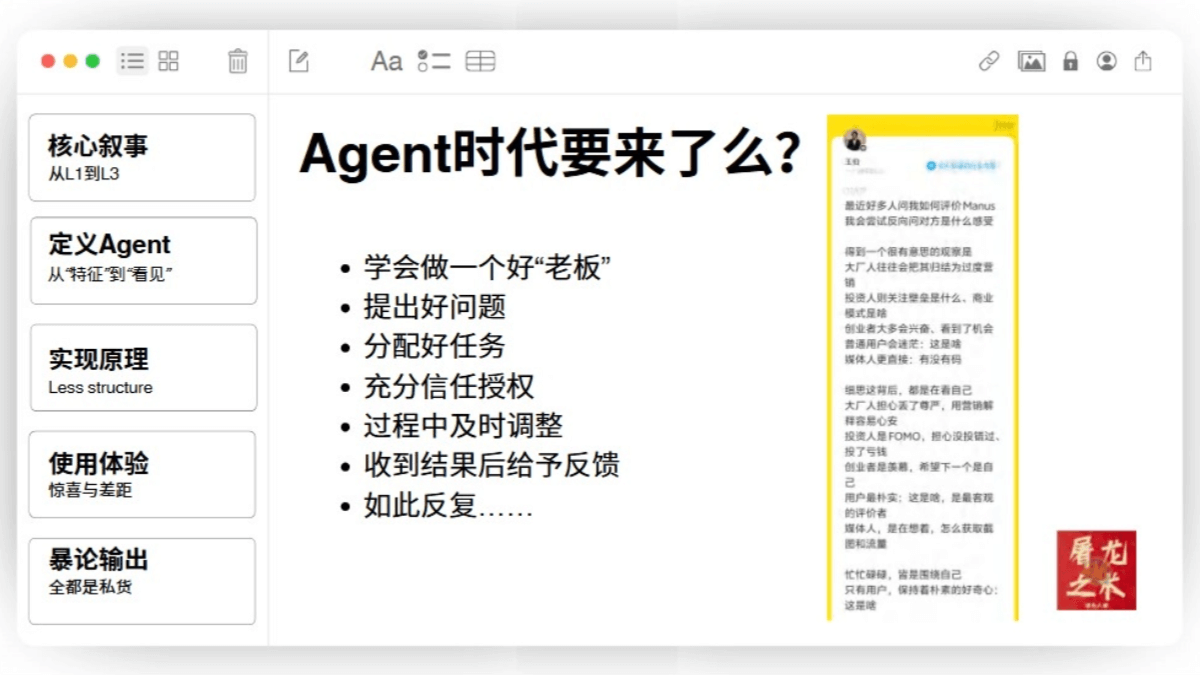
From my experience, this is how I feel. I said I have a clearer understanding of how to face such an era. You need to learn to be a good boss, ask good questions, assign good tasks, give sufficient trust and authorization, make timely adjustments during the process, and give feedback after receiving results, and repeat this cycle. This is a personal feeling of mine as a non-technical practitioner who is interested in the industry, after all, someone who has used many AI tools. And at the same time, I would like to quote Teacher Yubo's evaluation of Manus, which goes like this:
"Recently many people have asked me how I evaluate Manus. I try to ask them in reverse what their feelings are, and get a very interesting observation. People from big companies tend to attribute it to excessive marketing, investors focus on what the moat is and what the business model is, entrepreneurs are mostly excited and see opportunity, users are confused about what this is, and media people are more direct, wondering if there is something to dig into. Behind all this, they are actually all looking at themselves. People from big companies worry about losing dignity, and explaining it through marketing makes them feel at ease. Investors are formal, worried about missing out if they do not invest, and losing money if they do. Entrepreneurs are envious, hoping the next one will be them. Users are the most plain: what is this? They are the most objective evaluators. Media people are thinking about how to get images and traffic, bustling around all centered on themselves, and only users maintain a simple curiosity: what is this?"
So what do I want to say on the last page? First, in the past more than two years, in this era of AI that I call the dark forest era. Whenever someone takes a step and gets the market right, it will always give you more positive feedback than you expected. This has been proven countless times. We should thank Manus for its explosive popularity in 2025. The year 2025 will become increasingly challenging, and I encourage everyone to keep going. Thank you for listening to this episode of the podcast. My PPT is available in Xiaoyuzhou if needed. Thank you.

Get"Manus Has No Secrets"PDF original file, scan the code to follow and reply: 20250314