
"How Ordinary People Can Seize the DeepSeek Dividend" was written by the doctoral student team of Tao Wei from the Metaverse Culture Laboratory of Tsinghua University's New Media Research Center. The article introduces DeepSeek's broad application capabilities in work, study, life, and social interaction. It points out that in the AI era, prompt-driven knowledge creation has become a core competitiveness, and the ability to ask questions and discern answers is key. Through multiple scenario cases, it demonstrates how DeepSeek can help users efficiently complete tasks, solve complex problems, and optimize decision-making. It encourages users to enhance their personal competitiveness by cultivating AI thinking, integration ability, guidance ability, and judgment. Master AI tools and seize the dividends of the AI era.
Webmaster's Recommendation:How to solve DeepSeek server busy? 16 free full-power R1 alternatives

Obtainthe original PDF file of "How Ordinary People Can Seize the DeepSeek Dividend", scan the QR code to follow and reply: 20250216
I. Introduction to DeepSeek
-
What is DeepSeek
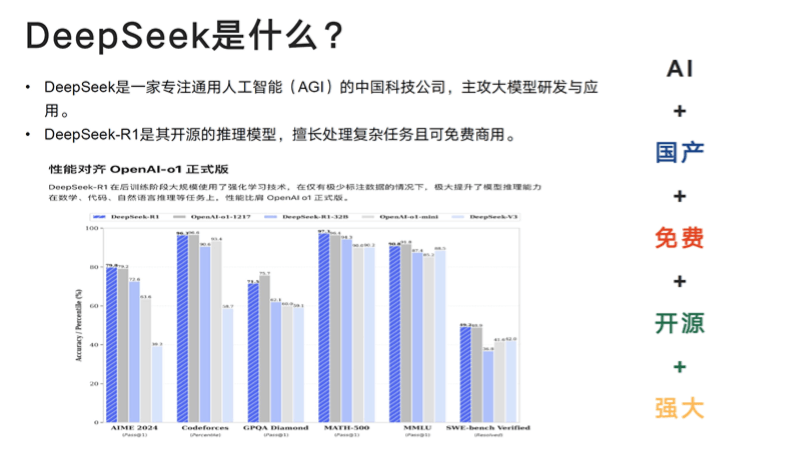
DeepSeek is a Chinese technology company focused on artificial general intelligence (AGI), specializing in the research, development, and application of large models. Its open-source reasoning model DeepSeek-R1 excels at handling complex tasks, with performance comparable to the official version of OpenAI's GPT-1, and supports free commercial use. DeepSeek-R1 uses reinforcement learning technology in the post-training stage, improving the model's reasoning ability, especially excelling in tasks such as mathematics, code, and natural language reasoning. DeepSeek provides a variety of application scenarios such as intelligent dialogue, text generation, semantic understanding, computational reasoning, and code generation. DeepSeek has broad application capabilities, including but not limited to decision support, style transfer, personalized recommendations, translation, multilingual processing,data analysis, knowledge reasoning, text generation, sentiment analysis, image understanding, etc.
II. Core Competitiveness in the AI Era
-
New Productivity Driven by Prompts
In the AI era, the cost of knowledge acquisition is approaching zero, and creating knowledge based on prompts has become key to individual and social competitiveness. Prompts can guide AI to generate specific content, driving innovation and clarifying direction. -
Re-creation in Selection
Faced with multiple solutions provided by AI, humans need critical thinking and logical judgment abilities, achieving innovative regeneration of solutions by selecting the optimal answer. -
Decision-making Power Empowered by Wisdom
The ability to ask questions and discern answers has become the core competitiveness in the era of information explosion. Achieving value creation through decision-making behavior is an important driving force for social development.
III. DeepSeek's Deep Thinking
- Example of the Deep Thinking Process
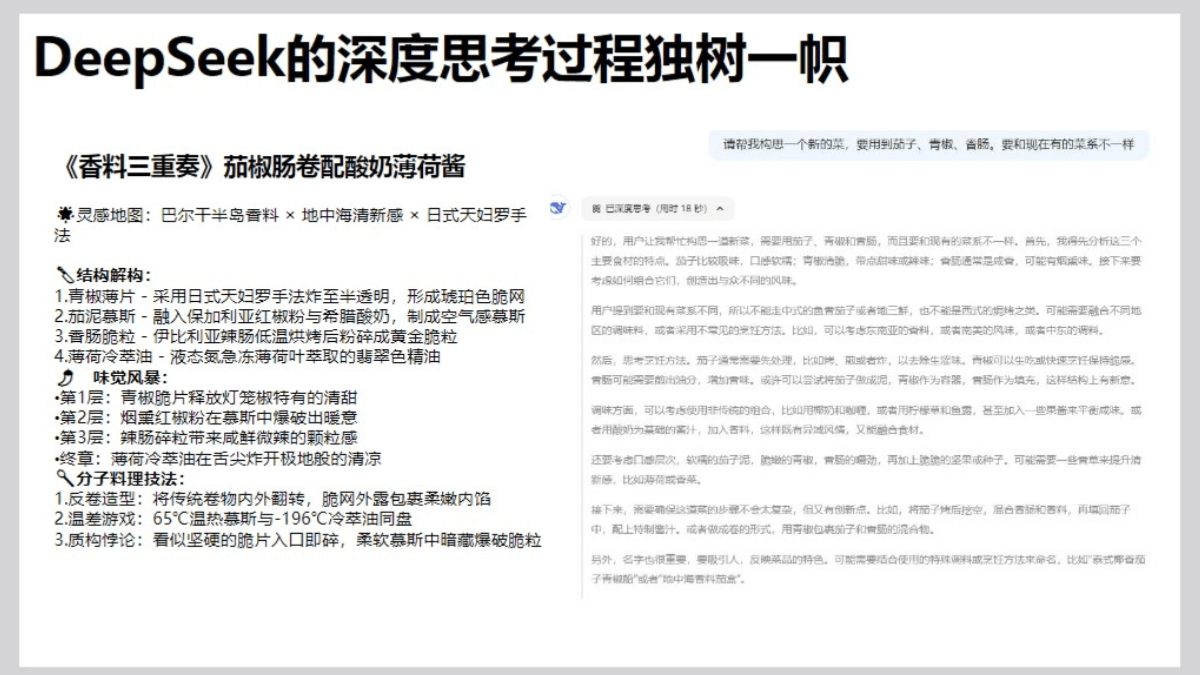
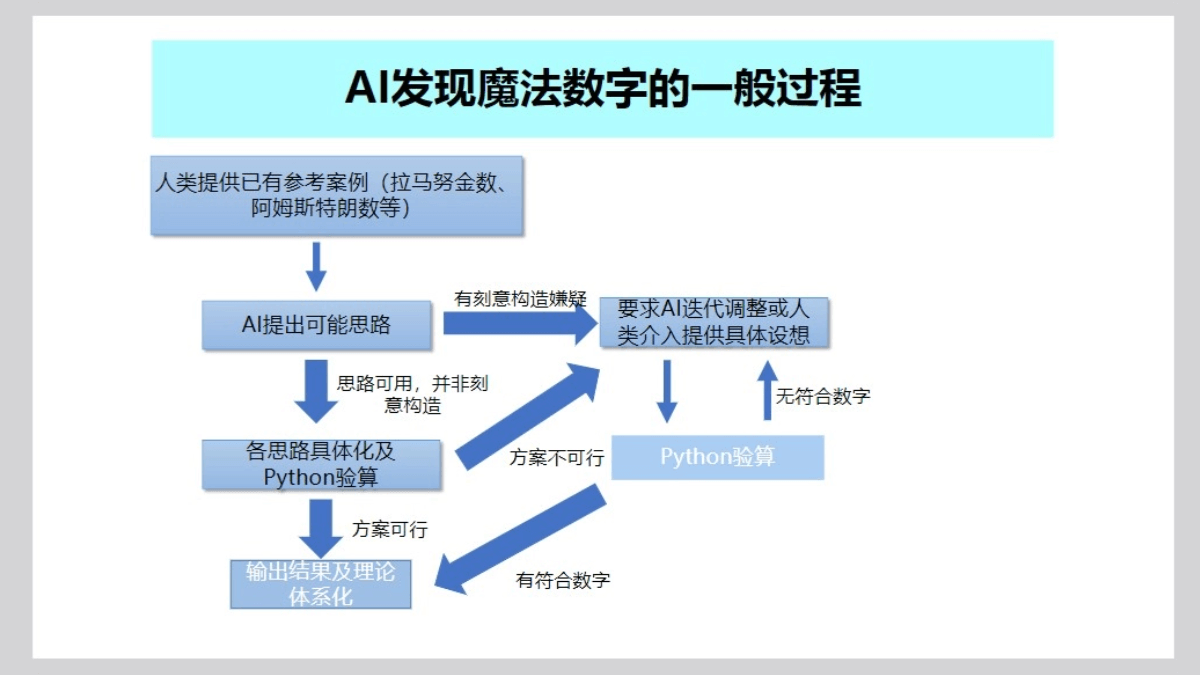
Through a complex molecular gastronomy example, it demonstrates how DeepSeek performs deep thinking through structural deconstruction and inspiration mapping to generate innovative solutions.
IV. How to Use DeepSeek to Solve Problems at Work
- Scenario 1: Write a 10,000-word project proposal within 1 hour
By using AI in stages (techniques such as framework replication, module filling, data grafting, and format optimization), quickly generate a high-quality project proposal. - Scenario 2: New employees quickly familiarize themselves with the company and industry situation
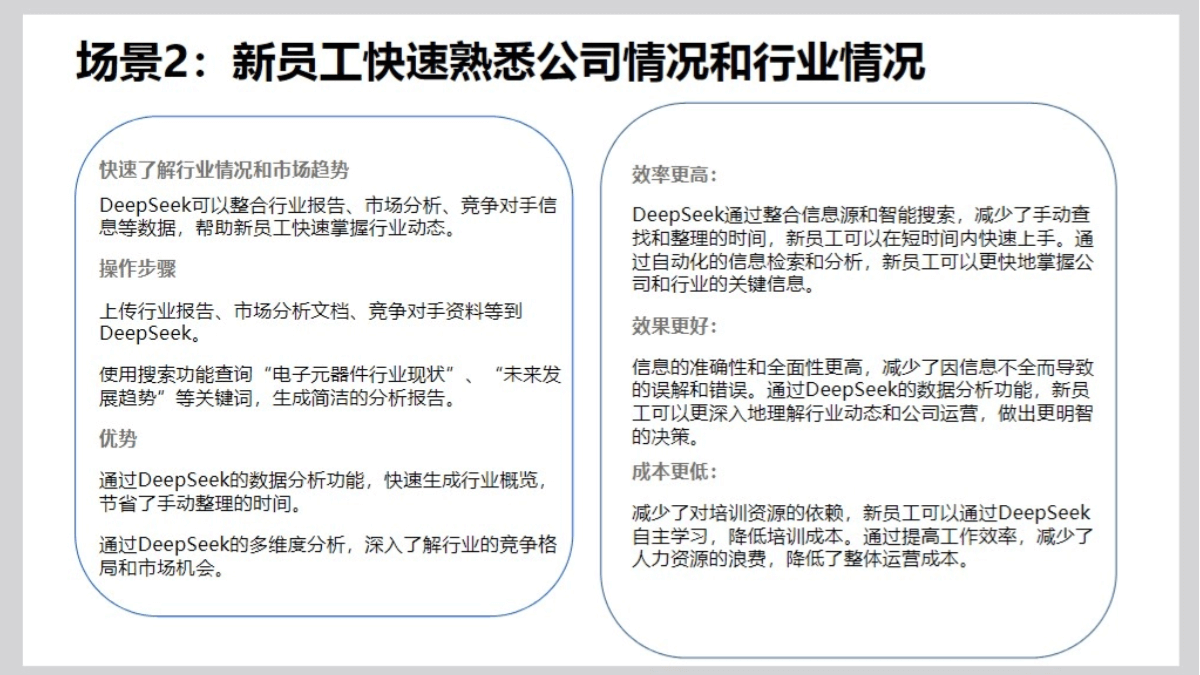
Use DeepSeek to integrate industry reports and market analysis, helping new employees quickly grasp key information about the company and industry. - Scenario 3: Daily customer communication and problem feedback handling
Use AI to quickly respond to customer questions, provide professional advice, reduce errors, and improve customer satisfaction. -
Scenario 4: How to bring up an urgent request for leave during a project
Use AI-assisted communication strategies to generate reasonable wording and help employees reduce workplace conflict when requesting leave.
V. How to use DeepSeek to overcome difficulties in learning
-
Scenario 1: What to do when you suddenly can't keep up in class
Use DeepSeek to quickly obtain problem explanations and help students keep up with classroom progress. -
Scenario 2: Liberal arts students quickly getting started with programming
Use AI-assisted programming tasks to quickly generate code and solutions. -
Scenario 3: Multi-agent online community simulation
Use AI to simulate social phenomena and opinion dynamics, and study the impact of biased information on group beliefs. -
Scenario 4: Uncharted research + rapid results
Combine AI's reasoning capabilities to explore unknown fields and quickly validate theories.
VI. How to use DeepSeek to handle affairs in life
-
Scenario 1: The morning battle of working mothers (daily chores management)
Use AI to optimize task priorities and time management, and improve life efficiency. -
Scenario 2: Decision support for work-life balance
Use AI-assisted decision-making to balance work and family affairs. -
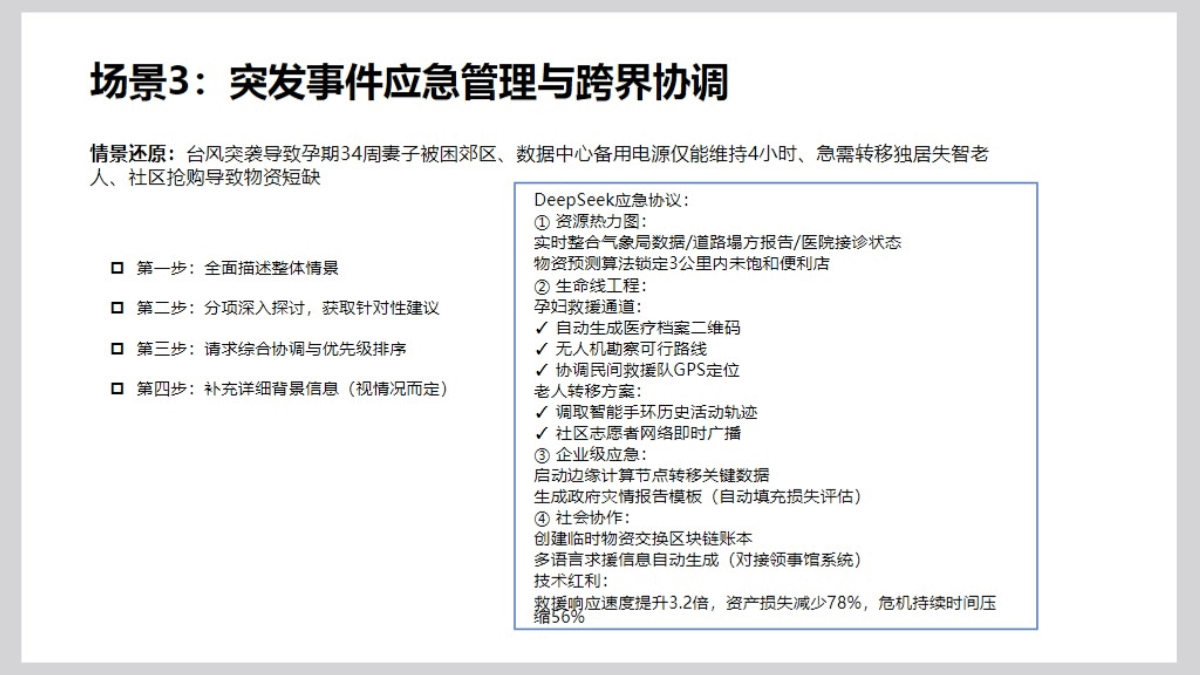
Scenario 3: Emergency incident management and cross-boundary coordination
Use AI to integrate resources and optimize emergency response and coordination capabilities.
VII. How to use DeepSeek to handle social relationships
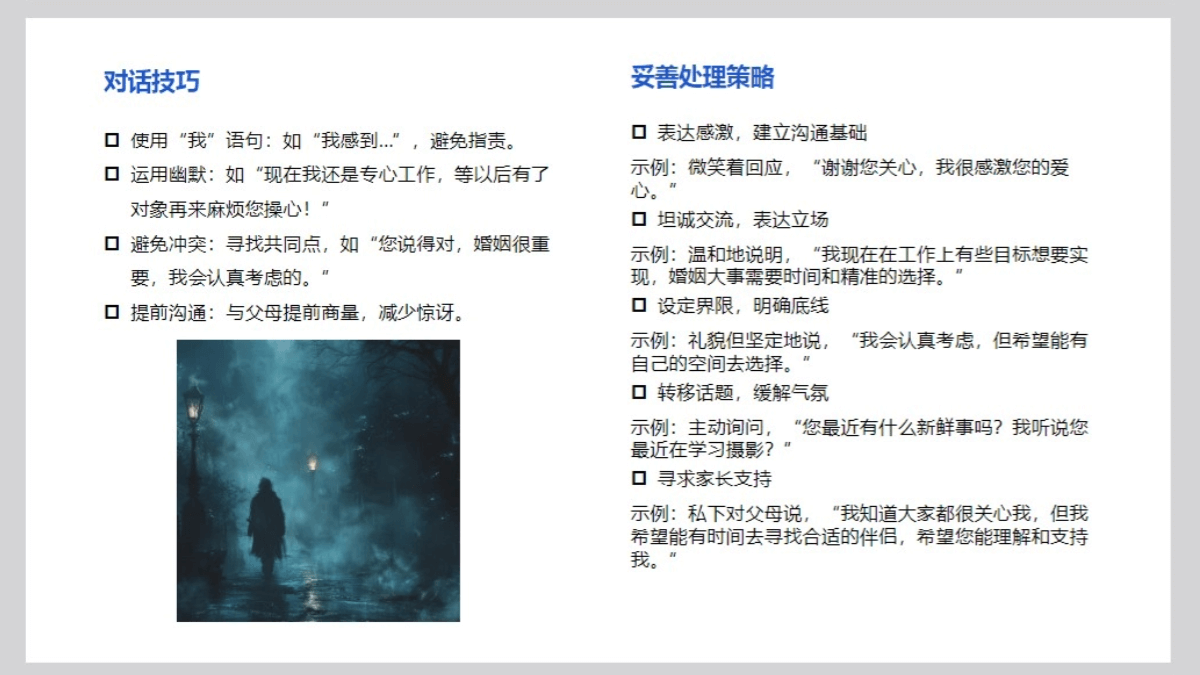
- Scenario 1: How to use AI to respond to marriage pressure during the New Year
Provide conversation techniques and strategies for dealing with marriage pressure. - Scenario 2: Generational conflict in the mother-in-law and daughter-in-law relationship
Use AI-assisted communication techniques to ease generational conflict. - Scenario 3: Maintaining a good social relationship with leaders
Use AI to optimize workplace communication and improve relationships with leaders. - Scenario 4: Inheritance rights conflicts in cross-national, cross-cultural, and cross-religious families
Use AI-assisted negotiation to balance cultural differences and legal principles.
VIII. How to use DeepSeek efficiently
-
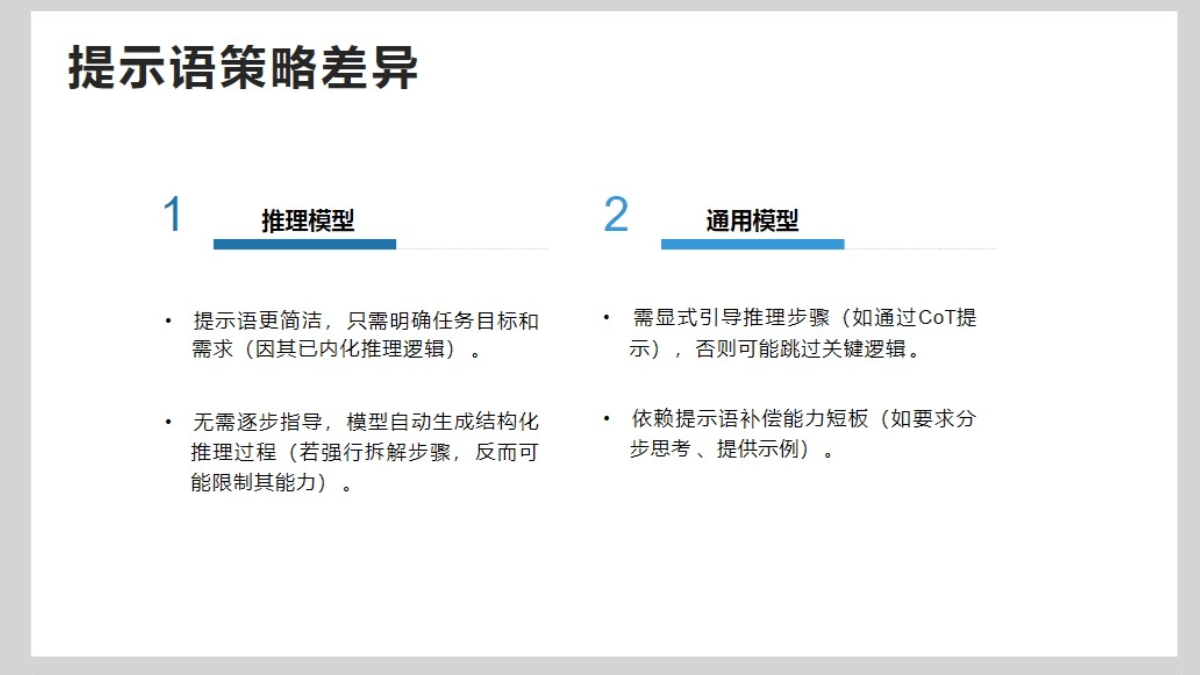
Differences in prompt strategies
Differences between reasoning models and general models in prompt design: reasoning models rely more on concise instructions, while general models require explicit guidance of reasoning steps. -
The core skill system of prompt design
Prompt design requires multiple skills such as contextual understanding, abstraction ability, critical thinking, innovative thinking, and ethical awareness. -
Advanced skills in prompt design
Includes techniques such as precisely defining tasks, appropriately decomposing complex tasks, introducing guiding questions, and controlling prompt length. -
Common pitfalls and response strategies
Avoid issues such as lack of iteration, excessive or vague instructions, assumed bias, and hallucination generation, and optimize prompt effectiveness through multiple rounds of dialogue, neutral language, fact-checking, and other methods.
IX. How to ask questions? Let AI generate what you want in one go
- The essence of prompts: A prompt is an instruction or information input by the user to an AI system, used to guide the AI to generate specific output or perform a specific task. It includes the following components:
-
Instruction: Clearly tell the AI the task that needs to be performed.
-
Context: Provide background information for the AI to help it understand the task more accurately.
-
Expectation: Clearly or implicitly express the requirements and expectations for the AI output.
-
- The Role of Prompts: Prompts are not only a bridge for interaction between humans and AI, but can also affect the quality and form of AI output. They can help AI better understand task requirements and generate content that meets user expectations.
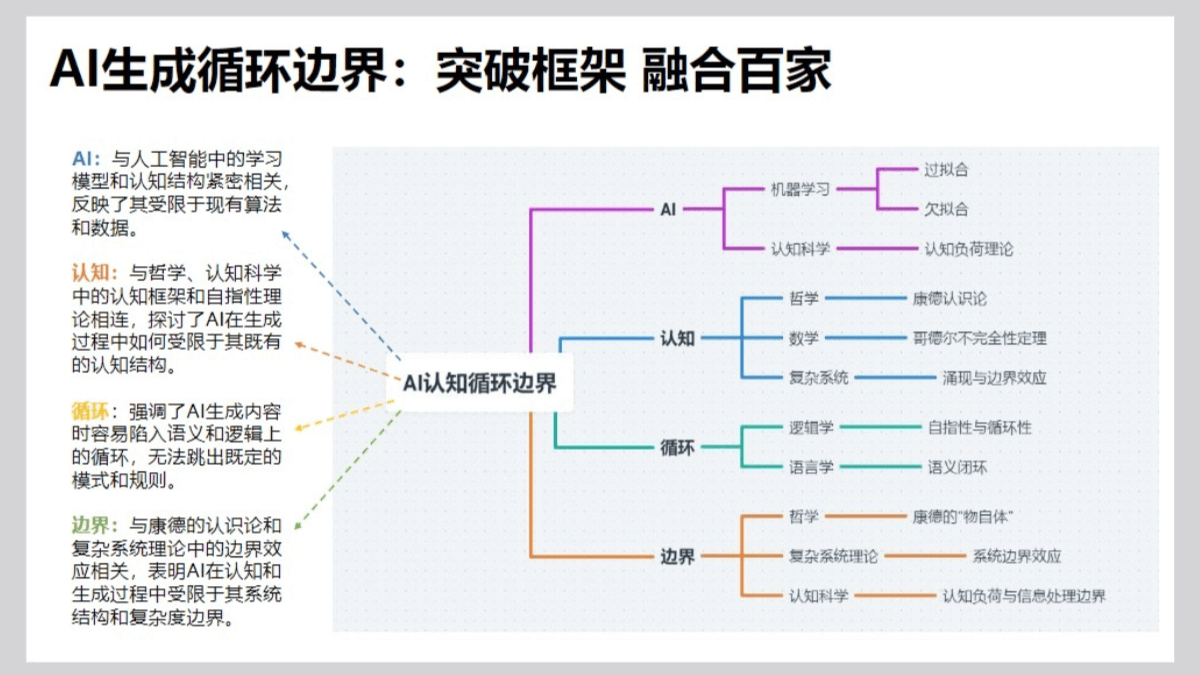
- Types of Prompts: According to different application scenarios, prompts can be divided into the following types:
- Instructional Prompts: Directly tell the AI the task that needs to be performed. For example: "Translate the following content into French: Hello, world."
- Question-and-Answer Prompts: Ask the AI a question and expect a corresponding answer. For example: "What do you think the future of artificial intelligence will be like?"
- Role-Playing Prompts: Require the AI to play a specific role and simulate a specific scenario. For example: "Suppose you are a 19th-century historian and comment on Napoleon's rise."
- Creative Prompts: Guide the AI to engage in creative writing or content generation. For example: "Write an adventure story in Hemingway's style."
- Analytical Prompts: Require the AI to analyze and reason about the given information. For example: "Analyze the conflict between utilitarianism and moralism in the 'trolley problem.'"
- Multimodal Prompts: Combine multiple forms of input such as text and images to guide the AI in generating integrated content.
- Core Skills in Prompt Design: Designing effective prompts requires the following core skills:
- Contextual Understanding: In-depth analysis of the task background and implicit requirements, taking into account cultural, ethical, and legal factors.
- Abstraction Ability: Identify general patterns and improve the reusability of prompts.
- Critical Thinking: Objectively evaluate AI output and identify potential biases and errors.
- Innovative Thinking: Explore unconventional prompt methods and push the boundaries of AI applications.
- Ethical Awareness: Embed ethical considerations into prompts to ensure the fairness and inclusiveness of AI applications.
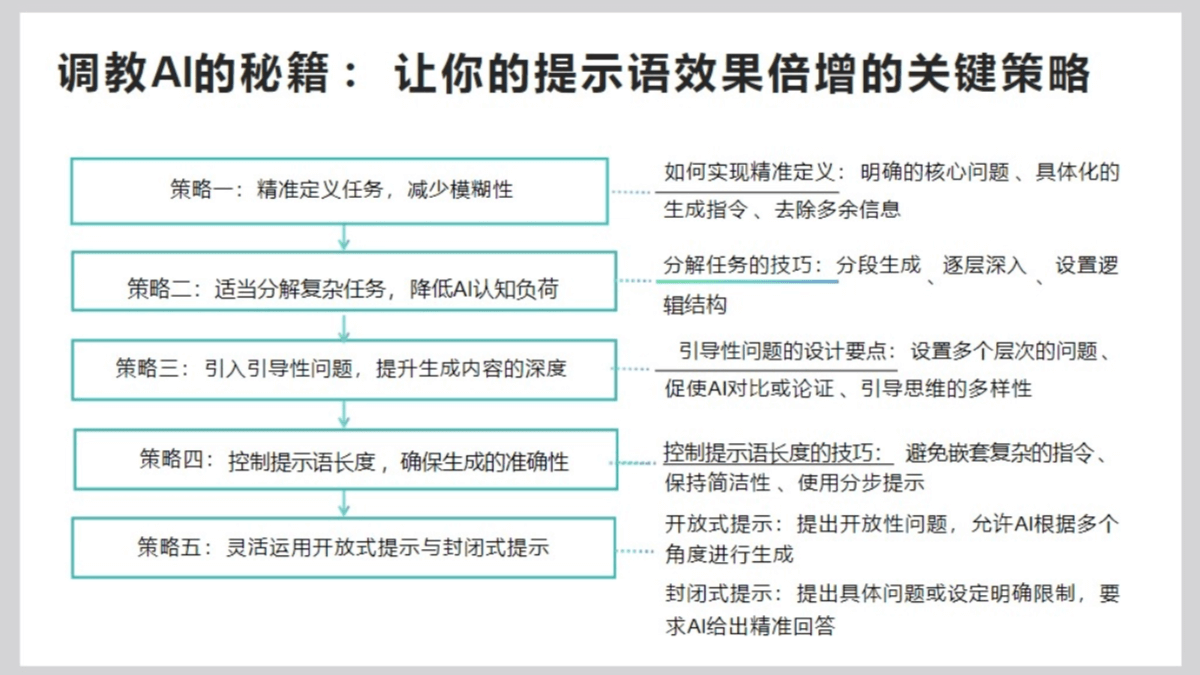
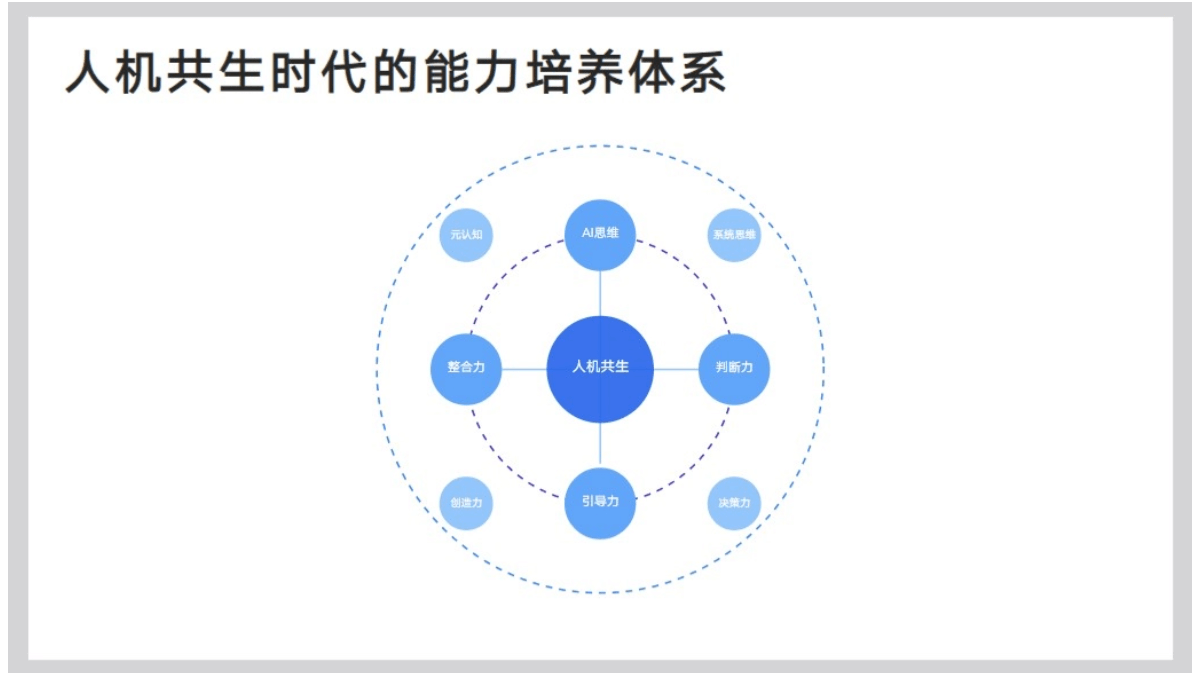
X. Capability Development System in the AI Era
-
AI Thinking
Understand AI's capability boundaries, decision logic, and data-driven analysis capabilities, and establish a human-machine collaboration model. -
Integration Ability
Integrate human and machine strengths, optimize resource orchestration, and achieve cross-domain knowledge transformation and creative recombination. -
Guidance Ability
Through prompt engineering, dialogue management, and task decomposition, ensure that AI output meets expectations. -
Judgment
Evaluate the accuracy and applicability of AI output, maintain independent thinking, and ensure content reliability and scenario adaptability.
Getthe original PDF file of "How Ordinary People Can Seize the DeepSeek Dividend", scan the code to follow and reply: 20250216