
The "2024 China Artificial Intelligence Industry Research Report" provides an in-depth analysis of the development status, trends, and challenges of China's AI industry in 2024. The report notes that in 2024 the state attached great importance to the development of AI technology, incorporating it into the national strategy, and governments across regions successively introduced supportive policies to promote technological innovation and industrial ecosystem development. In 2024, China's AI industry scale reached 269.7 billion yuan, with a growth rate of 26.2%, slightly lower than expected, mainly because the performance of large models in actual business scenarios did not fully meet customer needs and construction costs were relatively high. WithDeepSeekthe emergence of open-source models such as these, this helps China's AI industry advance toward an efficient, open, and autonomous direction. The report analyzes the impact of large models on the computing power industry, the development of foundational-layer tool products, and the promotion of commercialization practices by open-source innovation at the model layer, emphasizing the importance of building a security governance system oriented toward the new generation of AI.


Obtainthe original PDF file of the "2024 China Artificial Intelligence Industry Research Report", scan the QR code to follow and reply: 20250328
Macro Environment of China's Large Model Industry
- Policy Environment of China's Artificial Intelligence Industry: The state attaches great importance to the development of artificial intelligence and has issued a series of policies to promote technological innovation, resource development, standard establishment, and industry application. Governments across regions actively respond and introduce distinctive policies tailored to local conditions, promoting the formation of the AI industry ecosystem.
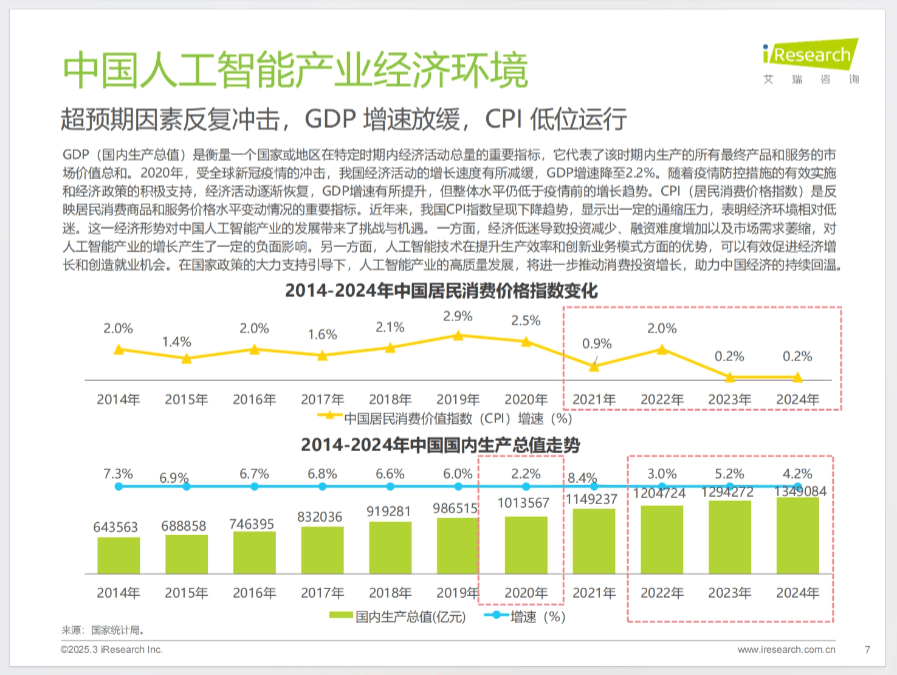
- Economic Environment of China's Artificial Intelligence Industry: In 2024, GDP growth slowed, and CPI remained at a low level. As a new quality productive force, AI technology shows broad development prospects. The economic situation brings both challenges and opportunities to the development of the AI industry.
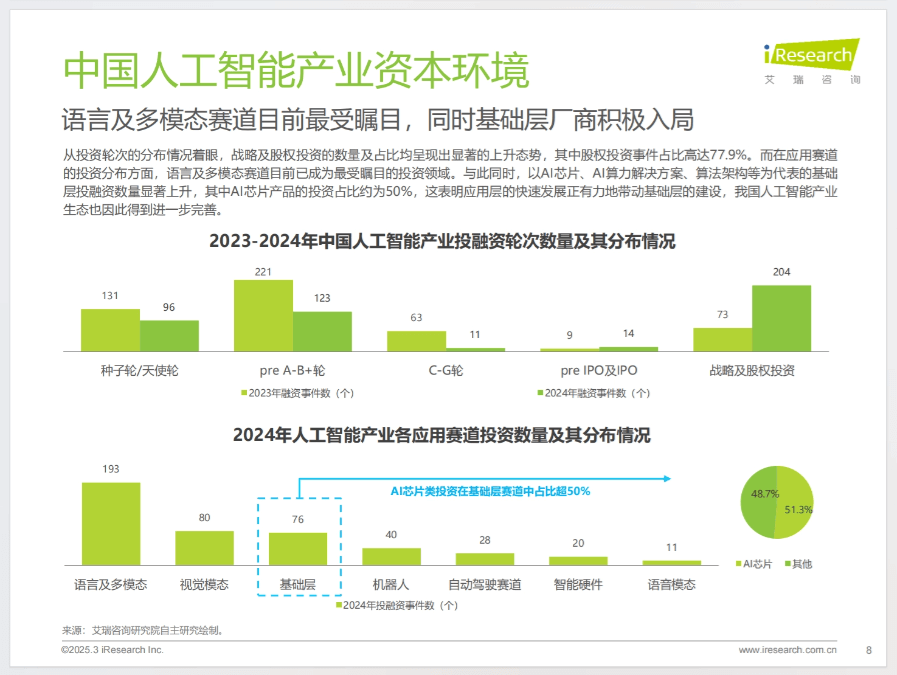
- Capital Environment of China's Artificial Intelligence Industry: The capital market continues to pay attention to artificial intelligence, with investment focus on language and multimodal model applications, chips, computing power services, and other fields. The foundational layer and application layer develop in coordination, and the industrial ecosystem is continuously improving.
- Social Environment of China's Artificial Intelligence Industry: The popularization of generative AI accelerates market education, and public acceptance has significantly increased. Issues such as job replacement, privacy, and security have triggered a certain degree of anxiety.
- Technological Environment of China's Artificial Intelligence Industry: The Transformer architecture dominates the development of large models. Research and development based on reinforcement learning and chain-of-thought optimization enhance model reasoning capabilities, accelerate cross-modal integration, and continue exploration in areas such as inference efficiency optimization and new attention mechanisms.
Overview of the Value of China's Large Model Industry
- China Artificial Intelligence Industry Landscape: It covers the AI foundational layer (computing power foundation, data foundation, algorithm foundation), technology layer (machine learning, computer vision, intelligent speech, etc.), and application layer (AI + pan-security, finance, government affairs, etc.), and displays the composition of the large model layer and tool layer.
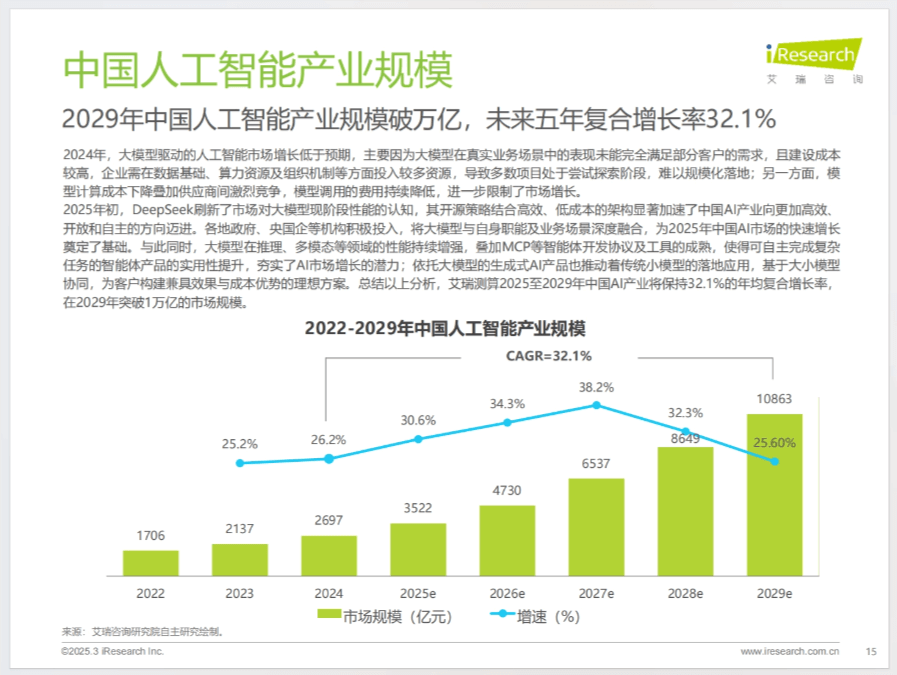
- Scale of China's Artificial Intelligence Industry: In 2024, the scale of China's AI industry was 269.7 billion yuan, with a growth rate of 26.2%, slightly lower than expected. It is expected that from 2025 to 2029, China's AI industry will maintain a compound annual growth rate of 32.1%, breaking through a market scale of 1 trillion yuan in 2029.
- Analysis of the Impact of Large Models on the Position of the Computing Power Industry: In 2024, intelligent computing centers in some regions were idle. With the explosive growth of inference applications, demand for computing power on the inference side has risen substantially, and the utilization rate of intelligent computing centers is expected to gradually increase.
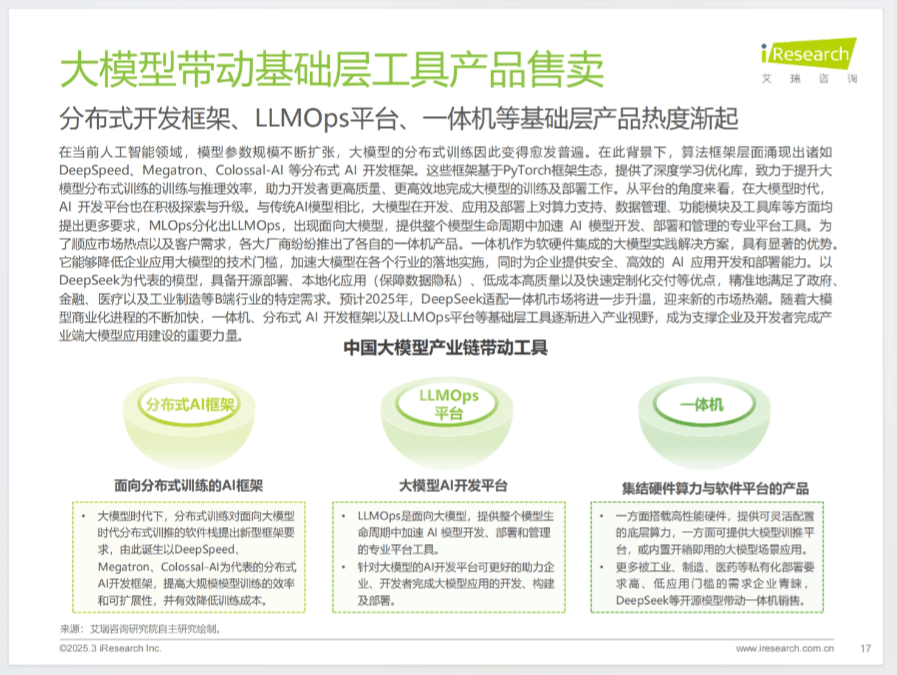
- Large models drive sales of foundational-layer tool products: Distributed AI frameworks, LLMOps platforms, and all-in-one machine products continue to evolve, deeply integrating software and hardware advantages to accelerate the training and deployment of large models.
- Open-source innovation at the model layer drives commercialization practices: Open-source models such as DeepSeek, based on innovative model architectures and training task optimization, significantly reduce training and inference costs, driving commercialization practices for large models.
- The "enclosure" trend among application vendors is gradually emerging: Product performance at the application layer has become the focus of competition, with price and traffic becoming core competitive strategies, and large model practices becoming more customized and productized.
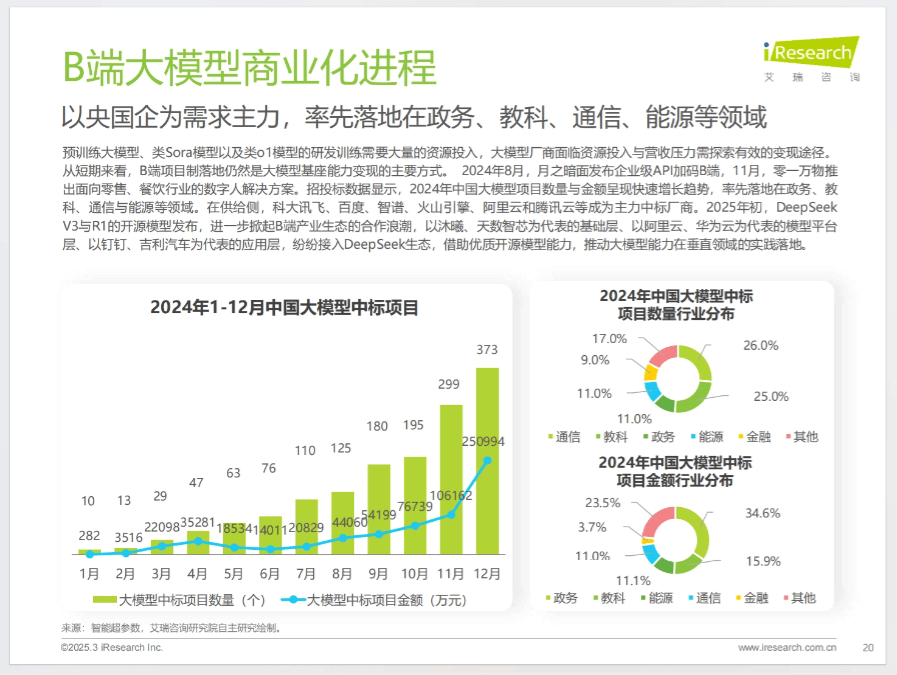
- Commercialization progress of B-end large models: B-end large model commercialization is mainly project-based; in 2024, the number and amount of winning bids grew rapidly, mainly concentrated in fields such as government affairs, education and scientific research, communications, and energy, with iFLYTEK, Baidu, and others as the main winning vendors. In early 2025, the DeepSeek open-source model will promote B-end industry ecosystem cooperation.
- Analysis of C-end AI product ecological niches: In 2024, C-end AI products developed rapidly, covering content creation, intelligent dialogue, emotional companionship, etc., mainly based on a "free + subscription" model, with insufficient user stickiness, product forms and ecosystem barriers not yet stable, and fierce market competition.
- In-depth product insight: AI Coding: AI Coding products improve developer efficiency and lower the programming threshold by automatically generating code. In 2024, related technologies made breakthroughs, driving products to evolve from assistive to autonomous, and in the future are expected to achieve end-to-end implementation from natural language requirements to software development delivery.
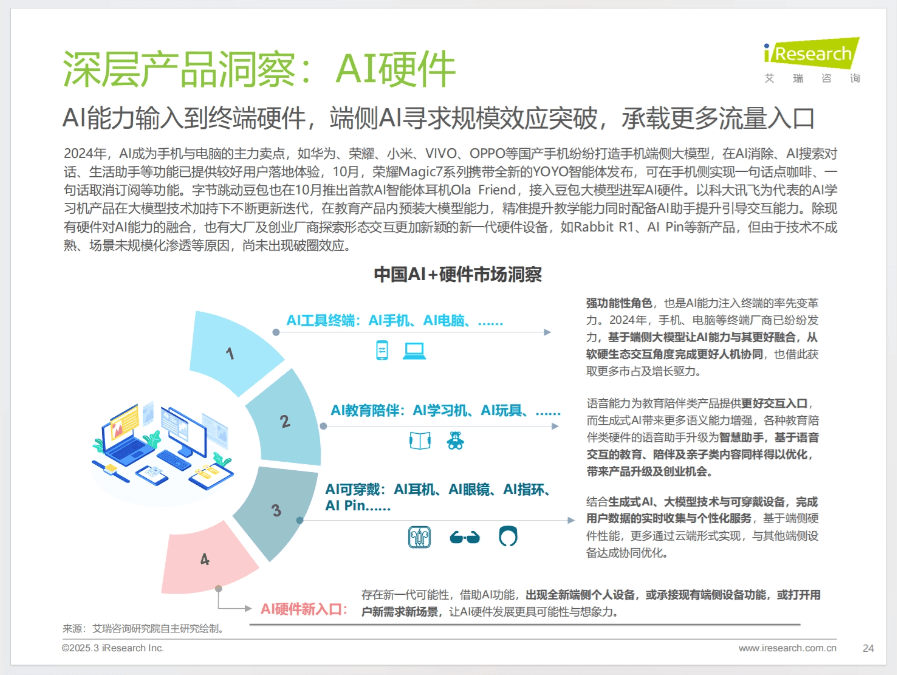
- In-depth product insight: AI hardware: In 2024, AI became a selling point for hardware such as phones and computers, driving the development of on-device AI. AI hardware products cover AI tool terminals, educational companionship, wearable devices, etc., and in the future new on-device devices are expected to emerge, expanding the possibilities of AI hardware.
Commercialization progress of China's large model industry
- Speech modality: Product forms are mainly AI speech solutions and AI generation; speech recognition and generation capabilities continue to strengthen, with focus on end-to-end speech large model technical architecture.
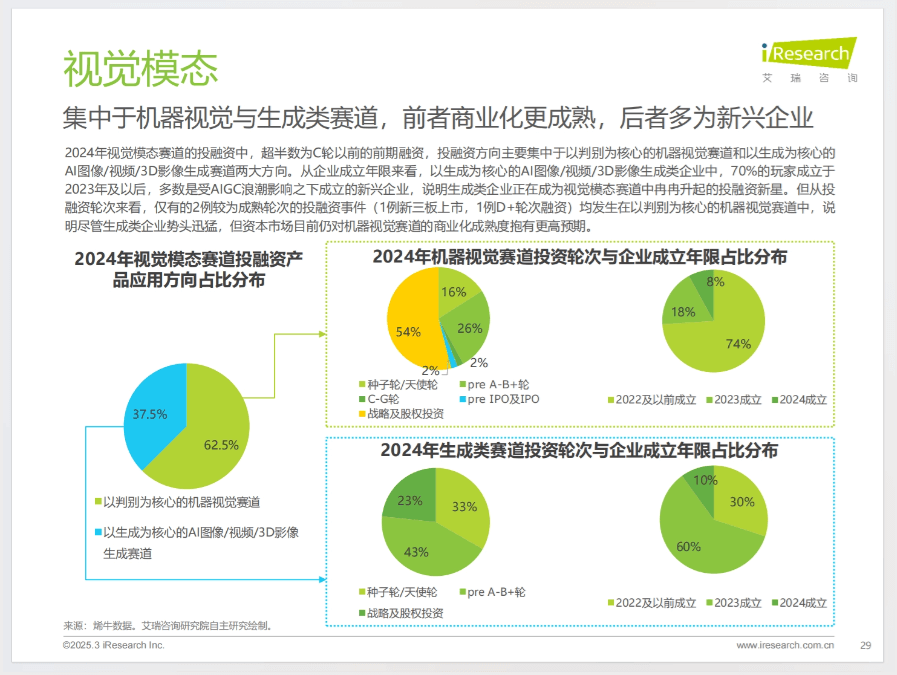
- Vision modality: Concentrated in machine vision and generative tracks, with the Transformer architecture as the main technical theme; product positioning is clear, and functions as the starting point target G-end, large B, small and medium B, and C-end markets respectively.
- Language modality and multimodality: Multimodal architectures will still focus on a single path of generation or understanding, with future expectations for deep technological integration. AI products based on large language model technology are mostly within the reach of big tech companies, especially in the C-end ecosystem.
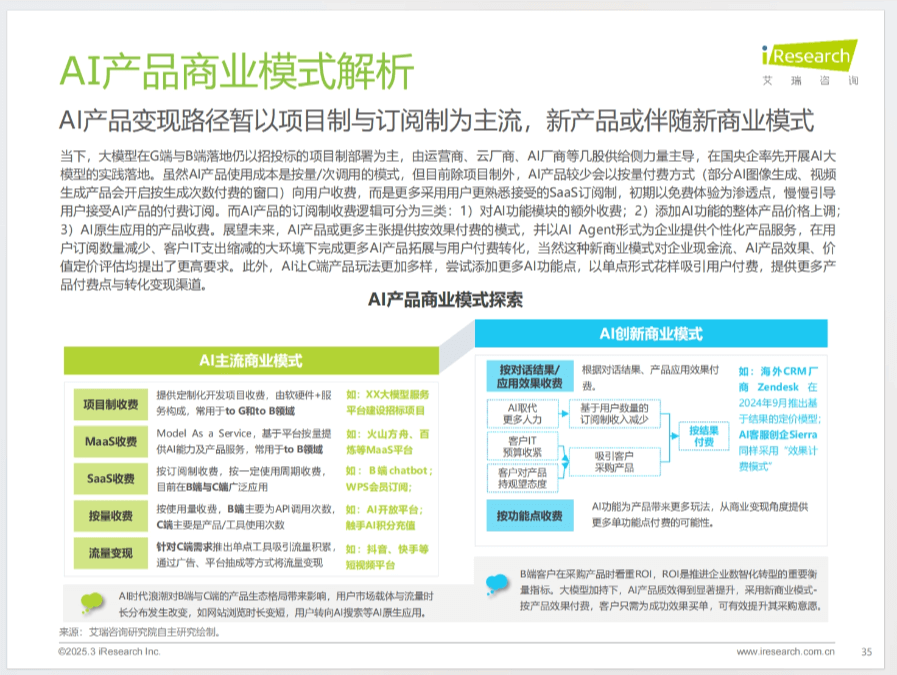
- Analysis of AI product business models: AI product monetization paths currently mainly use project-based and subscription models, and new products may come with new business models.
- Attempts at AI product globalization: Going global has become a key strategy for enterprises to expand markets and revenue, with product directions mainly concentrated in areas such as AI image/video and AI social/emotional companionship.
China's large model industry practice cases
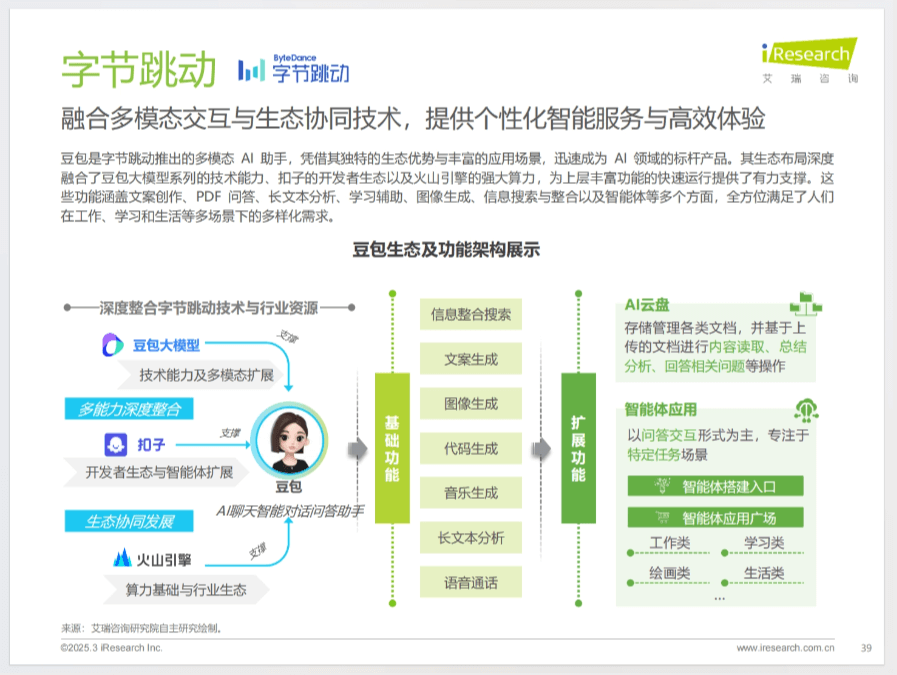
- ByteDance: Provides a one-stop large model and AI-native application development and service platform for enterprises, with a rich variety of top-level applications, integrating multimodal interaction and ecosystem collaboration technologies to deliver personalized intelligent services and an efficient experience.
- Alibaba Mail: Serving millions of enterprises, a leading domestic enterprise email product, integrating AI into segmented scenarios, with automation capabilities bringing out the business value of email.
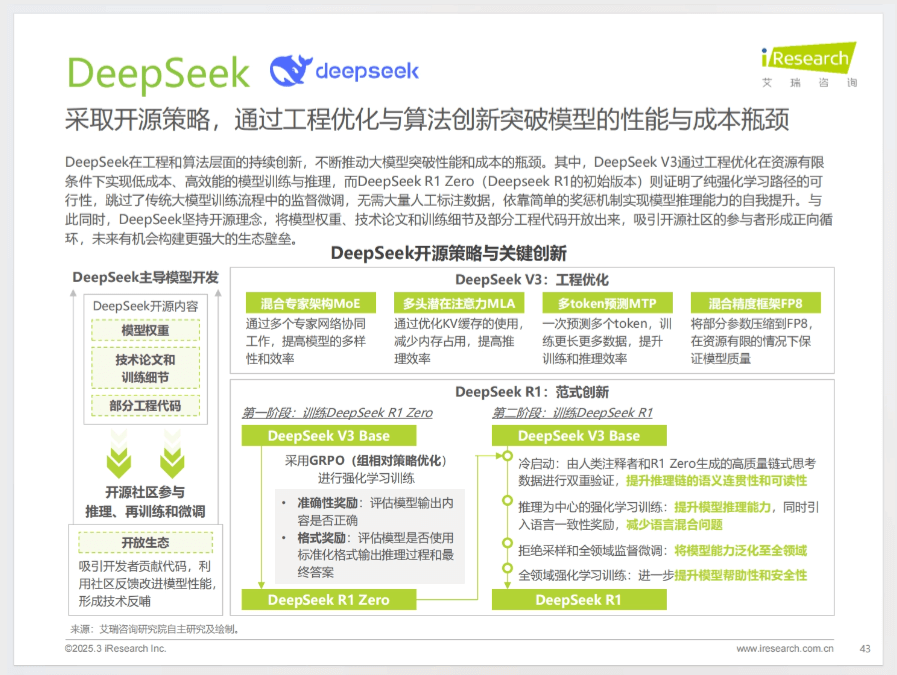
- DeepSeek: Focused on research and development of underlying large model technologies, its general models and reasoning models have reached industry-leading levels, adopting an open-source strategy, and breaking through the performance and cost bottlenecks of models based on engineering optimization and algorithmic innovation.
Development Trends of China's Large Model Industry
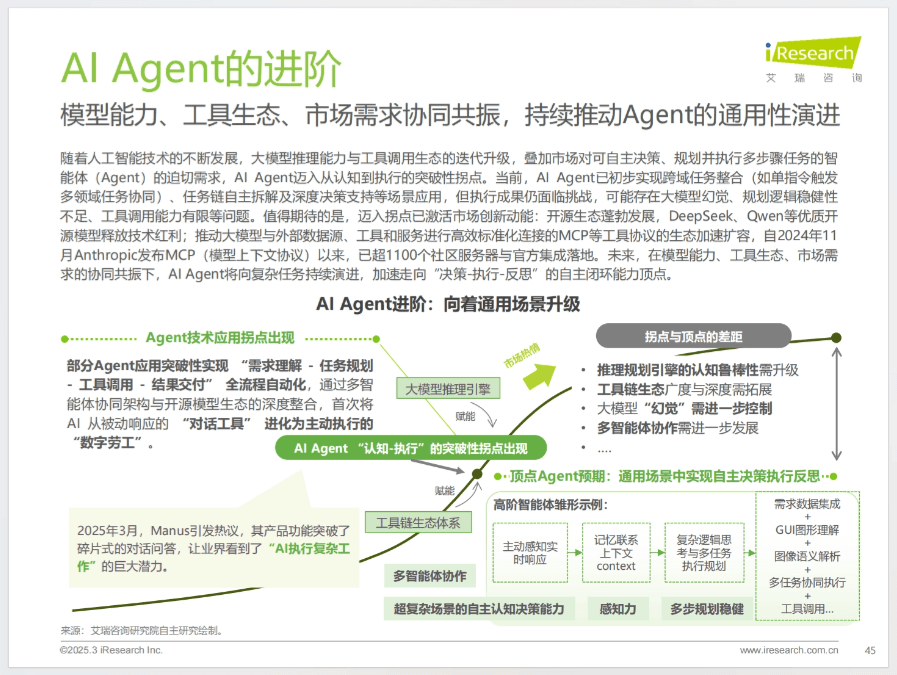
- The Advancement of AI Agents: Model capabilities, tool ecosystems, and market demand resonate in synergy, continuously driving the evolution of Agent generality, continuously evolving toward complex tasks, and accelerating toward the pinnacle of autonomous closed-loop capabilities of "decision-making-execution-reflection."
- The Evolution of Physical AI: As a bridge integrating digital intelligence and the physical world, Physical AI is becoming the next competitive high ground for AI, and needs to address a series of challenges such as hardware acceleration and software optimization, and cross-industry ecosystem collaboration.
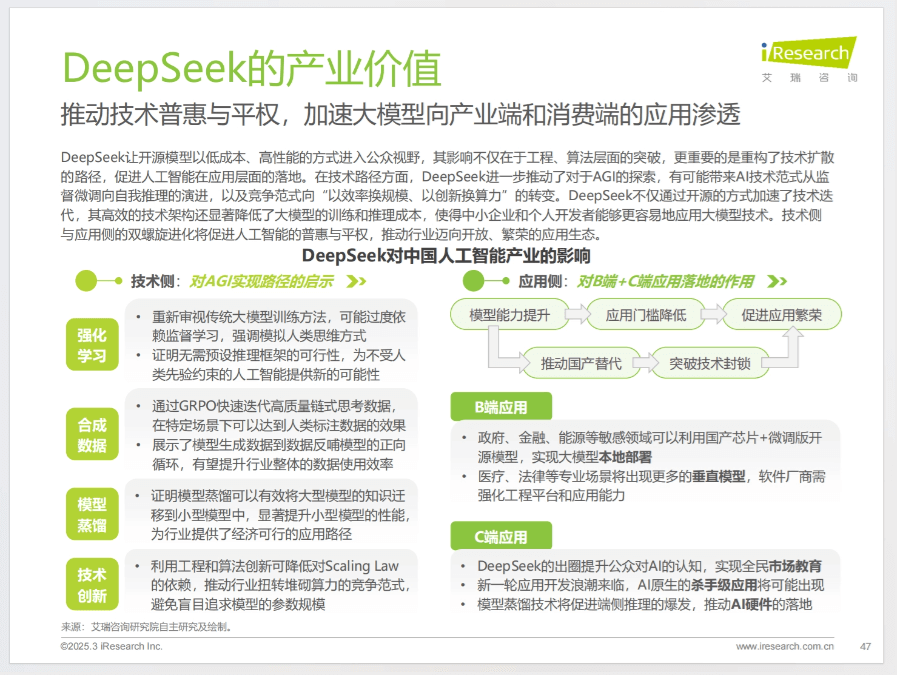
- The Industrial Value of DeepSeek: Promoting technology inclusiveness and equity, accelerating the penetration of large models into industrial and consumer applications, reconstructing the path of technology diffusion, and promoting the implementation of artificial intelligence at the application level.
- The Construction of an AI Security Governance System: Security is the red line for industrial development, and it is necessary to build a governance framework for the new generation of artificial intelligence, coordinating efforts across multiple levels including technology, business, law, and ethics, to ensure the safe development of artificial intelligence.
Obtainthe original PDF file of the "2024 China Artificial Intelligence Industry Research Report", scan the QR code to follow and reply: 20250328