
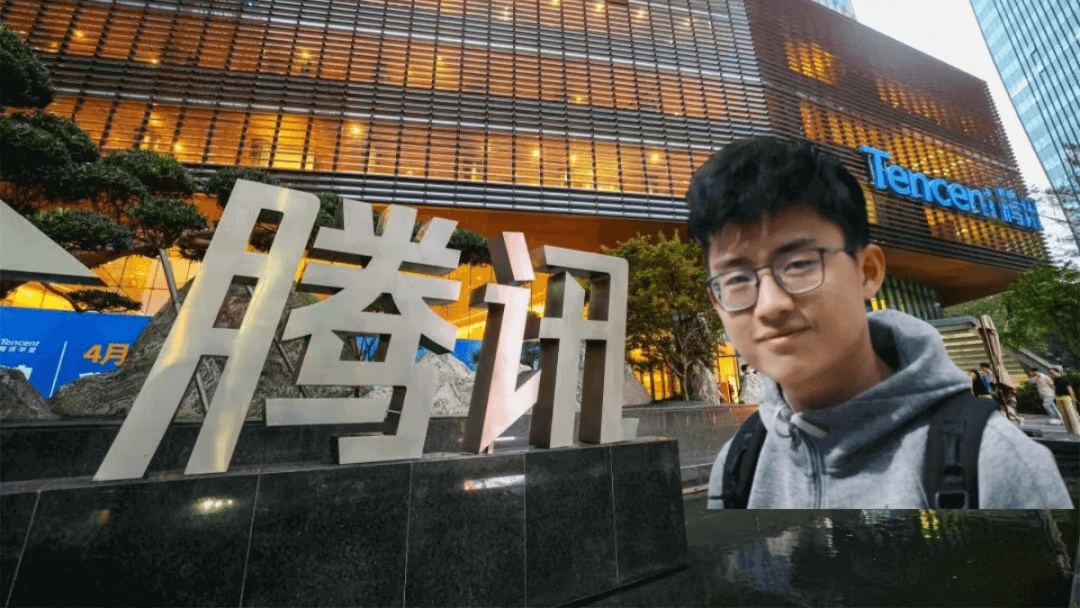
From the PC internet to the mobile internet, Tencent secured its position with two tickets: QQ and WeChat. However, as artificial intelligence (AI) gradually becomes the core variable of the next technological cycle, even Tencent, with its vast social empire and gaming cash flow, is beginning to face unprecedented challenges.
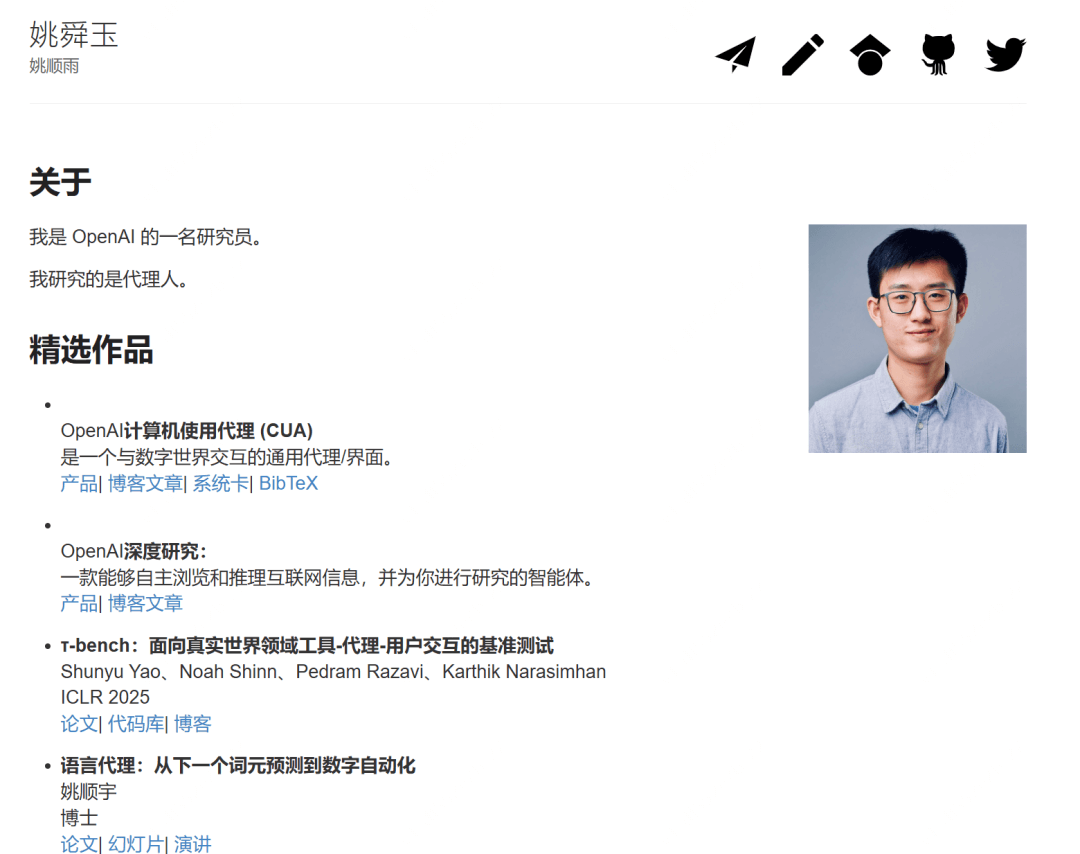
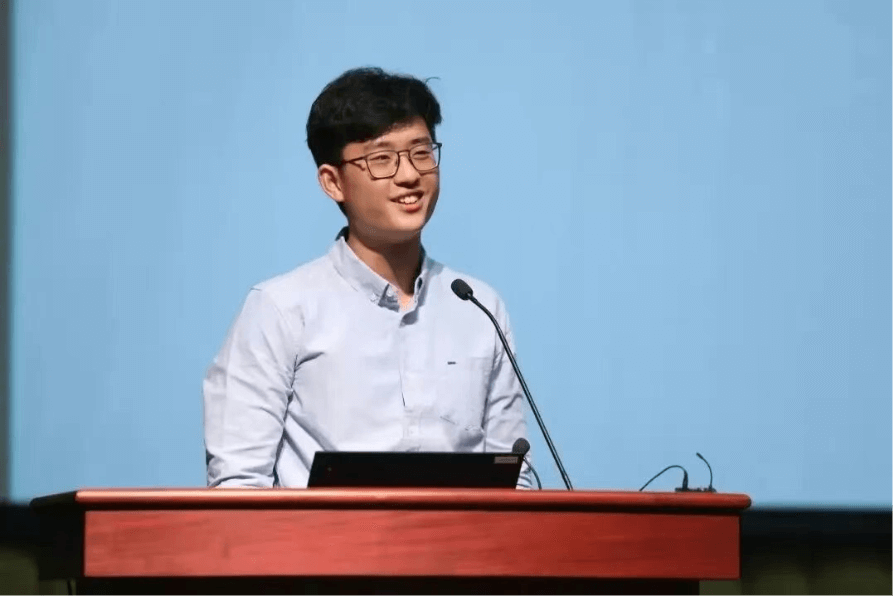
Just when the industry widely believed that Tencent was adopting a 'follow-the-leader strategy' in the 'battle of a hundred models' and proceeding at a somewhat steady pace, a blockbuster piece of news exploded in the AI community: former OpenAI core technical member Yao Shunyu has officially joined Tencent as Chief AI Scientist, taking full charge of the technical development and strategic planning of Tencent's AI large models.
This is not merely a simple personnel change; it is a key move by Tencent in the AI field, and more broadly, a microcosm of Chinese internet giants competing globally for top AI talent against the backdrop of China-US technological rivalry.
Who is Yao Shunyu? Why is Tencent willing to spend heavily to bring him on board?
How will Yao Shunyu's arrival steer the course of this trillion-dollar giant?

01. Why Yao Shunyu?
Before analyzing the significance of Yao Shunyu joining, we need to first understand the 'talent profile' he represents and Tencent's current technical pain points.
1. The Return and Scarcity of Silicon Valley AI Talent
Yao Shunyu represents the most scarce resource in the current global AI field: an architect with hands-on experience in Scaling Law.
Before OpenAI set off a global explosion, the AI field focused more on algorithm optimization for specific tasks (such as facial recognition and recommendation algorithms). The success of the GPT series proved the feasibility of 'brute force yields miracles'—when the number of parameters, data volume, and computing power reach a certain threshold, models exhibit Emergent Abilities.
His research and practice in recent years have long surpassed single-model optimization at their core. He is more like a 'product philosopher' deeply involved on the front lines, thinking abouthow to find long-term sustainable applications for AI。
He proposed the thesis of AI's 'first and second halves.' In his view, the 'first half,' represented by Transformer and the GPT series, will see the industry gap become increasingly smaller.
Yao Shunyu joining Tencent with OpenAI's technical DNA means Tencent directly obtains the 'map' to the core path toward AGI (Artificial General Intelligence).For Tencent, it means acquiring a proven methodology and technological vision.
2. Tencent's Slowness and Urgency
Tencent's layout in the AI field was not late. As early as 2016, Tencent established AI Lab and possesses multiple top-tier teams such as YouTu Lab and WeChat AI. However, in the first wave after the release ofChatGPT, compared with Baidu's ERNIE Bot and Alibaba's Tongyi Qianwen, Tencent's 'Hunyuan' large model appeared particularly low-key and somewhat late.
This 'slowness' stems partly from Tencent's product philosophy of 'striking only after the enemy has shown his hand'—not rushing to release half-finished products and emphasizing product usability and ecosystem integration. On the other hand, it also exposed the problems of scattered AI forces within Tencent and the lack of a unified technical foundation.
Tencent only officially released in September 2023Hunyuan Large Model, and although it performs well in the Chinese context, there is still a gap compared with world-class levels such as GPT-4 in multimodal capabilities, reasoning cost control, and cutting-edge exploration.
Tencent urgently needs a technical leader who can command the overall situation and possesses an international perspective, to integrate the scattered computing power under the internal horse racing mechanism, break down departmental walls, and build a unified, powerful AI foundation with the ability to continuously evolve. Yao Shunyu is precisely the chosen "wall breaker."
02. Horse racing, or brute force creates miracles?
To understand Yao Shunyu's mission, one must first see clearly Tencent's AI chessboard. For Tencent, AI is no longer a tool that adds brilliance to something already good, but a genetic mutation that concerns survival.
Tencent's strategic core has always revolved around "connection."
PC era: connecting people to people (QQ).
Mobile era: connecting people to services (WeChat).
Industrial internet era: connecting enterprises to digitalization (Tencent Cloud).
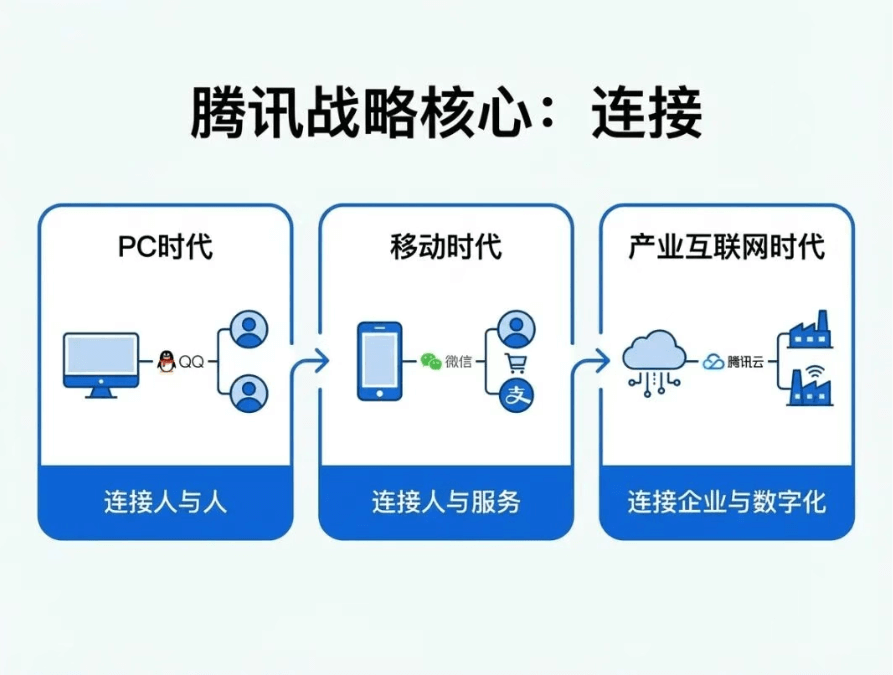
In the AI era, the essence of connection has changed. AI is no longer merely a pipe for connection, but has become the brain of connection.
Tencent has always emphasized "Tech for Good" and "user value." In the new strategic cycle,AI is regarded as the core driving force for improving user experience and empowering industrial upgrading。
Currently, Tencent's AI layout presents a dual-wheel drive model of "basic research + business implementation":
Basic research layer
Tencent AI Lab: focuses on machine learning, computer vision, speech recognition, andNLPbasic research.
Tencent YouTu Lab: strong in computer vision technology, widely used in healthcare, security, and other fields.
WeChat AI: focuses on speech and text intelligence within the WeChat ecosystem.
Technology foundation layer
Tencent Hunyuan large model: it is Tencent's current strategic focus. As a full-chain self-developed general large model, Hunyuan carries all of Tencent's hopes in the AGI era. It must not only serve Tencent's internal businesses, but also export capabilities externally through Tencent Cloud.
Business application layer
C-end (consumer internet): intelligent upgrading of products such as WeChat, QQ, Tencent Video, and Tencent News.
B-end (industrial internet): AI assistantization of Tencent Meeting, Tencent Docs, and WeCom, as well as solutions for vertical industries such as finance, healthcare, and industry.
Tencent's famous "horse racing mechanism" created WeChat and Honor of Kings in the mobile internet era, but in the era of AI large models, this mechanism may become an obstacle.
Large model training requires the concentration of extremely massive computing power and data resources. If each BG (business group) fights separately and reinvents the wheel, it will not only cause resource waste, but also lead to scattered computing power, making it impossible to train truly top-tier models.
Yao Shunyu's first task after joining is very likely to be "reducing vassal powers" and "centralizing power"—unifying standards at the technical level,concentrating the entire company's computing resources (GPU clusters) and high-quality data, focusing on one core foundation model, and then adapting it to different business scenarios through technologies such as distillation and pruning. This requires extremely high political wisdom and technical prestige.
03. Tencent's anxiety
Why is Tencent so anxious? Because AI is reconstructing the three pillars on which Tencent depends for survival: social networking, gaming, and content.
Reconstruction of social networking: when WeChat meetsAI Agent
WeChat is Tencent's moat, with more than 1.3 billion monthly active users. But in the AI era, the traditional "chat box + menu" interaction model is being challenged.
Imagine that in the future WeChat will no longer be just a communication tool, but a super AI Agent.
You don't need to switch between Meituan, Didi, and Ctrip apps; you just need to say to WeChat AI: “Help me book a flight to Shanghai for tomorrow, set an alarm, and check the local weather by the way.”
WeChat Official Accounts are no longer static articles, but a conversational knowledge base.
Moments are no longer just images and text, but AI-generated personalized videos.
If Tencent cannot take the lead in achieving this transformation, once a newAI Nativesocial product (such as an evolved version of Character.ai) emerges, WeChat's position as a traffic gateway will face a dimensional strike.
The gaming revolution: AIGC and the awakening of NPCs
Games are Tencent's “cash cow.” They contribute a large portion of Tencent's revenue.
AI's changes to gaming are disruptive:
- Cost reduction and efficiency improvement: Using technologies such as Midjourney and Stable Diffusion to generate concept art and 3D models can reduce art costs by more than 50%.
- Experience upgrade: Traditional NPCs (non-player characters) only recite lines according to scripts. With the support of large models, NPCs can have memory, personality, and emotions, and even engage in dynamic plot interactions with players.
- Gameplay innovation: UGC (user-generated content) will evolve into AIGC, and players can create game levels or even entire game worlds through simple instructions.
Tencent hasHonor of Kings, Game for Peace, and other national-level games. If it can take the lead in deeply embedding AI technology, it will greatly extend the game lifecycle and build an extremely high competitive barrier.
Cloud-driven: the new engine of the industrial internet
In the B-end market, Tencent Cloud is facing fierce competition from Alibaba Cloud and Volcano Engine.
MaaS (Model as a Service) is becoming the new standard for cloud services. Enterprise customers no longer buy only servers and bandwidth, but buy “intelligence.”
Relying on the Hunyuan large model, Tencent Cloud is building an “industry large model store.” In high-frequency scenarios such as code generation, data analysis, and intelligent customer service, it is narrowing the gap with the world's top cloud vendors.
04. The chess match: Tencent vs Alibaba and ByteDance
For Tencent, Yao Shunyu is not only a technical executive, but also a strategic symbol.
In the deep waters of AI, direction is more important than effort.
The reason OpenAI leads is that they chose correctly at every key fork in the road. As someone who experienced it firsthand, Yao Shunyu's intuition and judgment will help Tencent avoid detours.
Yao Shunyu's joining sends a strong signal to global AI talent: Tencent is serious, and it is determined to build world-class AI.
In China's technology landscape, the AI war among BAT has never stopped.
Tencent's AI capital expenditure in the fourth quarter of 2024 reached 39 billion yuan, but in the third quarter of 2025 capital expenditure fell 24% year-on-year and 32% quarter-on-quarter, indicating that it is relatively conservative in AI technology investment. Although Tencent places more emphasis on integrating AI capabilities with its existing ecosystem (such as WeChat), its underlying large model research and development lags relatively behind, relying more on external technologies (such as DeepSeek). Its market share in the AI cloud services market is relatively low (7%), mainly relying on the C-end ecosystem (such as WeChat) and AI applications in its gaming business.
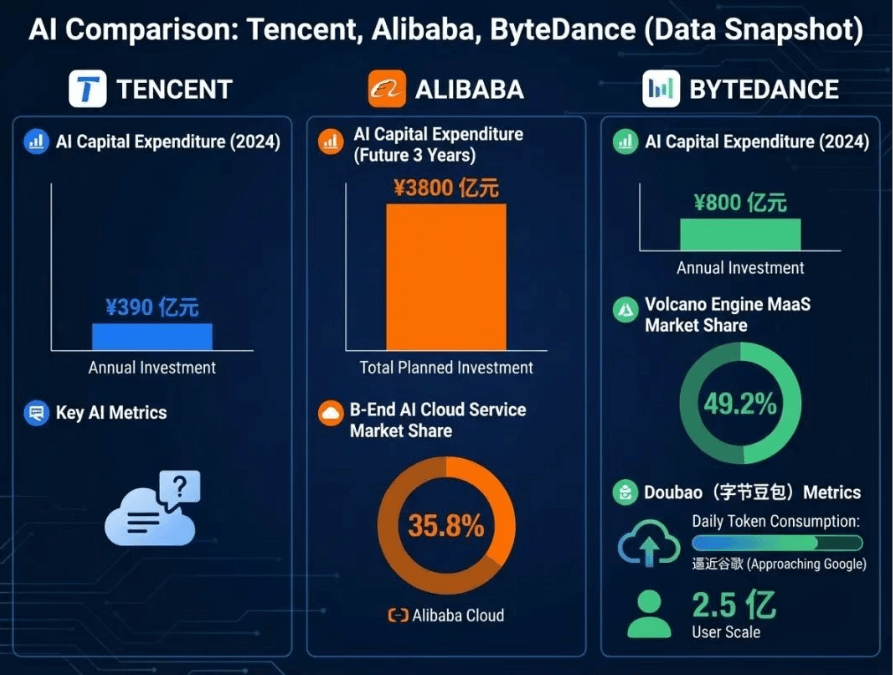
Alibaba plans to invest 380 billion yuan over the next three years to build cloud and AI infrastructure, covering chips, large models, cloud computing and other fields, with a focus on e-commerce, cloud services and enterprise applications. It leads the To B AI cloud services market with a 35.8% share, while Volcano Engine holds 49.2% of the MaaS market. Alibaba's Tongyi Qianwen is backed by Alibaba Cloud and emphasizes B-side empowerment and integration with e-commerce scenarios.
Tencent VS Alibaba: The competition between the two is mainly in the cloud. Tencent's advantage lies in its SaaS ecosystem (Tencent Meeting, WeCom), which gives it a natural entry point when deploying large models in B-side office scenarios.
ByteDance invested about 80 billion yuan in AI in 2024. With the traffic advantage of 30 trillion tokens per day and its "App Factory" model, it rapidly iterates products (such as Doubao and Jimeng AI). Its daily token calls are close to Google's level.
Although it was relatively late in releasing large models, its recommendation algorithm genes are strikingly similar to those of large AI models. Products such as Doubao are growing rapidly in C-side applications.
Tencent VS ByteDance: It is a contest for traffic and time. ByteDance excels at using AI-generated content (Douyin, TikTok) to capture users' time. Tencent must use AI to improve content production efficiency and social stickiness, and hold its traffic base.
The competition among Tencent, Alibaba and ByteDance involves both zero-sum games (such as market competition) and ecosystem complementarity (such as cloud services and AI applications).
05. The Elephant Dances, the Future Has Come
Yao Shunyu joining Tencent is a key move at the right time, aimed at core issues.
Tencent's AI strategy has shifted from "scattered following" to "concentrated assault," and from a "model scale" race to the ultimate battlefield of "agent applications" and "reliability." He shoulders the arduous mission of integrating internal resources, unifying the technology foundation, conquering the frontiers of agents, and deeply empowering core businesses such as WeChat, gaming and cloud with AI capabilities.
Whether it can succeed depends on whether Yao Shunyu can translate his technical vision into Tencent's massive organizational execution power. It also depends on whether Tencent can give him enough strategic patience and resource support, and even more on Tencent's courage to reform itself.
This battle has only just begun. It is hoped that Tencent, this massive penguin, can learn to fly in the hurricane of AI.
The future has come, and what is coming has already arrived.
Original link:27-year-old Yao Shunyu takes the helm of the AI banner, preparing to build another "Tencent"