
What is Academic Research Skills
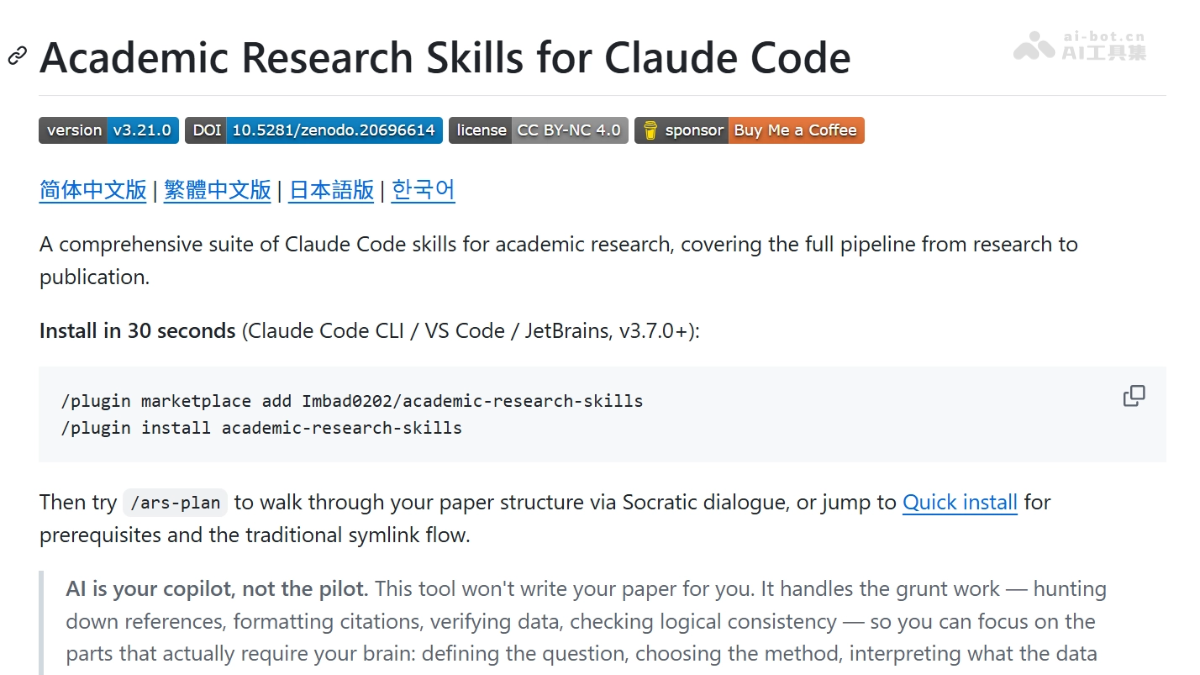
Academic Research Skills is an open-source academic skills plugin developed by Cheng-I Wu for Claude Code , covering the entire process from topic research, paper writing, and peer review to revision and finalization. The plugin collaborates through 39+ professional agents, providing features such as citation traceability verification, Socratic research guidance, anti-hallucination verification, and experiment provenance registration. The core goal of Academic Research Skills is to help researchers transform fragmented information into a complete paper that meets academic standards.
Main Features of Academic Research Skills
-
Deep Research: 13 agents collaborate to complete literature retrieval, PRISMA systematic review, and Socratic research guidance, helping you distill falsifiable research questions from fragmented information.
-
Paper Writing: 12 agents cover outline, abstract, review, revision, and final draft, supporting style calibration and bilingual abstract generation.
-
Peer Review: 7 agents simulate journal reviewers + devil's advocate, conducting evidence-anchored narrative evaluation of the paper from multiple dimensions.
-
Pipeline Orchestration: A 10-stage full-process orchestrator that sets mandatory quality gates at key nodes, ensuring each step advances only after user confirmation.
-
Citation Traceability Verification: Cross-verifies each citation through the quadruple indexes of Semantic Scholar, OpenAlex, Crossref, and arXiv, and adds a three-layer anchor audit for claim fidelity.
-
Experiment Provenance Registration: Registers reproduction locks, negative results, and known limitations of external experiments in the Material Passport, auditing the alignment between paper claims and experimental evidence.
-
Anti-Hallucination and Anti-Sycophancy: Built-in devil's advocate concession threshold protocol and intent detection layer prevent the AI from converging prematurely or compromising without principle when you insist.
-
Cross-Model Verification: Supports invoking a second model family to independently perform review and quality checks, reducing the systematic cognitive blind spots of a single model.
-
Multi-Format Delivery: One-click output of Markdown, DOCX, LaTeX (APA 7.0 / IEEE / Chicago) and compilation to PDF.

Follow WeChat and reply "open source" to joinAI Open-Source Project Communication Group
How to Use Academic Research Skills
-
Installation: Execute in Claude Code
/plugin marketplace add Imbad0202/academic-research-skillsfor one-click installation. -
Topic Planning: Run
/ars-plan, and sort out the research questions and chapter structure through Socratic dialogue. -
Literature Research: Use Deep Research's
fullorsystematic-reviewmode to retrieve and systematically organize literature. -
Experiment Registration(if involved): Register reproduction locks and negative results of external experiments in the Material Passport.
-
Paper Writing: Invoke Academic Paper's
fullmode, and 12 agents complete the outline to first draft according to the pipeline. -
Midterm Quality Check: Through the mandatory quality gate at Stage 2.5, cross-verify citation existence and logical consistency.
-
Peer Review: Use Academic Paper Reviewer's
fullMode launches a 5-person virtual review panel for multi-dimensional review. -
Revision Response: Revise according to review comments, and generate an R&R traceability matrix to respond item by item.
-
Final Quality Check: Audit the alignment between claims and experimental evidence again through Stage 4.5, confirming zero regression.
-
Final Delivery: Choose APA/IEEE/Chicago format to output LaTeX/PDF, and generate a 6-dimensional collaborative quality assessment report.
Core advantages of Academic Research Skills
-
Full-process closed loop: Covers the complete academic pipeline from topic selection, research, writing, review, and revision to submission, with no need to switch between multiple tools.
-
Human-AI collaboration design: Adheres to the "AI is a co-pilot" philosophy, requiring user confirmation at every key node to avoid academic misconduct caused by AI ghostwriting.
-
Traceable citations: Cross-verifies through the fourfold indexing of Semantic Scholar, OpenAlex, Crossref, and arXiv, and adds three-layer anchor auditing of claim fidelity to eliminate hallucinated citations.
-
Auditable experiments: Supports external experiment traceability registration, automatically audits the alignment between paper claims and experimental evidence, and prevents ablations that were not performed from being written into the main text.
-
Anti-sycophancy mechanism: The devil's advocate adopts a concession threshold protocol to prevent the AI from compromising without principle when the user insists, ensuring the rigor of the research design.
-
Cross-model validation: Supports independent review and quality check by a second model family, reducing the risk of systematic cognitive blind spots and framework lock-in from a single model.
Project address of Academic Research Skills
- GitHub repository:https://github.com/Imbad0202/academic-research-skills
Application scenarios of Academic Research Skills
-
Computer empirical research: Starting from the vague observation that "the model performs better," split it into falsifiable hypotheses and ablation experiment designs, and after writing in IMRaD structure, intercept citation hallucinations and statistical errors at the quality check gate.
-
Systematic literature review: Execute search, inclusion and exclusion, risk of bias assessment, and compliant report generation according to the PRISMA protocol, directly outputting a review or meta-analysis paper that meets academic standards.
-
Paper revision and review response: Parse review comments to generate a revision roadmap, and use
rebuttal-auditto verify item by item whether the response covers all concerns, preventing omission of key baseline comparisons. -
Interdisciplinary topic exploration: When the research direction is not yet clear, use exploratory Socratic dialogue to prevent the AI from converging too early, helping distill research questions with theoretical contributions from fragmented information.
-
Academic writing teaching: Embed the 10-stage pipeline into the course, allowing students' first drafts to be reviewed by a virtual 5-person review panel, and then conduct classroom revision workshops based on structured review reports.