
What is ZeroSearch
ZeroSearch is an innovative large model search engine framework open-sourced by Alibaba Tongyi Lab, which incentivizes the search capabilities of large models based on reinforcement learning, without the need to interact with real search engines. The framework is based on the pretrained knowledge of large models, transformed into a retrieval module, generating relevant or noisy documents according to queries, and dynamically controlling the generation quality. On multiple question-answering datasets, ZeroSearch's performance exceeds Google Search, greatly reducing training costs (by more than 80%). Based on lightweight supervised fine-tuning and a curriculum learning mechanism, ZeroSearch gradually improves the model's reasoning ability, supports multiple reinforcement learning algorithms, and has strong scalability and generality.
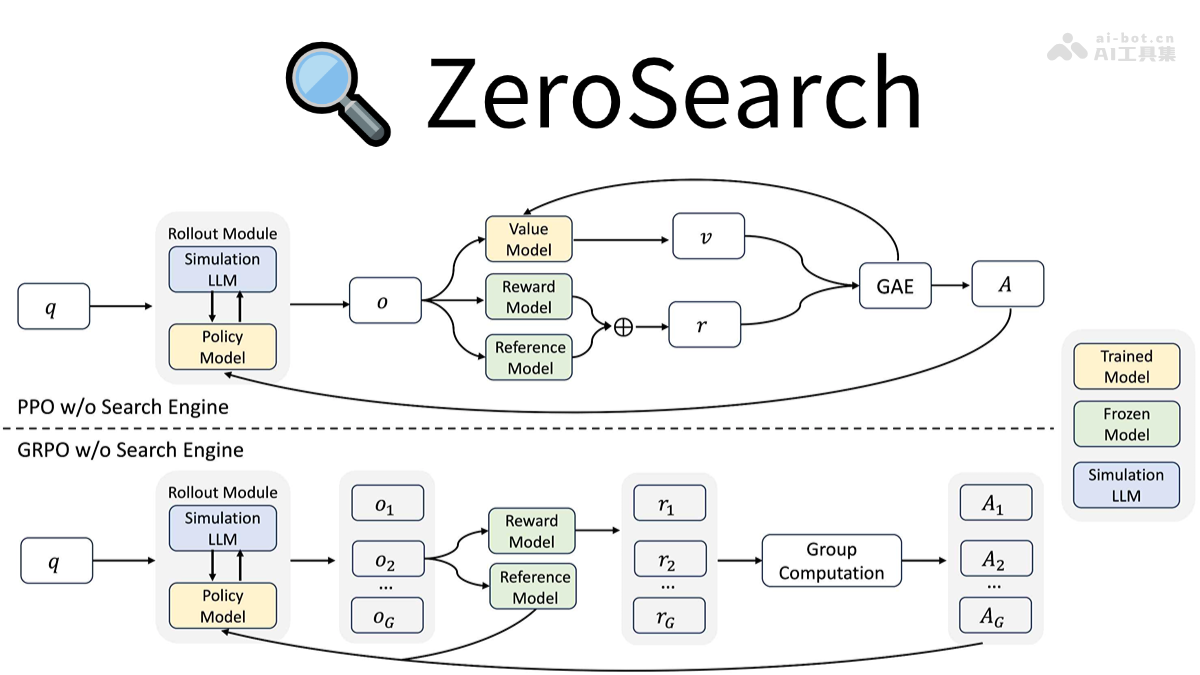
ZeroSearch's Main Features
- No need for real search engine interaction: Simulates the way search engines work, incentivizes the search capabilities of large models, avoids interaction with real search engines (such as Google), and reduces costs and uncontrollability.
- Dynamic control of document quality: Supports the generation of relevant or noisy documents, and based on adjusting keywords in prompts, flexibly controls the quality of generated documents, providing diverse retrieval scenarios for training.
- Reduce costs: Compared with using real search engines for reinforcement learning training, ZeroSearch's training cost is greatly reduced (by more than 80%), making large-scale training more feasible.
- Support multiple models and algorithms: Compatible with large models of different parameter scales (such as 3B, 7B, 14B), and supports multiple reinforcement learning algorithms (such as PPO, GRPO).
ZeroSearch's Technical Principles
- Simulated search engine: Based on the large model's own knowledge, it is transformed into a simulated search engine, generating relevant or noisy documents according to queries, replacing real search engines.
- Lightweight supervised fine-tuning: Fine-tunes the large model based on a small amount of labeled data to generate high-quality or low-quality documents, adapting to different training needs.
- Curriculum learning mechanism: Gradually increases the noise level of documents during training, allowing the model to start from simple scenarios and gradually adapt to more challenging tasks, improving reasoning ability.
- Reward mechanism based on F1 score: Uses the F1 score as the reward signal, focusing on the accuracy of answers and ensuring that the answers generated by the model match the true answers as closely as possible.
- Multi-turn interaction template: Designs clear reasoning, search, and answer stages, and guides the model to complete tasks step by step based on structured tags (such as <think>, <search>, <answer>).
ZeroSearch's Project Address
- Project official website:https://alibaba-nlp.github.io/ZeroSearch/
- GitHub repository:https://github.com/Alibaba-nlp/ZeroSearch
- HuggingFace model library:https://huggingface.co/collections/sunhaonlp/zerosearch
- arXiv technical paper:https://arxiv.org/pdf/2505.04588
ZeroSearch's Application Scenarios
- Intelligent question-answering system: Quickly and accurately answers user questions, suitable for intelligent customer service and intelligent assistants.
- Content creation: Helps creators obtain information, generate first drafts, or provide inspiration, suitable for news, copywriting, and academic writing.
- Education and learning: Provides students with instant answers, supporting online education and intelligent tutoring.
- Enterprise knowledge management: Helps employees quickly retrieve internal company resources and improve work efficiency.
- Research and development: Provides researchers with the latest research results and accelerates the research process.