
What Is Z-Image
Z-Image is an image generation model launched by Alibaba Tongyiimage generationmodel with 6B parameters. The model includes three variants: Z-Image-Turbo, Z-Image-Base, and Z-Image-Edit, which excel in fast inference, base development, and image editing, respectively. The model adopts a single-stream DiT architecture, supports bilingual text rendering, and can generate or edit high-quality images based on natural language instructions. Through decoupled DMD and DMDR technologies, Z-Image performs excellently in performance and generation quality, making it suitable for a variety of creative applications.
The Z-Image base model is now officially open-sourced, with a model size of 6B, built specifically for high-quality creation and the developer ecosystem. The base model natively supports CFG guidance and fine-tuning mechanisms such as LoRA and ControlNet, giving creators deep controllability over image details while maintaining generation diversity.
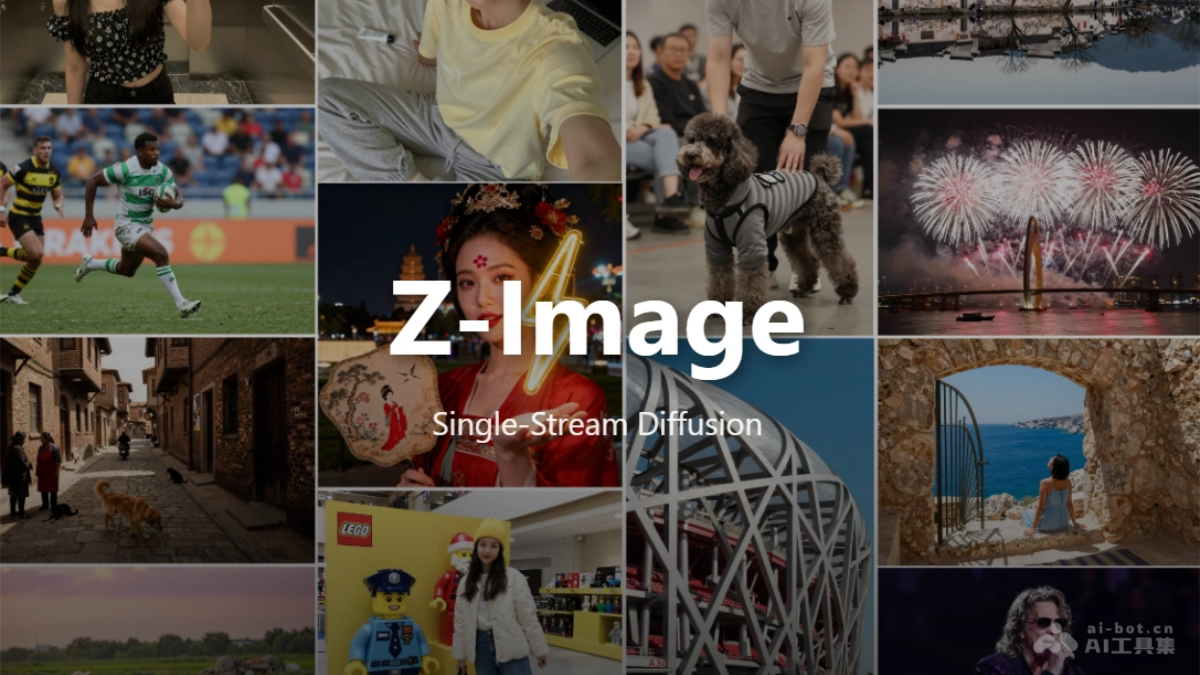
Main Features of Z-Image
-
Efficient Image Generation: Z-Image can quickly generate high-quality realistic images, suitable for a variety of scenarios such as creative design, artistic creation, and virtual content generation.
-
Bilingual Text Rendering: Supports Chinese and English text rendering, and can accurately generate images containing complex textual content, suitable for image generation tasks in multilingual environments.
-
Creative Image Editing: Through the Z-Image-Edit variant, users can precisely edit images based on natural language instructions, enabling creative transformations and style adjustments.
-
Low-Resource Adaptation: The Z-Image-Turbo version optimizes inference efficiency and can run quickly on low-resource devices such as consumer-grade GPUs, making it suitable for enterprise-level and consumer-level application scenarios.
-
Community-Driven Development: Provides a base model (Z-Image-Base) to facilitate developers in fine-tuning and custom development, meeting diverse needs.
Technical Principles of Z-Image
-
Single-Stream Diffusion Transformer Architecture (S3-DiT): Z-Image uses a single-stream diffusion transformer architecture, connecting text, visual semantic tokens, and image VAE tokens at the sequence level to form a unified input stream. Compared with dual-stream methods, this significantly improves parameter efficiency and reduces computational cost.
-
Decoupled DMD (Distribution Matching Distillation): Through decoupled DMD technology, the CFG augmentation (CA) and distribution matching (DM) mechanisms are separated and optimized, significantly improving the performance of few-step generation and achieving efficient image generation.
-
DMDR (DMD + Reinforcement Learning): Combining reinforcement learning (RL) and distribution matching distillation (DMD) further improves semantic alignment, aesthetic quality, and structural coherence, generating higher-quality images.
-
Optimized Inference Performance: Supports technologies such as Flash Attention and model compilation, further accelerating the inference process, reducing latency, and improving the model's efficiency in practical applications.
-
Multilingual Understanding and Generation: Through multimodal pretraining and fine-tuning, Z-Image can understand and generate image content containing Chinese and English, supporting cross-language image generation tasks.
Project Address of Z-Image
- Project Official Website:https://tongyi-mai.github.io/Z-Image-blog/
- GitHub Repository:https://github.com/Tongyi-MAI/Z-Image
- HuggingFace Model Library:
- https://huggingface.co/Tongyi-MAI/Z-Image-Turbo
- https://huggingface.co/Tongyi-MAI/Z-Image
Application Scenarios of Z-Image
-
Art Galleries: Artists can use Z-Image to generate unique artworks and explore different styles and themes.
-
Advertising Material Generation: Quickly generate high-quality advertising images for social media, posters, banners, etc.
-
Film and television special effects: The model can generate virtual scenes, characters, or special effect elements to assist film and television production.
-
Game development: The model quickly generates characters, scenes, and props in games, accelerating the game development process.
-
Teaching materials: Generate images related to teaching content, such as historical scenes, scientific phenomena, etc., to enhance teaching effectiveness.