
What is Xiaomi-Robotics-U0
Xiaomi-Robotics-U0 is a 38-billion-parameter unified embodied synthesis model launched by Xiaomi. Based on continuous training of a world foundation model, it jointly optimizes five major tasks: text-to-image generation, image editing, embodied scene generation, embodied transfer, and embodied video generation. Xiaomi-Robotics-U0 is the first model to support high-quality multi-view scene generation across multiple robot embodiments. It surpasses GPT-Image-2.0 in human evaluations of embodied scene generation and transfer, ranks first on the World Arena embodied video generation leaderboard, and improves π0.5's out-of-distribution success rate on real-world manipulation tasks from 36.9% to 63.2%.
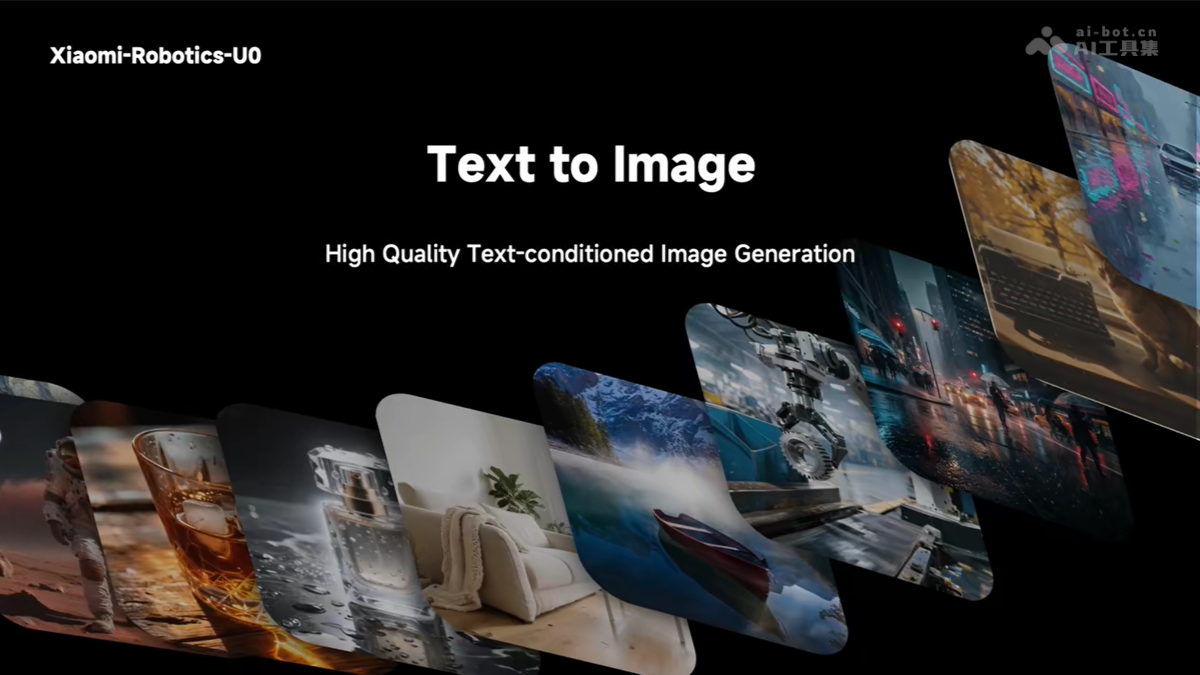
Main Features of Xiaomi-Robotics-U0
-
Text-to-Image Generation: Supports high-quality text-to-image synthesis, preserving the visual knowledge of the foundation world model.
-
Image Editing: Supports Any-to-Image editing, including fine-grained operations such as camera control, temporal control, and structure extraction.
-
Embodied Scene Generation: Generates multi-view consistent initial observation frames based on robot embodiment and scene descriptions.
-
Embodied Transfer: Achieves structured and controllable transfer across scenes while maintaining multi-view consistency and interaction dynamics.
-
Embodied Video Generation: Supports zero-shot multi-view embodied video generation, synthesizing static scenes into temporally coherent manipulation videos.
Technical Principles of Xiaomi-Robotics-U0
-
Unified Autoregressive Framework: Initialized based on EMU3.5, it uses an IBQ Tokenizer for 16×16 spatial compression, unifying all modalities into a discrete vocabulary for next-token prediction.
-
Joint Continual Training: Conducts continual training with a unified autoregressive objective on general-domain and embodied datasets, avoiding the loss of generalization caused by using limited robot data.
-
FlashAR+ Inference Acceleration: Introduces a vertical prediction head with anti-diagonal parallel decoding, combined with vLLM optimization, accelerating 1024×1024 resolution image generation by 82.9×.
-
Structured Control Decomposition: Decouples scenes into five independent control dimensions: workspace, task objects, irrelevant objects, lighting, and background, supporting scalable embodied video enhancement.
-
Subtask-Subgoal Interleaved Learning: Uses HDBSCAN clustering to decompose robot trajectories into subtasks and generate interleaved image-text sequences, capturing long-horizon task progress and fine-grained interaction dynamics.

Follow WeChat and reply “Open Source” to join theAI Open Source Project Exchange Group
How to Use Xiaomi-Robotics-U0
- Environment Setup: Visit the Xiaomi Robotics official website to download model weights and inference code, and configure a high-performance GPU environment that supports CUDA and vLLM.
- Model Loading: Initialize based on the EMU3.5 architecture and load the 38-billion-parameter checkpoint of Xiaomi-Robotics-U0, uniformly calling the IBQ Tokenizer to process multimodal input sequences.
- Text-to-Image Generation: Input a text description and directly generate high-quality 1024×1024 resolution images through standard autoregressive next-token prediction.
- Image Editing: Provide one to three reference images along with text instructions, and the model performs fine-grained editing such as camera control, time control, or structure extraction based on Any-to-Image capabilities.
- Embodied Scene Generation: Input a robot morphology description and structured scene text, and the model outputs an initial observation frame that strictly satisfies multi-view consistency and geometric coherence.
- Embodied Transfer: Given the current multi-view observations and a target scene description, the model generates transferred multi-view RGB images while preserving interaction dynamics.
- Embodied Video Generation: Provide an initial observation frame and task instructions, and the model generates 15 to 25 temporally coherent frames of robot manipulation video through autoregressive rollout.
- Inference Acceleration: Enable the FlashAR+ vertical prediction head and vLLM optimization to achieve an 82.9x speedup in image generation at 1024x1024 resolution.
- Data Engine Application: The generated embodied scenes or video sequences are directly fed into downstream robot policy networks to improve out-of-distribution generalization for real-world manipulation tasks.
Core Advantages of Xiaomi-Robotics-U0
-
Unification: The first model to unify base image/video generation and embodied generation within a single framework, avoiding the forgetting of visual knowledge caused by post-training.
-
Multi-view Consistency: Supports high-quality multi-view scene generation across multiple robot morphologies, strictly satisfying geometric coherence and camera calibration constraints.
-
Controllable Transfer: Introduces a structured control mechanism that enables fine-grained editing of dimensions such as workspace, background, and lighting while preserving interaction dynamics.
-
Data Engine Capability: The generated embodied scenes can be directly expanded into temporally coherent manipulation videos, providing scalable synthetic trajectories for downstream policy learning.
-
SOTA Performance: Surpasses GPT-Image-2.0 on embodied scene generation and transfer, and ranks first on World Arena for embodied video generation.
Project Address of Xiaomi-Robotics-U0
- Project Website:https://robotics.xiaomi.com/xiaomi-robotics-u0.html
- HuggingFace Model Repository:https://huggingface.co/collections/XiaomiRobotics/xiaomi-robotics-u0
- arXiv Technical Paper:https://arxiv.org/pdf/2607.11643
Comparison of Xiaomi-Robotics-U0 with Similar Competitors
| Dimension | Xiaomi-Robotics-U0 | π0.5 |
|---|---|---|
| Positioning | Unified embodied synthetic world model, focused on generating controllable data and scenes | End-to-end vision-language-action policy model, focused on directly controlling robots |
| Parameter Scale | 38-billion-parameter autoregressive Transformer | Adopts a VLM backbone + Action Expert hierarchical architecture |
| Core Capabilities | Multi-view scene generation, embodied transfer, video generation, image editing | End-to-end robot control, household generalization task execution |
| Architecture | Initialized based on EMU3.5, unified next-token prediction | Pretrained discrete action tokens, post-trained flow matching to generate continuous actions |
| Data Engine | Can directly generate embodied scenes and videos, improving the out-of-distribution success rate of π0.5 from 36.9% to 63.2% | Does not itself possess data generation capabilities, relies on real-world collection |
| Multi-view Consistency | Natively supports multi-view scene generation and geometrically coherent transfer across multiple robot morphologies | As a single-view policy model, it does not directly handle multi-view synthesis |
| Visual knowledge retention | Jointly train general generation and embodied tasks, VLM benchmarks remain high (ERQA 40.8, SEED 78.6) | VLM benchmark scores are low (ERQA 0.0, SEED 21.5), visual understanding is impaired |
Application scenarios of Xiaomi-Robotics-U0
-
Robot data synthesis: Generate large-scale, diverse synthetic manipulation trajectories for real robot training, addressing the issues of high cost and limited scenarios in real data collection.
-
Cross-embodiment scenario transfer: Transfer the same manipulation task from one robot embodiment (e.g., single-arm) to another (e.g., dual-arm), maintaining scenario consistency.
-
Simulation environment construction: Rapidly generate high-quality multi-view robot manipulation scenarios for simulation platform training and policy validation.
-
Manipulation policy enhancement: Use generated out-of-distribution data to improve the generalization ability of robot policies, e.g., increasing the success rate of π0.5 by 26.3%.
-
Embodied intelligence research: As a world foundation model, support fundamental research such as long-horizon task planning, subtask decomposition, and interactive dynamics prediction.