
What is Xiaomi-Robotics-0
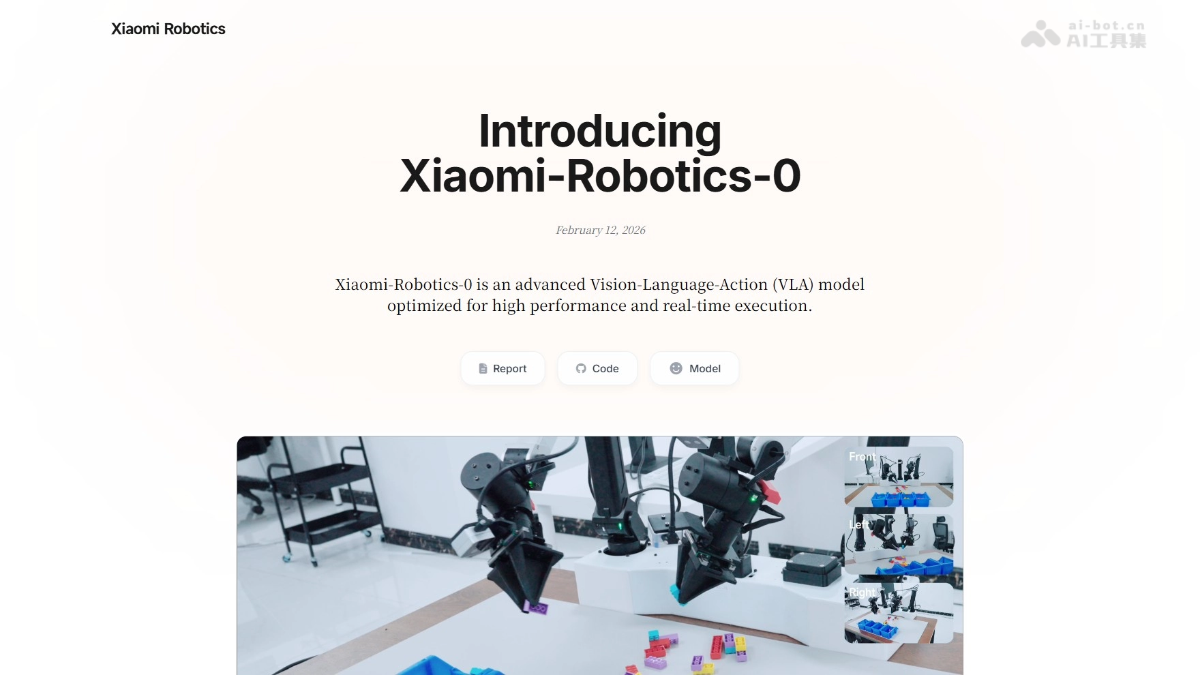
Xiaomi-Robotics-0 is Xiaomi's first-generation open-source robot VLA (Vision-Language-Action) large model, with 4.7 billion parameters, adopting a MoT hybrid architecture,Qwen3-VLA multimodal model acts as the "brain" to understand visual-language instructions, while a Diffusion Transformer acts as the "cerebellum" to generate high-frequency action chunks. It innovatively introduces asynchronous execution and Λ-shape attention masking to solve action stuttering caused by inference latency, achieving real-time smooth control on consumer-grade GPUs. It sets new SOTA on simulation benchmarks such as LIBERO and CALVIN, and has been successfully applied to real-machine dual-arm manipulation tasks such as block disassembly and towel folding.
Main Features of Xiaomi-Robotics-0
-
Natural Language Understanding: The model can parse ambiguous human instructions and identify spatial relationships and manipulation intentions from visual input.
-
Action Generation Control: The model can output high-frequency smooth action sequences to drive the robot to complete precise physical operations.
-
Real-Time Asynchronous Execution: Supports parallel inference and execution, eliminating latency and stuttering, and ensuring coherent and smooth actions.
-
Dual-Arm Collaborative Manipulation: Supports two hands working together to complete complex long-horizon tasks such as block disassembly and towel folding.
-
Adaptive Strategy Adjustment: The model can automatically switch action strategies to respond flexibly when grasping fails or the environment changes.
-
Multimodal Capability Retention: The model retains general understanding capabilities such as visual question answering and object detection, preventing catastrophic forgetting.
Technical Principles of Xiaomi-Robotics-0
-
MoT Hybrid Architecture: Uses the Qwen3-VL-4B multimodal model as the "brain" to process visual-language input, and a Diffusion Transformer as the "cerebellum" responsible for action generation, with a total parameter count of 4.7 billion, balancing general understanding and fine-grained control.
-
Two-Stage Training: In the first stage, the Action Proposal mechanism enables the VLM to learn action distribution alignment feature space, mixing visual-language and robot data to prevent forgetting; in the second stage, the VLM is frozen, and the DiT is specially trained to recover precise action sequences from noise through flow matching.
-
Asynchronous Execution Mechanism: While the robot executes the current action chunk, it performs parallel inference for the next chunk, using the Clean Action Prefix to take the previous moment's action as an input condition, ensuring temporal continuity of the trajectory and mechanically eliminating action discontinuities caused by inference latency.
-
Λ-shape Attention Mask: Replaces the DiT's causal attention mask, allowing noise tokens adjacent to the prefix to attend to historical actions for smooth transitions, while prohibiting subsequent tokens from accessing the prefix, forcing them to attend to visual signals, preventing the model from copying inertial actions and improving responsiveness to sudden environmental changes.
Project Addresses of Xiaomi-Robotics-0
- Project Website:https://xiaomi-robotics-0.github.io/
- GitHub Repository:https://github.com/XiaomiRobotics/Xiaomi-Robotics-0
- HuggingFace Model Library:https://huggingface.co/collections/XiaomiRobotics/xiaomi-robotics-0
- Technical Paper:https://xiaomi-robotics-0.github.io/assets/paper.pdf
Application Scenarios of Xiaomi-Robotics-0
-
Industrial Precision Assembly: The model can precisely disassemble complex assemblies composed of up to 20 blocks, suitable for precision assembly scenarios such as electronic products and automotive parts.
-
Home Service Cleaning: The model can actively shake a towel to expose occluded corners, identify excess items and put them back, suitable for housework assistance and elderly care scenarios.
-
Logistics Warehouse Sorting: The model leverages high-frequency, smooth motion generation capabilities to adapt to the diverse product handling needs of different shapes and materials.
-
Scientific Research and Education Development: The model supports universities and research institutions in conducting embodied intelligence algorithm research, robot control strategy development, and teaching demonstrations.
-
Commercial Interactive Display: The model can be deployed in exhibition halls, stores, launch events, and other scenarios to demonstrate low-latency, highly smooth human-robot collaboration capabilities and enhance the brand's technological image.