
What is Xiaomi OneVL
Xiaomi OneVL is an open-source autonomous driving large model launched by Xiaomi's Embodied Intelligence Team. It is the industry's first to unify three major technical routes—VLA vision-language-action, world models, and latent space reasoning—within a single framework. Through dual auxiliary decoders supervising compact latent variables, the model achieves breakthroughs in thinking as fast as not thinking while performing better than thinking. Its vehicle-side inference latency is only 0.24 seconds, and it reaches SOTA on four benchmarks including NAVSIM. The model weights and code are fully open-sourced under the Apache 2.0 license.
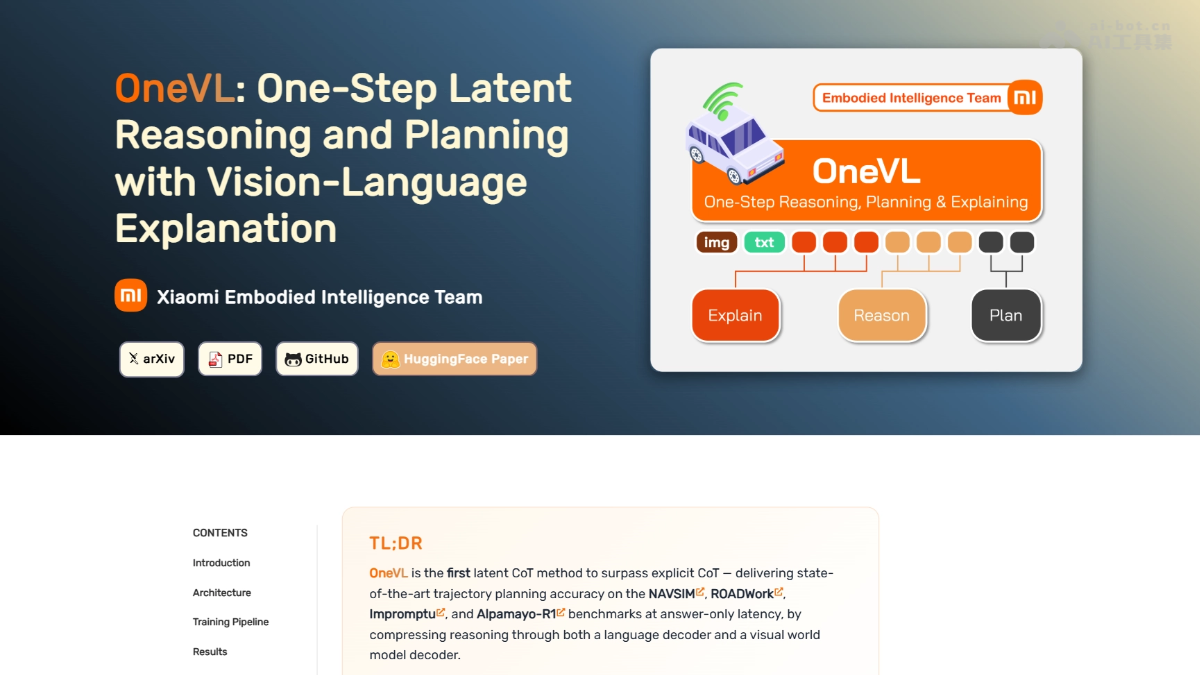
Main Features of Xiaomi OneVL
- Unified Vision-Language-Action (VLA) Reasoning: Integrates scene understanding, language reasoning, and driving action output into a single framework, achieving a one-step end-to-end closed loop from perception to decision-making to execution.
- World Model Future Prediction: Equipped with a built-in visual world model decoder that can predict scene frames 0.5 seconds and 1.0 seconds into the future, forcing the model to internalize the causal dynamics of road geometry, vehicle motion, and environmental changes.
- Latent Chain-of-Thought (Latent CoT) Reasoning: Performs deep reasoning within compact latent variables. During inference, the auxiliary decoders are discarded, and all latent tokens are completed through a single parallel prefill, with a latency of only 0.24 seconds—comparable in speed to "direct prediction" but with higher accuracy.
- Dual Auxiliary Decoder Supervised Training: During the training phase, a language decoder reconstructs the textual chain of thought, and a visual decoder predicts future frames. The dual-dimensional supervision ensures that latent variables simultaneously encode semantic reasoning and the causal laws of the physical world.
- High-Precision Trajectory Prediction: Based on the Qwen3-VL-4B-Instruct backbone network, with an MLP head attached on top to output trajectories, it achieves a PDM-score of 88.84 on the NAVSIM benchmark, surpassing 8B competitors.
Technical Principles of Xiaomi OneVL
- Unification of Three Major Technical Routes: Xiaomi OneVL is the first to integrate three independent technical routes—VLA (vision-language-action), world models, and latent space reasoning—into a single framework, enabling the model to understand the current scene while predicting future environmental evolution based on physical causal laws and outputting driving actions, achieving an end-to-end closed loop from perception and reasoning to decision-making.
- Dual Auxiliary Decoder Supervision Architecture: During the training phase, the model introduces two auxiliary decoders: the language decoder is responsible for reconstructing the textual chain of thought, ensuring that latent variables encode semantic reasoning capabilities; the visual world model decoder is responsible for predicting future frames (T+0.5s, T+1.0s), forcing latent variables to internalize physical dynamics such as road geometry and vehicle motion. During inference, the two decoders are discarded, and only the compact latent variables are retained for prediction.
- Three-Stage Progressive Training: Training is divided into three stages: trajectory alignment, language reasoning alignment, and visual world model alignment, progressively aligning latent variables with trajectory outputs, language reasoning objectives, and visual prediction objectives. Skipping any stage leads to catastrophic performance degradation (up to 21.71 points), proving that the three-stage joint optimization is crucial for stable training.
- One-Step Latent Space Parallel Reasoning: During inference, all latent tokens are completed through a single parallel prefill, without the need for autoregressive token-by-token generation. The vehicle-side latency is only 0.24 seconds (4.16Hz), comparable in speed to "directly outputting the answer," and significantly surpasses explicit chain-of-thought methods in accuracy, becoming the first latent space reasoning solution that outperforms explicit CoT in performance.
- Lightweight Model Foundation: The backbone network uses Qwen3-VL-4B-Instruct, with a compact MLP head attached on top for trajectory prediction, and the vision tokenizer uses Emu3.5-VisionTokenizer (codebook size 131072). At the 4B parameter scale, it achieves a PDM-score of 88.84 on the NAVSIM benchmark, surpassing 8B competitors AdaThinkDrive and LaST-VLA.
Core Advantages of Xiaomi OneVL
- Both Speed and Accuracy: Xiaomi OneVL is the industry's first latent-space reasoning method whose accuracy surpasses explicit chain-of-thought, with an on-vehicle inference latency of only 0.24 seconds, comparable in speed to direct prediction but with better results, and 32% faster than explicit autoregressive CoT.
- Unification of Three Major Technical Routes: Xiaomi OneVL is the first to integrate the three independent technical routes of VLA, world models, and latent-space reasoning into a single framework, enabling the model to simultaneously possess scene understanding, physical causal reasoning, and future prediction capabilities.
- Two-Dimensional Interpretable Decision-Making: Xiaomi OneVL simultaneously provides two kinds of decision basis, linguistic explanation and visual prediction. It can use text to explain driving logic and can also use generated images to show future scenes, solving the "black box" interpretability problem of autonomous driving.
- Both Lightweight and High-Performance: The model is based on the 4B-parameter Qwen3-VL-4B-Instruct backbone network and achieves a PDM-score of 88.84 on the NAVSIM benchmark, surpassing 8B competitors and achieving higher performance with a smaller model scale.
- Fully Open Source and Commercially Usable: The model's model weights, training and inference code are all fully open-sourced under the Apache 2.0 license, supporting free secondary development and commercial application by academia and industry.
- Comprehensive SOTA on Four Benchmarks: Xiaomi OneVL reaches the current state-of-the-art level on all four authoritative benchmarks: NAVSIM, ROADWork, Impromptu, and Alpamayo-R1, among which the ADE of Alpamayo-R1 is the best among all methods.
Project Address of Xiaomi OneVL
- Project Official Website:https://xiaomi-embodied-intelligence.github.io/OneVL/
- GitHub Repository:https://github.com/xiaomi-research/onevl
- arXiv Technical Paper:https://arxiv.org/pdf/2604.18486
Comparison of Xiaomi OneVL with Similar Competitors
| Comparison Dimension | Xiaomi OneVL | EMMA (Waymo) |
|---|---|---|
| Affiliated Institution | Xiaomi Embodied Intelligence | Waymo(Google) |
| Model Positioning | End-to-end VLA + world model unified framework | End-to-end multimodal generalist autonomous driving model |
| Base Model | Qwen3-VL-4B-Instruct(4B) | Gemini / PaLI-X (large-scale, specific parameters not disclosed) |
| Core Architecture | Latent-space reasoning + dual auxiliary decoders (language + visual world model) | Pure-text VQA paradigm, with all inputs and outputs represented as natural language text |
| Reasoning Method | Single parallel prefill, 0.24-second latency (4.16Hz) | Autoregressive CoT token-by-token generation, high latency, computationally expensive |
| World Model | Built-in visual decoder, can predict future 0.5s/1.0s frames | No explicit world model, lacks future scene generation capability |
| Action Output | Continuous trajectory prediction (directly output by MLP head) | BEV coordinates in text form (waypoints), requiring text-to-float conversion |
| Interpretability | Language + vision dual dimensions(text explanation + future image prediction) | Text CoT reasoning chain (rationale) + visual grounding (3D/BEV position annotation) |
| Multi-Task Capability | Focuses on motion planning, SOTA on four benchmarks | General-purpose ist model, jointly trained for planning, 3D detection, road graph estimation, and scene understanding |
| Training method | Three-stage progressive alignment (trajectory→language→vision) | End-to-end fine-tuning, multi-task co-training, leveraging Gemini pretrained world knowledge |
| Sensor input | Vision (camera) | Vision (camera), does not support LiDAR / radar |
Application scenarios of Xiaomi OneVL
-
Mass production deployment of high-level autonomous driving: Solves the bottleneck of traditional CoT reasoning having excessively high latency and being unable to be deployed in real time.
-
Decision-making in complex road conditions: Predicts dynamic scenarios such as pedestrian intent and vehicle merging, avoiding "black box" risks.
-
Visualization of model decisions: Provides auditable and interpretable linguistic and visual decision bases for autonomous driving systems.
-
Secondary development for academic research: Open-source code and weights support commercial use by academia and industry under the Apache 2.0 license.