
What is XGrammar
XGrammar is an open-source software library launched by Tianqi Chen's team, providing efficient, flexible, and portable structured data generation capabilities for large language models (LLMs). It defines structures based on context-free grammar (CFG) and supports recursive composition to represent complex structures, making it suitable for generating data in formats such as JSON and SQL. XGrammar uses a byte-level pushdown automaton to optimize the interpretation of CFG, reducing per-token latency and achieving up to a 100x speedup with almost no additional overhead. XGrammar integrates multiple system optimizations, such as adaptive token mask caching and context expansion, improving mask generation speed and reducing preprocessing time. XGrammar's C++ backend is designed for easy integration and supports zero-overhead structured generation in LLM inference.
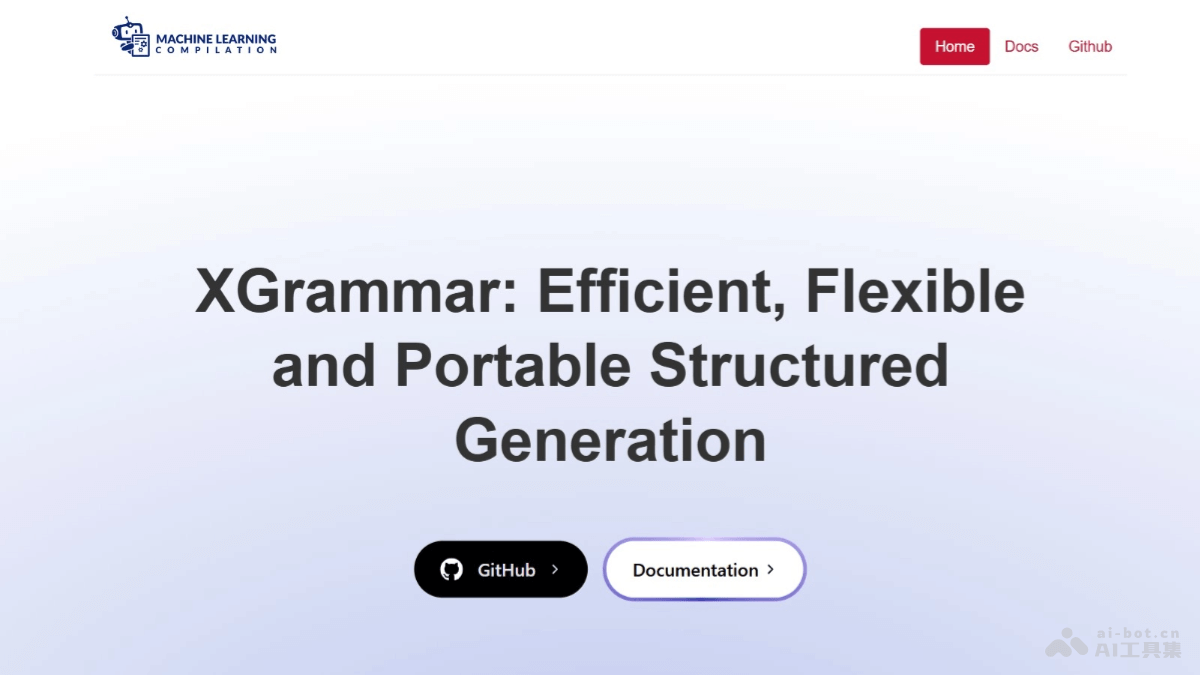
Main Features of XGrammar
- Efficient Structured Generation: Supports context-free grammar (CFG), enabling the definition and generation of structured data that follows specific formats such as JSON and SQL.
- Flexibility: Based on CFG recursive rules, it can flexibly represent complex structures and adapt to diverse structured data requirements.
- Zero-Overhead Integration: XGrammar is co-designed with LLM inference engines, enabling zero-overhead structured generation in LLM inference.
- Fast Execution: Based on system optimizations, it significantly improves the execution speed of structured generation, reducing per-token latency by up to 100x compared with SOTA methods.
- Cross-Platform Deployment: It has a minimal and portable C++ backend and can be easily integrated into multiple environments and frameworks.
- Adaptive Token Mask Cache: Generated during the preprocessing stage to accelerate runtime mask generation.
Technical Principles of XGrammar
- Byte-Level Pushdown Automaton (PDA): Uses a byte-level PDA to interpret CFG, supports one or more bytes per character edge, handles irregular token boundaries, and supports tokens containing sub-UTF8 characters.
- Preprocessing and Runtime Optimization: During the preprocessing stage, an adaptive token mask cache is generated, accelerating runtime mask generation based on precomputed context-independent tokens.
- Distinguishing Context-Free and Context-Dependent Tokens: Distinguishes context-free tokens from context-dependent tokens, precomputes the validity of context-free tokens at each position in the PDA, and stores them in the adaptive token mask cache.
- Grammar Compilation: Based on the grammar compilation process, a considerable portion of tokens in the mask are precomputed to accelerate mask generation speed.
- Algorithm and System Optimizations: Includes context expansion, persistent execution stack, pushdown automaton structure optimization, and more, further improving mask generation speed and reducing preprocessing time.
- Overlapping Mask Generation with LLM Inference: Parallelizes the mask generation process on the CPU with the LLM inference process on the GPU, eliminating the overhead of constrained decoding.
XGrammar Project Address
- Project Website:xgrammar.mlc.ai
- GitHub Repository:https://github.com/mlc-ai/xgrammar
- arXiv Technical Paper:https://arxiv.org/pdf/2411.15100
Application Scenarios of XGrammar
- Programming Language Assistance: Used to assist in writing and debugging code, automatically generating code snippets that conform to specific programming language specifications, improving development efficiency.
- Database Operations: Generate query statements that conform to SQL syntax, helping developers or applications automatically build database queries and reducing the workload of manually writing SQL statements.
- Natural Language Processing (NLP): Generate structured training data for training and optimizing NLP models, improving the models' ability to process structured information.
- Web Development: Automatically generate front-end code and API documentation, ensuring consistency between documentation and code, and improving development efficiency and maintainability.
- Configuration Files and Templates: Generate and populate configuration files and templates, such as automatically generating system configurations and filling in email templates, improving the level of automation.