
What is xAR
xAR is a novel autoregressive visual generation framework jointly proposed by ByteDance and Johns Hopkins University. Through "Next-X Prediction" and "Noisy Context Learning" technologies, the framework addresses the issues of insufficient information density and cumulative errors in traditional autoregressive models for visual generation.
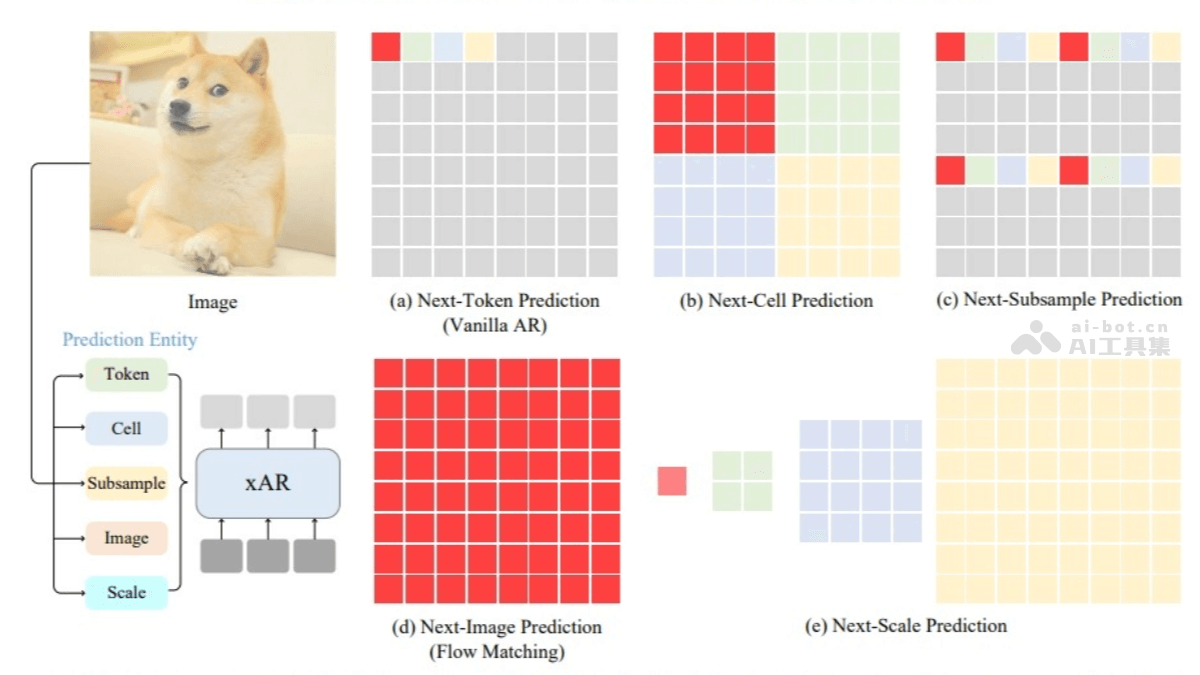
xAR's Main Features
- Next-X Prediction: Extends the traditional "next-token prediction" to support the model in predicting more complex entities (such as image patches, units, subsampling, entire images, etc.), capturing richer semantic information.
- Noisy Context Learning: By introducing noise during training, it improves the model's robustness to errors and alleviates the cumulative error problem.
- High-Performance Generation: On the ImageNet dataset, the xAR model outperforms existing technologies such as DiT and other diffusion models in both inference speed and generation quality.
- Flexible Prediction Units: Supports various prediction unit designs (such as units, subsampling, multi-scale prediction, etc.), suitable for different visual generation tasks.
xAR's Technical Principles
- Flow Matching: xAR is based on the flow matching method to transform the discrete token classification problem into a continuous entity regression problem. Specifically:
- The model generates noisy inputs through interpolation and noise injection.
- At each autoregressive step, the model predicts the velocity flow from the noise distribution to the target distribution, thereby gradually optimizing the generation results.
- Inference Strategy: During the inference stage, xAR adopts an autoregressive approach to generate images step by step:
- First, it predicts the initial unit (such as an 8×8 image patch) from Gaussian noise.
- Based on the generated units, the model gradually generates the next unit until the entire image is completed.
- Experimental Results: xAR achieved significant performance improvements on the ImageNet-256 and ImageNet-512 benchmarks:
- xAR-BThe (172 million parameters) model is 20 times faster in inference speed than DiT-XL (675 million parameters), while achieving a Fréchet inception distance (FID) of 1.72, outperforming existing diffusion models and autoregressive models.
- xAR-HThe (1.1 billion parameters) model achieved an FID of 1.24 on ImageNet-256, setting a new state-of-the-art level, and does not rely on visual foundation models (such as DINOv2) or advanced guidance interval sampling.
xAR's Project Address
- Project Official Website:https://oliverrensu.github.io/project/xAR/
- arXiv Technical Paper:https://arxiv.org/pdf/2502.20388
xAR's Application Scenarios
- Art Creation: Artists can use xAR to generate creative images, serving as a source of inspiration for artworks or directly for creation. xAR can generate images with rich details and diverse styles, supporting creative needs at different resolutions and styles.
- Virtual Scene Generation: In game development and virtual reality (VR), xAR can quickly generate realistic virtual scenes, including natural landscapes, urban environments, and virtual characters, enhancing the user experience.
- Old Photo Restoration: By generating high-quality image content, xAR can repair damaged parts in old photos, restoring their original details and colors.
- Video Content Generation: xAR can generate specific scenes or objects in videos, for use in video special effects production, animation generation, and video editing.
- Data augmentation: By generating diverse images, xAR can expand training datasets and improve the generalization ability and robustness of models.