
What is X-Fusion
X-Fusion is a multimodal fusion framework jointly proposed by the University of California, Los Angeles, the University of Wisconsin-Madison, and Adobe Research. It extends pre-trained large language models (LLMs) to multimodal tasks while preserving their language capabilities. The framework adopts a dual-tower architecture, freezing the parameters of the language model while introducing independent weights for the visual modality to process visual information. At the input and output levels, it aligns text and visual features at the intermediate processing level to achieve efficient multimodal fusion.
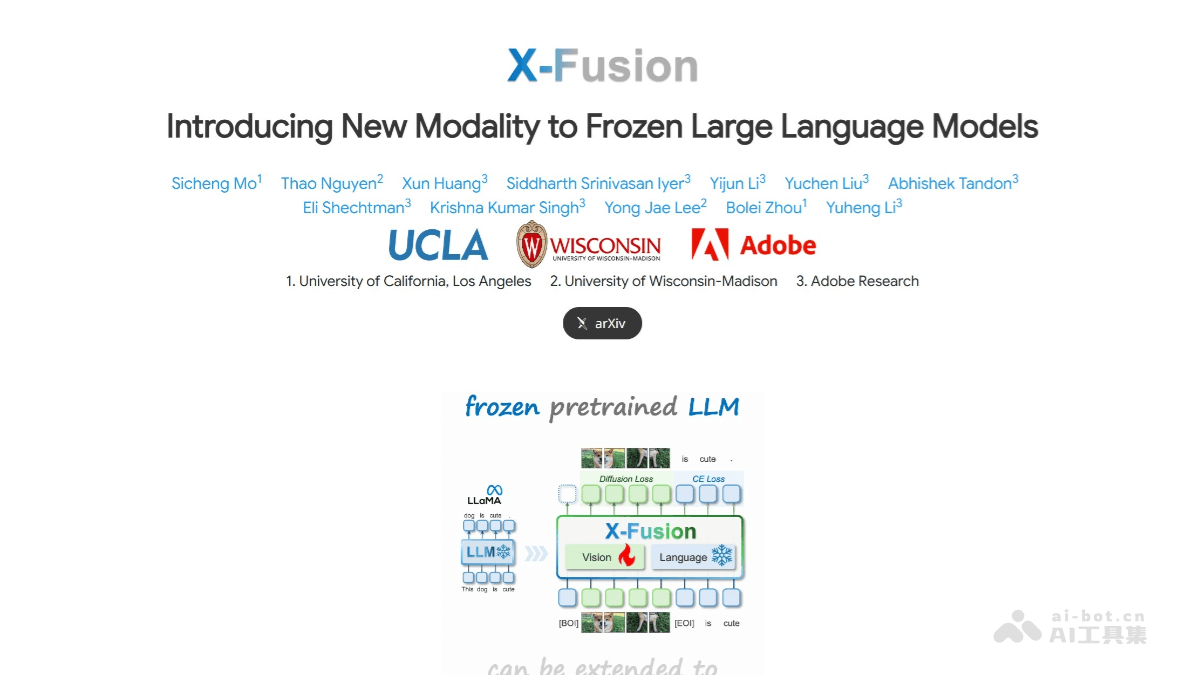
X-Fusion's main features
- Multimodal task extension: It can handle various multimodal tasks such as image-to-text (e.g., image captioning) and text-to-image (e.g., image generation).
- Performance optimization: It improves overall performance by reducing noise in image data; at the same time, data from understanding tasks can significantly improve the quality of generation tasks.
- Multi-task training: It supports training multiple vision-language tasks simultaneously (e.g., image editing, localization, visual question answering, etc.) without the need to create specific weights for each task.
- Pre-trained model transfer: It can transfer the capabilities of pre-trained diffusion models to the vision tower, further improving image generation capabilities.
X-Fusion's technical principles
- Dual-tower architecture design: X-Fusion adopts a dual-tower architecture, freezing the parameters of the language model while introducing independent weights for the visual modality. This allows the model to process language and visual information separately when handling multimodal tasks, and align the features of the two modalities at the intermediate level, achieving efficient multimodal understanding and generation.
- Modality-specific weights: In the dual-tower architecture, the language tower and the vision tower process text and visual input respectively. The language tower keeps the pre-trained parameters unchanged, while the vision tower introduces new weights to process visual information. This separated processing approach ensures the preservation of language capabilities while enhancing visual understanding capabilities.
- Feature alignment and fusion: X-Fusion performs feature alignment and fusion at the input, intermediate processing, and output levels. Through this multi-level alignment, the model can better integrate language and visual information, improving the performance of multimodal tasks.
- Training strategy optimization: During training, X-Fusion studied the impact of noise levels and data ratios on performance. Experiments show that reducing noise in image data can significantly improve overall performance, and data from understanding tasks also has a positive impact on generation tasks.
X-Fusion's project address
- Project homepage:https://sichengmo.github.io/XFusion/
- arXiv technical paper:https://arxiv.org/pdf/2504.20996
X-Fusion's application scenarios
- Autonomous driving: By fusing data from multiple sensors such as cameras and radar, X-Fusion can provide more comprehensive environmental perception capabilities and improve the safety and reliability of autonomous driving.
- Robot navigation: It helps robots perform precise localization and path planning in complex environments, enhancing their autonomous navigation capabilities.
- Human-computer interaction: By combining multimodal inputs such as voice, gestures, and facial expressions, X-Fusion can achieve more natural and intelligent human-computer interaction. For example, in smart home scenarios, a voice assistant can recognize the user's gestures and expressions through visual data and provide more accurate services.
- Sentiment analysis: In sentiment analysis, X-Fusion can combine speech and visual data to more accurately identify the user's emotional state.
- Medical imaging analysis: By fusing different modalities of medical imaging (such as MRI, CT, etc.), X-Fusion can help doctors more comprehensively understand the condition, improving the accuracy of disease diagnosis and the ability for early detection.