
What is WorldScore
WorldScore is a unified evaluation benchmark for world generation models proposed by Stanford University. It decomposes world generation into a series of next-scene generation tasks, enabling unified evaluation of different methods through explicit camera-trajectory-based layout specifications. WorldScore evaluates three key aspects of generated worlds: controllability, quality, and dynamics. The benchmark includes a carefully curated dataset covering 3,000 test samples, including diverse worlds that are static and dynamic, indoor and outdoor, and realistic and stylized.
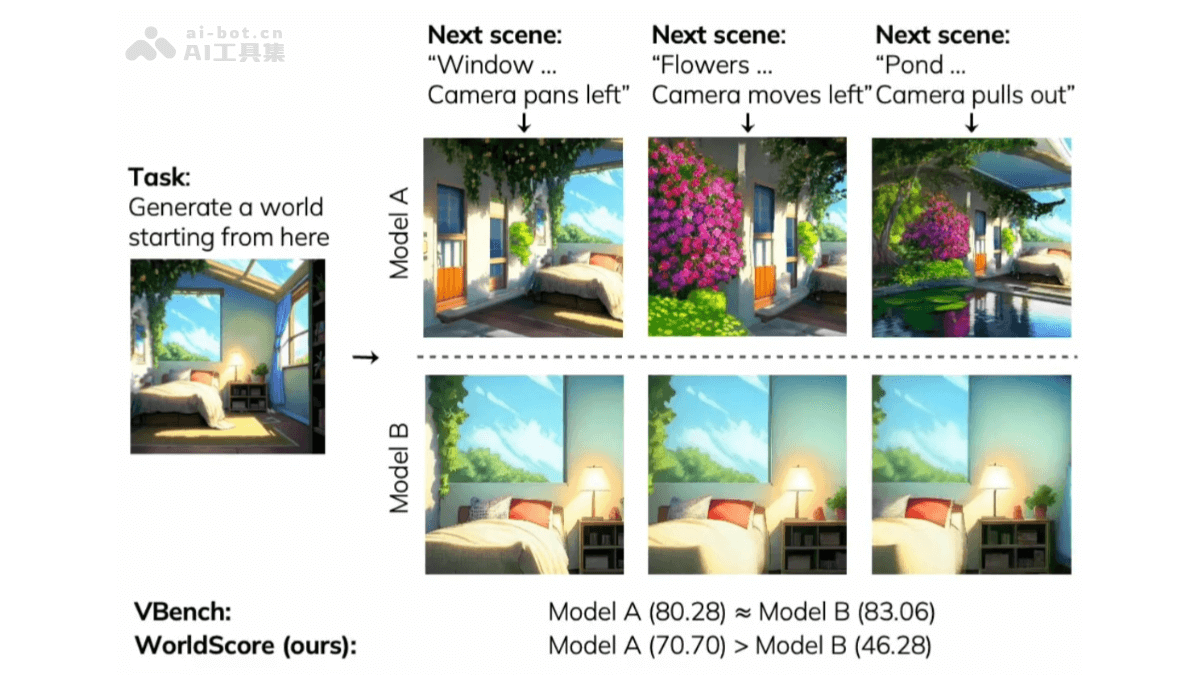
Main Features of WorldScore
- Unified Evaluation Framework: WorldScore provides a unified evaluation framework for measuring the performance of different world generation models. It decomposes world generation tasks into a series of next-scene generation tasks, enabling unified evaluation of different methods through explicit camera-trajectory-based layout specifications.
- Evaluation Dimensions: It evaluates generated worlds from three key aspects: controllability, quality, and dynamics.
- Multi-Scene Generation: WorldScore is the only benchmark that supports multi-scene generation and can evaluate model performance in generating consecutive scenes.
- Unification: It can uniformly evaluate 3D, 4D, image-to-video (I2V), and text-to-video (T2V) models, providing a comprehensive evaluation framework.
- Long Sequence Support: It supports generating multiple scenes and evaluates model performance in long-sequence generation tasks.
- Image Conditioning: It supports image-based conditional generation and is suitable for image-to-video generation tasks.
- Multi-Style: It includes data in multiple visual styles and can evaluate model generation capabilities under different styles.
- Camera Control: It evaluates a model's ability to follow camera trajectories, ensuring that generated scenes conform to the specified camera motion.
- 3D Consistency: It evaluates the stability of scenes in geometric structure, ensuring that generated 3D scenes remain consistent across different viewpoints.
Technical Principles of WorldScore
- Diverse Dataset: The WorldScore dataset contains multimedia data in dynamic and static configurations, suitable for image-to-video and image-to-3D tasks.
- Dynamic Configuration: It includes fields such as images, visual motion, visual style, motion type, style, camera path, objects, and prompts.
- Static Configuration: It includes fields such as images, visual motion, visual style, scene type, category, style, camera path, content list, and prompt list.
- Dataset Scale: The dataset is divided into training and test sets, with 1,000 samples in the dynamic configuration and 2,000 samples in the static configuration.
- Camera-Trajectory-Based Layout Specification: Through explicit camera-trajectory-based layout specifications, it enables unified evaluation of different methods.
- Multimodal Data Support: It supports data in multiple modalities, including images, videos, and 3D models, and is suitable for multimodal content generation tasks.
WorldScore Project Address
- Project Website:https://haoyi-duan.github.io/WorldScore/
- Github Repository:https://github.com/haoyi-duan/WorldScore
- arXiv Technical Paper:https://arxiv.org/pdf/2504.00983
- HuggingFace Dataset:https://huggingface.co/datasets/Howieeeee/WorldScore
Benchmark Comparison of WorldScore
WorldScore differs from other existing benchmarks in several aspects, and the following is a detailed comparison:
| Benchmark | Number of Examples | Multi-scene | Unification | Long Sequence | Image Condition | Multi-style | Camera Control | 3D Consistency |
|---|---|---|---|---|---|---|---|---|
| TC-Bench | 150 | ❌ | ❌ | ❌ | ✅ | ❌ | ❌ | ❌ |
| EvalCrafter | 700 | ❌ | ❌ | ❌ | ❌ | ❌ | ❌ | ❌ |
| FETV | 619 | ❌ | ❌ | ❌ | ❌ | ❌ | ❌ | ❌ |
| VBench | 800 | ❌ | ❌ | ❌ | ❌ | ❌ | ❌ | ❌ |
| T2V-CompBench | 700 | ❌ | ❌ | ❌ | ❌ | ❌ | ❌ | ❌ |
| Meng et al. | 160 | ❌ | ❌ | ❌ | ❌ | ❌ | ❌ | ❌ |
| Wang et al. | 423 | ❌ | ❌ | ✅ | ❌ | ❌ | ❌ | ❌ |
| ChronoMagic-Bench | 1649 | ❌ | ❌ | ❌ | ❌ | ❌ | ❌ | ❌ |
| WorldModelBench | 350 | ❌ | ❌ | ❌ | ✅ | ❌ | ❌ | ❌ |
| WorldScore | 3000 | ✅ | ✅ | ✅ | ✅ | ✅ | ✅ | ✅ |
Application Scenarios of WorldScore
- Image-to-Video Generation: By generating high-quality video content, it is applied to fields such as video production and animation design.
- Image-to-3D Generation: Converting 2D images into 3D models, it is used in scenarios such as virtual reality, augmented reality, and 3D modeling.
- Dataset Support: The dataset contains multimedia data in dynamic and static configurations, is suitable for a variety of tasks, and helps researchers optimize and improve models.
- Research and Development: The WorldScore dataset provides researchers with a standardized testing platform for developing and validating new 3D/4D scene generation algorithms.
- Autonomous Driving Scenario Generation: By generating realistic 3D scenes, it is used for the training and testing of autonomous driving systems, helping to improve the safety and reliability of autonomous driving systems.