
What is WorldDreamer
WorldDreamer is a general world model based on Transformer, dedicated to understanding and predicting the changes and motion patterns of the physical world, and enhancing the capability of video generation. It can perform multiple video generation tasks in natural scenes and autonomous driving scenarios, such as text-to-video, image-to-video, video editing, and action sequence-to-video. WorldDreamer achieves this by mapping visual inputs to discrete tokens and predicting masked tokens, integrating multimodal prompts to facilitate interaction within the world model. Experiments show that WorldDreamer performs excellently in generating videos in different scenarios, including natural scenes and driving environments, demonstrating its versatility in tasks such as text-to-video conversion, image-to-video synthesis, and video editing.
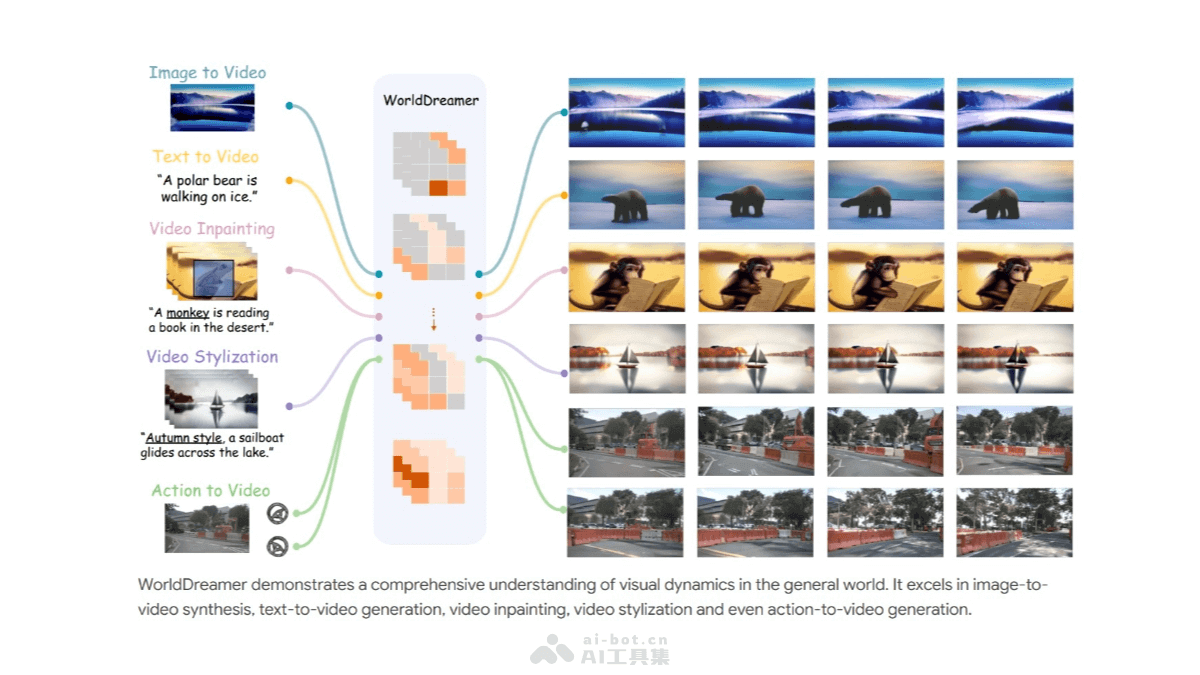
Main Features of WorldDreamer
- Image to Video: Predicts future video frames based on a single image, treating the remaining video frames as masked visual tokens, predicting these tokens to generate high-quality, coherent video content.
- Text to Video: Given only language text input, WorldDreamer predicts the corresponding video, assuming all visual tokens are masked, generating videos that match the input language description.
- Video Inpainting: Specifies mask regions on a given video, changes the video content in the masked regions according to language input, achieving local modification and content replacement in the video.
- Video Stylization: Inputs a video segment, randomly masks certain pixels, and WorldDreamer can change the video style according to the input language, such as creating specific thematic effects.
- Action to Video: In autonomous driving scenarios, inputs the initial frame and future driving commands, and WorldDreamer predicts future video frames, generating videos that conform to driving actions.
Technical Principles of WorldDreamer
- Visual Tokenization: WorldDreamer first uses VQGAN to encode images and videos into discrete visual tokens. This step converts continuous visual signals into discrete forms that can be processed by the model.
- Transformer Architecture: Based on the Transformer architecture, WorldDreamer builds a general world model for understanding and predicting the dynamics and physical laws in visual signals.
- Spatial Temporal Patchwise Transformer (STPT): To address the inherent spatiotemporal characteristics in video signals, WorldDreamer proposes STPT, which enables attention to focus on local patches within spatiotemporal windows, facilitating the learning of visual signal dynamics and accelerating the convergence of the training process.
- Multimodal Prompts: WorldDreamer integrates language and action signals through cross-attention mechanisms, constructing multimodal prompts to facilitate interaction within the world model.
- Predicting Masked Visual Tokens: WorldDreamer transforms the world modeling framework into an unsupervised visual token prediction problem, capturing latent motion and physical laws in visual data by predicting masked visual tokens.
- Parallel Video Decoding: Compared with diffusion-based methods, WorldDreamer exhibits superior speed advantages, requiring only a few iterations to decode videos in parallel, about 3 times faster than diffusion-based methods.
- Unsupervised Learning: WorldDreamer supports unsupervised learning by training through predicting masked visual tokens, without the need for additional supervision signals.
WorldDreamer's project address
- Project official website:world-dreamer.github.io
- Github repository:https://github.com/JeffWang987/WorldDreamer
- arXiv technical paper:https://arxiv.org/pdf/2401.09985
Application scenarios of WorldDreamer
- Natural scene video generation: WorldDreamer can generate corresponding video content based on images or text descriptions of natural scenes, and is suitable for the simulation and display of various natural scenes such as natural landscapes and animal behavior.
- Driving environment video generation: In the field of autonomous driving, WorldDreamer can generate subsequent videos based on driving actions or initial frames, simulating vehicle motion under different driving strategies, and providing simulated training data for autonomous driving technology.
- Video editing: WorldDreamer supports video repair and modification. Users can specify areas for content changes based on language input, ensuring that the video is consistent with the user's description and achieving fine-grained video editing.
- Image-to-video synthesis: WorldDreamer can predict future frames from a single image, achieving high-quality video generation, presenting cinema-level smooth motion, and maintaining consistency with the original image.
- Text-to-video generation: Generate videos based on text content, achieving a perfect match between language and video content. Users can customize video content, style, and camera movement through language input.