
What is WorldClaw
WorldClaw is an Agent-driven open-world 3D generation framework launched by the Tencent Hunyuan team. Users input a single natural language description, and the system can automatically plan terrain, regions, buildings, objects, and spatial relationships, adopting a global-to-local generation strategy to construct in Blender a complete 3D scene that can be freely explored and supports per-object editing. The framework is jointly driven by multiple models such as Claude Opus, GPT-Image-2, SAM3, and Hunyuan3D, and possesses vision Agent self-check and repair capabilities, which can automatically fix contact issues such as floating and clipping.
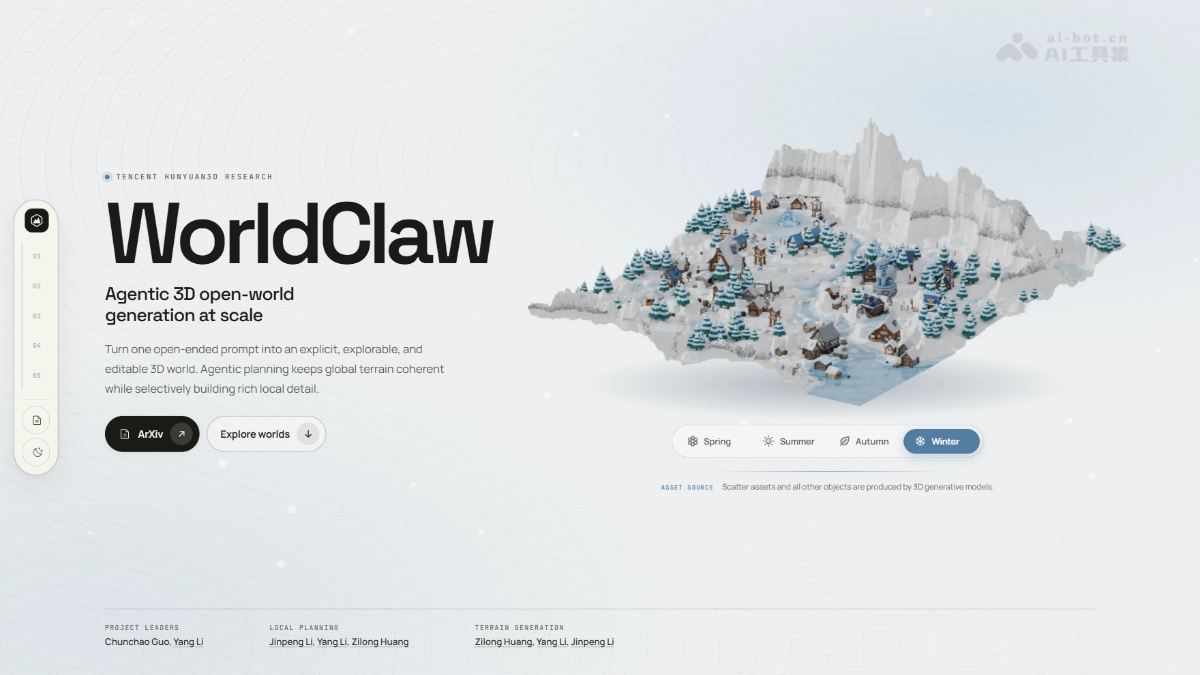
WorldClaw's main features
-
Intelligent scene planning: The planning Agent analyzes the user's description and converts open-ended prompts into a structured scene specification containing regions, terrain, objects, materials, and spatial relationships.
-
Global-to-local generation: First establish the world terrain and spatial framework, then gradually fill in the details of each region, avoiding road breaks and scale imbalance.
-
Independent asset generation: Objects such as buildings, vegetation, and vehicles remain independent instances rather than a single baked model, supporting individual movement, replacement, and editing.
-
Visual self-check and repair: The vision Agent performs multi-view rendering checks on proportions, poses, and contact issues, and automatically fixes defects such as floating objects and clipping.
-
Deep Blender integration: The entire workflow of terrain generation, asset generation, scene placement, checking, and rendering runs in Blender 5.1.1, and supports operation via the MCP interface.
WorldClaw's technical principles
-
Multi-Agent collaborative architecture: The system consists of a planning Agent, a scene optimization Agent, and a visual inspection Agent, which are responsible for scene design, Blender operations, and quality verification, respectively.
-
Multi-model division of labor: Claude Opus 4.8 serves as the Agent foundation model, GPT-Image-2 handles image generation, SAM3/SAM3D handles segmentation, and Hunyuan3D handles 3D reconstruction and asset generation.
-
Coarse-to-Fine generation strategy: First generate a semantic height field to determine the terrain skeleton, generate object composition plans by region, and finally independently reconstruct each 3D asset and combine them.
-
Local repair mechanism: For contact issues, only modify the corresponding support region to avoid damaging the overall terrain structure.
How to use WorldClaw
-
Input description: Describe the desired open-world scene in natural language.
-
Intelligent planning: The planning Agent automatically breaks down the prompt and generates a structured scene specification containing regions, terrain, objects, and spatial relationships.
-
Terrain skeleton generation: The system generates a semantic height field, determining the spatial foundation of terrain regions such as mountains, rivers, and coasts.
-
Regional asset generation: Generate independent 3D assets such as buildings, vegetation, and vehicles by region, and place them in the corresponding positions.
-
Visual inspection and repair: The vision Agent performs multi-view rendering checks and automatically fixes issues such as abnormal proportions, floating, and clipping.
-
Export and edit: Obtain the complete scene in Blender, freely adjust object positions, replace assets, or modify materials.
WorldClaw's core advantages
-
From prompt to complete world: A natural language description that can automatically plan and generate a complete explorable 3D scene including terrain, buildings, vegetation, and facilities, without the need for manual asset-by-asset modeling.
-
Independently Editable Assets: All objects remain independent textured Meshes and instances, supporting individual movement, replacement, and material modification without regenerating the entire world.
-
Intelligent Self-Check and Repair: The visual Agent proactively checks proportions, poses, and contact issues, automatically repairing common 3D defects such as floating and clipping to improve generation quality.
-
Deep Blender Integration: The entire pipeline runs in Blender 5.1.1, supports direct operation via the MCP interface, and is easy to integrate into existing 3D workflows.
WorldClaw's project address
- Project Official Website:https://tencent-hunyuan.github.io/Hunyuan3D-WorldClaw/
- arXiv Technical Paper:https://arxiv.org/pdf/2608.05248
Comparison of WorldClaw with similar competing products
| Dimension | WorldClaw (Tencent Hunyuan) | Lyra 2.0(NVIDIA) |
|---|---|---|
| Input Method | Natural language prompts | Single image + custom camera trajectory (optional text guidance) |
| Core Driver | Multi-Agent collaboration (planning + scene optimization + visual inspection) | Generative reconstruction pipeline (video generation → 3D reconstruction) |
| Generation Strategy | Coarse-to-Fine: first a global terrain skeleton, then independent assets generated region by region | Autoregressive video generation + feed-forward 3D Gaussian Splatting reconstruction |
| Consistency Assurance | Agent plans the global structure + visual Agent performs multi-view inspection and repair | Frame-by-frame 3D geometric memory routing (against spatial forgetting) + self-enhanced drift correction (against temporal drift) |
| Asset Generation | Natively generates independent Mesh instances such as buildings, vegetation, and vehicles | Reconstructs generated video into 3D Gaussians and surface Meshes |
| Editability | Independent object-level editing, supporting movement, replacement, and material changes | Meshes can be exported to simulation engines; object-level editing capability is limited |
| Terrain System | Semantic height field generation for complex open terrain (peaks, canyons, rivers) | Expands from a single image, supports large-scale indoor and outdoor scenes, with no explicit terrain skeleton |
| Engine Integration | Deep integration with Blender 5.1.1 (direct operation via MCP interface) | Can be exported to physics simulation engines such as NVIDIA Isaac Sim |
| Underlying Model | Claude Opus 4.8 + GPT-Image-2 + SAM3 + Hunyuan3D | Based on the Wan 2.1-14B DiT video diffusion model |
WorldClaw's Application Scenarios
-
Game Prototype Development: Rapidly generate open-world level blockouts and concept scenes, accelerating early-stage gameplay validation and iteration.
-
Film and Television Virtual Production: Build large-scale exterior virtual environments, supporting directors in shot previews and digital asset previsualization.
-
VR/AR Experience Design: Generate freely explorable immersive 3D spaces for virtual tourism, training simulations, or exhibitions.
-
Architecture and Urban Planning: Visualize large-scale regional planning schemes, intuitively displaying the layout of terrain, buildings, and public facilities.
-
3D Creative Concept Art: Provides designers with an editable complete scene base, significantly reducing the cost of manual construction from scratch.