
What is WonderWorld
WonderWorld is an innovative 3D scene generation framework jointly launched by Stanford University and MIT. It can quickly generate diverse and coherent 3D virtual worlds from a single image. Based on the core Fast LAyered Gaussian Surfels (FLAGS) representation and guided depth diffusion technology, the framework completes scene generation in less than 10 seconds, greatly improving the speed of 3D scene creation and ensuring geometric consistency between new and old scenes. Users interactively shape and explore virtual environments in real time using text instructions and camera movement, giving WonderWorld broad application potential in fields such as game development, virtual reality, and creative design.
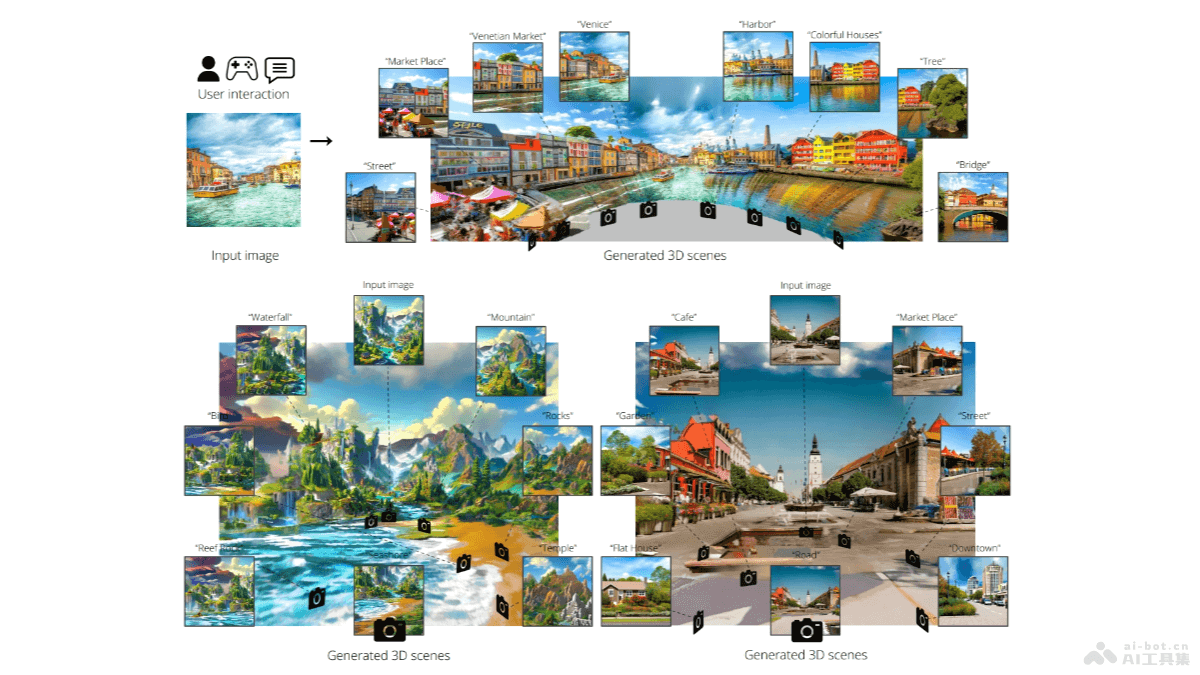
WonderWorld's main features
- Fast 3D scene generation: Quickly generate 3D scenes from a single image, and users can render and explore in real time.
- Interactive control: Users specify the content and position of the generated scene based on moving the camera and entering text prompts.
- Diverse scene creation: Supports generating 3D scenes with different styles and elements, such as cities, nature, fantasy, and more.
- Real-time user interaction: While rendering in real time, it supports user interaction with the generated scene, such as moving and rotating the viewpoint.
- Coherent scene connection: Newly generated scenes can remain geometrically coherent with existing scenes, forming a unified virtual world.
- User-driven content creation: Users create personalized virtual environments according to their own imagination and needs.
WonderWorld's technical principles
- Fast LAyered Gaussian Surfels (FLAGS): A novel scene representation method that accelerates scene generation and optimization using a layered design and geometry-based initialization.
- Single-view layer generation: Uses a text-guided diffusion model and single-view images to generate scene images, and uses a layered method to fill in occluded regions in the scene.
- Geometry-based initialization: Based on estimating the normal and depth information of a monocular camera, it quickly initializes the geometric parameters of each layer in the scene, reducing optimization time.
- Guided depth diffusion: A training-free method that uses partially visible depth information to guide depth estimation and generate new scenes geometrically consistent with existing scenes.
- Real-time rendering: During user interaction, it can render scenes generated by camera movement and text prompts in real time, providing a smooth user experience.
WonderWorld's project address
- Project official website:kovenyu.com/wonderworld
- arXiv technical paper:https://arxiv.org/pdf/2406.09394
WonderWorld's application scenarios
- Game development: Game designers can quickly generate and iterate 3D game worlds, improving the efficiency of game design and supporting players in exploring open worlds generated with AI assistance.
- Virtual reality (VR): In virtual reality applications, create immersive 3D environments, allowing users to experience rich and diverse virtual scenes, such as virtual tourism, education, or training simulations.
- Augmented reality (AR): Combined with AR technology, WonderWorld can add virtual elements to scenes in the real world, bringing users an enhanced interactive experience.
- Film and entertainment: In film production and animation, quickly generate cinematic-quality 3D backgrounds and scenes, reducing the time required for traditional modeling and rendering.
- Architectural design and planning: Architects and urban planners use WonderWorld to create and present design proposals, allowing clients to preview the development blueprint of a building or city in a virtual environment.