
What is Wonderland
Wonderland is a technology launched by a research team from the University of Toronto, Snap, and UCLA. It can generate high-quality, wide-range 3D scenes from a single image and allows control of the camera trajectory. It proves that 3D reconstruction models can be effectively built on the latent space of diffusion models to achieve efficient 3D scene generation, and it is a breakthrough advancement in the field of single-view 3D scene generation. By combining video diffusion models and large-scale 3D reconstruction models, Wonderland solves the viewpoint distortion problem in traditional 3D reconstruction technology and achieves precise viewpoint control and multi-view video generation.
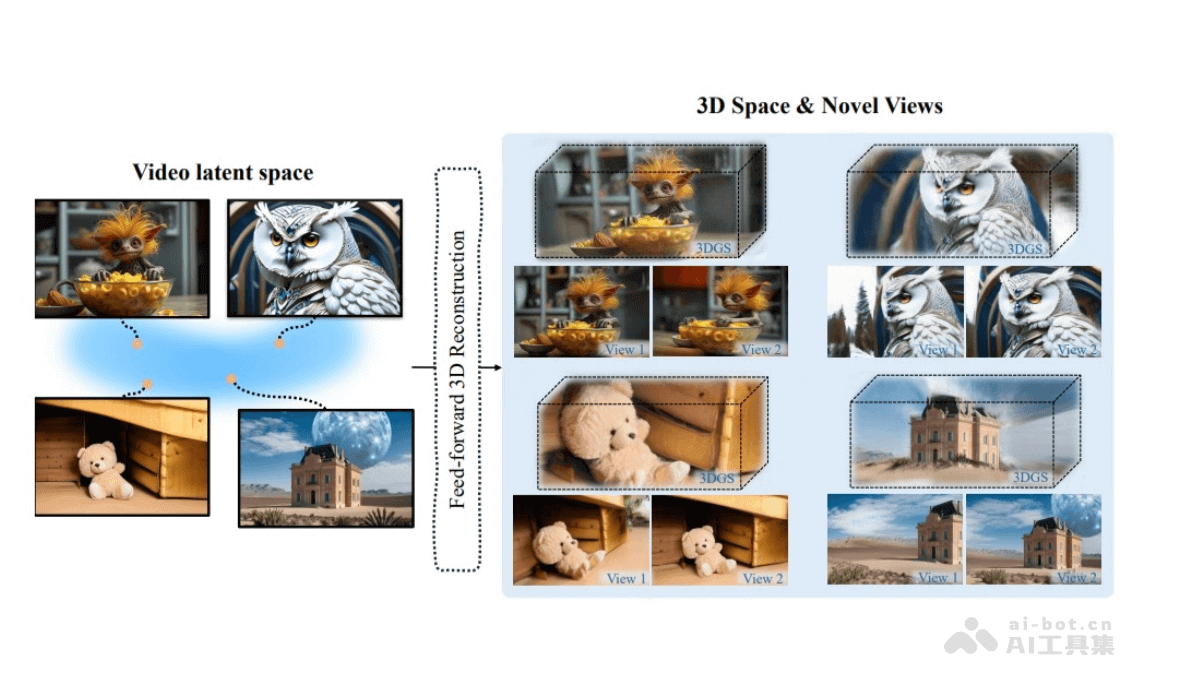
Wonderland's main features
- Video generation: Based on a single image and camera condition, Wonderland can achieve precise viewpoint control for video generation and generate high-quality videos with 3D-geometry consistency. It has strong generalization ability, can follow various complex trajectories, and is suitable for input images of various styles.
- 3D scene generation: Based on a single image and based on LaLRM, Wonderland can generate high-quality, expansive 3D scenes, and can deeply explore and generate high-quality, expansive 3D scenes.
- Zero-shot 3D scene generation: Under the premise of single-image input, Wonderland can perform efficient feed-forward reconstruction of 3D scenes, and its 3D scene reconstruction quality on multiple benchmark datasets is superior to existing methods.
- Wide-coverage scene generation capability: Wonderland can efficiently generate wide-range complex scenes. The generated 3D scenes have a high degree of geometric consistency and also have strong generalization ability, and can handle out-of-domain scenes.
Wonderland's technical principles
- Combination of video diffusion models and 3D reconstruction models: Wonderland proves for the first time that 3D reconstruction models can be effectively built on the latent space of diffusion models to achieve efficient 3D scene generation. Video diffusion models can accurately create videos according to a specified camera trajectory, generate latent features containing multi-view information, and at the same time maintain 3D consistency.
- Dual-branch camera control mechanism: Using ControlNet and LoRA modules, Wonderland achieves precise control over rich camera viewpoint changes during video generation, significantly improving the video quality, geometric consistency, and static features of multi-view generation.
- Large-scale latent-based 3D reconstruction model (LaLRM): Wonderland innovatively introduces the 3D reconstruction model LaLRM, using the latents generated by the video generation model to directly reconstruct 3D scenes (feed-forward reconstruction). The reconstruction model is trained using an efficient progressive training strategy, converting information in the video latent space into a 3D Gaussian point distribution (3D Gaussian Splatting, 3DGS), significantly reducing memory requirements and reconstruction time costs.
- Key innovation from a single image to a three-dimensional world: Traditional 3D reconstruction techniques often rely on multi-view data or per-scene optimization, and are prone to distortion when handling backgrounds and invisible regions. By combining video generation models and large-scale 3D reconstruction models, Wonderland achieves efficient and high-quality large-scale 3D scene generation.
- Embedding 3D awareness into video diffusion models: By introducing camera pose control into video diffusion models, Wonderland embeds multi-view information of the scene into the video latent space and can ensure 3D consistency.
Wonderland's project addresses
- Project website:https://snap-research.github.io/wonderland
- arXiv technical paper:https://arxiv.org/pdf/2412.12091
Wonderland's application scenarios
- Architectural Design: In the field of architectural design, Wonderland can be used to create high-quality 3D models and scenes, helping designers and clients understand and present architectural designs more intuitively.
- Virtual Reality (VR): In the field of virtual reality, Wonderland can generate a wide range of 3D scenes, providing users with an immersive experience, suitable for applications such as virtual tourism and educational training.
- Film and Television Special Effects: Wonderland's technology can be used to generate high-quality 3D scenes and videos, providing more realistic special effects and backgrounds for film and television production.
- Game Development: In the field of game development, Wonderland can be used to quickly generate game environments and scenes, improving the efficiency and quality of game development.
- Business Presentations: Enterprises can use Wonderland to create engaging product demonstrations, build virtual stores, online exhibitions, etc., providing customers with a brand-new shopping experience.
- Virtual Product Demonstrations: Electronic product manufacturers can develop virtual demonstration systems that allow users to experience various functions of a product before purchase, including appearance design, hardware configuration, and software applications, etc.