
What is the Willow Quantum Chip
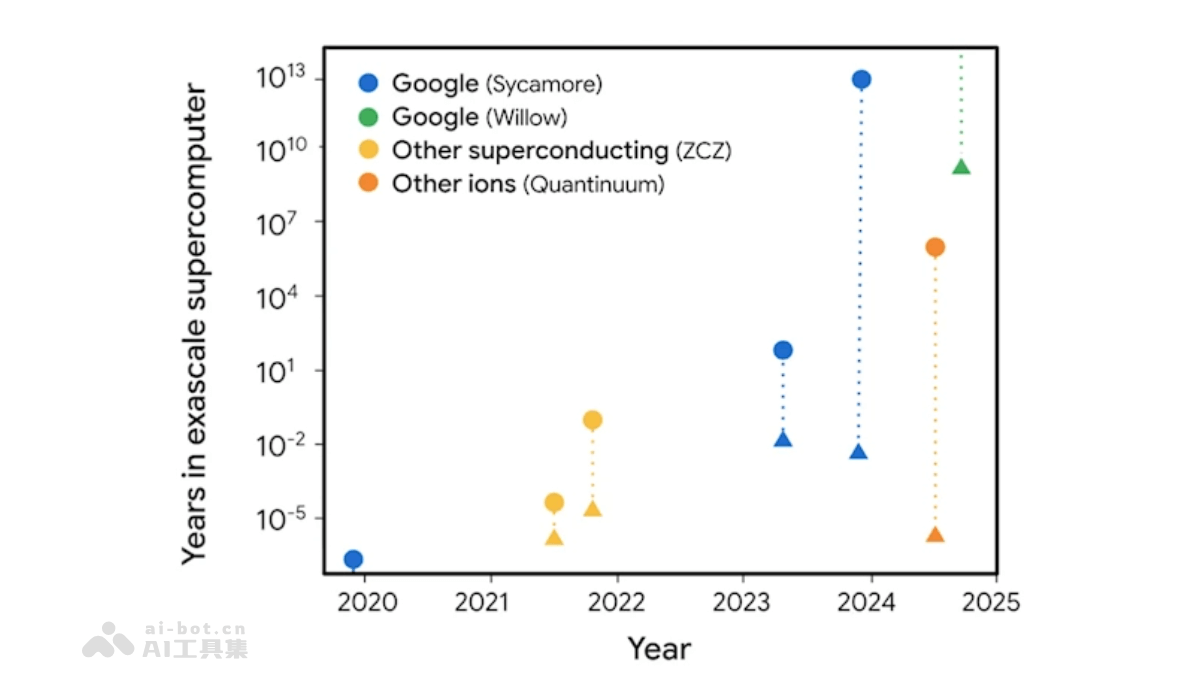
The Willow Quantum Chip is Google's latest release, featuring 105 physical qubits and achieving significant breakthroughs in quantum error correction and computational efficiency. Willow successfully solved a nearly 30-year error correction challenge in the field of quantum computing, achieving a significant reduction in error rates while increasing the number of qubits. Willow completed a standard benchmark computation in under five minutes, whereas the current fastest supercomputer would take 10^25 years to complete the same computation, a time exceeding the age of the universe. The launch of the chip demonstrates Google's leading position in quantum computing technology and marks an important step toward the commercialization of quantum computing.
Main Features of the Willow Quantum Chip
- Quantum Error Correction: Willow achieved a breakthrough in which error rates decrease exponentially as the number of qubits increases, solving a nearly 30-year error correction challenge in the field of quantum computing.
- Computational Performance: Willow performed excellently in the Random Circuit Sampling (RCS) benchmark, able to complete a standard benchmark computation in under five minutes, whereas the current fastest supercomputer would take 10^25 years to complete the same computation.
- System Performance: Willow demonstrated the best performance in two system benchmarks: quantum error correction and random circuit sampling. Its T1 time (the time a qubit maintains its excited state) is close to 100 microseconds, about 5 times higher than the previous generation chip.
- Hardware Specifications: Willow has 105 qubits and has reached the industry's best level in multiple key metrics.
- Practical Applications: Google expects to use the Willow chip to drive the application of quantum computing technology in fields such as medicine, energy, and artificial intelligence, solving major real-world problems.
Technical Principles of the Willow Quantum Chip
- Qubits and Error Correction: Willow has 105 physical qubits and achieved the industry's best performance in two system benchmarks: quantum error correction and random circuit sampling.
- T1 Time Improvement: Willow's T1 time (a measure of how long a qubit maintains its excited state) is close to 100 microseconds, a 5-fold improvement over the previous generation chip, indicating a significant improvement in qubit stability and performance.
- Performance Advantage: In the Random Circuit Sampling (RCS) benchmark, Willow demonstrated astonishing performance advantages. It completed a computation in just under 5 minutes, whereas today's fastest supercomputer would need 10^25 years to complete the same computation.
- Scalability: Willow's architecture supports easily adding more qubits without significantly increasing error rates, laying a solid foundation for the future development of quantum computing technology.
- Quantum Hardware Design: The Willow chip has been optimized in hardware design. By improving the physical structure of qubits, it reduces the impact of environmental noise on qubits and adopts an efficient cooling system to keep qubits in a low-temperature environment close to absolute zero, further improving system stability.
Willow Quantum Chip Project Address
- Related Technical Papers:https://www.nature.com/articles/s41586-024-08449-y
Application Scenarios of the Willow Quantum Chip
- Financial Sector: Applications of quantum computing in finance include portfolio optimization, trading, fraud detection, and more. Quantum computing can perform parallel operations, is less troubled by high-dimensional problems, and has probabilistic tunneling characteristics, so it will not get trapped in the valley of local minima.
- Chemical Engineering: Quantum computing improves efficiency and reduces resource consumption by simulating chemical reactions, helping the development of new materials and drugs.
- Life Sciences: In the field of life sciences, quantum computing can be used to evaluate experimental values such as the cost, time, and performance of drug research and development.
- Transportation and Logistics: Quantum computing focuses on combinatorial optimization problems, achieving route planning and logistics assembly with better solutions, improving efficiency and reducing costs.
- Optimization to Solve Complex Problems: Quantum computers can solve complex optimization problems that traditional computers find difficult to solve, such as non-exponential multiplication problems, the traveling salesman problem, and other NP-complete problems, and have important applications in industries such as logistics, finance, and transportation.